White Papers
A Library of Research for Systemic Change
Research publications exploring methodologies and frameworks for addressing complex systemic challenges.

Governance Stability Simulator: A Control-Theoretic Model of Institutional Adaptation
An open analytical framework modelling governance as a feedback control system. Demonstrates how latency and signal fidelity place hard mathematical ceilings on institutional performance — and why subsidiarity is an engineering requirement, not a political preference. Paper I in the Governance as Engineering series.

Fractality as Stability: A Multi-Scale Control-Theoretic Proof
No single-scale controller can stabilize a system facing simultaneous fast, medium, and slow disturbances. Fractal architectures — nested hierarchies of controllers matched to their disturbance timescale — are the stability-optimal solution. Paper II in the Governance as Engineering series.

The Observability-Democracy Connection: How Representation Chains Destroy the Signal They Are Meant to Transmit
Representation chains with three or more layers are constitutionally unobservable: noise variance exceeds surviving signal variance at the policy layer. No institutional reform within the existing architecture can restore preference transmission fidelity. Paper III in the Governance as Engineering series.

Requisite Variety and the Commons: Why Proximity Governs
The tragedy of the commons is an architectural failure — a missing feedback loop — not a motivational one. Ashby's Law of Requisite Variety determines which governance systems can stabilize renewable resources: state management performs worse than open access, and indigenous resource sovereignty is a structural engineering requirement. Paper IV in the Governance as Engineering series.
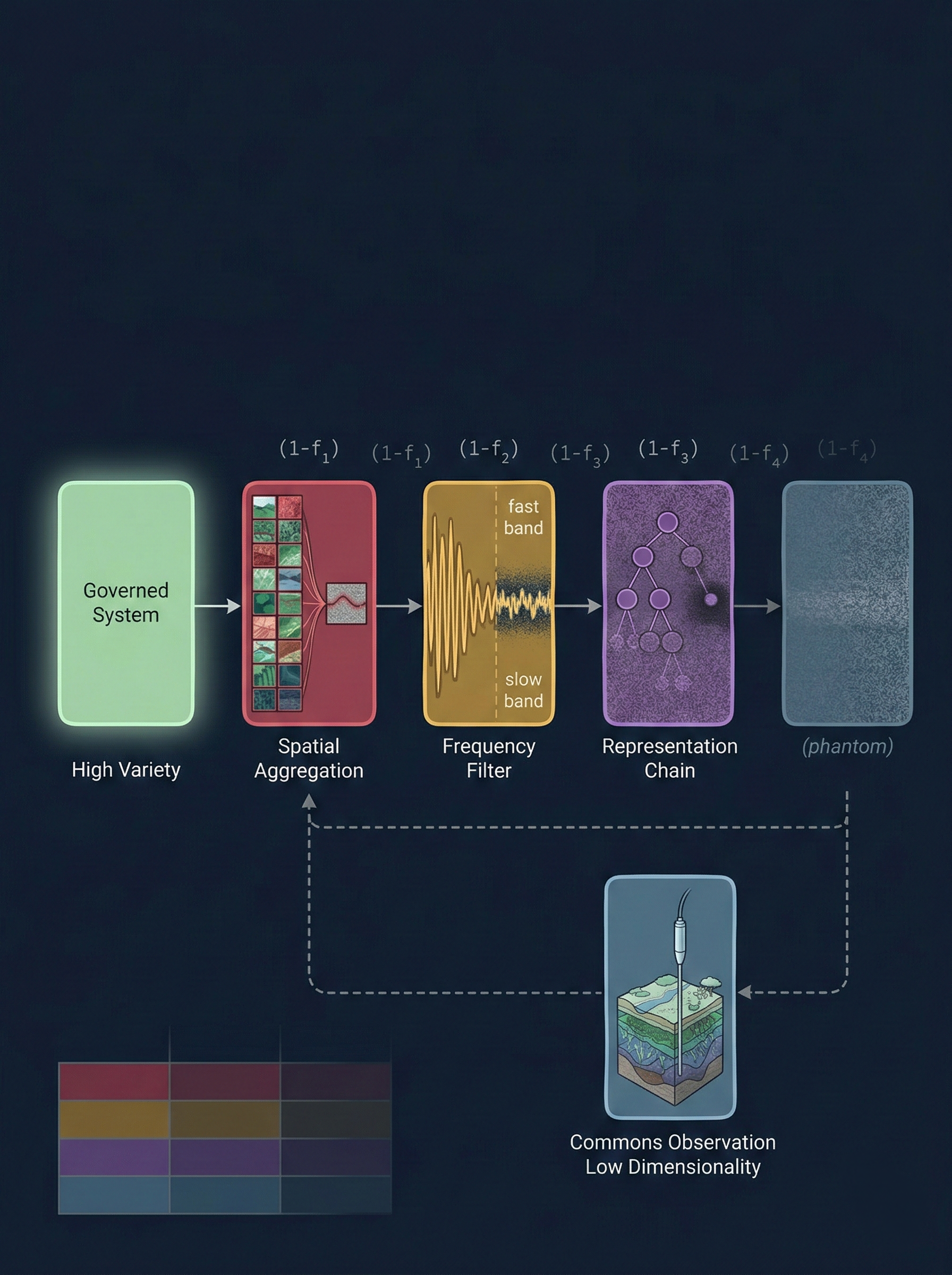
The Coordination Failure Tax
Four governance failure modes — spatial blindness, frequency gaps, preference invisibility, and observational inadequacy — do not add. They multiply. This paper introduces the coordination failure tax, maps the compounding mechanism formally, and shows how the Global Governance Frameworks constitute a structural response to all four diagnosed constraints simultaneously.

The Architecture of Stability: A Systems-Theoretic Framework for Power and Governance
A transdisciplinary analysis showing that centralized governance with time delay is mathematically unstable, and proposing fractal subsidiarity—with Sweden as the prototype—as the constitutional solution for adaptive, resilient societies.

Preventing 1933: The Architecture of Democratic Resilience
A systems architecture analysis of the Weimar Republic's collapse, demonstrating how dual-currency systems and epistemic protocols could prevent a modern democratic failure.

Beyond Integration: Nonduality, Psychosis, and the Aperture Problem
A personal and theoretical exploration of consciousness development, modal flexibility, and the systemic barriers preventing safe exploration of psychiatric medication necessity. Integrates Project Janus framework with nondual recognition to propose new approaches to mental health, AI alignment, and human development.

The Fractal-Cybernetic Model of Consciousness
A transdisciplinary framework bridging cybernetics, fractal geometry, and contemplative science to explain consciousness evolution toward awakening. Integrates Ashby's requisite variety, Mandelbrot's fractality, and nondual mysticism into a unified model of consciousness development.

Cognitive Scaffolding: A Multi-Model AI Synthesis Method
A comprehensive methodology for leveraging diverse AI models to develop robust, holistic solutions for the global polycrisis.

The Regenerative Governance: Integrating the Hardware, Heart, and Nervous System
A foundational white paper introducing the core architectural innovation of the Global Governance Frameworks.

The Currency of Care: Why Universal Basic Income Isn't Enough
An in-depth exploration of why UBI is a necessary but insufficient solution to the 'crisis of value,' proposing the AUBI system.

Addiction as Integration Failure: A Multi-Domain Framework
A rigorous analysis applying Project Janus to the crisis of attention, proving that modern addiction is a systemic integration failure, not an individual pathology.

The Change Paradox Field Manual
A comprehensive, open-source protocol for building transformative political power. Integrates nervous system regulation, Spiral Dynamics, and on-the-ground organizing tactics into a 7-step framework for movements that win.

Beyond the Duopoly: A Playbook for Post-Polarized Politics
Diagnoses political polarization as a systems failure and proposes an integrated framework to restore democracy's capacity for collective wisdom.

The Infinite Paradox: Non-Dual Ethics for Planetary Governance
A comprehensive framework for governance that honors both moral clarity and systems humility, providing practical tools for navigating ethical dilemmas.

The Responsive Society: Aligning with Truth in an Unknown World
A foundational white paper exploring how societies can navigate uncertainty with wisdom rather than fighting it with force.

Beyond Fragmented Truth: A Reasoning Path from Ancient Wisdom to Modern Governance
A methodological framework for using AI-enhanced reasoning to bridge ancient wisdom traditions and contemporary governance challenges.

A Collaborative Map of Awakening: Integrating States of Consciousness
Introduces a bi-dimensional framework distinguishing between universal awareness development and diverse contemplative realizations.

Beyond States: Weaving the Five Streams of Holistic Co-Flourishing
Argues that consciousness development alone is insufficient, requiring integration across five interdependent streams for true flourishing.