Appendix C: References and sources
A note on methodology
As with the preceding papers in this series, the concepts here were developed through extended dialogue with multiple AI systems — Claude (Anthropic), ChatGPT (OpenAI), Gemini (Google), DeepSeek, and Grok (xAI) — rather than through direct reading of the primary literature. The references below are the sources those systems identified as foundational, provided for readers who wish to engage with the primary literature directly.
The specific contribution of this paper — formalising commons governance as a requisite variety problem, demonstrating the state management paradox, and characterising traditional ecological knowledge as a slow-variable observation system — emerged from this collaborative process. The underlying theoretical tools belong to long-established traditions in cybernetics, ecology, and institutional economics. This paper brings them together with a simulation that makes the structural results quantitatively visible.
Cybernetics and requisite variety
Ashby, W. R. (1956). An Introduction to Cybernetics. Chapman and Hall.
The Law of Requisite Variety is the central formal tool of this paper. Ashby’s demonstration that only variety can absorb variety — and that a regulator cannot stabilize a system whose variety exceeds the regulator’s own — provides the theoretical foundation for the observation dimensionality argument. Ashby discusses applications to biological and organizational systems; the application to commons governance is the contribution of this paper.
Ashby, W. R. (1952). Design for a Brain. Wiley.
The earlier treatment of adaptive systems and the mechanisms by which systems acquire requisite variety. Relevant to the discussion of intergenerational knowledge as an accumulated variety-acquisition process.
Wiener, N. (1948). Cybernetics: Or Control and Communication in the Animal and the Machine. MIT Press.
The foundational text of cybernetics. Wiener’s treatment of feedback control in biological and social systems provides the conceptual background for the feedback loop integrity analysis.
Commons governance and institutional economics
Ostrom, E. (1990). Governing the Commons: The Evolution of Institutions for Collective Action. Cambridge University Press.
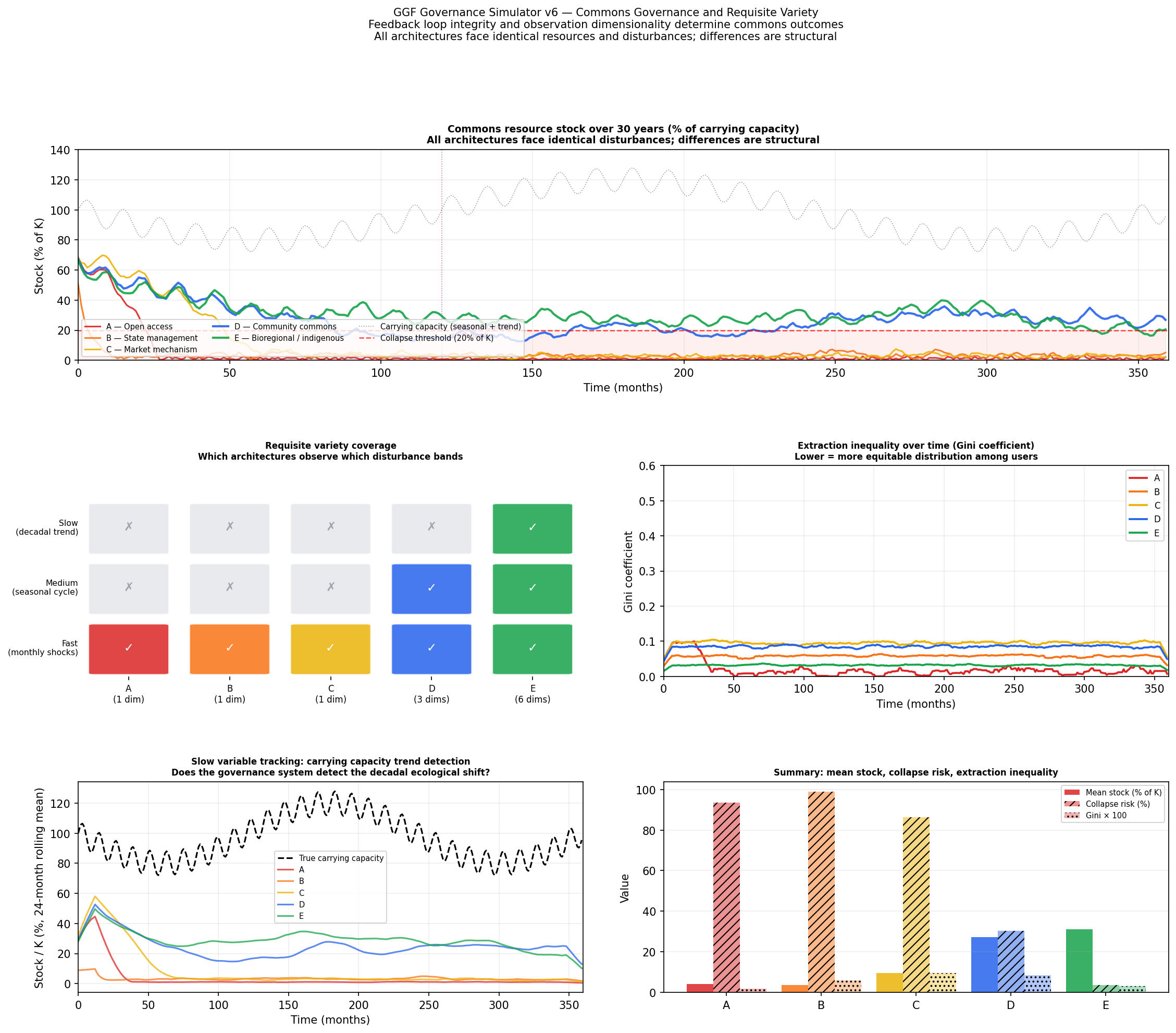
The foundational empirical and theoretical work on self-governing commons institutions. Ostrom’s eight design principles are reinterpreted in this paper as a set of observation channel opening mechanisms — institutional arrangements that increase effective observation dimensionality. The performance gap between Architecture C and D in the simulation corresponds to the observation dimensionality difference that Ostrom’s principles create.
Ostrom, E. (2005). Understanding Institutional Diversity. Princeton University Press.
Extends the design principles to a broader institutional analysis framework (the Institutional Analysis and Development framework). Provides the theoretical grounding for understanding how governance rules interact with resource dynamics.
Hardin, G. (1968). The tragedy of the commons. Science, 162(3859), 1243–1248.
The original statement of the commons problem. This paper’s central argument — that Hardin misidentified the cause as motivational rather than architectural — is a reinterpretation of Hardin’s scenario in control-theoretic terms.
Dietz, T., Ostrom, E., & Stern, P. C. (2003). The struggle to govern the commons. Science, 302(5652), 1907–1912.
Overview of the conditions under which commons governance succeeds or fails. The observation quality conditions identified in this paper map onto several of Dietz et al.’s enabling conditions for successful governance.
Berkes, F. (1989). Common Property Resources: Ecology and Community-Based Sustainable Development. Belhaven Press.
Early systematic documentation of community-based natural resource management. Berkes’ concept of adaptive co-management anticipates the observation dimensionality argument: effective co-management works because it integrates the observation systems of multiple positioned actors.
Traditional ecological knowledge
Berkes, F. (2008). Sacred Ecology. 2nd ed. Routledge.
The most comprehensive treatment of traditional ecological knowledge as a governance resource. Berkes’ account of TEK as an adaptive management system operating across multiple timescales maps directly onto the slow-variable observation argument of this paper.
Gadgil, M., Berkes, F., & Folke, C. (1993). Indigenous and traditional knowledge of the environment. Ambio, 22(2–3), 151–156.
A foundational paper establishing traditional ecological knowledge as a form of ecological monitoring and governance that operates across timescales unavailable to modern science. The argument that TEK provides information about slow variables is directly relevant to the Architecture E findings.
Tengö, M., Brondizio, E. S., Elmqvist, T., Malmer, P., & Spierenburg, M. (2014). Connecting diverse knowledge systems for enhanced ecosystem governance. Ambio, 43(5), 579–591.
Proposes a “multiple evidence base” framework for integrating indigenous and local knowledge with scientific knowledge in biodiversity governance. This framework is consistent with the observation dimensionality argument: different knowledge systems are not competing narratives but complementary observation channels covering different signal dimensions.
Ens, E. J., et al. (2015). Indigenous biocultural knowledge in ecosystem science and management. Biological Conservation, 181, 133–149.
Empirical review of how indigenous biocultural knowledge contributes to biodiversity conservation outcomes. Documents the slow variable signal dimensions that long-run community observation provides.
Ecology and resource dynamics
May, R. M. (1977). Thresholds and breakpoints in ecosystems with a multiplicity of stable states. Nature, 269(5628), 471–477.
The foundational treatment of ecological threshold effects and regime shifts — the nonlinear dynamics that logistic growth simplifies away but that make the slow variable detection argument more urgent in real systems.
Folke, C., Carpenter, S., Walker, B., Scheffer, M., Elmqvist, T., Gunderson, L., & Holling, C. S. (2004). Regime shifts, resilience, and biodiversity in ecosystem management. Annual Review of Ecology, Evolution, and Systematics, 35, 557–581.
Comprehensive treatment of regime shifts — the irreversible threshold crossings that the logistic growth model understates. The argument that governance must detect slow variables before regime shift crossing is made more urgent by this literature.
Holling, C. S. (1978). Adaptive Environmental Assessment and Management. Wiley.
The foundational text of adaptive management — the framework that most closely anticipates the observation dimensionality argument in an ecological context. Holling’s emphasis on the importance of monitoring across multiple spatial and temporal scales maps directly onto the requisite variety analysis.
Spatial governance and bioregionalism
Sale, K. (1985). Dwellers in the Land: The Bioregional Vision. Sierra Club Books.
The canonical statement of bioregionalism as a governance philosophy. Sale’s argument that governance units should be defined by ecological rather than administrative boundaries is given a formal basis in this paper’s analysis of observation dimensionality and spatial coupling.
McGinnis, M. D., & Ostrom, E. (2014). Social-ecological system framework: Initial changes and continuing challenges. Ecology and Society, 19(2), 30.
The Social-Ecological System (SES) framework as an integrative approach to analysing commons governance. The SES framework’s emphasis on matching governance structures to resource system properties is consistent with the requisite variety argument.
Indigenous sovereignty and governance
Cobo, J. M. (1983). Study of the Problem of Discrimination Against Indigenous Populations. United Nations Economic and Social Council.
The foundational UN document establishing the international framework for indigenous rights. The paper’s argument that resource sovereignty is an engineering requirement rather than solely a rights-based claim supplements rather than replaces the rights framework Cobo develops.
Anaya, S. J. (2004). Indigenous Peoples in International Law. 2nd ed. Oxford University Press.
The comprehensive legal treatment of indigenous peoples’ rights in international law, including resource rights. Provides the legal context within which the engineering argument operates.
Tipa, G., & Welch, R. (2006). Cultivating a culture of participation: Maori involvement in local government decision-making. Planning Theory and Practice, 7(1), 61–78.
A case study of Maori participation in water governance in New Zealand — a practical example of the integration of traditional ecological knowledge into formal governance frameworks that the analysis of Architecture E models in stylised form.