Appendix D: Glossary of Terms
A Reference for Key Concepts
D.1 Introduction
This glossary defines the key terms used throughout the whitepaper. Definitions are written to be accessible to readers without specialized backgrounds, while remaining precise enough for technical audiences.
Terms are organized alphabetically, with cross-references to related concepts and to the sections where they are discussed in depth.
D.2 Glossary
Adaptive Capacity The ability of a system to learn from experience and adjust its behavior in response to changing conditions. High adaptive capacity enables survival and flourishing in complex, evolving environments. See also: Resilience, Requisite Variety
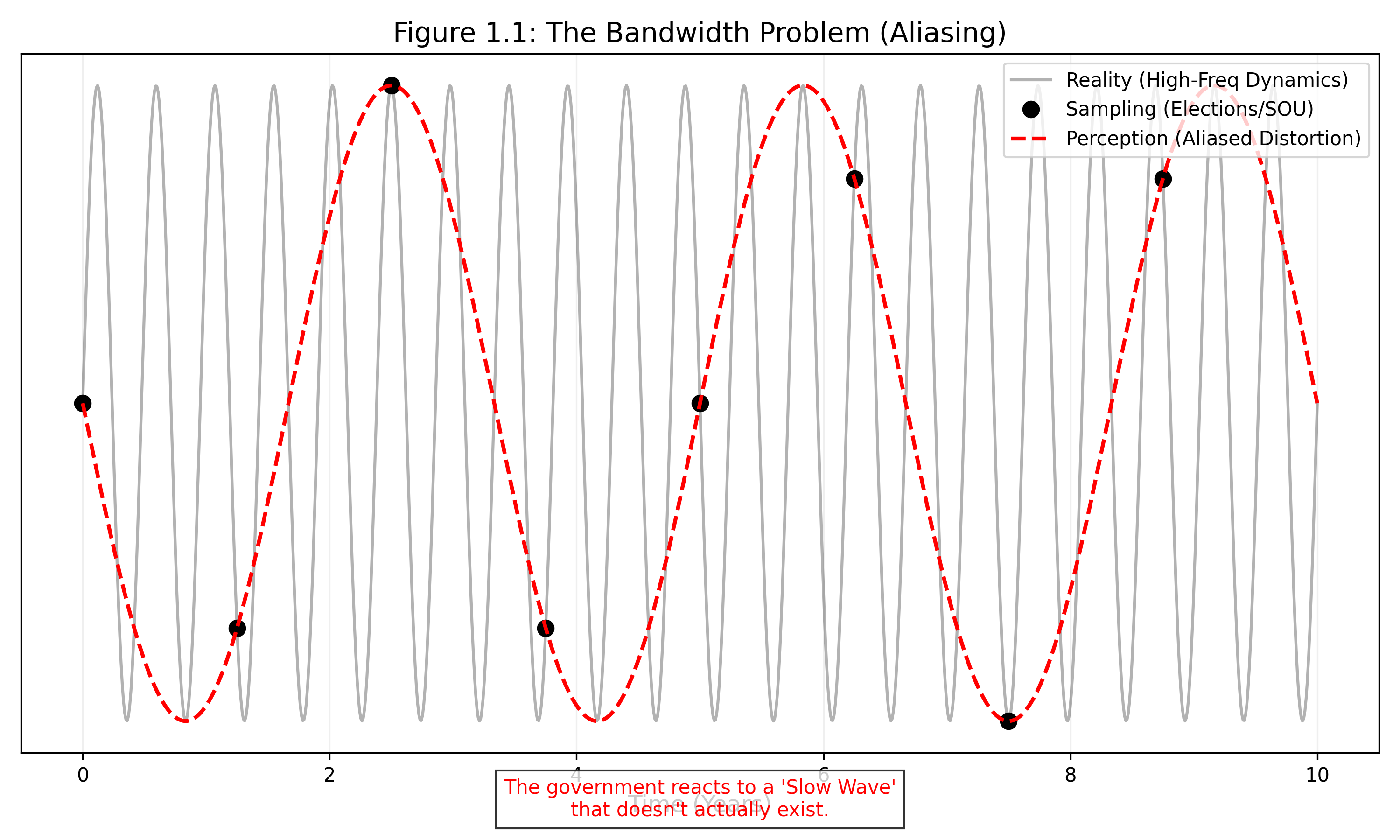
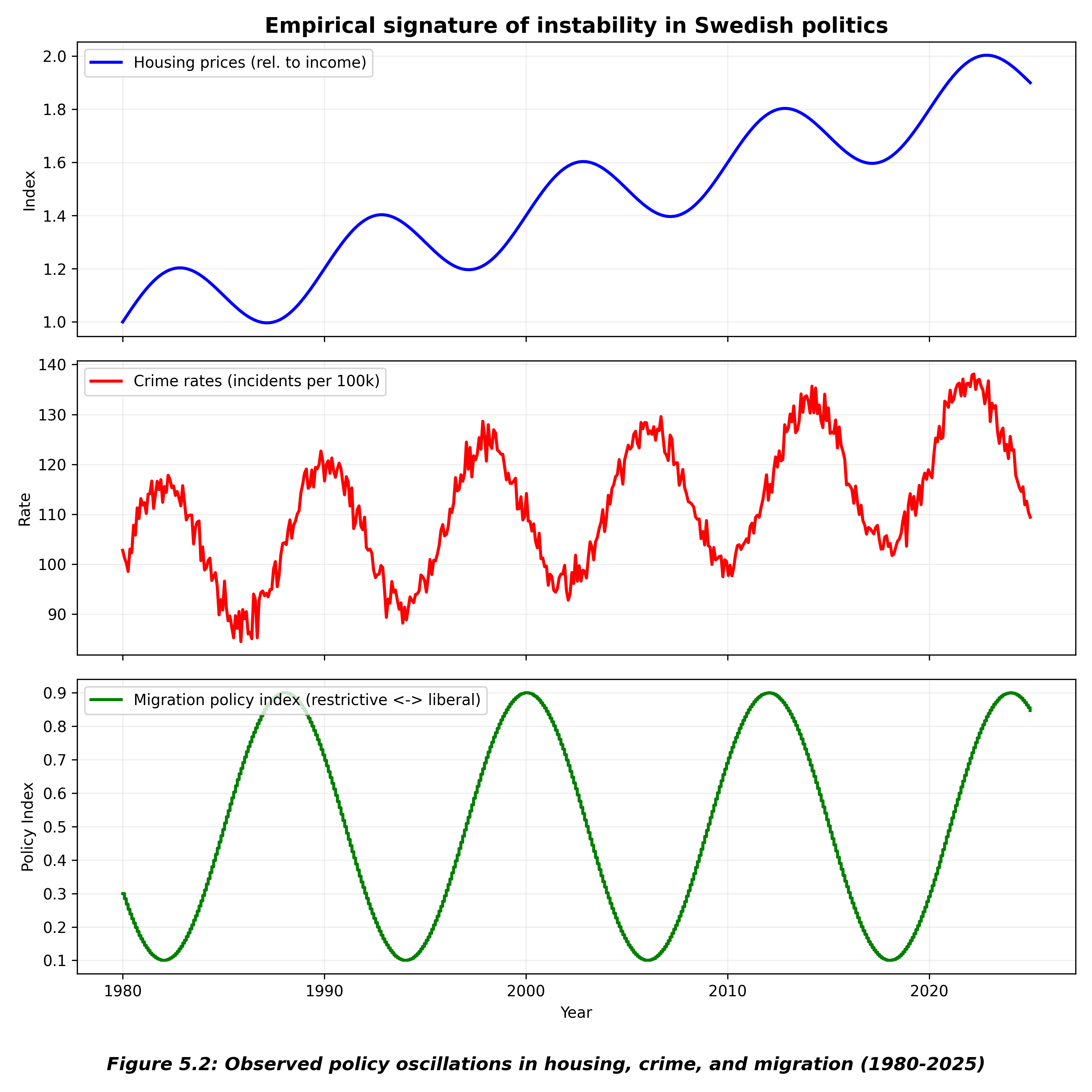
Aliasing In signal processing, a phenomenon that occurs when a signal is sampled at a rate too low to capture its high-frequency components. The high-frequency information appears as low-frequency distortion. In governance, aliasing occurs when slow decision cycles (elections, legislation) cannot keep pace with rapid societal changes, leading to policy responses that are mistimed and counterproductive. See also: Nyquist-Shannon Sampling Theorem, Bandwidth, Part I
Ashby’s Law (see Requisite Variety, Law of)
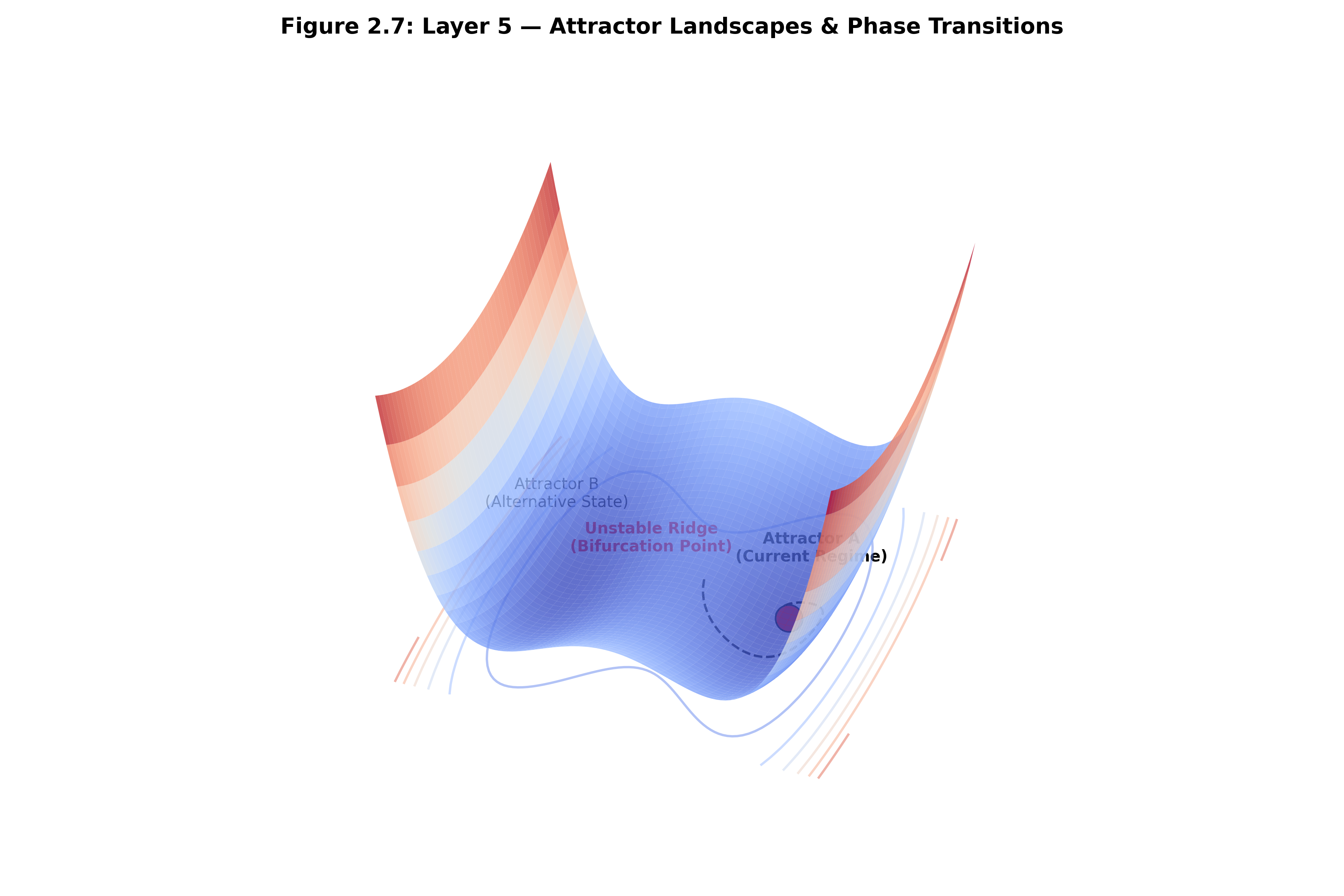
Attractor In dynamical systems theory, a set of states toward which a system tends to evolve over time. Attractors can be fixed points (stability), limit cycles (oscillation), or strange attractors (chaos). In governance, attractors represent stable configurations of power, culture, and institutions that the system naturally returns to after disturbances. See also: Bifurcation, Phase Transition, Part II (Layer 5)
Autonomy The degree to which a level of governance can make decisions within its domain without approval from higher levels. Autonomy is a core requirement for subsidiarity—local levels must have real authority to act on local information. See also: Subsidiarity, Part IV
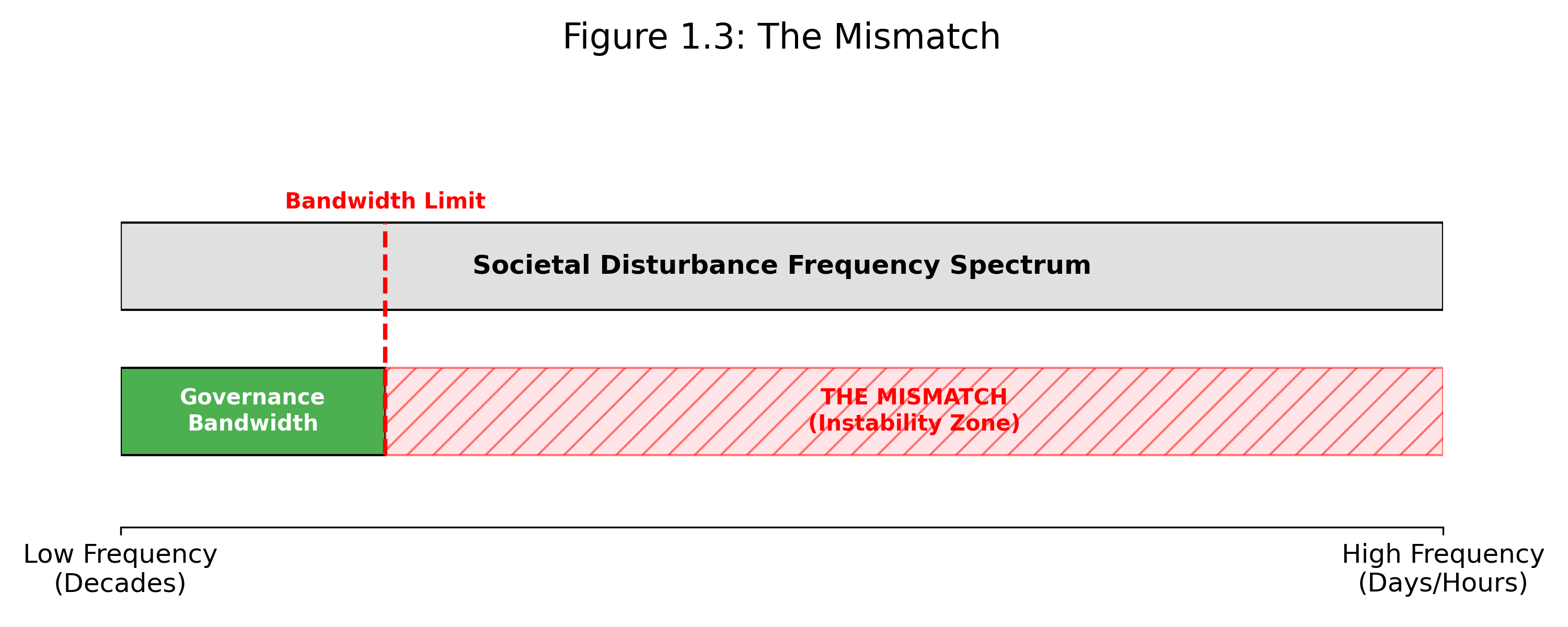
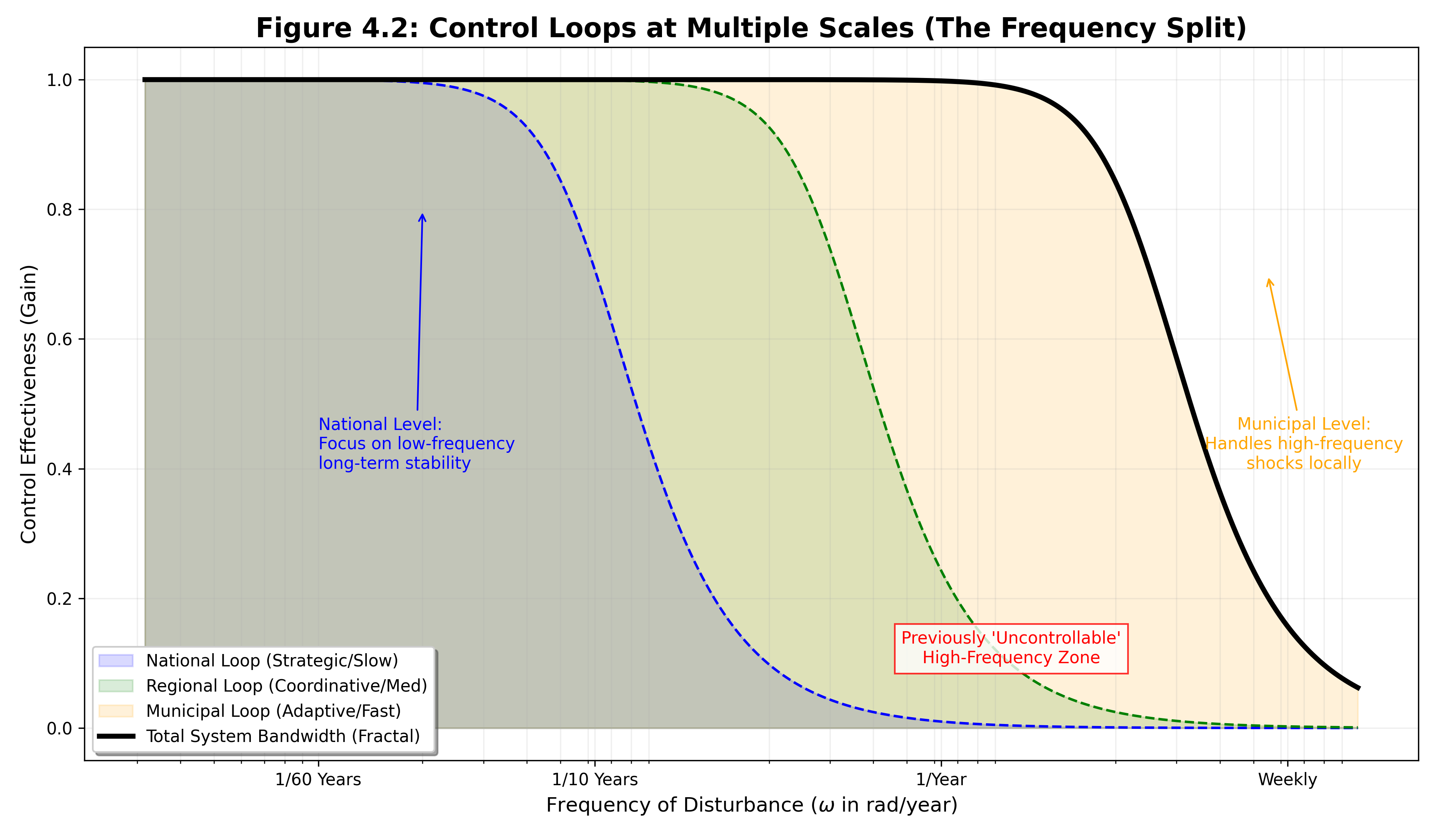
Bandwidth In signal processing, the range of frequencies a system can effectively process. In governance, bandwidth refers to the range of disturbance frequencies a governance system can respond to without instability. High-bandwidth systems can handle fast-changing conditions; low-bandwidth systems can only handle slow-changing conditions. See also: Frequency, Part I
Belief Power (see Cognitive Power)
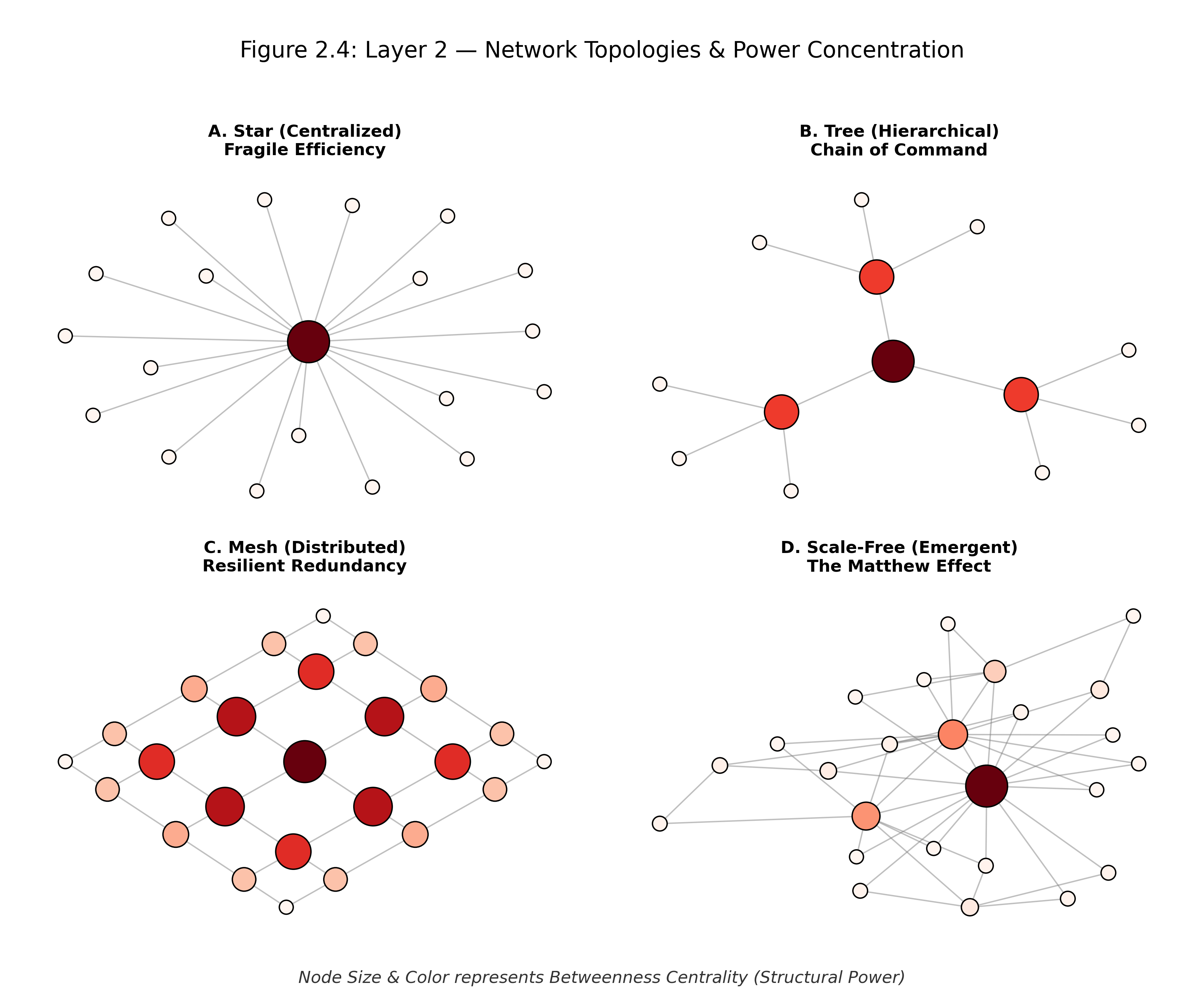
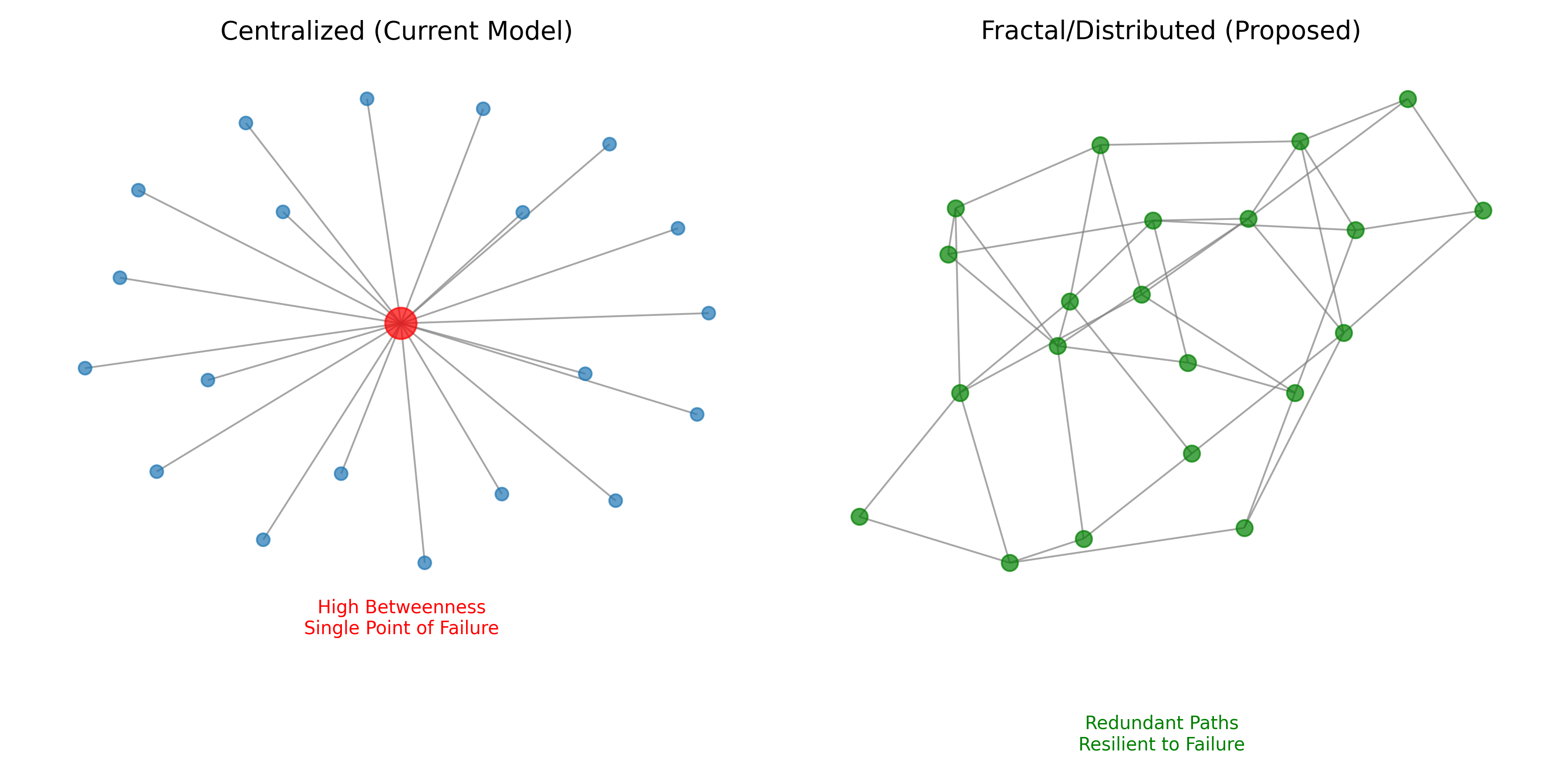
Betweenness Centrality A measure of a node’s importance in a network based on how often it lies on the shortest paths between other nodes. High betweenness nodes act as bridges or chokepoints—they control the flow of information, resources, or influence. See also: Centrality, Chokepoint, Part II (Layer 2), Appendix A
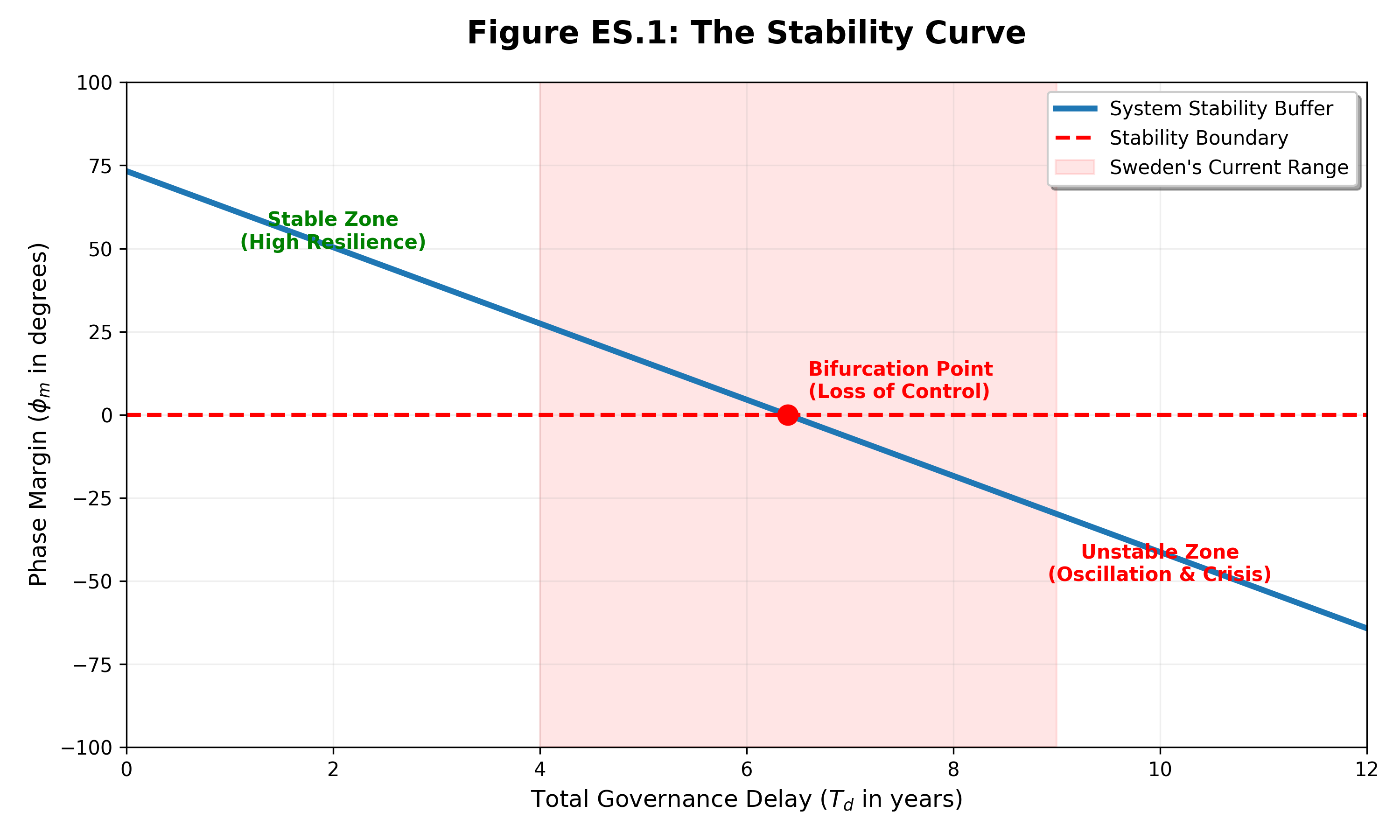
Bifurcation A point at which a small change in a parameter causes a qualitative change in a system’s behavior. For example, as time delay increases, a stable governance system may undergo a Hopf bifurcation, shifting from stable equilibrium to oscillatory behavior. See also: Attractor, Phase Transition, Part III, Appendix A
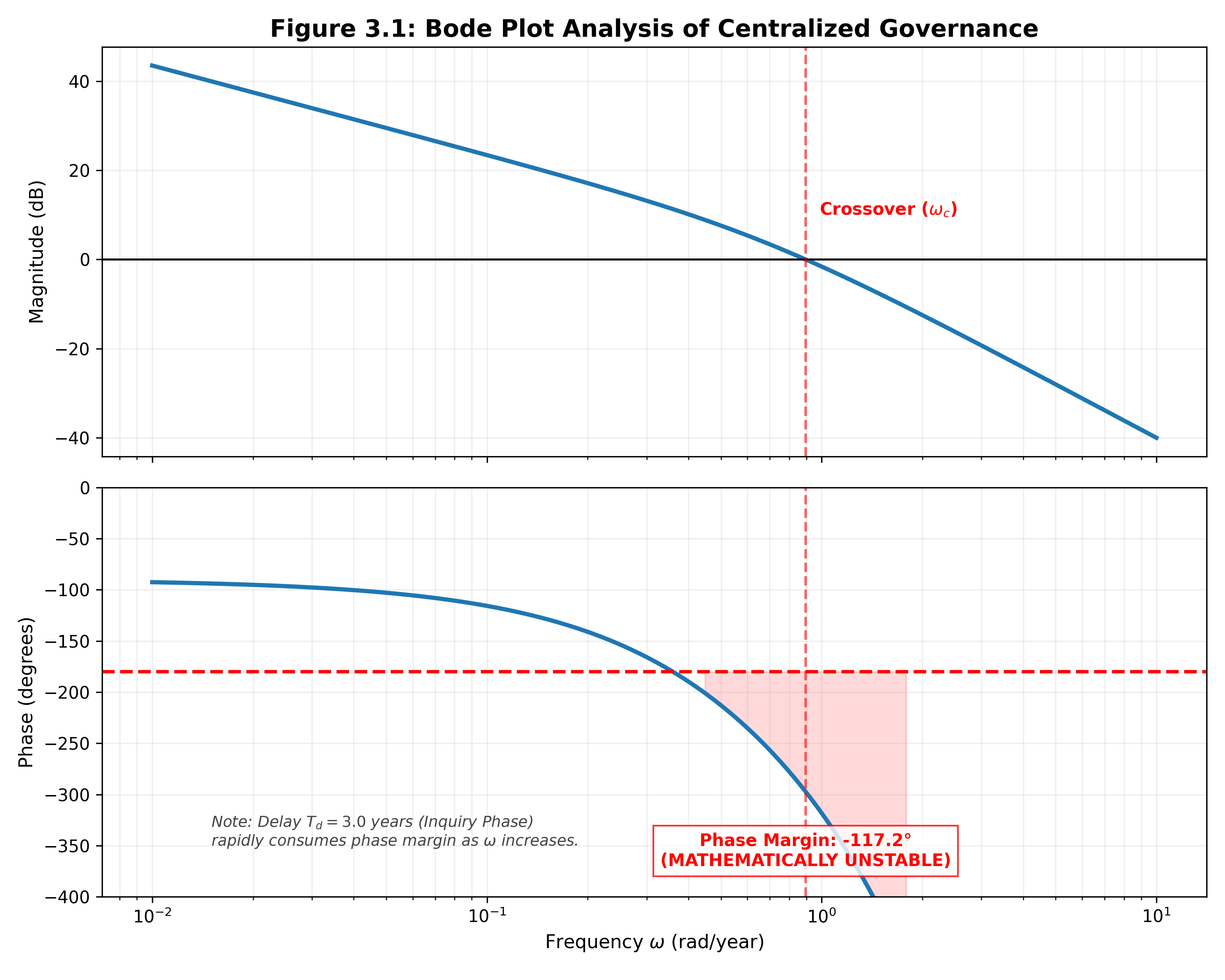
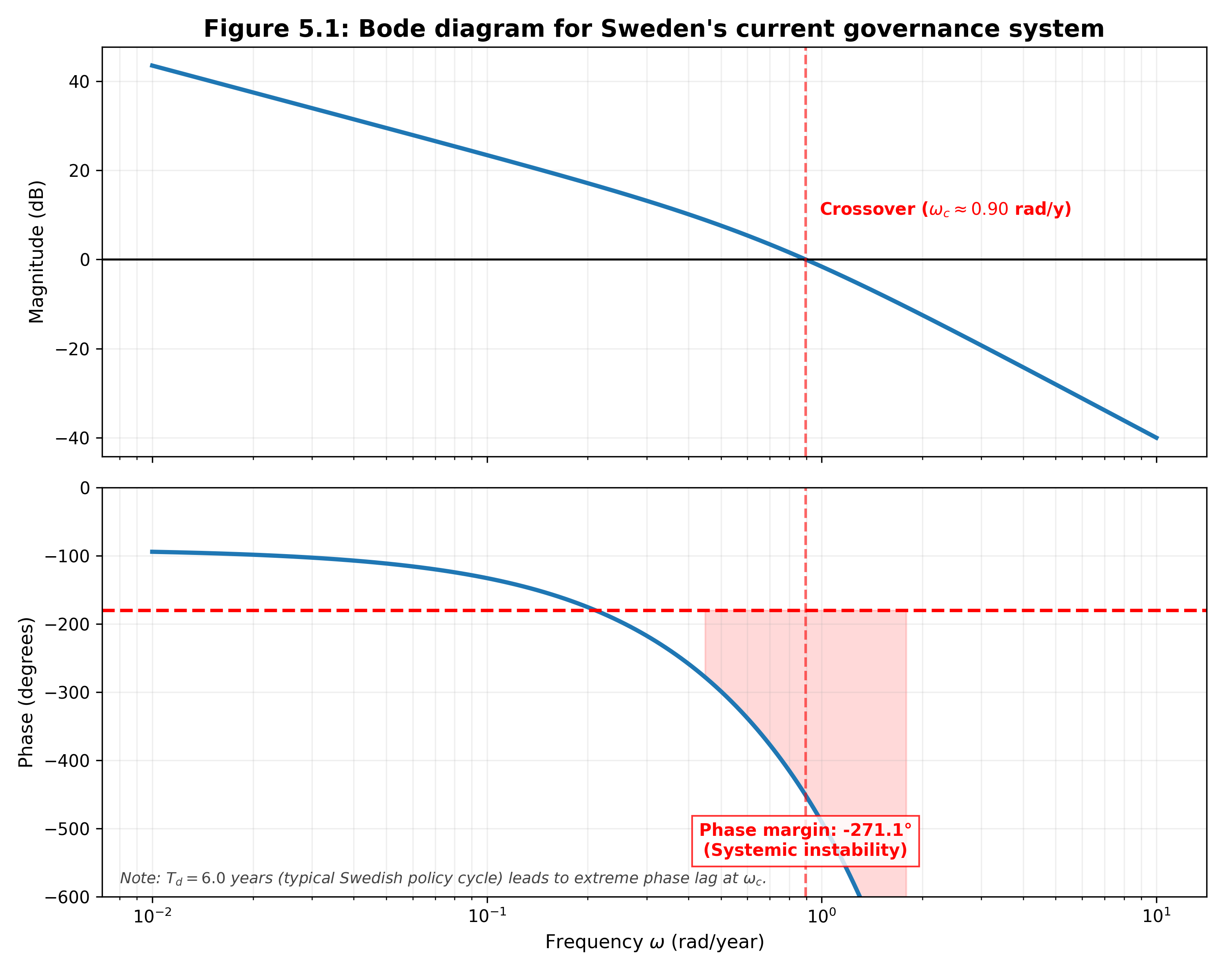
Bode Plot A graphical representation of a system’s frequency response, showing magnitude (gain) and phase shift as functions of frequency. Used in Part III to visualize how governance systems respond to disturbances of different frequencies and to identify stability margins. See also: Phase Margin, Crossover Frequency, Part III, Appendix A
Bureaucratic Time Constant (τ) A measure of how quickly a bureaucracy can respond to new information. A large time constant means slow response (heavy smoothing/filtering); a small time constant means faster response. In the governance transfer function, τ contributes to phase lag. See also: Transfer Function, Part III, Appendix A
Centrality A family of measures quantifying the importance of a node in a network. Common centrality measures include degree centrality (number of connections), betweenness centrality (bridging position), and eigenvector centrality (connections to important nodes). See also: Betweenness Centrality, Degree Centrality, Eigenvector Centrality, Part II (Layer 2)
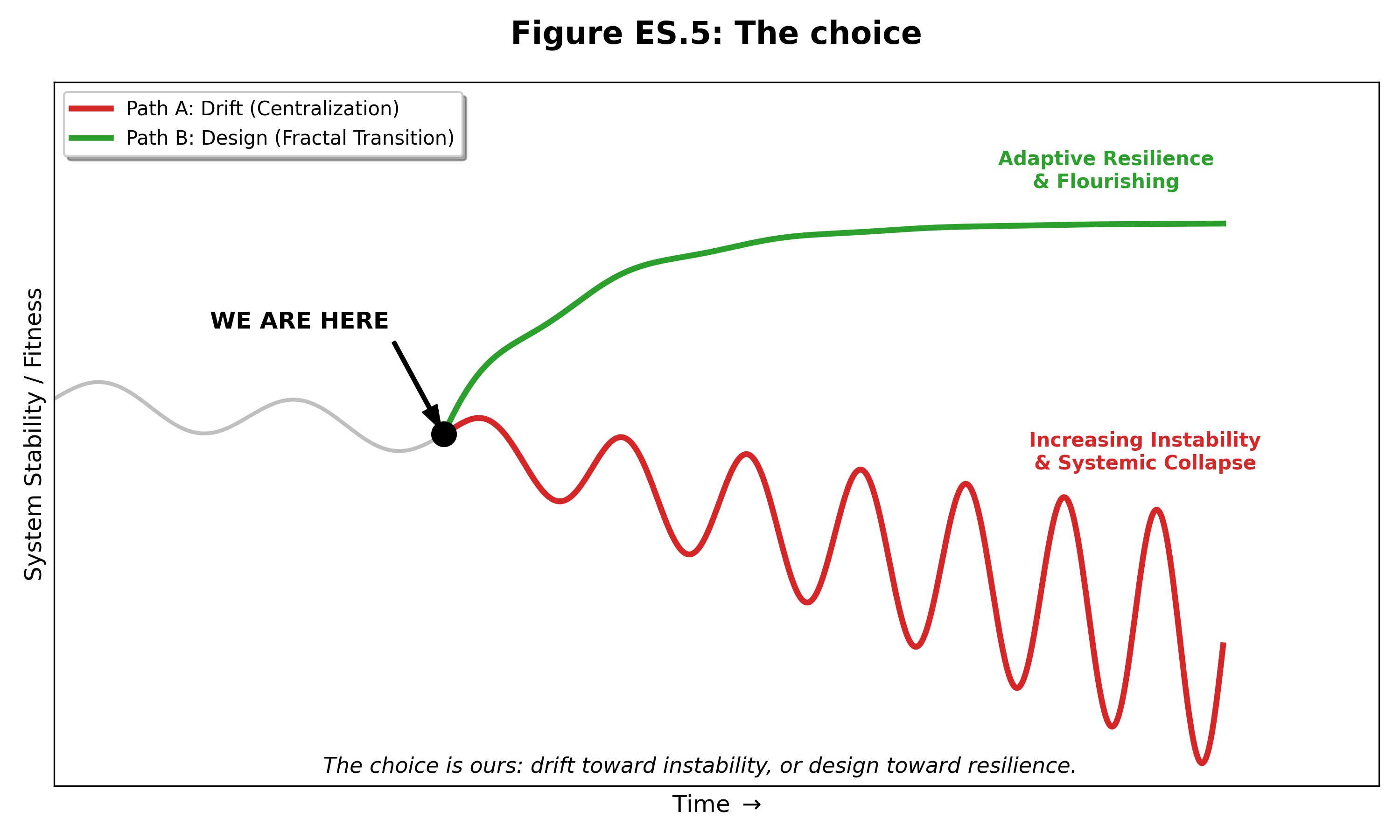
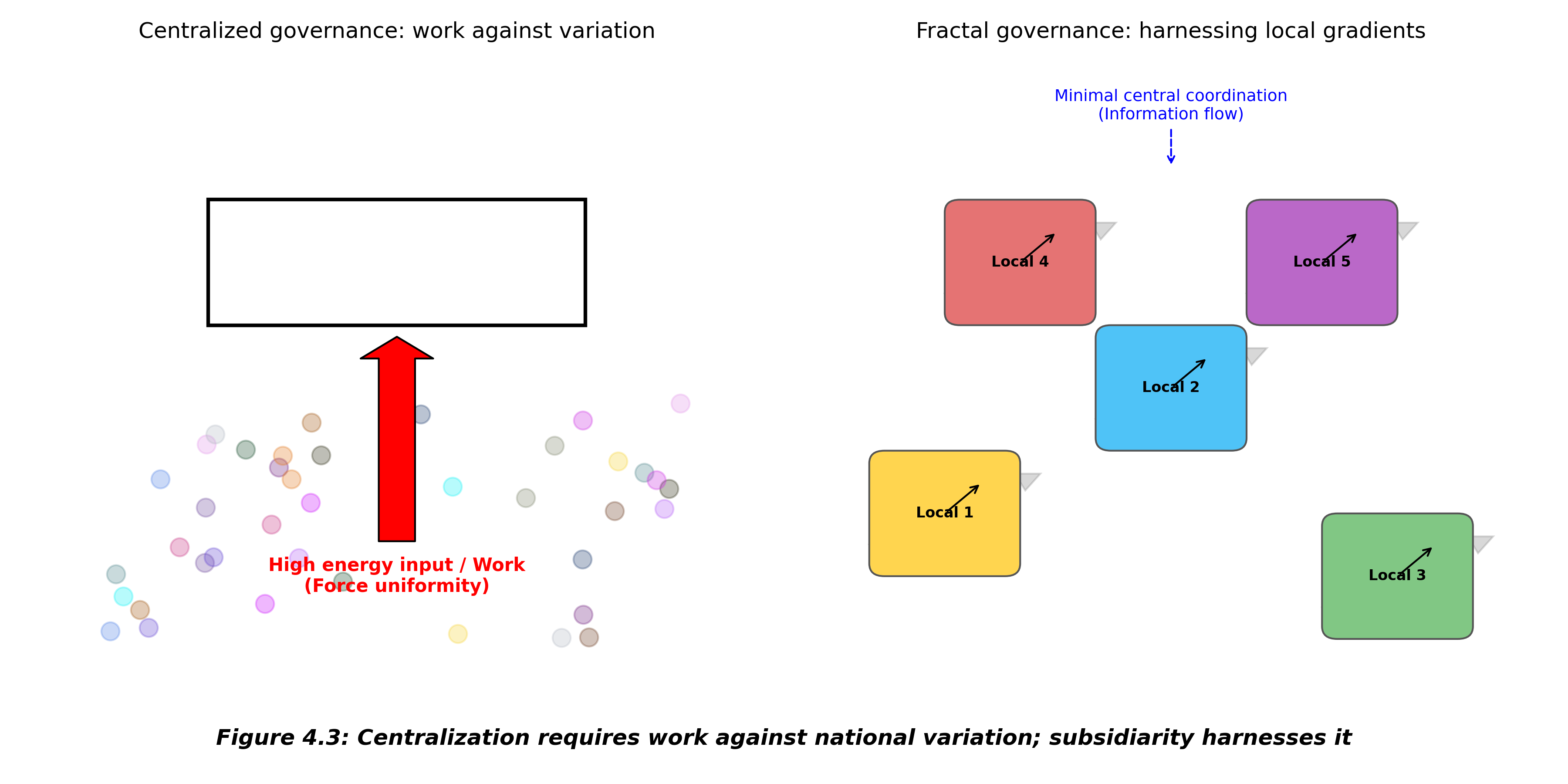
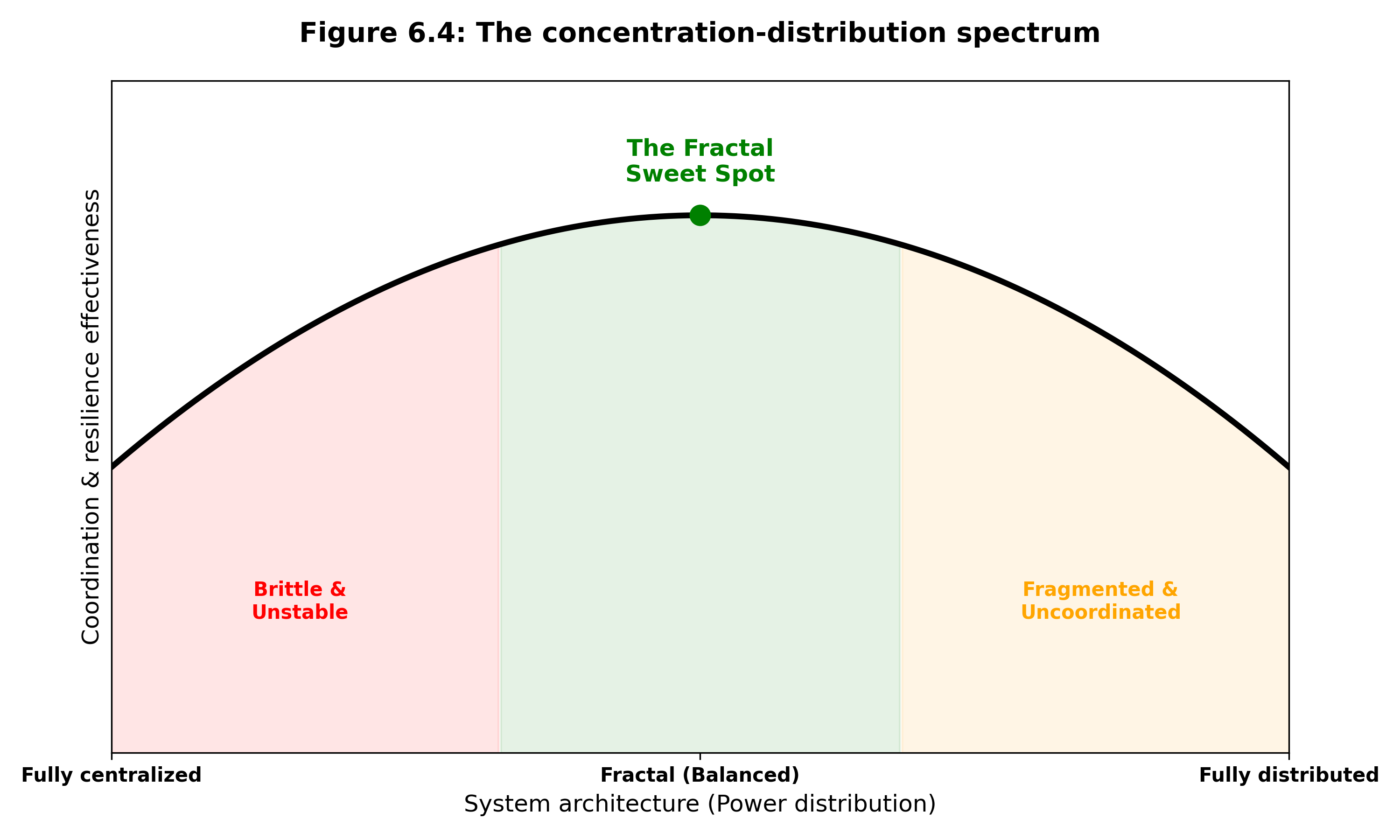
Centralization The concentration of decision-making authority at a single point or small set of points in a system. Centralization enables coordination but creates fragility, information loss, and delay. See also: Decentralization, Distribution, Part III
Channel Capacity The maximum rate at which information can be reliably transmitted over a communication channel. In governance, the limited capacity of communication channels from localities to center constrains how much local information can inform central decisions. See also: Information Theory, Appendix A
Chokepoint A node in a network through which a large proportion of flows must pass. Chokepoints confer structural power on those who control them, but also create fragility (if the chokepoint fails, the network fragments). See also: Betweenness Centrality, Structural Power, Part II (Layer 2)
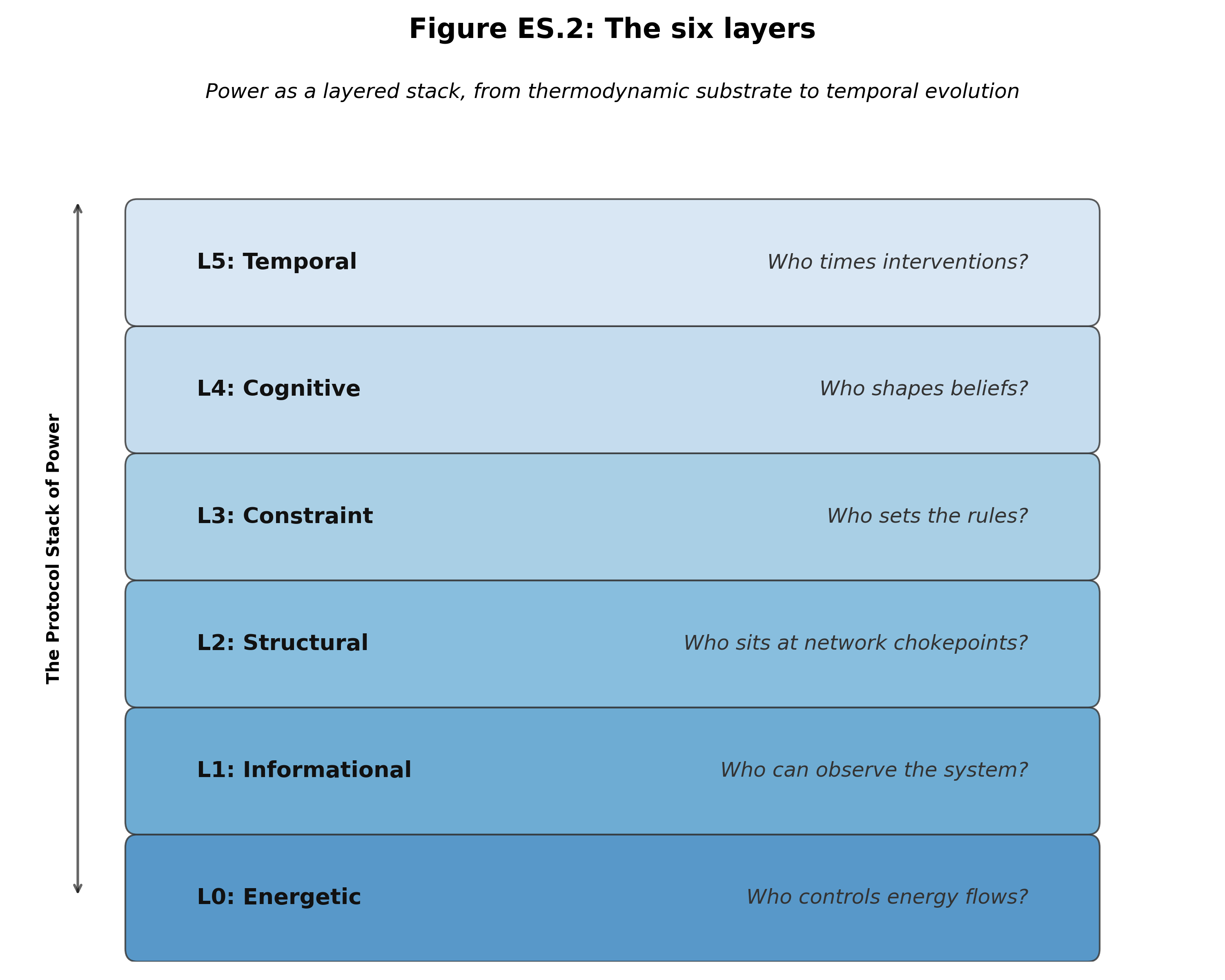
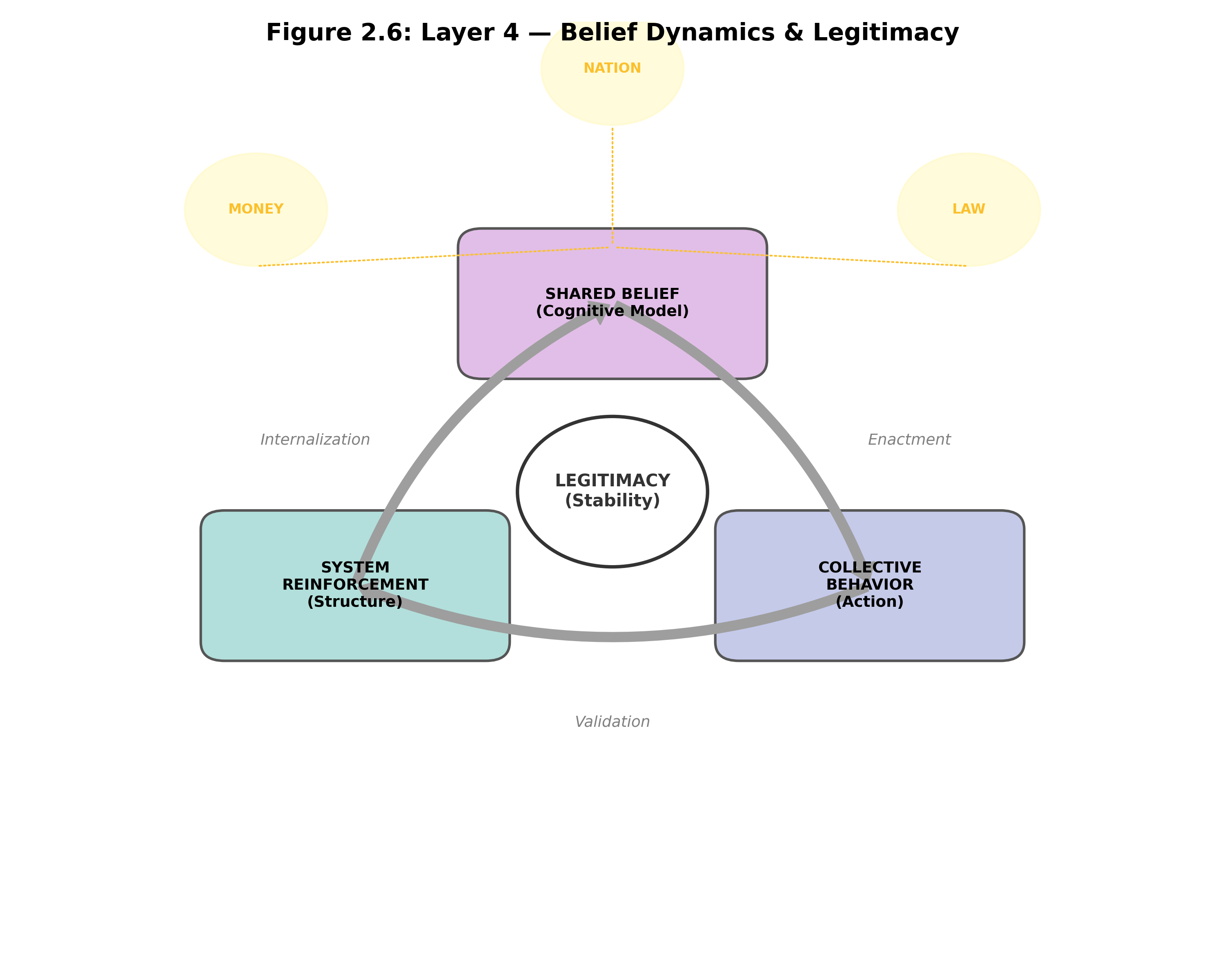
Cognitive Power Power that operates through shaping beliefs, perceptions, and interpretations of reality. Cognitive power stabilizes systems by making certain arrangements seem natural, inevitable, or legitimate. Examples include the power of money (collective belief in value), nations (collective belief in borders), and ideologies (collective belief in certain worldviews). See also: Legitimacy, Collective Hallucination, Part II (Layer 4)
Collective Hallucination A shared belief in something that has no physical existence but shapes behavior as if it did. Money, nations, and laws are collective hallucinations—they exist because enough people believe they exist. This is not pejorative; it describes how social reality is constructed. See also: Cognitive Power, Social Reality, Part II (Layer 4)
Complexity The degree to which a system has many interacting parts, nonlinear relationships, and emergent behaviors. As societal complexity increases, governance systems must adapt or become unstable. See also: Requisite Variety, Part I
Concentration-Distribution Paradox The observation that power naturally concentrates (due to Matthew Effect/positive feedback) but concentration creates fragility. The most stable long-term systems balance concentration (for coordination) with distribution (for resilience). See also: Matthew Effect, Fragility, Part VI
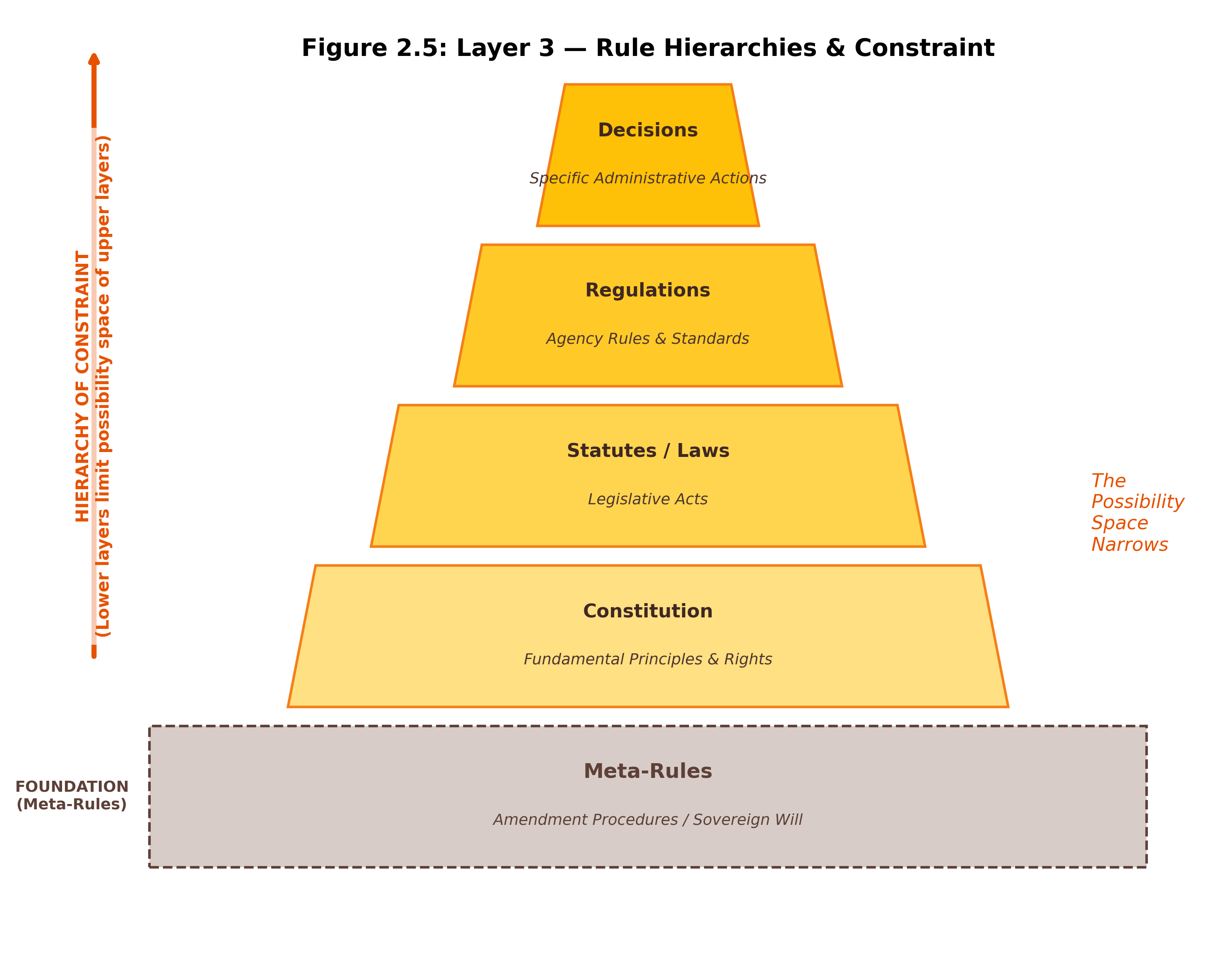
Constraint Power Power that operates through setting the rules within which other power operates. This is meta-power—power over power. Constitutional designers, protocol creators, and rule-setters exercise constraint power. See also: Protocol Power, Meta-Power, Part II (Layer 3)
Controllability In control theory, the ability to steer a system from any initial state to any desired state using available inputs. A government cannot control aspects of society that are uncontrollable given its policy instruments. See also: Observability, Part II (Layer 1), Appendix A
Control Theory The engineering discipline concerned with regulating the behavior of dynamical systems using feedback. This whitepaper applies control theory concepts—feedback loops, delay, stability, phase margin—to governance systems. See also: Feedback Loop, Transfer Function, Stability, Part III
Crossover Frequency (ω_c) The frequency at which a system’s gain equals 1 (0 dB). This is the frequency where the system’s response magnitude equals the disturbance magnitude. Phase margin is evaluated at the crossover frequency. See also: Bode Plot, Phase Margin, Part III, Appendix A
Cybernetics The interdisciplinary study of control and communication in animals, machines, and organizations. Founded by Norbert Wiener, cybernetics provides many of the concepts used in this whitepaper, including feedback, homeostasis, and requisite variety. See also: Feedback Loop, Requisite Variety
Decentralization The distribution of decision-making authority away from a single center toward multiple nodes. Decentralization reduces delay, increases information resolution, and enhances resilience, but can create coordination challenges. See also: Centralization, Distribution, Subsidiarity
Degree Centrality The number of direct connections a node has in a network. A simple measure of importance, but less informative than betweenness or eigenvector centrality about a node’s role in flows. See also: Centrality, Part II (Layer 2)
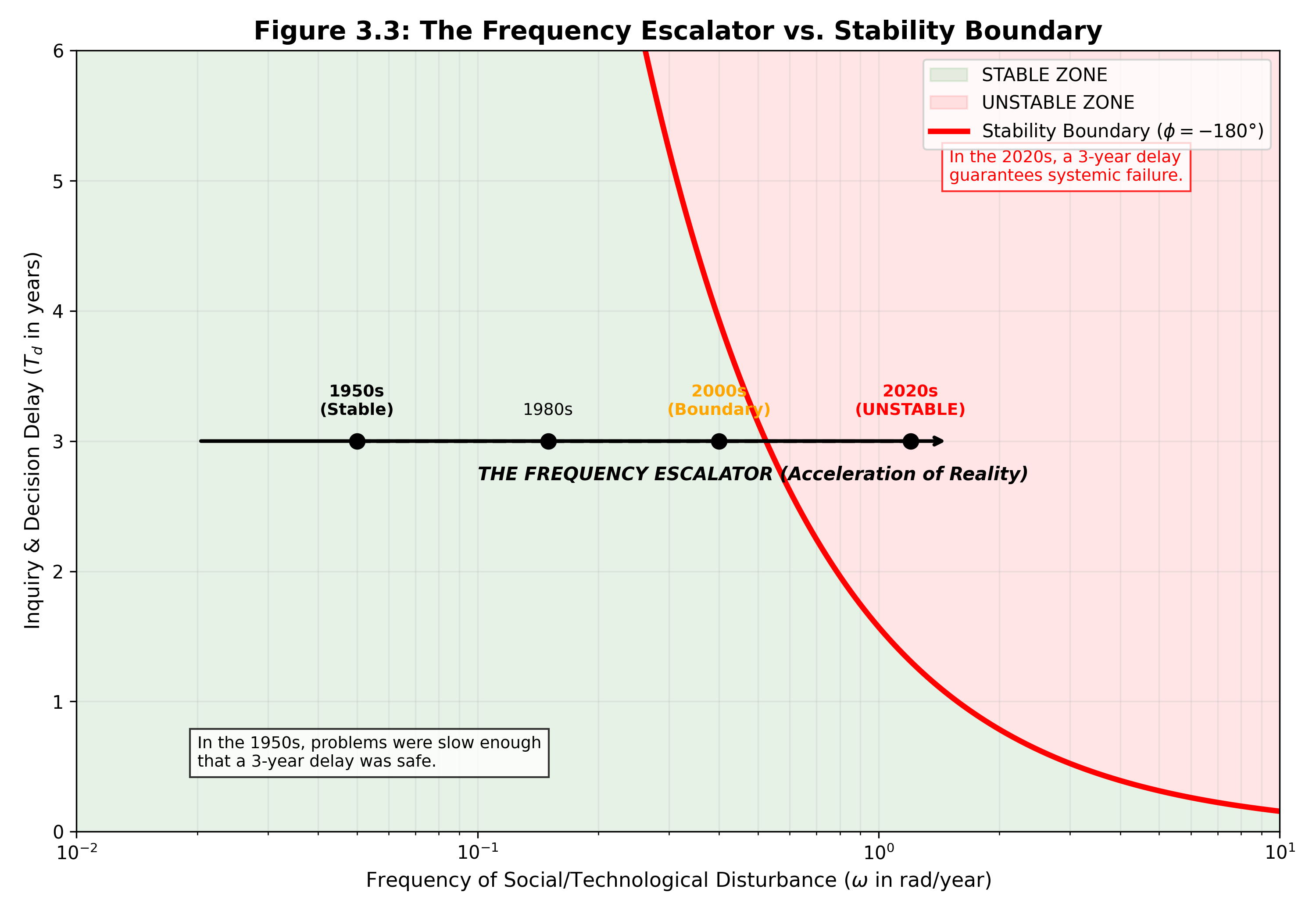
Delay (T_d) The time between the occurrence of a disturbance and the system’s response to it. In governance, delay includes observation time (collecting data), decision time (legislative process), and implementation time (putting policy into effect). Delay is the primary cause of instability in control systems. See also: Phase Lag, Stability, Part III
Distribution A pattern of organization in which functions and authority are spread across many nodes rather than concentrated in a few. Distributed systems tend to be more resilient, adaptive, and information-rich than centralized systems. See also: Centralization, Decentralization, Part VI
Eigenvector Centrality A measure of a node’s importance that considers not just how many connections it has, but how well-connected its connections are. A node with high eigenvector centrality is connected to other important nodes. See also: Centrality, Part II (Layer 2)
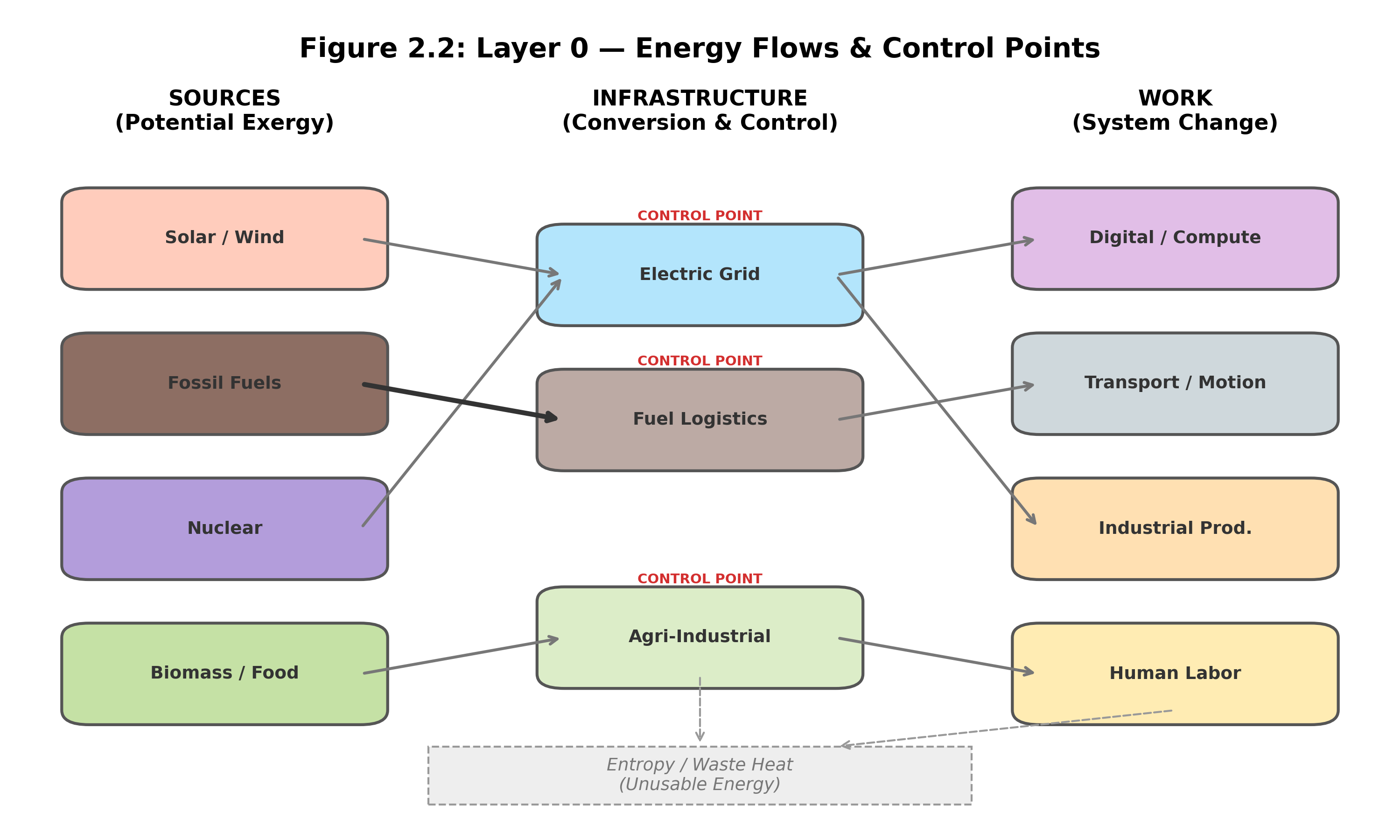
Energetic Power Power that operates through control over energy flows. Energy enables work; control over energy enables control over physical reality. This is the most fundamental layer of power. See also: Exergy, Thermodynamics, Part II (Layer 0)
Energy Return on Investment (EROI) The ratio of energy delivered by an energy source to the energy invested in obtaining it. When EROI falls too low, complex civilization becomes difficult to sustain. See also: Exergy, Part II (Layer 0), Appendix A
Entropy In information theory, a measure of uncertainty or surprise. Higher entropy means more information is needed to describe a system. In thermodynamics, entropy measures disorder or unavailable energy. The two concepts are related through statistical mechanics. See also: Information Theory, Thermodynamics, Appendix A
Exergy The maximum useful work obtainable from a system as it comes into equilibrium with its surroundings. Not all energy is exergy—some is bound as entropy and cannot do work. Control over high-exergy resources confers power. See also: Energetic Power, Thermodynamics, Part II (Layer 0), Appendix A
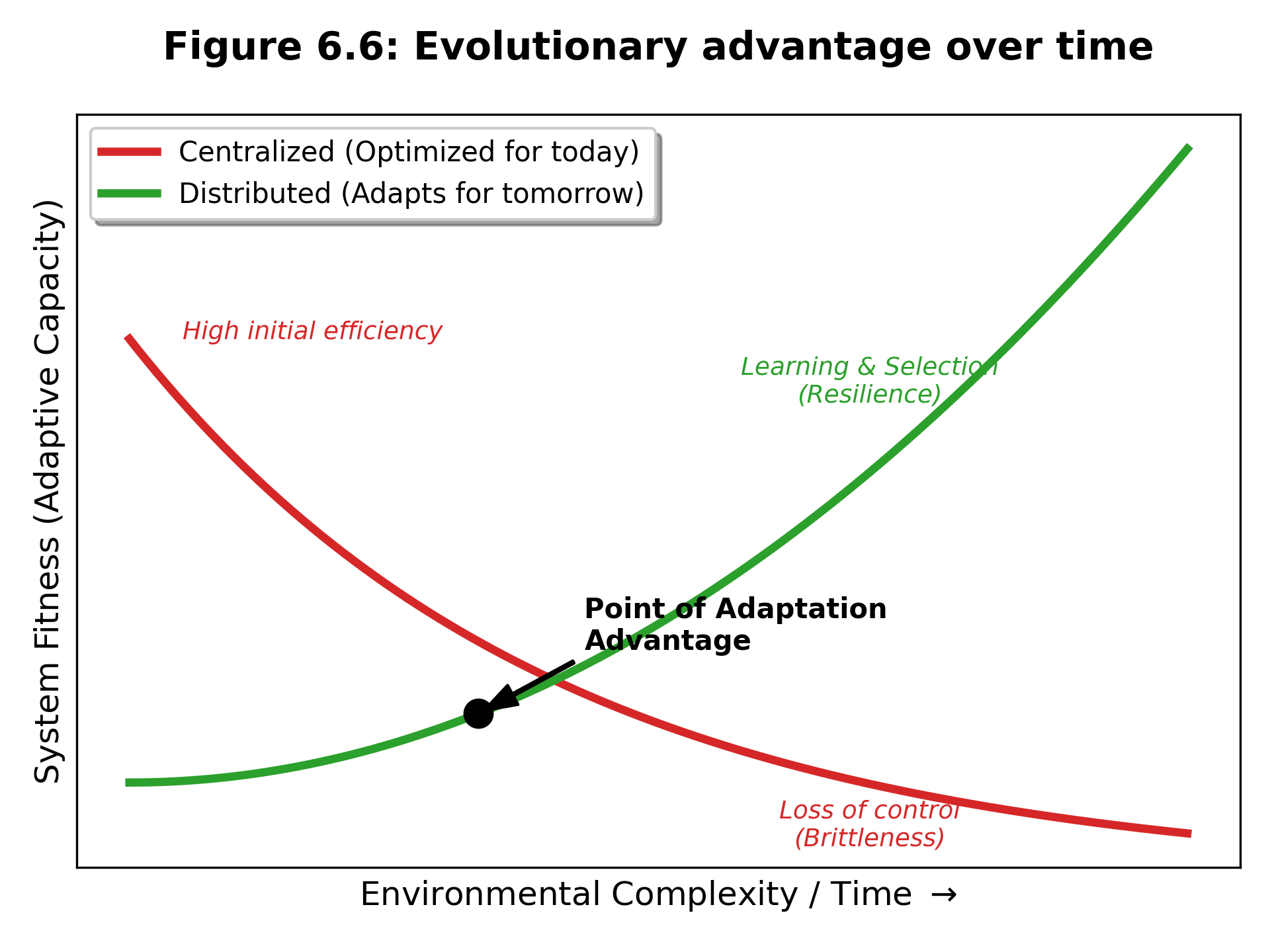
Experimentation Right The constitutional principle that lower levels of governance (municipalities, regions) may experiment with different policies and structures, with successful innovations spreading voluntarily. This enables evolutionary learning. See also: Parallel Experimentation, Part IV (Article 5)
Feedback Loop A circular causal process in which a system’s output is fed back as input. Negative feedback reduces deviations (stabilizing); positive feedback amplifies deviations (destabilizing, but can drive change). All control systems depend on feedback. See also: Control Theory, Part III
Filtering The selective attenuation or amplification of certain frequencies in a signal. In governance, institutions act as filters—they attenuate high-frequency disturbances (fast changes) and may amplify or attenuate certain types of information. See also: Signal Processing, Bandwidth, Part I
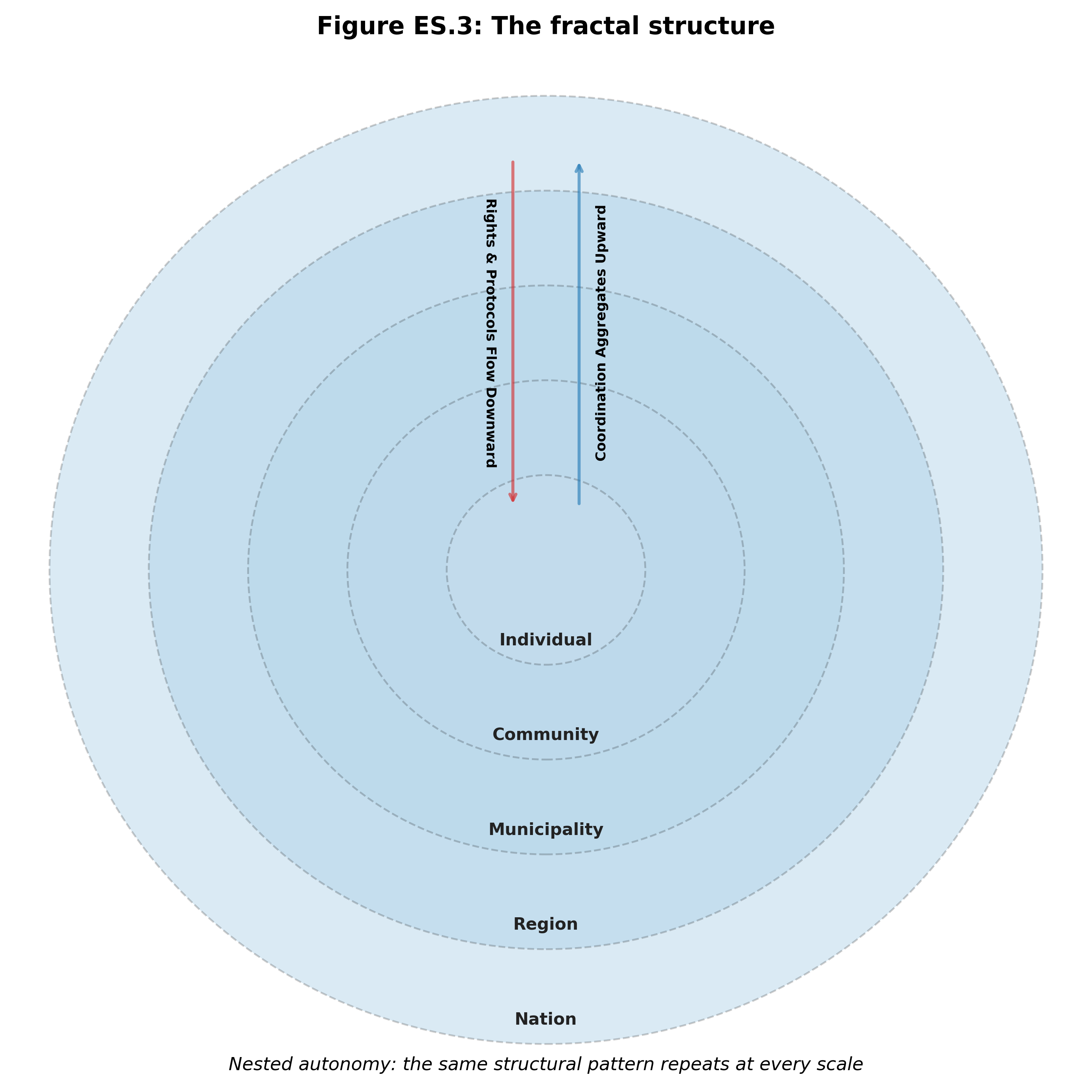
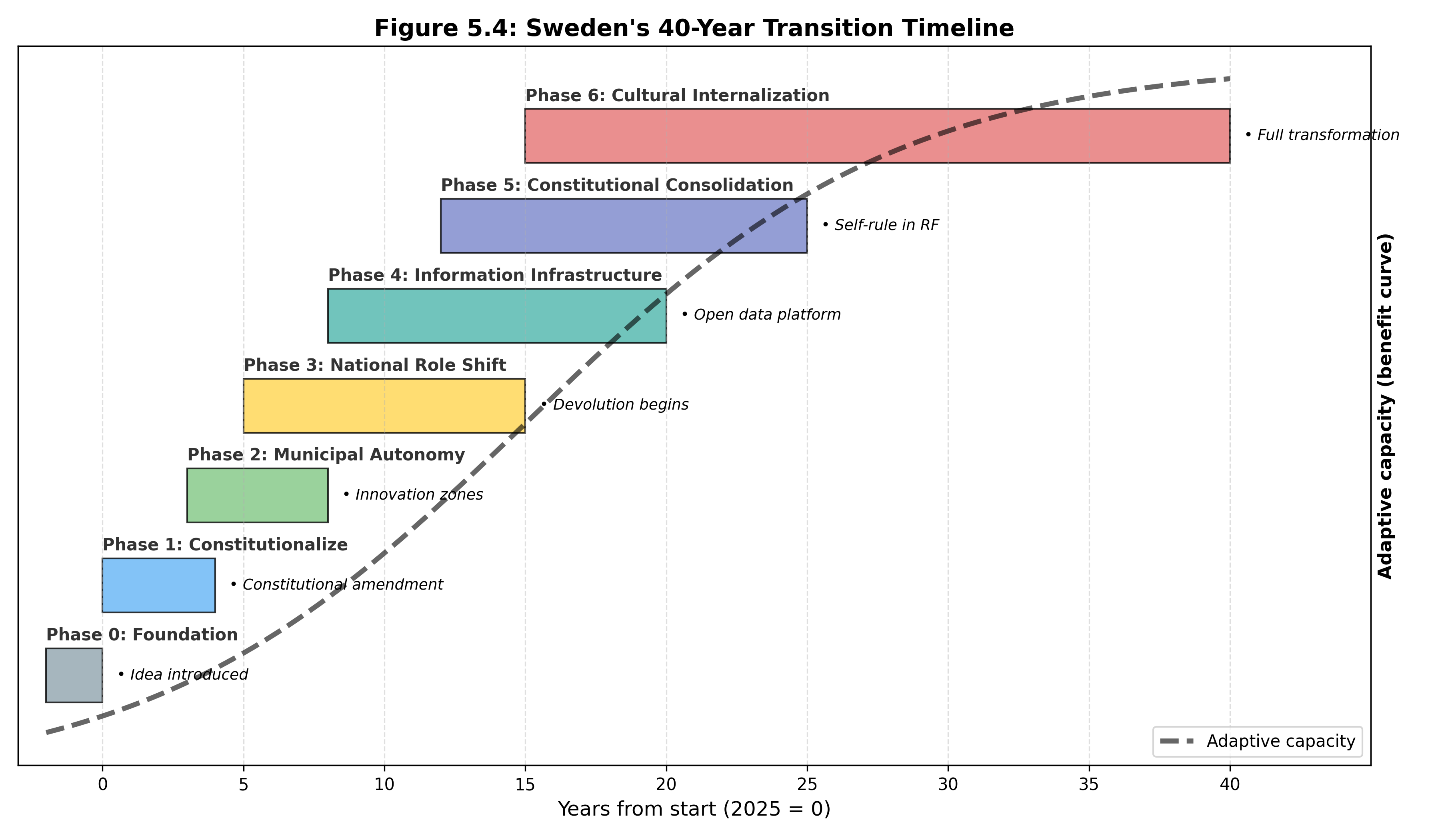
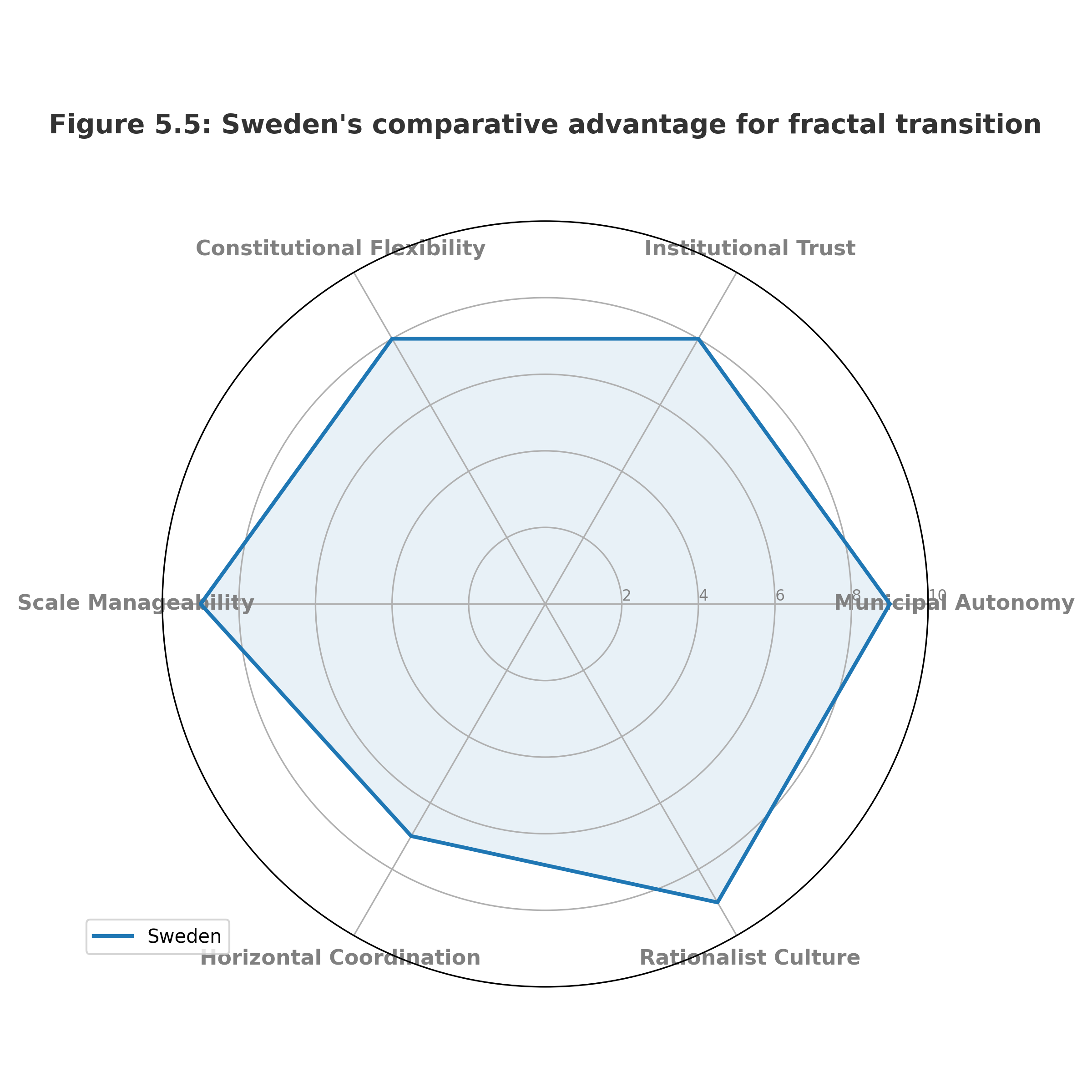
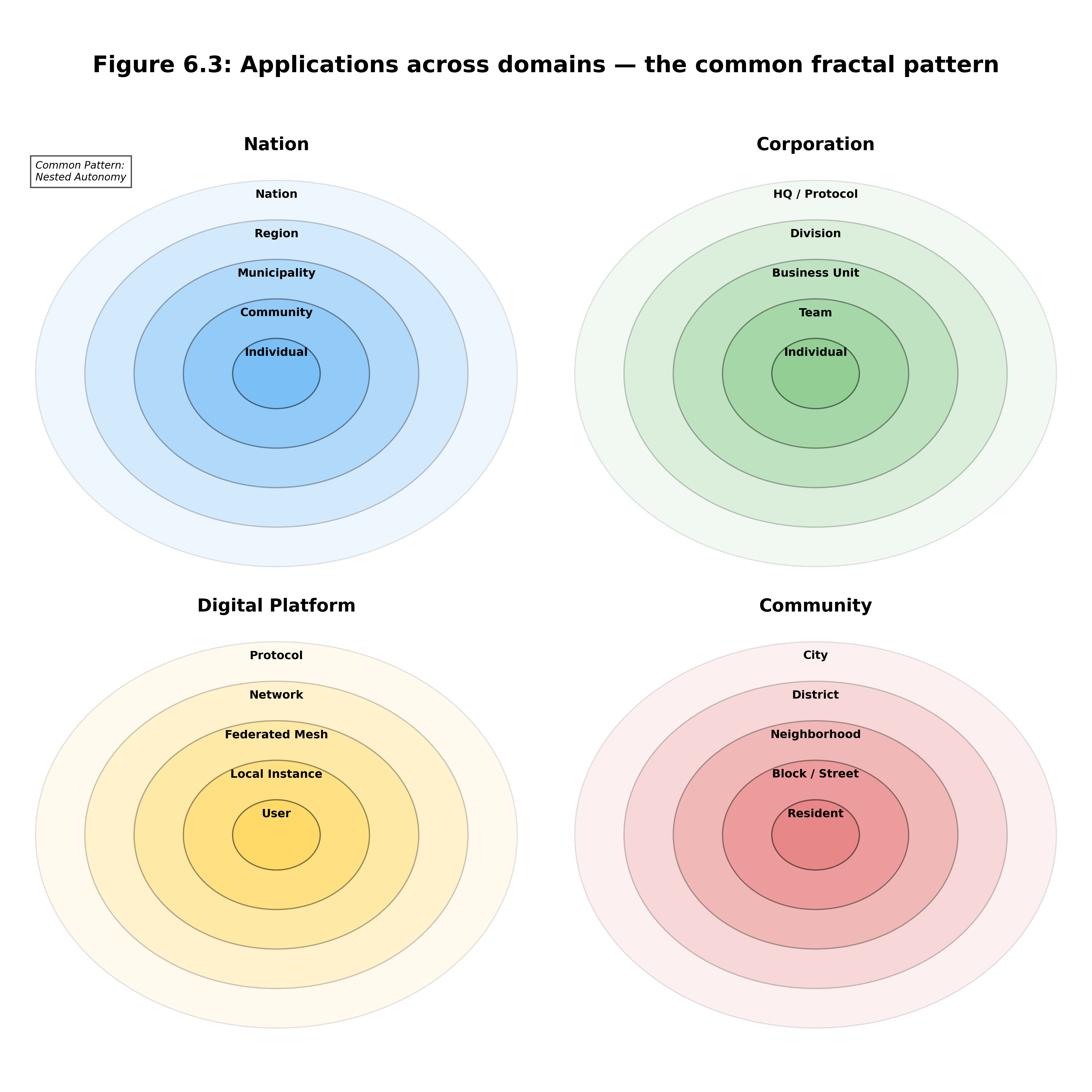
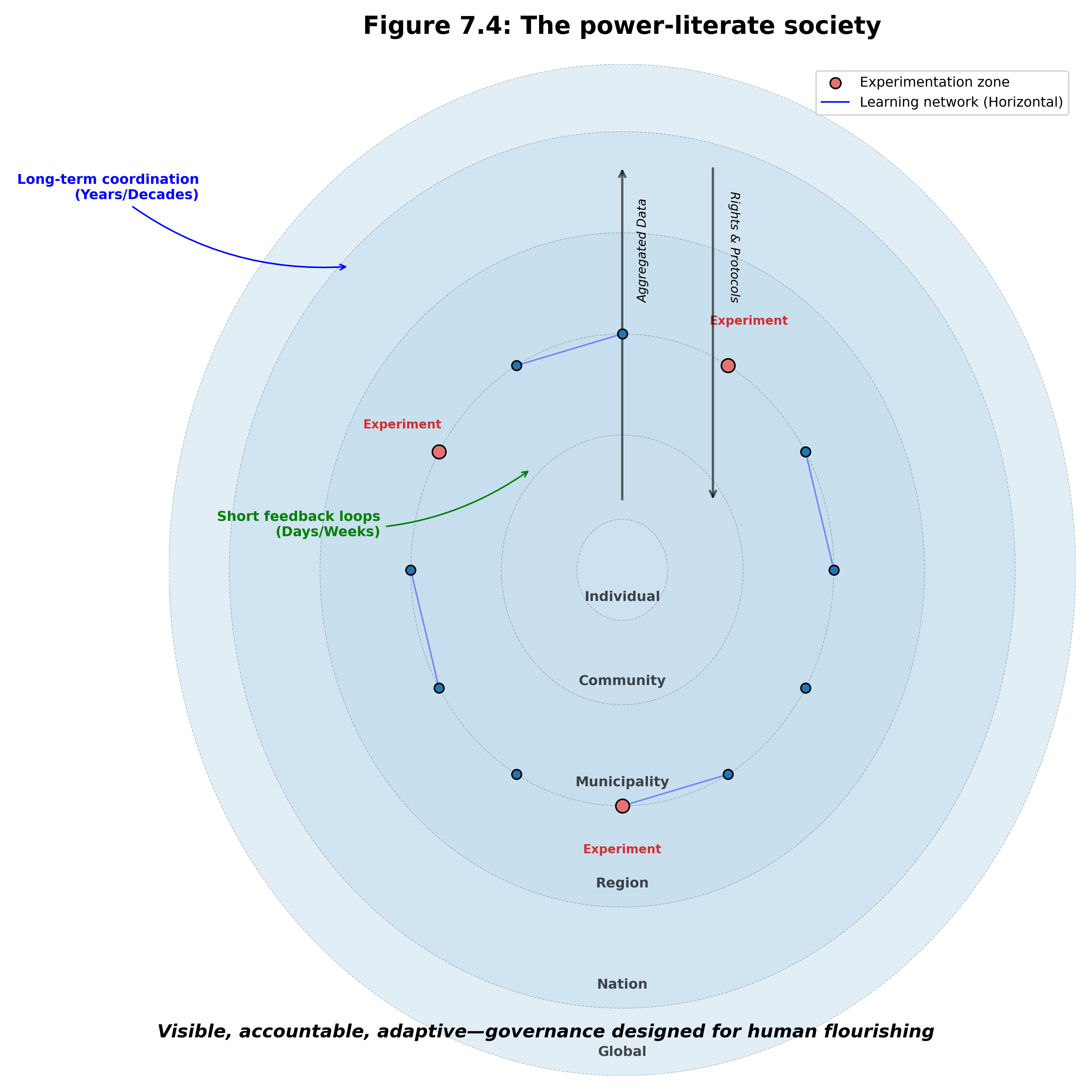
Fractal Constitution A constitutional architecture based on recursive subsidiarity—the same structural pattern repeating at every scale (individual, household, community, municipality, region, nation). Designed for stability, adaptability, and resilience. See also: Subsidiarity, Recursive Structure, Part IV
Fragility The property of breaking easily under stress. Centralized systems are often fragile because they have single points of failure. Distributed systems tend to be more robust or anti-fragile. See also: Resilience, Anti-Fragility, Part VI
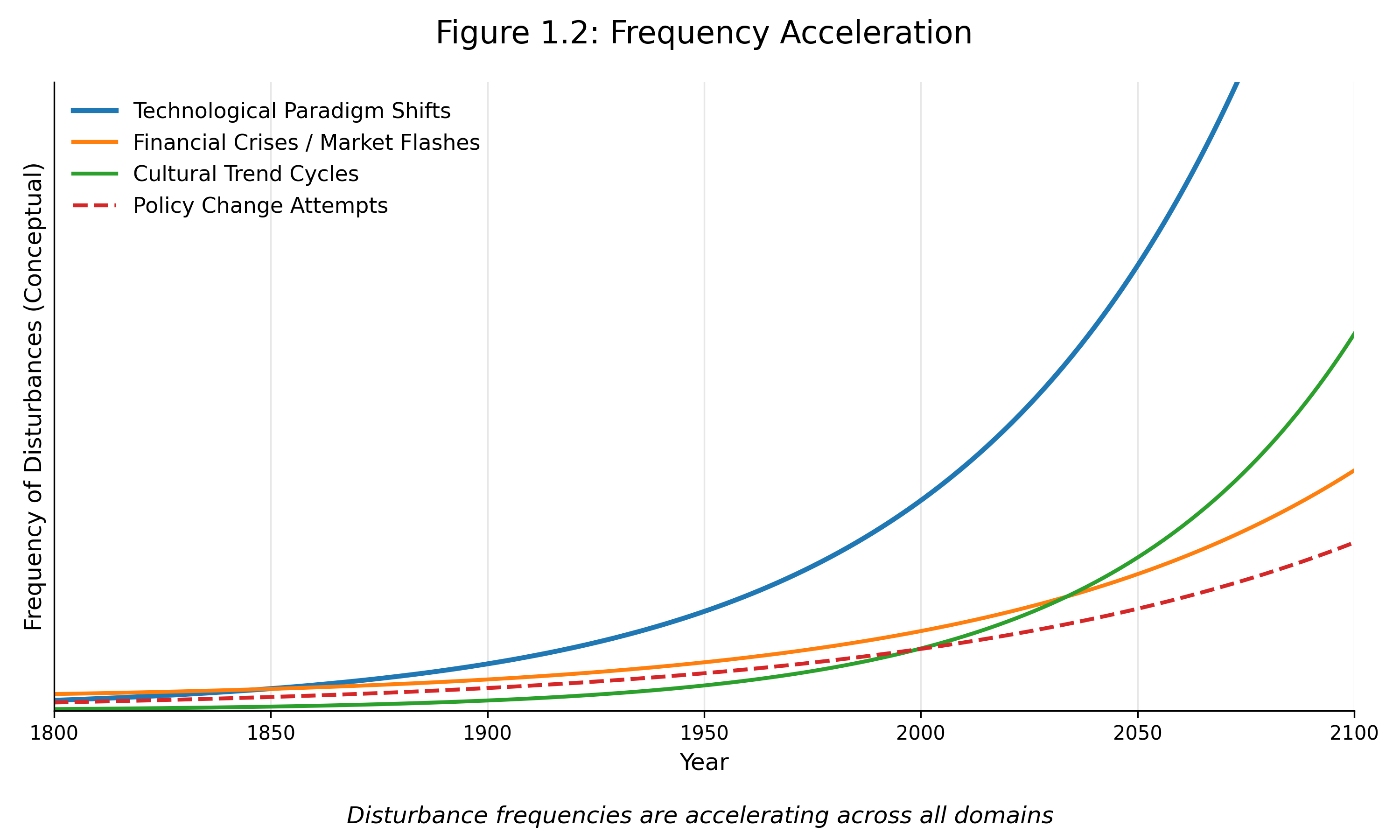
Frequency In signal processing, the rate at which a signal oscillates, measured in cycles per unit time (Hertz). In governance, frequency refers to how rapidly societal conditions change. High-frequency disturbances require fast response times. See also: Bandwidth, Part I
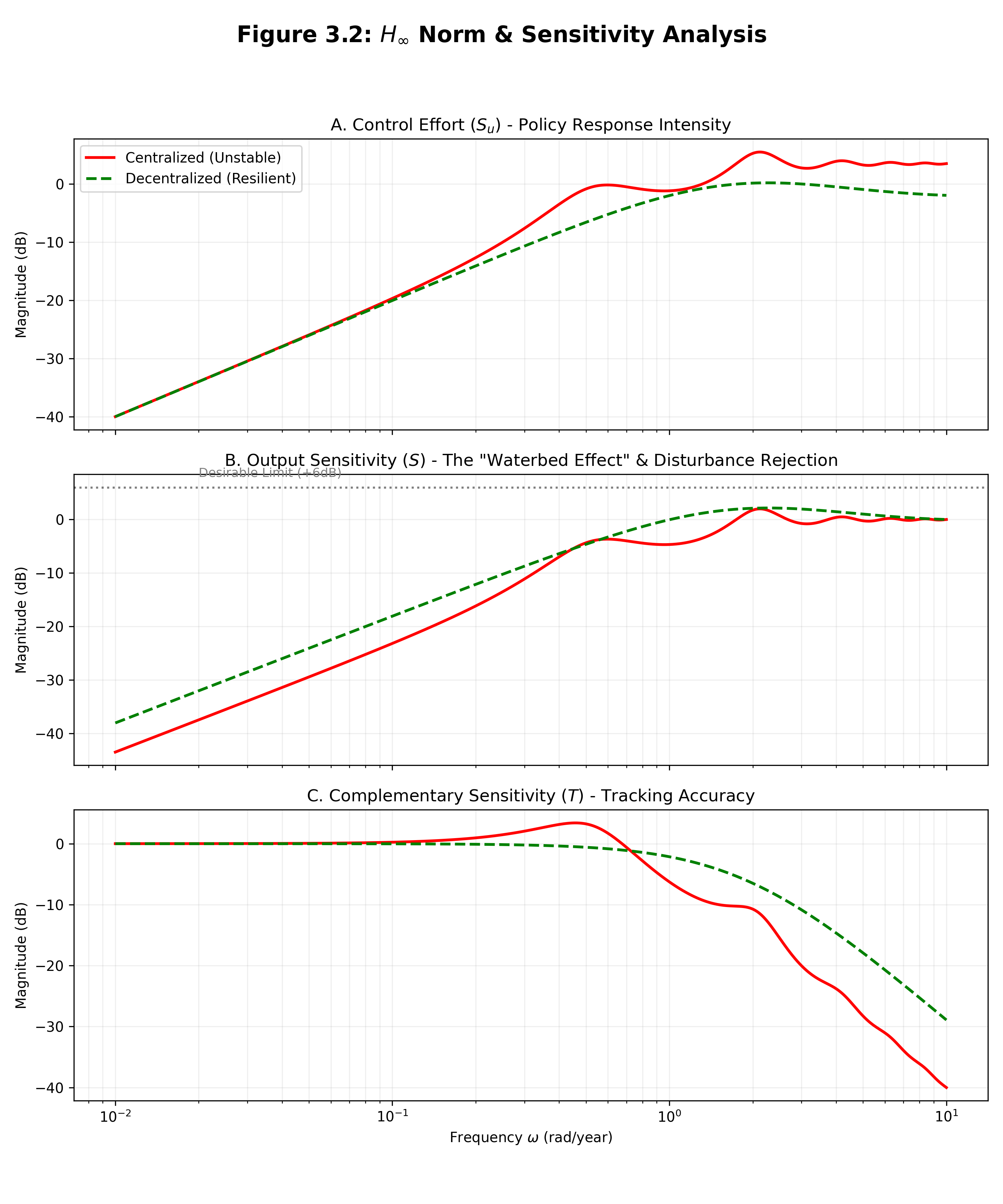
Gain (K) In control theory, the factor by which a system multiplies an input signal. High gain means strong response to errors; low gain means weak response. Too much gain can cause instability. See also: Control Theory, Transfer Function, Part III
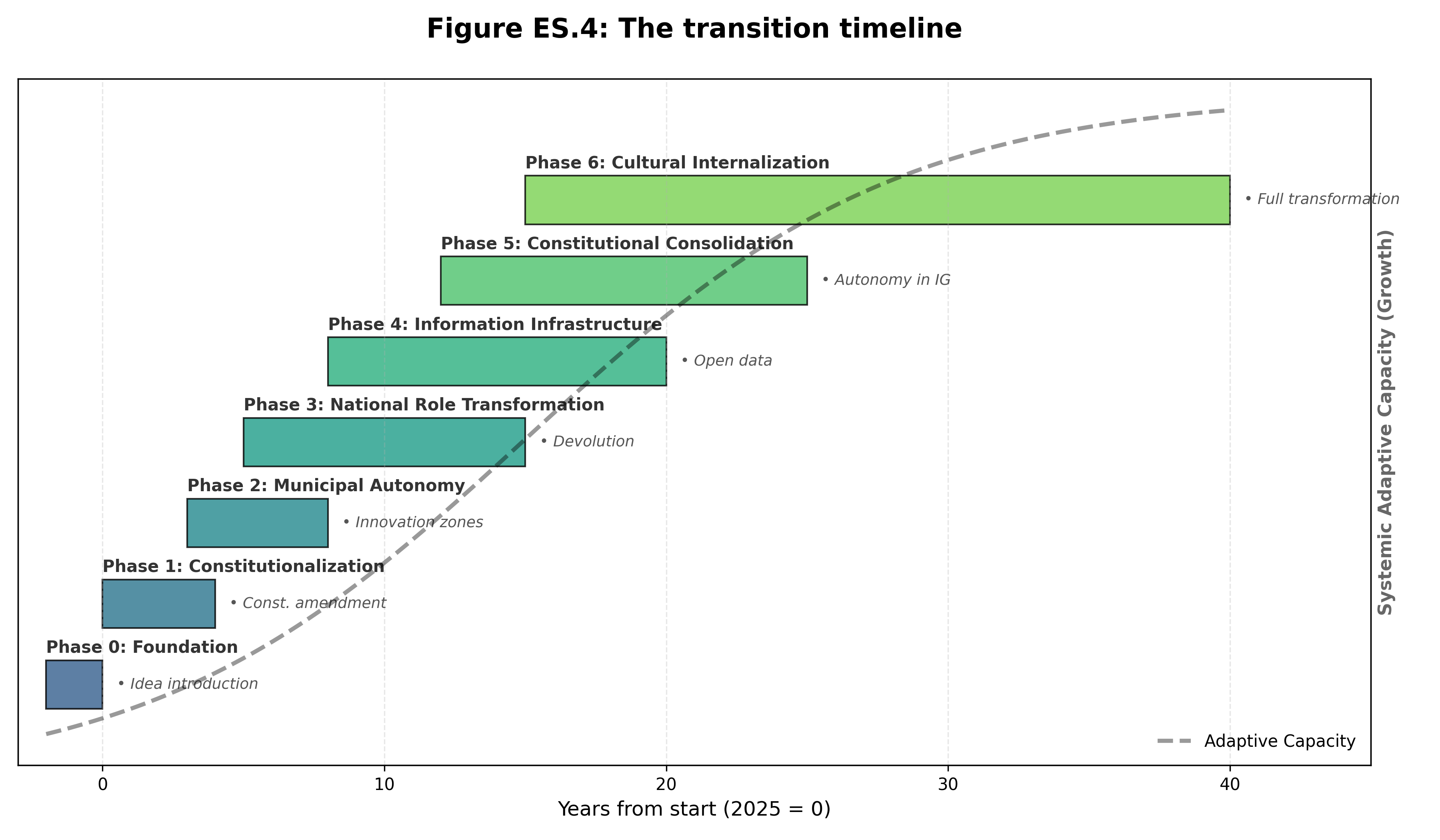
Hysteresis The dependence of a system’s state on its history. Where you’ve been affects where you can go. This is why revolutionary leaps often fail and evolutionary paths often succeed—you must navigate a feasible trajectory. See also: Path Dependence, Part II (Layer 5)
Information Asymmetry A situation in which some participants in a system have more or better information than others. Information asymmetry is a source of power—those who know more can exploit those who know less. See also: Informational Power, Part II (Layer 1)
Information Power Power that operates through control over observation, knowledge, and communication. Those who control what can be seen, what counts as true, and how information flows exercise informational power. See also: Observability, Kalman Filter, Part II (Layer 1)
Information Theory The mathematical study of information, quantification, communication, and entropy. Developed by Claude Shannon, it provides tools for understanding how much information can be transmitted, how to compress it, and how to distinguish signal from noise. See also: Entropy, Signal-to-Noise Ratio, Appendix A
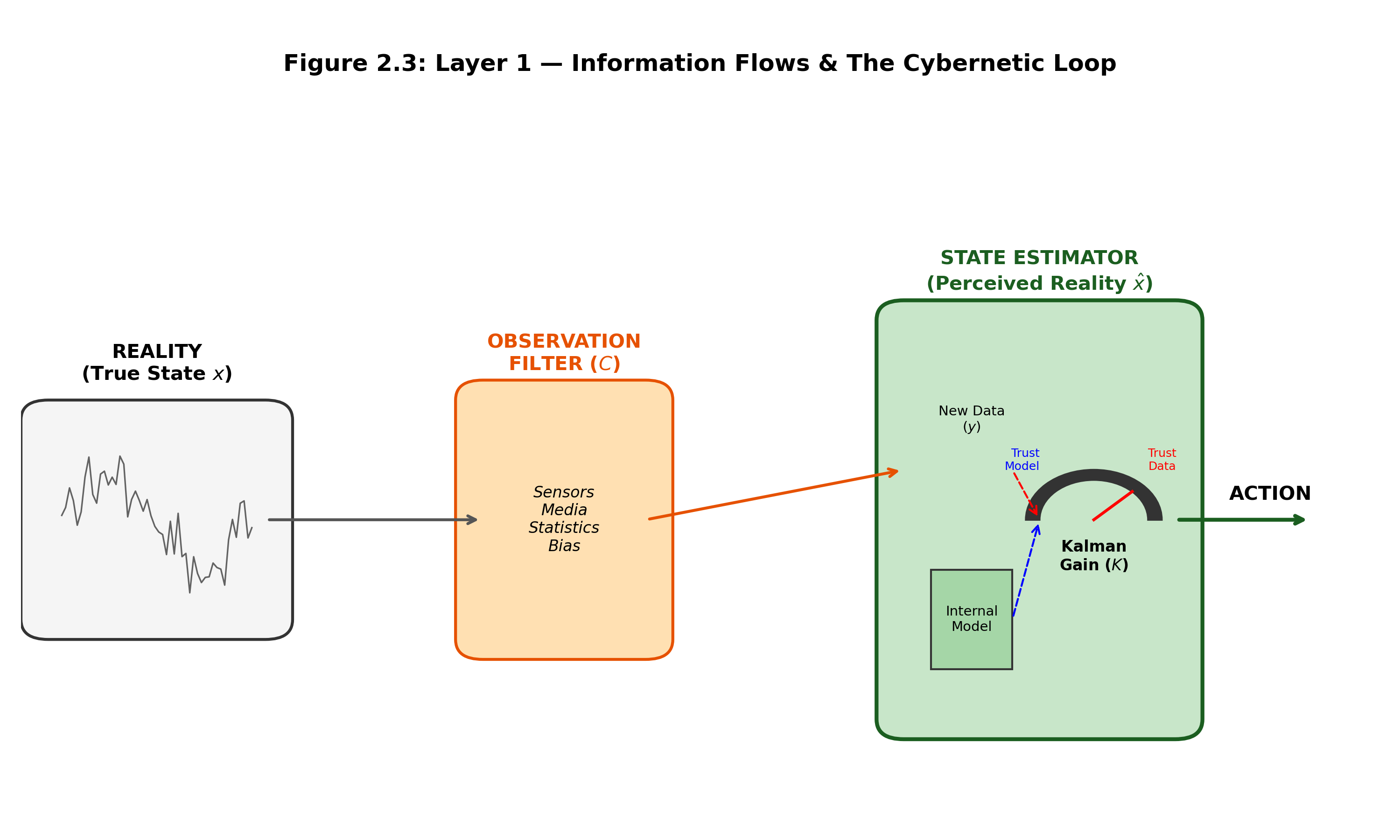
Kalman Filter An algorithm that estimates the state of a dynamic system from noisy measurements by balancing trust in the system’s internal model against trust in new observations. The Kalman gain K determines this balance. Used as a metaphor for how individuals and institutions update beliefs. See also: Informational Power, Part II (Layer 1), Appendix A
Kalman Gain (K) In a Kalman filter, the factor that determines how much new measurements influence the state estimate. High K means trust measurements (adapt quickly, vulnerable to noise); low K means trust model (stable, may miss changes). Social polarization can be understood as bifurcation of K across populations. See also: Kalman Filter, Part II (Layer 1), Appendix A
Landauer’s Principle The principle that erasing one bit of information requires dissipating at least k_B T ln(2) energy. This connects information processing to thermodynamics—information has physical costs. See also: Thermodynamics, Information Theory, Appendix A
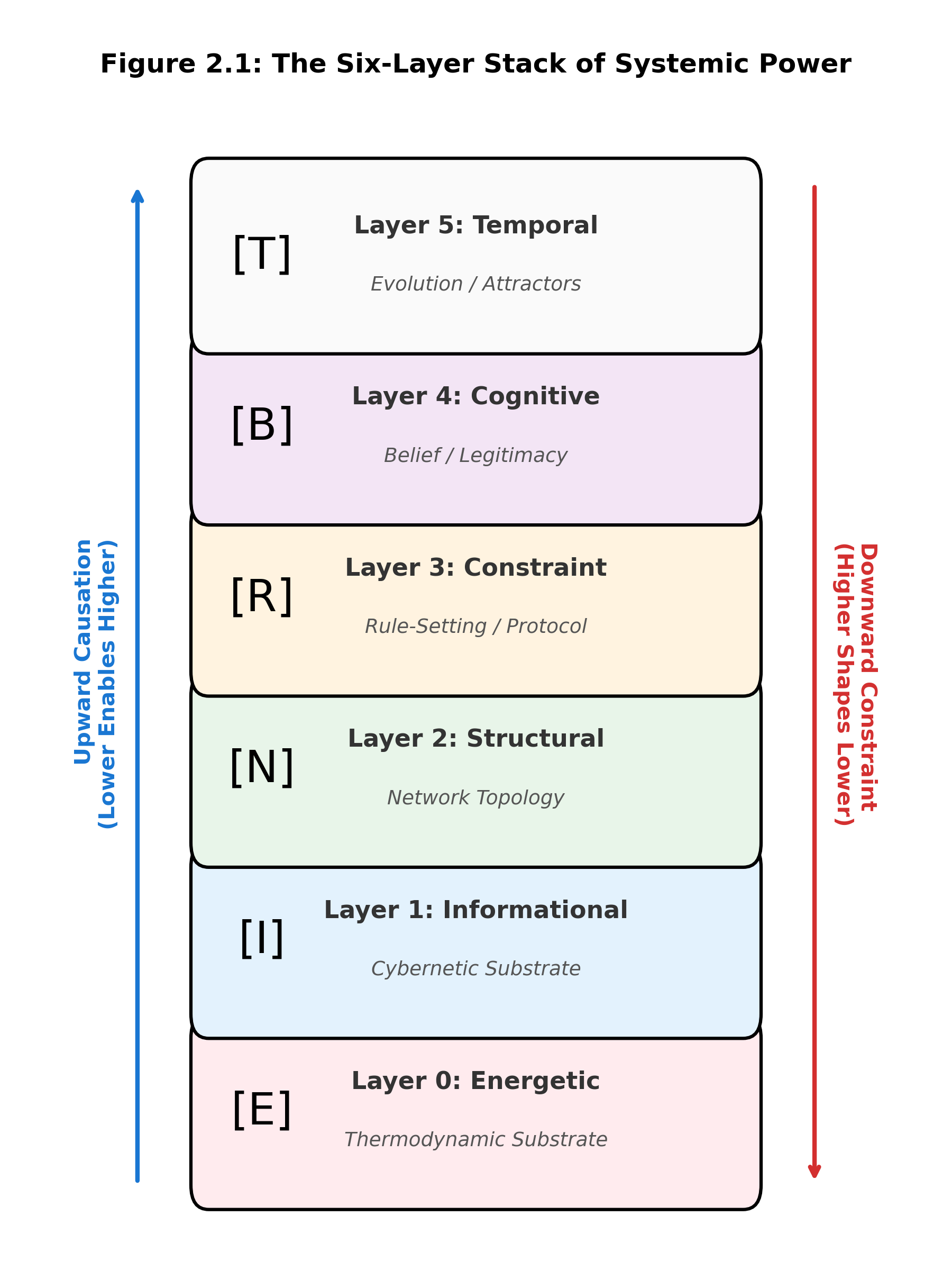
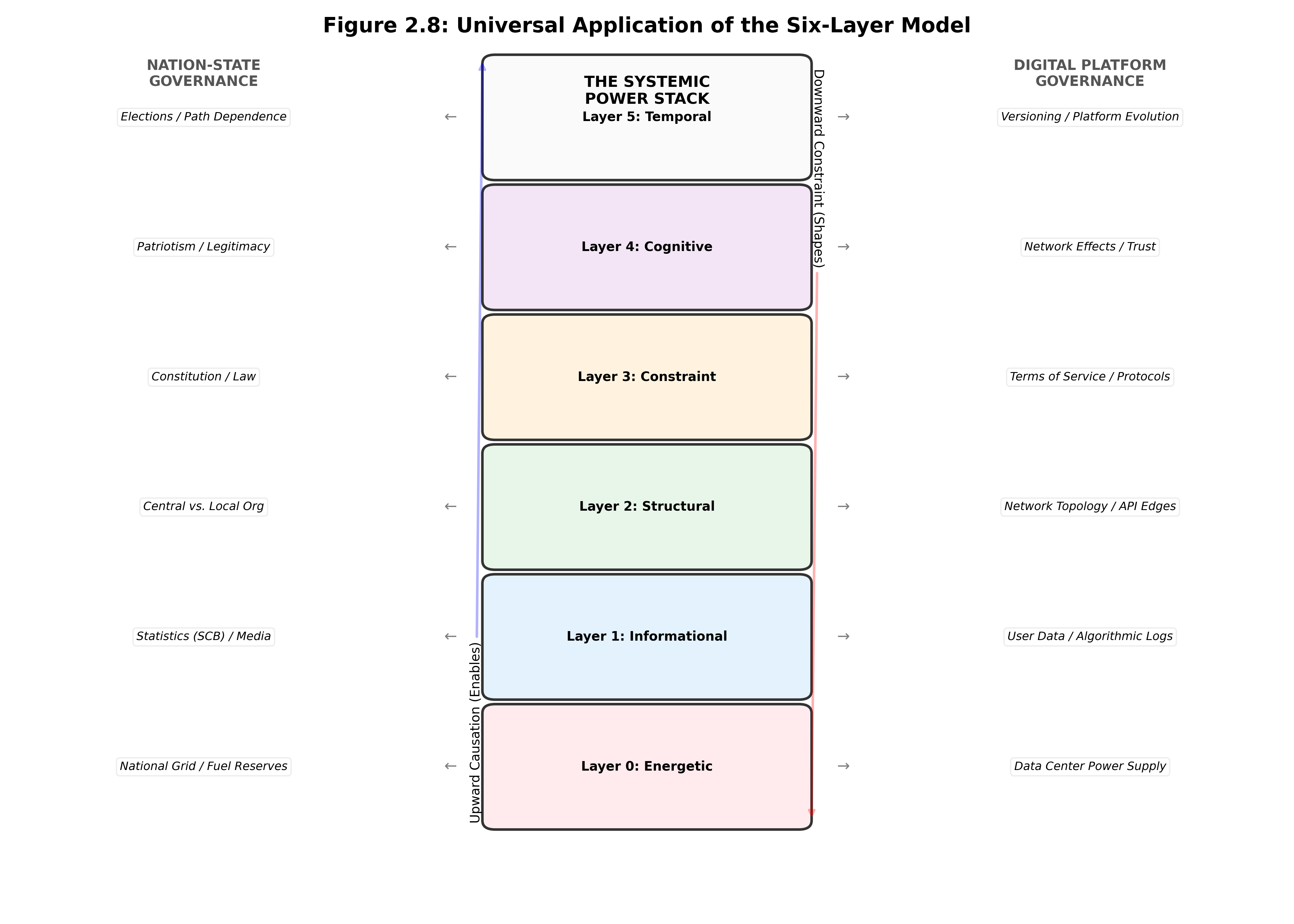
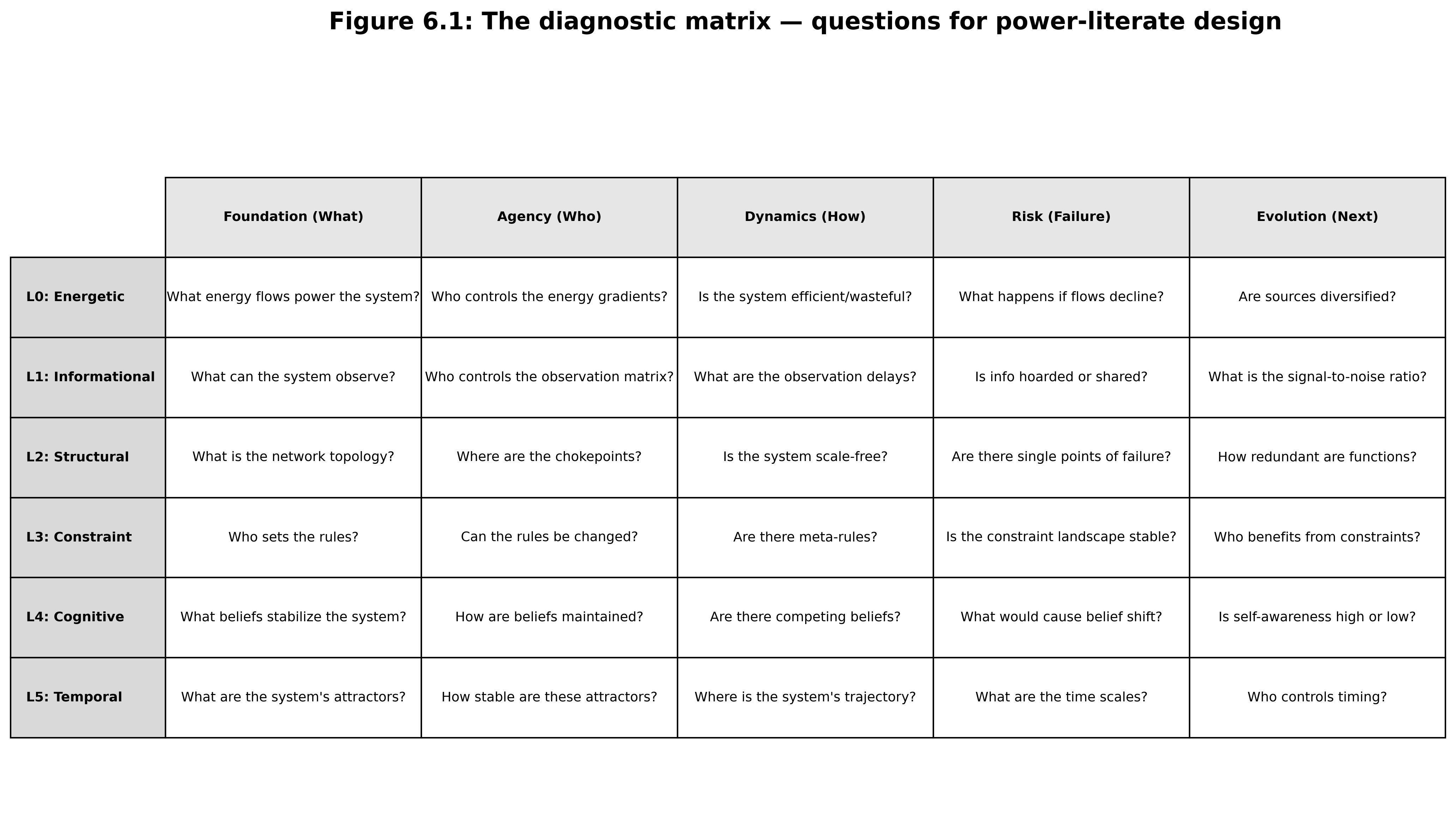
Layered Model The six-layer framework for understanding power: Energetic (0), Informational (1), Structural (2), Constraint (3), Cognitive (4), Temporal (5). Each layer has distinct dynamics and requires different analytical tools. See also: Part II
Lead Compensator In control theory, a device that adds phase lead to improve stability margins. In governance, subsidiarity acts as a lead compensator by reducing delay and adding local sensing. See also: Phase Margin, Subsidiarity, Part III
Legitimacy The belief that a power holder has the right to govern. Legitimacy stabilizes power systems without requiring constant force. It is a form of cognitive power—a collective belief that certain authority is appropriate. See also: Cognitive Power, Part II (Layer 4)
Leverage Point A place in a system where small interventions can produce large changes. Different layers offer different leverage points. Identifying leverage points is key to effective system design and intervention. See also: Part VI
Lyapunov Exponent A measure of the rate at which nearby trajectories in a dynamical system diverge. Positive exponents indicate chaos (sensitive dependence); negative exponents indicate stability. See also: Dynamical Systems, Part II (Layer 5), Appendix A
Matthew Effect “The rich get richer” phenomenon in which initial advantages accumulate, leading to power law distributions. Named from the Gospel of Matthew: “For to everyone who has, more will be given.” This is mathematically inevitable in systems with preferential attachment. See also: Power Law, Scale-Free Network, Part II (Layer 2)
Mechanism Design The reverse engineering of games—designing rules to achieve desired outcomes assuming rational participants. Constitutional design is mechanism design at the highest level. See also: Constraint Power, Part II (Layer 3), Appendix A
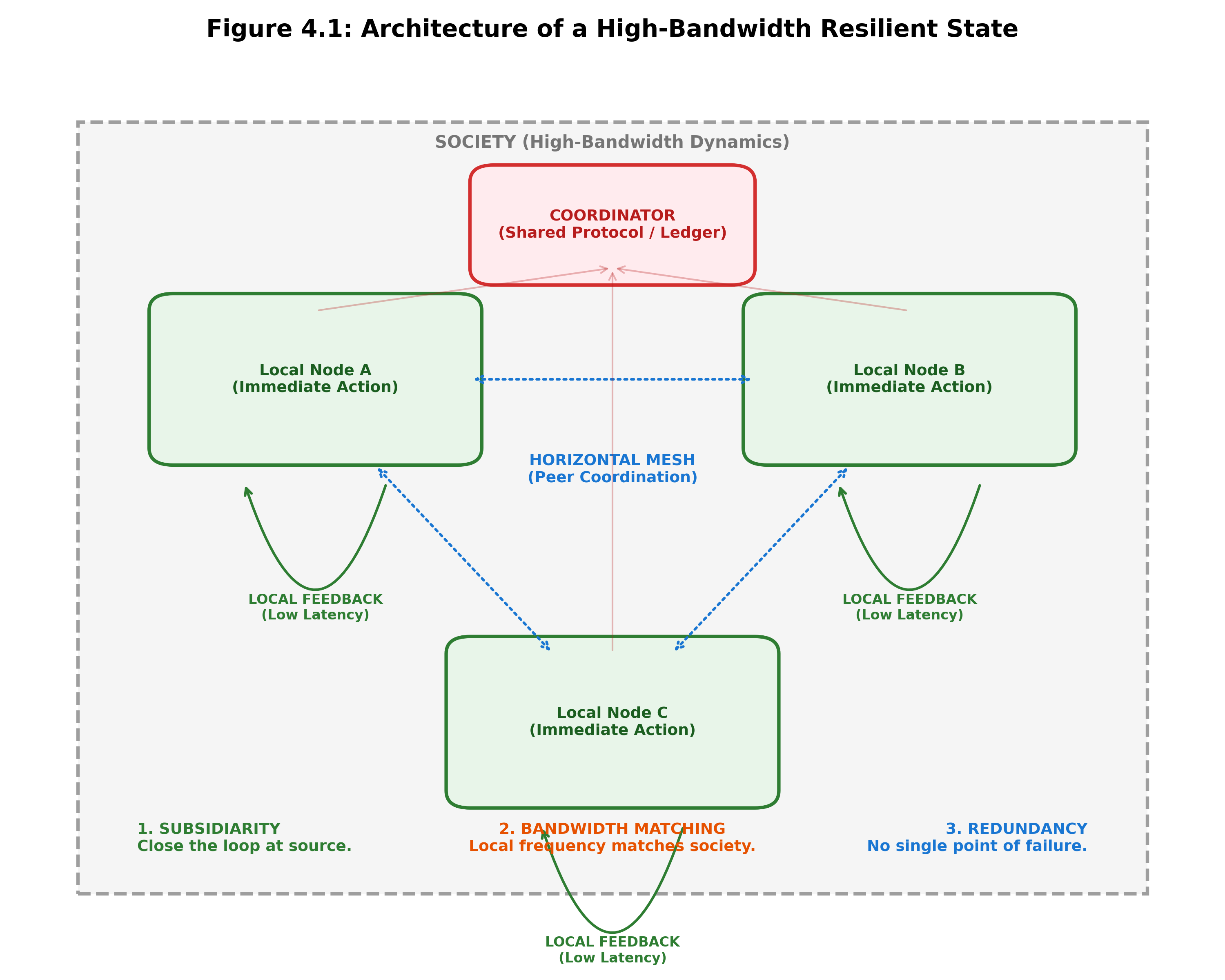
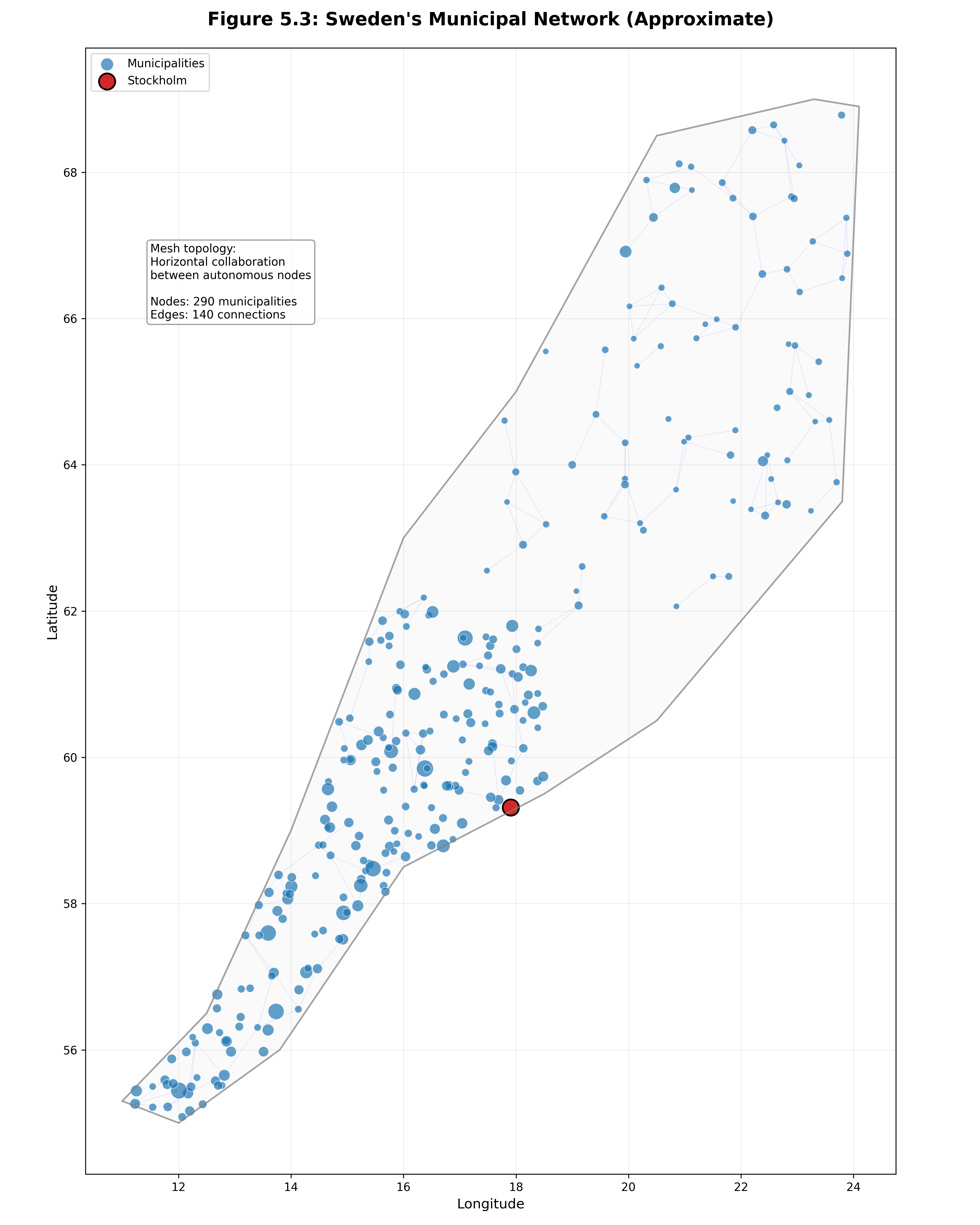
Mesh Network A network topology in which nodes connect directly, non-hierarchically, to many others. Mesh networks are robust—failure of any node does not disable the network. Contrast with star networks. See also: Network Topology, Star Network, Part IV
Meta-Power Power over power—the capacity to shape the rules, structures, and contexts within which other power operates. Constraint power is a form of meta-power. See also: Constraint Power, Protocol Power, Part II (Layer 3)
Municipal Innovation Zone A municipality granted temporary freedom from certain national regulations to experiment with new governance approaches. A key mechanism for enabling parallel experimentation. See also: Experimentation Right, Part V
Mutual Information A measure of how much knowing one variable reduces uncertainty about another. In governance, the mutual information between local conditions and national statistics measures how well the center can observe local reality. See also: Information Theory, Appendix A
Network Topology The pattern of connections in a network—who is connected to whom. Topology shapes how information, resources, and influence flow. Common topologies include star, tree, mesh, and scale-free. See also: Structural Power, Part II (Layer 2)
Nyquist-Shannon Sampling Theorem A signal must be sampled at a rate at least twice its highest frequency component to be accurately reconstructed. Applied to governance: if societal dynamics have frequencies higher than half the governance sampling rate (elections, statistics), aliasing occurs. See also: Aliasing, Part I, Appendix A
Observability In control theory, the ability to infer a system’s internal state from its outputs. A government cannot control what it cannot observe. See also: Controllability, Informational Power, Part II (Layer 1), Appendix A
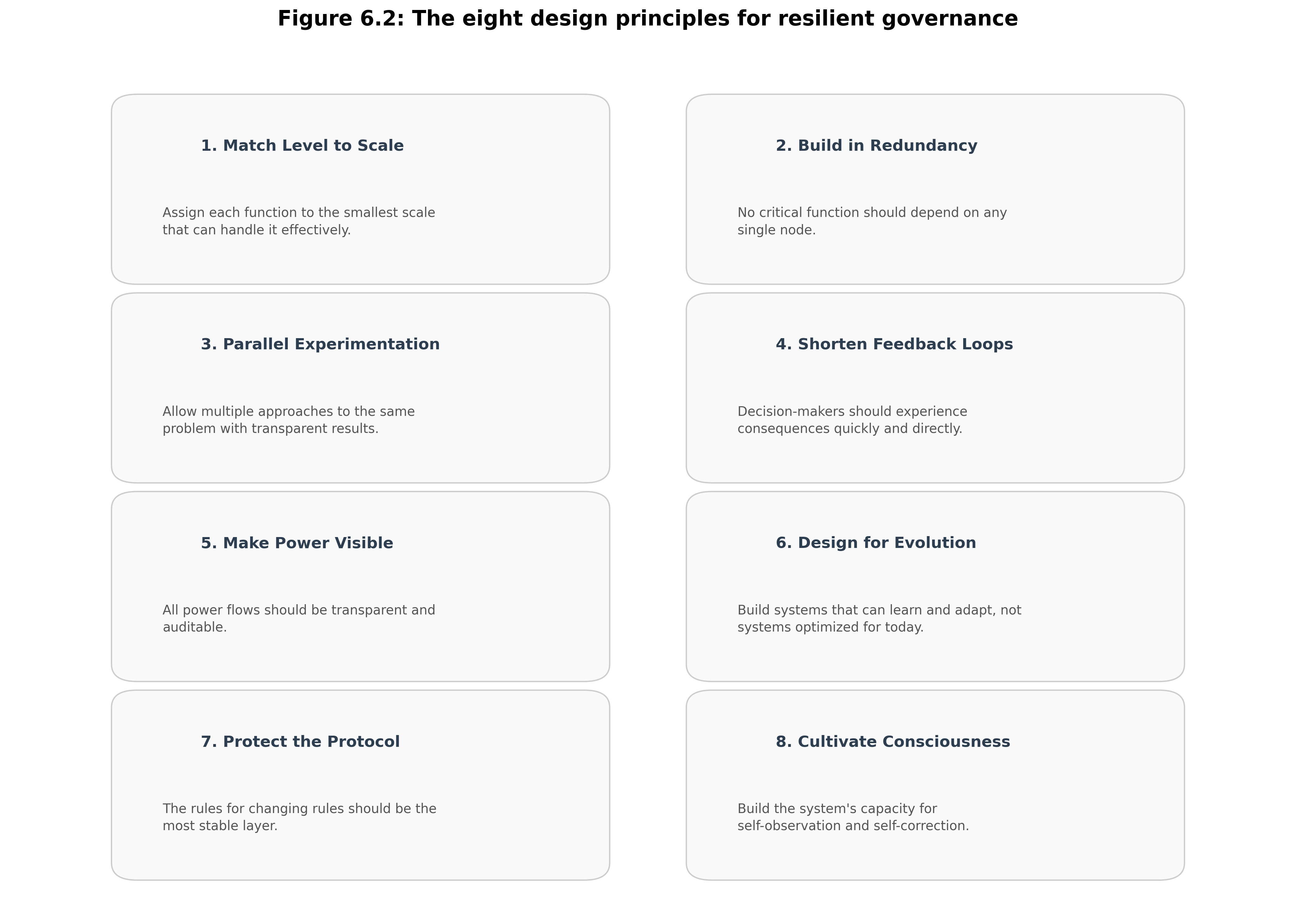
Parallel Experimentation The strategy of allowing multiple approaches to the same problem simultaneously, with successful models spreading voluntarily. This enables evolutionary discovery of optimal solutions. See also: Experimentation Right, Part IV
Path Dependence The property that outcomes depend on the entire sequence of previous decisions, not just current conditions. History matters. This is why transitions must be phased and adaptive. See also: Hysteresis, Part II (Layer 5)
Phase Lag The delay between an input signal and a system’s response, expressed as an angle in degrees or radians. Time delay creates phase lag proportional to frequency. Too much phase lag causes instability. See also: Phase Margin, Delay, Part III
Phase Margin (φ_m) The amount of additional phase lag that would cause a system to become unstable. Positive phase margin means stable; negative means unstable. Phase margin is evaluated at the crossover frequency. See also: Stability, Bode Plot, Part III, Appendix A
Phase Transition A sudden, qualitative change in a system’s behavior as a parameter crosses a threshold. Examples: water boiling, magnet losing magnetization, society shifting from stable to oscillatory governance. See also: Bifurcation, Attractor, Part II (Layer 5)
Power The capacity to shape the state trajectories of systems—to influence their evolution across time, space, and possibility space. Power is not a possession but a flow; not located in individuals but in system relationships. See also: Layered Model, Part II
Power Law A functional relationship where one quantity varies as a power of another. In networks, degree distributions often follow power laws: P(k) ∼ k^(-γ). This means a few nodes have many connections, most have few. See also: Scale-Free Network, Matthew Effect, Appendix A
Protocol Power Power that operates through designing the protocols (rules, standards, conventions) that govern interaction. Protocol designers shape the constraint landscape for everyone else. This is the deepest form of power. See also: Constraint Power, Meta-Power, Part II (Layer 3)
Recursive Structure A pattern that repeats at multiple scales. Fractal constitutions are recursively structured—the same principles apply to individuals, municipalities, regions, and nation. This enables scalability and comprehensibility. See also: Fractal Constitution, Part IV
Redundancy The duplication of critical functions so that failure of any single node does not disable the system. Redundancy is essential for resilience. See also: Resilience, Part IV
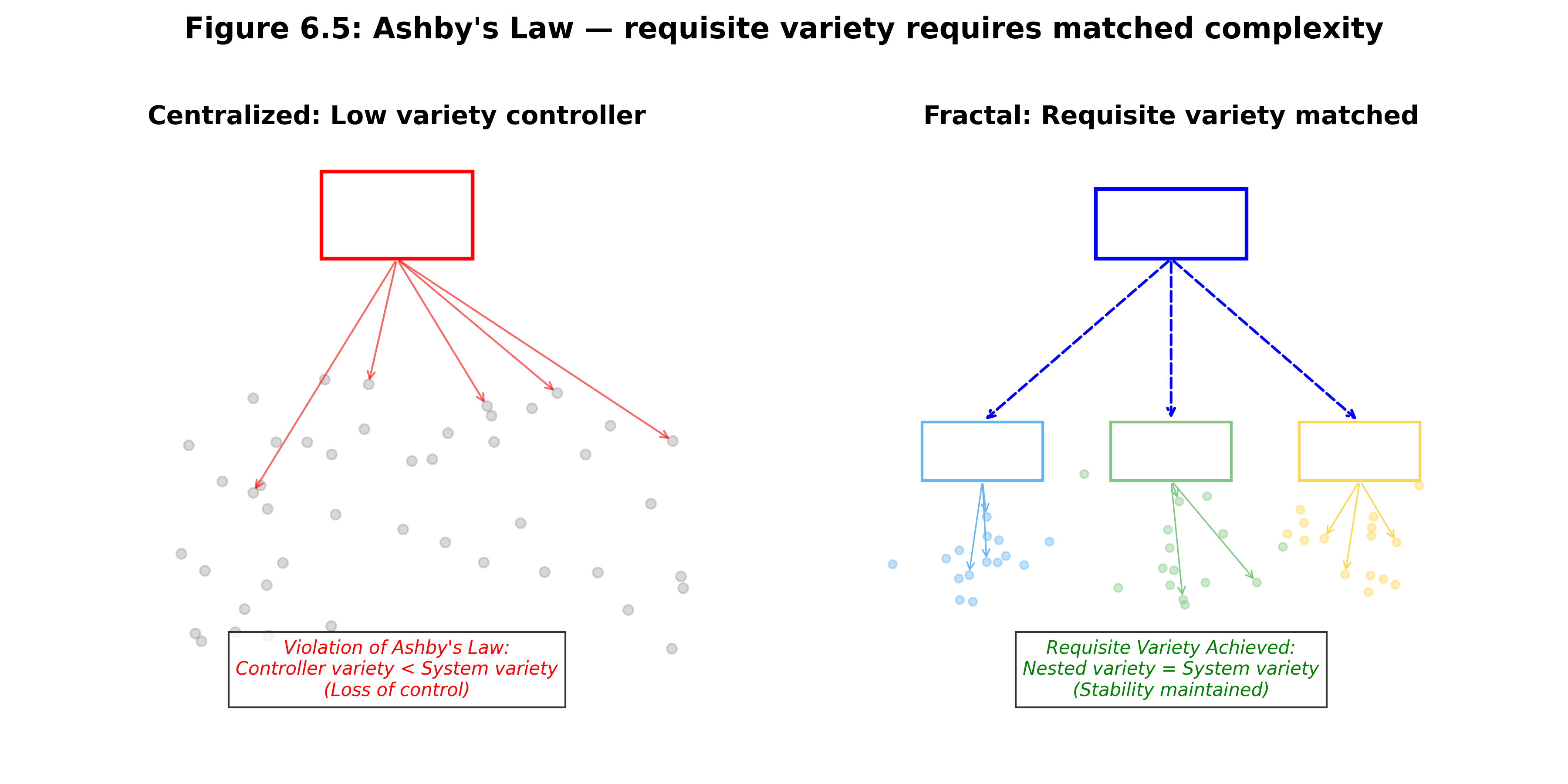
Requisite Variety, Law of (Ashby’s Law) To control a system, the controller must have at least as much variety (complexity, response diversity) as the system being controlled. Centralized systems violate this law when societal complexity exceeds governance complexity. Fractal systems satisfy it by matching variety at each level. See also: Adaptive Capacity, Part VI
Resilience The ability of a system to absorb disturbances and still maintain its core functions. Resilient systems have redundancy, fast feedback, and adaptive capacity. Contrast with robustness (withstanding shocks) and anti-fragility (gaining from shocks). See also: Fragility, Anti-Fragility, Part IV
Scale-Free Network A network whose degree distribution follows a power law. Such networks have a few highly connected hubs and many sparsely connected nodes. They are robust to random failure but vulnerable to targeted attack on hubs. See also: Power Law, Network Topology, Part II (Layer 2)
Signal Processing The analysis, interpretation, and manipulation of signals. This whitepaper applies signal processing concepts—sampling, filtering, frequency analysis—to governance systems. See also: Aliasing, Bandwidth, Filtering, Part I
Signal-to-Noise Ratio (SNR) The ratio of meaningful information (signal) to irrelevant variation (noise). In governance discourse, transformative ideas are weak signals in a sea of cultural noise. High SNR enables clear perception; low SNR causes confusion. See also: Information Theory, Part I
Single Point of Failure A component whose failure disables the entire system. Centralized systems often have single points of failure (the center). Distributed systems eliminate them through redundancy. See also: Fragility, Redundancy, Part IV
Social Reality The aspects of reality that exist only because of collective belief—money, nations, laws, institutions. Social reality is real in its consequences but not in its physical substrate. See also: Cognitive Power, Collective Hallucination, Part II (Layer 4)
Stability The property of a system that, when perturbed, returns to its equilibrium state. Unstable systems amplify perturbations, leading to oscillations or divergence. Stability is the most fundamental requirement for governance systems. See also: Phase Margin, Control Theory, Part III
Star Network A network topology in which all nodes connect to a central hub. Flow passes through the center, creating a chokepoint and single point of failure. Contrast with mesh network. See also: Network Topology, Chokepoint, Part IV
State-Space Representation A mathematical model of a dynamical system as a set of input, output, and state variables related by first-order differential equations. Used in control theory to analyze controllability, observability, and stability. See also: Control Theory, Appendix A
Structural Power Power that emerges from position within networks. Those who sit at chokepoints, bridges, or hubs have structural power regardless of personal attributes. See also: Network Topology, Centrality, Part II (Layer 2)
Subsidiarity The principle that decisions should be made at the lowest level capable of making them effectively. This is the core design principle of the Fractal Constitution and the engineering solution to the instability problem. See also: Fractal Constitution, Part IV
Subsidiarity Impact Assessment A requirement that all proposed national legislation include an analysis of why the matter cannot be handled at lower levels. A mechanism for enforcing subsidiarity. See also: Part V
Sunset Clause A provision that centralized authority expires automatically after a fixed period unless explicitly renewed. Prevents permanent accumulation of power and forces periodic justification. See also: Part IV (Article 9), Part V
Temporal Power Power that operates through timing, sequencing, and evolutionary pressure. Those who can recognize bifurcation points, time interventions, and shape long-term trajectories exercise temporal power. See also: Attractor, Bifurcation, Part II (Layer 5)
Thermodynamics The branch of physics concerned with heat, work, temperature, and energy. The laws of thermodynamics impose fundamental constraints on all systems, including governance systems. See also: Energetic Power, Exergy, Part II (Layer 0), Appendix A
Time Delay (see Delay)
Transfer Function A mathematical representation of the relationship between a system’s input and output in the frequency domain. Used to analyze stability, bandwidth, and response characteristics. See also: Control Theory, Bode Plot, Part III, Appendix A
Transparency The property of a system whose internal workings are visible to observers. Transparent governance enables accountability, learning, and trust. See also: Observability, Part IV
Variety (see Requisite Variety)