III. The GGF as a structural response
The Global Governance Frameworks constitute a proposed post-Westphalian coordination architecture. They are often described in normative terms — as a response to climate breakdown, inequality, and institutional failure. This framing is accurate but incomplete. The GGF’s design principles are not primarily normative commitments. They are engineering responses to the four structural constraints the series has diagnosed. Each load-bearing element of the architecture addresses a specific failure mode. Remove any one element and the corresponding failure mode goes unaddressed; the coordination failure tax for that dimension is not reduced.
This section makes the mapping explicit.
The Westphalian baseline
Before examining the GGF’s responses, it is useful to characterize what they are responding to. The Westphalian nation-state system — the dominant governance architecture for most of the world — exhibits all four failure modes simultaneously.
Observation is concentrated at the national level, which receives aggregated statistics about local conditions. A housing shortage in one district, soil degradation in one watershed, or a community resilience deficit in one region is invisible to national governance until it has grown large enough to appear in national aggregates — by which point the problem has already compounded. This is the Paper I failure mode: spatial blindness from aggregation.
National governance operates at a single temporal scale, calibrated to electoral cycles and legislative processes. Fast-moving crises — pandemic emergence, financial contagion, local ecological tipping points — outrun the national response timescale. Slow-moving structural changes — soil degradation, demographic transition, long-run deindustrialization — move below the threshold of electoral visibility. Neither the fast nor the slow frequency band is adequately governed. This is the Paper II failure mode: frequency gaps from single-scale control.
Democratic representation in Westphalian systems typically operates through chains of three to five layers: citizen to local representative to regional assembly to national parliament to executive. Paper III establishes that chains of this depth cannot transmit citizen preferences to the policy level with positive SNR. The policy layer governs a phantom signal — a distorted echo of citizen preferences that has been aggregated, averaged, and noise-corrupted beyond recovery. This is the Paper III failure mode: preference invisibility from deep representation chains.
Natural commons — fisheries, forests, watersheds, atmospheric sinks — are predominantly governed by national and international bodies using aggregate monitoring and periodic quota-setting. Paper IV establishes that this architecture performs worse than open access under conditions of resource decline, because the observation lag between stock change and quota adjustment authorizes overharvest precisely when the resource can least afford it. This is the Paper IV failure mode: observational inadequacy from low-dimensional commons monitoring.
The Westphalian system, in other words, is not a system that partially satisfies the structural constraints. It exhibits all four failure modes simultaneously. The coordination failure tax is not reduced at any dimension. The compounding calculation from Section II applies in full.
The GGF’s structural responses
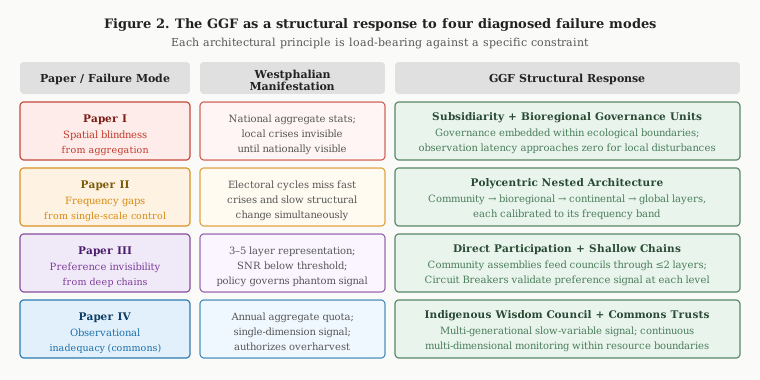
Figure 2. The GGF as a structural response to four diagnosed failure modes.
The GGF addresses each failure mode through a specific architectural choice. The mapping is not incidental — each design principle is the structural response to the diagnosed constraint.
Paper I failure (spatial blindness) → Subsidiarity and bioregional governance units
The GGF places governance authority within the systems it governs. Bioregional Autonomous Zones are defined by ecological boundaries — watersheds, biomes, coastal systems — rather than administrative ones, and are governed by councils embedded within those boundaries. This positioning eliminates the aggregation step that destroys spatial information in Westphalian governance. The council observing a watershed is positioned within the watershed; it observes conditions directly rather than through an aggregate signal. The observation latency approaches zero for local disturbances; the spatial information that would be destroyed in aggregation is never aggregated.
The subsidiarity principle — that decisions should be made at the lowest level capable of addressing the problem — follows from the same structural analysis. It is not a preference for local governance as such. It is the recognition that governance positioned outside a system cannot observe what is happening inside it, and that information destroyed in transmission cannot be recovered at the receiving end.
Paper II failure (frequency gaps) → Polycentric nested architecture
The GGF’s polycentric structure — overlapping jurisdictions of Territorial Councils, Commons Trusts, Guilds, and the Indigenous Wisdom Council, operating at community, bioregional, continental, and global scales — is designed to cover the full disturbance frequency spectrum that no single governance scale can cover alone.
Fast disturbances — acute local crises, rapid ecological change, community-level conflict — are addressed by community-level governance with short response latency. Medium disturbances — seasonal resource variation, regional economic cycles, multi-year ecological trends — are addressed by bioregional governance calibrated to those timescales. Slow disturbances — multi-decadal ecological shifts, civilizational transition pressures, intergenerational resource dynamics — are addressed by the Indigenous Wisdom Council and global coordination layers operating at the timescales at which those disturbances manifest.
The architecture does not produce redundancy across scales. It produces coverage — each scale governing the frequency band it can actually observe and respond to, without attempting to govern the bands that its observation latency makes inaccessible.
Paper III failure (preference invisibility) → Direct participation and shallow chains
The GGF’s democratic mechanisms are designed around the SNR constraint established in Paper III. Where Westphalian systems route preferences through chains of five or more layers, the GGF’s participatory structures minimize chain depth: direct community assemblies feed bioregional councils through a single layer of aggregation, not through multiple layers of representation. The preference signal survives this transmission because the chain is short enough to keep noise variance below signal variance.
Digital participation infrastructure — where implemented — further reduces effective chain depth by enabling citizens to express preferences on specific decisions rather than delegating their entire preference set to a representative for a fixed term. The preference signal becomes more specific, more frequent, and less aggregated, reducing the information loss at each step.
The Circuit Breaker mechanisms — which pause implementation of decisions that exceed specified thresholds of community dissent — function as preference signal validation: they detect when the policy layer has drifted beyond the boundary of what the preference signal, however imperfectly transmitted, would authorize.
Paper IV failure (observational inadequacy) → Indigenous Wisdom Council and Commons Trusts
The GGF’s most distinctive architectural feature, from the perspective of the series, is the structural role assigned to indigenous governance systems. Paper IV establishes that effective commons governance requires observation dimensionality matching the resource system’s disturbance variety — and that the slow ecological signal, which spans decades to centuries, can only be accessed by governance systems that have been embedded within specific ecologies across those timescales. Indigenous governance systems, developed through generations of direct resource observation, possess exactly this slow-variable observation capacity. The knowledge is not metaphorical or cultural. It is a multi-generational observational record of slow-moving ecological variables that modern monitoring programmes have not existed long enough to observe.
The Indigenous Wisdom Council is not, in this framing, a concession to identity politics or historical redress — though it may be those things as well. It is a structural requirement for commons governance with sufficient observation dimensionality to cover the slow frequency band. An architecture without it has a permanent frequency gap at the slow end of the disturbance spectrum, regardless of how sophisticated its other monitoring systems are.
Commons Trusts — governance bodies holding renewable resources in stewardship rather than ownership — address the same failure mode at the medium frequency band. By positioning governance authority within specific resource systems with continuous monitoring mandates, they provide the multi-dimensional observation that periodic national survey cannot.
What happens if any element is removed
The load-bearing nature of each architectural choice becomes visible when any one element is removed.
A GGF without the Indigenous Wisdom Council — retaining subsidiarity, polycentric structure, and shallow representation chains — still fails on observation dimensionality. The slow ecological signal remains inaccessible. The Paper IV failure mode is unaddressed. For any commons governed by this truncated architecture, the simulation predicts collapse risk approaching Architecture B levels for disturbances at the slow frequency band, regardless of how well the other three constraints are satisfied.
A GGF without shallow representation chains — retaining bioregional positioning, polycentric frequency coverage, and commons observability — still fails on preference transmission. The policy layer governing each bioregional council is separated from citizen preferences by a chain deep enough to lose signal. The community assemblies and commons trusts operate with high observation dimensionality; the preference signal that should guide their mandate is still being destroyed in transmission. The structure is well-observed but ungoverned by actual citizen preferences.
Each element is necessary. None is sufficient alone. The architecture is integrated in the specific sense that satisfying three of the four constraints while leaving the fourth unaddressed still pays the coordination failure tax on the unaddressed dimension.