Whitepaper · Series II

Fractality as Stability

A Multi-Scale Control-Theoretic Proof

Context

This paper extends the control-theoretic governance framework from paper one to multi-scale disturbance environments. The core finding: no single-scale controller can stabilize a system facing simultaneous fast, medium, and slow disturbances. Fractal architectures — nested hierarchies of controllers matched to their disturbance timescale — are the stability-optimal solution.

The frequency-latency constraint (f_max ≈ 1/2τ) places a hard ceiling on what any single-scale controller can achieve. Fractality closes all frequency gaps simultaneously. This is not a governance preference. It is a structural result.

Executive summary

The previous paper in this series demonstrated that governance architectures with lower latency and higher signal fidelity outperform centralized architectures under localized disturbance. That result concerned a single type of disturbance at a single scale. Real governance environments are not like that.

Real governance systems face simultaneous disturbances across multiple timescales: fast local shocks that demand response within days, medium pressures that operate over months, and slow secular drifts that unfold over years or decades. This paper demonstrates that no single-scale controller can stably govern a system subject to disturbances across all three bands simultaneously. The limitation is not political or institutional. It follows from a fundamental relationship in feedback control theory between a controller’s latency and the maximum frequency of disturbance it can stabilize.

The formal result: any controller with response latency τ cannot stabilize disturbances faster than f_max ≈ 1/(2τ). A central controller with τ = 12 can handle slow drift but is structurally blind to fast and medium disturbances. A local controller with τ = 2 can handle fast shocks but systematically over-reacts to slow drift, producing sustained oscillation. Neither architecture covers the full disturbance spectrum. Both leave a frequency gap that no tuning of their parameters can close.

Fractal architectures — nested hierarchies of controllers, each matched to the timescale of its disturbance band — close all frequency gaps simultaneously. The local layer handles fast shocks with high signal fidelity and low latency. The regional layer absorbs medium pressures. The global layer tracks slow drift. Each layer handles what it can reach; no layer is asked to handle what it structurally cannot.

This paper extends the Governance Stability Simulator to a multi-scale disturbance environment and compares three architectures: centralized control (Architecture A), distributed local control (Architecture B), and fractal multi-scale control (Architecture C). All three architectures are given identical actuator resources. Performance differences are attributable to architecture alone.

The finding is not that fractal governance is preferable. It is that fractal architecture is the stability-optimal response to a multi-frequency disturbance environment — in the same sense that the human nervous system, the immune system, and the internet are fractal, not because their designers preferred distributed structures, but because single-scale alternatives are provably less stable.


Part I: The multi-scale problem

Governance disturbances are not monochromatic

The first paper in this series modelled a single class of disturbance: a localized shock striking two nodes simultaneously, with the rest of the system undisturbed. This is a useful test case for isolating the averaging problem, but it does not reflect the actual disturbance environment that governance systems face.

Real governance environments contain disturbances operating simultaneously across at least three distinct timescales.

Fast disturbances — periods of days to weeks — include acute local crises: crime waves, supply disruptions, public health emergencies, sudden civil unrest. These require response within the window during which they are occurring. A response that arrives after the event has resolved is not a response; it is an intervention into a different system state.

Medium disturbances — periods of months to a year or two — include regional economic pressures, seasonal demographic fluctuations, and the accumulation of deferred infrastructure stress. These do not demand immediate action but require sustained tracking and graduated correction. They are too persistent to ignore and too slow to treat as emergencies.

Slow disturbances — periods of years to decades — include secular trends: long-run demographic shifts, gradual institutional erosion, the accumulation of ecological damage, and the slow drift of social cohesion. These operate below the threshold of daily political salience but constitute the most consequential long-run challenges governance systems face.

These three bands do not arrive sequentially. They are superimposed. At any moment, a governance system is simultaneously managing fast shocks at specific locations, medium pressures across certain regions, and slow trends across the full system. The question is whether any single architectural choice can handle all three simultaneously.

The frequency-latency constraint

The answer follows from a fundamental result in control theory.

Any feedback controller has a maximum controllable frequency — the fastest disturbance it can stabilize — determined by its response latency:

f_max ≈ 1 / (2 · τ)

Where τ is the dead-time: the number of time steps between a disturbance occurring and a corrective response arriving at the affected node. This is the same latency constraint introduced in paper one, now applied to the frequency domain rather than to amplitude.

The constraint is strict. A controller cannot compensate for disturbances that complete a full cycle in less than twice its latency. It does not see them in time. By the time its response arrives, the disturbance has reversed direction, and the intervention amplifies rather than dampens the oscillation.

Applied to the three timescales above:

ControllerLatency τf_maxCan handle
Central120.042Slow drift only
Regional60.083Slow and medium
Local20.250All three bands

This suggests an obvious solution: make everything local. But this table only shows the upper frequency boundary. There is also a lower-frequency problem, and it runs in the opposite direction.

The slow-drift problem for local controllers

A local controller with τ = 2 has excellent high-frequency coverage. It responds quickly to fast shocks. But it faces a structural problem with slow disturbances.

Slow drift moves in one direction for many time steps before reversing. A local controller observing only local conditions cannot distinguish between a genuine equilibrium shift (which should be tracked) and an early stage of a slow drift that will reverse (which should not be aggressively corrected). Because its gain must remain below the stability ceiling for τ = 2, it applies corrections at full authorized strength to every perceived deviation, including deviations that are early-stage slow drift.

The result is persistent oscillation around a moving target. The local controller is always slightly out of phase with the drift it cannot fully see. This oscillation is not instability in the traditional sense — the system does not diverge — but it produces sustained, unnecessary variance around the equilibrium. The system is never quite stable because it is always reacting to a slow trend as if it were a local perturbation.

This is the second failure mode the paper demonstrates. Architecture B (local only) performs well against fast shocks and poorly against slow drift — not because its parameters are miscalibrated, but because no single-scale local controller can simultaneously be appropriately aggressive for fast disturbances and appropriately patient for slow ones.

The frequency gap theorem

These two observations — that centralized controllers cannot handle high-frequency disturbances, and that local-only controllers cannot handle low-frequency drift — constitute a formal result: for any single-scale architecture, there exists a class of disturbances it structurally cannot stabilize. Call this the frequency gap.

The frequency gap of a centralized controller (large τ) lies in the fast and medium bands. The frequency gap of a local-only controller (small τ) lies in the slow band. Neither gap can be closed by tuning the controller’s gain parameter, because the constraint is topological: it arises from the relationship between latency and frequency, not from the setting of any adjustable parameter.

The only architectural response that closes all frequency gaps simultaneously is one that places controllers at each relevant timescale, each handling the band it can reach. This is the definition of a fractal control architecture.


Part II: Fractal architecture as the formal solution

Definition

A fractal control architecture is a nested hierarchy of controllers in which each layer is matched to the timescale of the disturbances it is responsible for managing. Faster layers have lower latency and higher signal fidelity; slower layers have higher latency and observe broader aggregations. Each layer handles the frequency band that its latency allows it to reach. Disturbances too fast for a given layer are handled by the layer below; disturbances too slow to require local action are delegated upward.

The term “fractal” refers to the self-similar structure of the hierarchy: the control logic at each scale resembles the logic at every other scale, but the parameters — latency, signal resolution, spatial scope — differ in a systematic way matched to the dynamics of that scale. This self-similarity is not decorative. It is the property that allows each layer to be designed independently using the same principles, and combined without requiring a central integrator that would reintroduce the latency problem.

The formal extension

The state transition equation from paper one extends naturally to multiple control layers. For node i at time t:

x_i(t+1) = A · x_i(t)
           + β · Σ_{j ∈ neighbours(i)} (x_j(t) − x_i(t))
           + B · u_local,i(t − τ_l)
           + B · u_regional,r(i)(t − τ_r)
           + B · u_global(t − τ_g)
           + d_i(t)
           + drift

Where:

  • u_local,i is the per-node local control signal, computed from local observation y_i(t)
  • u_regional,r(i) is the regional control signal for the region containing node i, computed from the regional mean
  • u_global is the global control signal, computed from the system-wide mean
  • τ_l < τ_r < τ_g — latencies are strictly ordered by scale
  • B = 1.0 for all layers — actuator effectiveness is equal, so performance differences reflect architecture alone

The control laws at each layer are proportional feedback, identical in form to paper one:

u_local,i(t)   = K_l · (x_ref − y_i(t))
u_regional,r(t) = K_r · (x_ref − mean(y_region_r(t)))
u_global(t)    = K_g · (x_ref − mean(y(t)))

With gain values constrained by the stability ceiling at each latency:

LayerτK_max ≈ 1/(τ·A
Local20.530.40
Regional60.180.15
Global120.0880.07

The gain values are not arbitrary. Each is chosen to remain safely below the ceiling imposed by its layer’s latency. A central controller is constrained to K = 0.07 not by lack of resources but because any higher gain at τ = 12 would produce oscillation. A local controller can use K = 0.40 precisely because its low latency supports a higher ceiling.

What each layer does

The local layer (τ = 2, σ = 0.5) observes each node with high fidelity and responds within two time steps. It is calibrated to absorb fast shocks — disturbances that complete a significant fraction of their cycle within 10–15 time steps. Its high gain relative to the other layers means it applies the strongest corrections, but only to locally-observed deviations. It neither knows nor needs to know what is happening at other nodes.

The regional layer (τ = 6, σ = 2.0) observes the mean condition of each of two regions and responds within six time steps. It handles medium-frequency pressures — persistent regional trends that the local layer’s noise would obscure at individual nodes. Its lower gain means it applies gentler, more sustained corrections calibrated to trends rather than shocks.

The global layer (τ = 12, σ = 5.0) observes the system-wide mean and responds within twelve time steps. It handles slow secular drift — the kind of gradual system-wide trend that would be invisible to local controllers and too noisy to detect in regional means, but is clear in a long-run system-wide average. Its very low gain means it applies only light corrections, appropriate for tracking a slow-moving trend rather than responding to a crisis.

What each layer does not do

The local layer does not have sight of regional or global conditions. It cannot and should not attempt to manage disturbances that exceed its geographic scope or that operate on timescales longer than its natural bandwidth. Asking a local controller to manage slow drift would require it to apply small, persistent corrections over long periods — a task for which its high gain and low latency make it structurally unsuitable.

The global layer does not direct the content of local decisions. It does not tell specific nodes what to do. It applies a uniform adjustment to the system-wide target in response to observed system-wide drift. In governance terms, it is setting the macroeconomic or constitutional context, not administering local services.

This division of function is not a governance preference. It is a consequence of matched bandwidth: each layer is only capable of managing the frequency band its latency allows it to observe and respond to. The architecture respects these limits rather than pretending they do not exist.

Biological and engineering existence proofs

The fractal control architecture described here is not a novel proposal. It is independently convergent on the same structural solution that evolution and engineering have arrived at wherever multi-scale stabilization is required.

The human nervous system implements three control layers directly analogous to the three modelled here. Spinal reflexes (τ ≈ milliseconds) handle fast local disturbances — the withdrawal reflex does not wait for brain processing. The cerebellum and basal ganglia (τ ≈ tens of milliseconds) coordinate regional motor patterns. The cerebral cortex (τ ≈ hundreds of milliseconds) manages slow intentional action. Each layer handles what it can reach. None of them is redundant.

The immune system operates similarly: innate immunity provides fast local response, adaptive immunity provides slower but higher-specificity regional response, and systemic inflammatory regulation provides slow global modulation. Removing any layer leaves a frequency gap that produces predictable vulnerability.

The internet routes data through a fractal hierarchy for exactly the same reason: edge devices handle local packet switching with minimal latency, regional infrastructure handles medium-scale routing, and backbone protocols handle slow global traffic patterns. The architecture emerged not from design philosophy but from engineering necessity: single-scale routing at global scale would either be too slow for local traffic or too fragile for global coordination.

These are not metaphors. They are examples of the same control-theoretic principle operating in different physical substrates. Governance systems that span multiple timescales face the same mathematical constraints as nervous systems and the internet. The solutions that are stable in those contexts are stable for the same reasons.

The coordination layer is not the slow controller

A frequent misunderstanding of fractal governance is that the global layer is simply the slow version of the local controller — a weaker, delayed version of the same function. This misreads both the architecture and the governance implication.

The global layer in a fractal system has a distinct function: it handles disturbances that are structurally invisible to lower layers. It does not supervise lower-layer decisions. It does not have authority over the content of local responses. Its legitimate scope is precisely the frequency band that lower layers cannot reach — slow secular drift, long-run constitutional context, system-wide coordination constraints.

In governance terms, this means the global layer’s authority is narrow but real. It is not justified by its ability to manage local crises — it cannot do that better than local controllers. It is justified by its ability to manage what local controllers structurally cannot: disturbances too slow and spatially diffuse for any lower scale to perceive and respond to in time.

This gives a precise answer to the question of what global governance is for: not the coordination of everything, but the stabilization of the frequency band that no lower layer can reach.


Part III: The simulation

Scenario design

The simulator models a network of ten nodes subject to three simultaneous disturbance types, each representing a different frequency band. The network is divided into two regions of five nodes each (nodes 0–4 and nodes 5–9) for the purposes of regional control. All parameters are held constant across architectures; performance differences are architectural.

Fast disturbances: An impulse of magnitude −35 strikes nodes 2 and 7 every 30 time steps, beginning at t = 20. These represent recurring local crises — acute, severe, spatially specific, and time-bounded. Frequency: 1/30 ≈ 0.033 cycles/step.

Medium disturbances: A sinusoidal pressure of amplitude ±12 is applied continuously to region 0 (nodes 0–4), with period 45. This represents sustained regional economic or demographic pressure — not catastrophic, but persistent and directional. Frequency: 1/45 ≈ 0.022 cycles/step.

Slow disturbances: A sinusoidal drift of amplitude ±8 is applied to the entire system with period 120, approximately matching the simulation length. This represents secular system-wide trends — slow enough that their direction is not obvious from local observation at any given moment. Frequency: 1/120 ≈ 0.008 cycles/step.

The three disturbance frequencies are deliberately chosen to fall within, at the boundary of, and outside the controllable range of each architecture, as shown in the frequency coverage diagram.

The three architectures

Architecture A — centralized control (τ = 12, σ = 5.0, K = 0.07): a single controller observes the system-wide mean with significant noise and applies a uniform response broadcast to all ten nodes. Latency of 12 places f_max at 0.042 — above the slow disturbance frequency but below the medium and fast frequencies. The controller cannot respond to medium or fast disturbances within their cycles.

Architecture B — local only (τ = 2, σ = 0.5, K = 0.40): each node observes itself with high fidelity and applies its own correction. Latency of 2 gives f_max = 0.250, covering all three disturbance frequencies in principle. The structural problem is with the slow band: the local controller cannot distinguish slow drift from a baseline shift and applies high-gain corrections to a trend that requires patience, producing persistent oscillation.

Architecture C — fractal (τ_l = 2, τ_r = 6, τ_g = 12; σ_l = 0.5, σ_r = 2.0, σ_g = 5.0; K_l = 0.40, K_r = 0.15, K_g = 0.07): all three layers active simultaneously. The local layer handles fast shocks with high fidelity. The regional layer tracks medium pressure. The global layer follows slow drift with appropriate patience. The layers are additive: each contributes its corrective signal within its natural band, without interfering with the others.

All architectures use B = 1.0 (equal actuator effectiveness). Architecture C applies more total control effort due to three active layers, but this is a governance cost worth measuring explicitly.

Simulation output

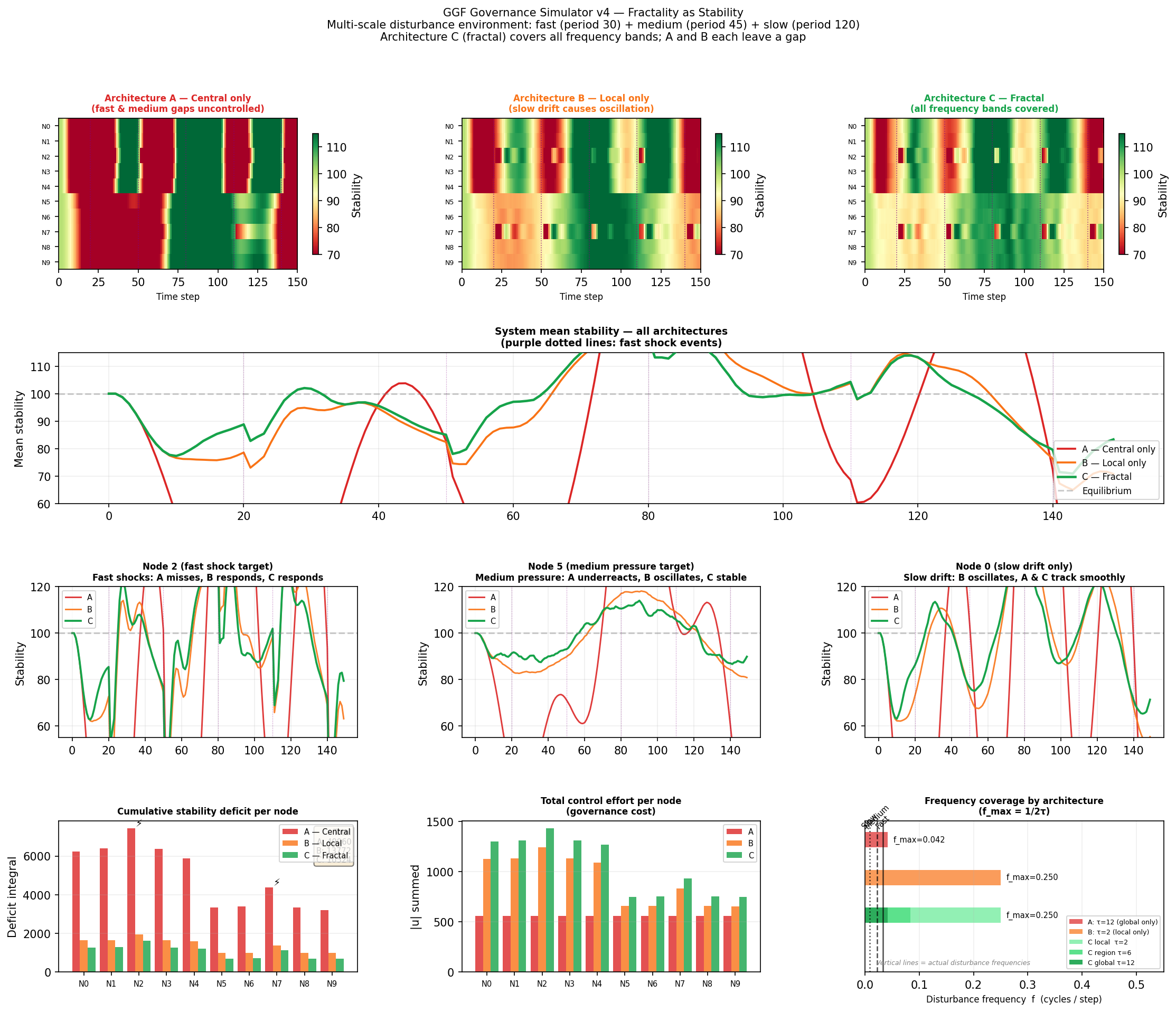
Simulation output: four rows of panels showing heatmaps, mean stability trace, representative node traces, and bottom-row metrics including deficit bars, control effort bars, and frequency coverage diagram.

Figure 1: GGF Governance Simulator v4 output. Top row: stability heatmaps for all three architectures (node × time, RdYlGn colormap, purple dotted lines mark fast shock events). Second row: system mean stability trace — Architecture A’s dramatic oscillation is attributable to high-gain corrections on an already-delayed and noise-corrupted signal. Third row: representative node traces for Node 2 (fast shock target), Node 5 (medium pressure target), and Node 0 (slow drift only), demonstrating each architecture’s characteristic failure mode. Bottom row: cumulative deficit per node, total control effort per node, and frequency coverage diagram showing the f_max = 1/(2τ) ceiling against actual disturbance frequencies.

Reading the results

Architecture A’s collapse is counterintuitive and important. With equal actuator effectiveness, the central controller is not handicapped by resource constraints. Its collapse — a stability standard deviation of 78.76 versus 20.05 for local-only and 16.52 for fractal — is attributable to its responding forcefully to a noise-corrupted, 12-step-delayed mean signal. When fast shocks arrive at nodes 2 and 7, the national mean registers a modest dip. The controller’s delayed, uniform, nationally-scaled response arrives after the shock has partially resolved and applies it across all ten nodes, including eight that needed no intervention. The pattern repeats at every fast shock event, compounding across the simulation. The same controller that is too weak for local crises is simultaneously too disruptive for nodes that were stable.

Architecture B’s oscillation on the slow band is the predicted failure mode. Node 0, which receives no fast shocks and sits in the low-medium-pressure region, should theoretically be the easiest node for Architecture B to manage. Instead, it exhibits persistent oscillation driven by the slow system-wide drift. The local controller’s high gain keeps it in constant motion around a target that is itself slowly moving. This is the lower-boundary failure: too fast and too strong for the long-period disturbance it cannot resolve.

Architecture C’s regional layer is the critical differentiator. The fractal architecture’s advantage over local-only is concentrated in the medium and slow bands. For fast shocks (Node 2), Architecture B and C perform comparably. For medium pressure (Node 5) and slow drift (Node 0), Architecture C’s regional and global layers provide the patience and spatial averaging that the local layer structurally cannot.

Quantitative summary

MetricArchitecture AArchitecture BArchitecture C
Total cumulative deficit53,43213,77211,170
Mean node stability89.696.997.6
Stability std deviation78.7620.0516.52
Total control effort3,5939,18110,263

Architecture C achieves the lowest deficit and lowest variance at the cost of modestly higher total control effort — approximately 12% more effort than local-only for a 19% reduction in deficit. The effort difference reflects the three active control layers applying simultaneous signals; in governance terms, this corresponds to the overhead of maintaining regional and global coordination infrastructure alongside local response capacity.

The cost-benefit ratio is most visible in the deficit bar chart: Architecture C’s advantage is not uniform. It is concentrated at nodes subject to medium and slow disturbances (the region 0 nodes and the nodes adjacent to fast-shock targets). At nodes primarily subject to fast shocks, Architecture B approaches C’s performance. This is consistent with the frequency-gap theorem: each architecture performs well within its natural band and fails at the boundaries.

The frequency coverage diagram

The bottom-right panel of Figure 1 makes the structural argument visually explicit. Vertical lines mark the three actual disturbance frequencies against horizontal bars showing each architecture’s f_max coverage.

Architecture A’s bar ends well before the medium and fast disturbance frequencies — both fall outside its controllable range. Architecture B’s bar extends past all three frequencies, but this overstates its capability in the slow band, where its high gain produces the oscillation described above. Architecture C’s three-layer bar shows the bands explicitly: local covers the fast range, regional covers the medium range, global covers the slow range, and together they span the full disturbance spectrum with appropriate gain at each layer.

No single bar in the diagram covers the full spectrum with appropriate gain at all frequencies. The fractal architecture is the only configuration that matches controller properties to disturbance properties across all three bands simultaneously.


Part IV: Structural observations

The simulation produces several findings that hold across parameter variations and are grounded in established control theory. They are presented here as structural results, not policy conclusions.

The frequency gap is not closable by tuning

The most important finding is negative: there is no parameter setting for a single-scale architecture that closes its frequency gap. Increasing the gain of a centralized controller beyond its latency ceiling causes instability rather than improved high-frequency response. Reducing the gain of a local-only controller to prevent slow-band oscillation simultaneously reduces its fast-shock response below the level needed for effective stabilization. The gap is topological, not parametric.

This matters because the intuitive governance response to underperformance is usually to adjust parameters: increase funding, reform procedures, add oversight, recruit better personnel. These interventions address the parametric space. They leave the topological constraints untouched. A centralized institution with τ = 12 that receives additional resources and better leadership remains a centralized institution with τ = 12. Its frequency gap persists.

Architectural reform — changing the latency structure, the information pathways, and the distribution of decision authority — addresses the topological constraints. Parameter reform does not.

The layers are complementary, not redundant

A natural concern about fractal architecture is that multiple control layers represent costly redundancy: local, regional, and global controllers all doing variations of the same thing. The simulation demonstrates that this is not the case. Each layer handles a frequency band that the others structurally cannot.

If the local layer is removed from Architecture C, medium and slow disturbances are handled but fast shocks produce exactly the response pattern seen in Architecture A — delayed, uniform, under-powered at the crisis nodes. If the global layer is removed, fast and medium disturbances are handled but the slow drift produces the oscillation pattern seen in Architecture B. Each removal opens a frequency gap. The layers are not doing variations of the same thing; they are doing qualitatively different things that happen to share the same formal structure.

This has a governance implication that runs counter to common institutional reform arguments. Proposals to eliminate redundant layers of government — to streamline by removing regional tiers, for instance — may be removing a layer that handles a frequency band that neither the layer above nor the layer below can reach. The apparent redundancy is a misidentification: what looks redundant from a political science perspective is functionally necessary from a control-theoretic one.

Architecture A’s instability is produced by its own corrections

A striking feature of Architecture A’s results is that its worst performance occurs not during fast shock events — when its latency prevents timely response — but in the periods immediately following those events, when its delayed response arrives and interacts with a system state that has already partially recovered.

This is not coincidental. The centralized controller computes its correction signal based on the system mean at time t, applies it at time t + 12, and the system mean has moved in the interim. When fast shocks depress nodes 2 and 7 at t = 20, the controller registers a modest national dip and begins preparing a nationally-broadcast response. By t = 32, the fast shock has partially resolved through natural decay and the (absent) local response would have begun recovery. The centralized correction then arrives — uniform across all ten nodes, sized for the magnitude observed at t = 20 — into a system that has partially self-corrected. It over-corrects. The over-correction is then observed at t + 12 and corrected in turn, generating an oscillation that is produced entirely by the controller’s own interventions.

This is the formal phenomenon known as hunting: a controller that is persistently out of phase with the system it governs generates endogenous oscillation independent of external disturbances. Architecture A’s instability in the simulation is substantially self-generated. The disturbances are the trigger; the oscillation is the controller’s own response to its own responses.

Coupling amplifies architecture-specific failure modes

The coupling term (β = 0.02) models crisis contagion between adjacent nodes. Its interaction with each architecture’s failure mode is instructive.

Under Architecture A, the fast shocks at nodes 2 and 7 propagate to adjacent nodes before the delayed central response arrives, increasing the number of affected nodes at the moment of intervention. The uniform correction must now address a larger affected area, which amplifies the over-correction problem.

Under Architecture B, coupling is not the primary problem — local controllers respond before contagion has time to develop. The coupling term instead amplifies the slow-drift oscillation: as some nodes begin to oscillate out of phase with the drift, their coupling to neighbors transmits phase errors, gradually desynchronizing the network and producing increased variance.

Under Architecture C, coupling is managed at the appropriate scale. Fast contagion is contained by local controllers before it reaches neighbors. Regional coupling effects are absorbed by the regional layer. Slow coupling — the gradual drift of the full system — is tracked by the global layer. The fractal architecture effectively matches its containment response to the spatial scale of the contagion, rather than applying a single containment strategy to all scales simultaneously.

The control effort differential is informative

Architecture C requires approximately 12% more total control effort than Architecture B and approximately 185% more than Architecture A. This cost deserves honest treatment.

The effort differential between C and B reflects the overhead of maintaining three active control layers simultaneously. In governance terms, this corresponds to the institutional cost of regional and global coordination infrastructure — the administrative layers that local institutions do not require. This is a real cost, not an artefact of the model.

The effort differential between C and A reflects something different. Architecture A’s low effort is not efficiency — it is inadequacy. A controller that does not respond to fast and medium disturbances uses very little control effort because it is not doing the work. Low effort in a system facing multi-scale disturbances is a symptom of failure, not a feature of design. The stability deficit data confirms this: Architecture A’s low effort produces the highest deficit by a factor of nearly five.

The appropriate metric is not control effort in isolation but deficit per unit effort — stability achieved per unit of governance cost. By this measure, Architecture C outperforms both alternatives.

Fractal stability is sensitive to protocol integrity

The fractal architecture’s performance depends on each layer operating within its natural frequency band and not interfering with adjacent layers. In the simulation, this is enforced by design: the gain values and latencies prevent any layer from operating outside its bandwidth.

In real governance systems, this constraint is not automatically enforced. A local council that attempts to manage slow secular trends through high-frequency interventions introduces the oscillation problem regardless of what the regional and global layers are doing. A global institution that attempts to manage local crises with uniform policies introduces the averaging problem regardless of local institutional quality.

The stability of fractal architecture requires protocol integrity: each layer must remain within its natural scope. This is not a normative preference for subsidiarity. It is a stability requirement. A fractal architecture whose layers violate their bandwidth boundaries degrades toward the failure modes of whichever single-scale architecture their violations most resemble.

This gives a precise technical meaning to the concept of subsidiarity: not that local is always better, but that each scale should handle what its latency and signal fidelity allow it to handle, and not attempt to handle what they do not.


Part V: Limitations

The disturbance timescales are illustrative

The three disturbance periods chosen — 30, 45, and 120 time steps — are selected to produce clear analytical separation between the frequency bands. They are not derived from empirical measurement of actual governance disturbance frequencies. Real governance systems face disturbances with messier, overlapping, and context-dependent timescales.

The gap between a fast crisis (days) and a slow secular trend (decades) in real governance is far larger than the ratio of periods in this simulation. This means the frequency separation is actually more pronounced in practice than the model suggests — which strengthens the core argument — but it also means the specific controller parameters used here cannot be directly applied to real institutional design without empirical calibration. Appendix C provides a reference table of estimated real-world disturbance timescales for governance contexts.

The three-scale model undercounts real governance layers

The simulation uses three scales: local, regional, and global. Real governance systems contain more gradations: individual, household, neighborhood, municipality, county, region, nation-state, continental bloc, global institution. The control-theoretic logic generalizes to any number of layers, but the optimal number of layers for a given system depends on the actual frequency spectrum of its disturbance environment — which is an empirical question the model does not address.

The three-scale model is the minimal demonstration of the principle. It shows that single-scale architectures leave frequency gaps and that multi-scale architectures close them. It does not prescribe the correct number of governance scales for any specific context.

The layers have clean frequency separation; real systems do not

The model assumes that each disturbance type operates within a well-defined frequency band, allowing clean layer assignment. Real disturbances are correlated across scales. The 2008 financial crisis began as a fast local shock in the US mortgage market, propagated through medium-term credit mechanisms, and produced slow-moving long-term effects on debt structures and institutional trust. It was simultaneously a fast, medium, and slow disturbance.

When disturbances are correlated across scales, the layer assignment problem becomes non-trivial. A disturbance that enters the fast band but cascades into the slow band requires coordinated response across layers — which the fractal architecture supports, but which the model does not explicitly demonstrate. The cross-scale cascade scenario is a significant extension warranted by future work.

The model is linear and time-invariant

As in paper one, the state transition equation is linear and the parameters are fixed throughout the simulation. Real governance systems exhibit nonlinear dynamics — threshold effects, hysteresis, path dependence — and their parameters change over time as institutions adapt. The fractal architecture result holds in the linear regime near equilibrium; its robustness under strongly nonlinear conditions is not demonstrated here.

Of particular concern for the fractal architecture specifically: the gain values at each layer are calibrated for stable operation near the equilibrium x_ref = 100. Under large shocks that drive the system far from equilibrium, the linear gain relationships may not hold, and interactions between layers may produce emergent dynamics not captured by the additive model. This is the principal area where nonlinear extension would most change the results.

Equal actuator effectiveness is a simplifying assumption

Setting B = 1.0 for all three layers ensures that performance differences are attributable to architecture alone. In reality, governance actuators at different scales have different effectiveness: local emergency response may be highly effective for its specific disturbance type, while global monetary policy instruments are blunt by necessity. The equal-actuator assumption understates the case for local control (which typically has higher actuator precision) and overstates the case for global control (which typically has lower). Differential actuator modelling would strengthen the fractal architecture result further, but at the cost of introducing additional parameters that require empirical justification.

The regional layer boundaries are fixed

In the simulation, nodes 0–4 and nodes 5–9 constitute fixed regions throughout. Real governance regions are not fixed: the appropriate regional grouping for managing a health crisis may differ from the appropriate grouping for managing an economic pressure or an environmental disturbance. Adaptive regional boundaries — where the regional layer’s scope reconfigures in response to the spatial distribution of the current disturbance — are not modelled. This is a meaningful extension, as one of the genuine advantages of fractal governance over fixed administrative hierarchy is the potential for variable-geometry coordination at intermediate scales.

The model does not capture democratic legitimacy

The performance metrics — deficit, variance, control effort — are purely stability-theoretic. They do not address questions of democratic legitimacy, accountability, or consent. A governance architecture that is stability-optimal in this framework could be deeply illegitimate if its institutions are not accountable to the populations they govern.

This is the correct scope for a technical paper, but it is worth stating clearly: the engineering argument demonstrates that fractal architecture is stability-optimal, not that any particular fractal governance arrangement is legitimate. The normative questions — who governs, with what mandate, subject to what accountability — remain irreducibly political. The engineering argument is a constraint on the solution space, not a solution.


Part VI: Implications

The two papers together constitute a formal foundation

Taken together, the two papers in this series establish two distinct but related results. Paper one demonstrated the subsidiarity principle: that localized disturbances are handled better by low-latency, high-fidelity local controllers than by high-latency centralized ones, because aggregation destroys spatial information. Paper two demonstrates the fractality principle: that multi-scale disturbance environments require multi-scale control architectures, because no single-scale controller can cover the full frequency spectrum of real governance challenges.

Subsidiarity tells us where decision authority should sit for local matters. Fractality tells us why multiple scales of authority must coexist and what each scale is legitimately responsible for. Together they constitute a formal justification for tiered governance — not as a political preference for decentralization, but as a structural requirement for stability in complex multi-scale systems.

The question of what global governance is for

The fractality result gives a precise and perhaps surprising answer to a question that has been contested since the emergence of international institutions: what is global governance for?

The standard answers are normative — global governance exists to protect universal human rights, to coordinate global public goods, to constrain the externalities of nation-state behavior. These are genuine functions, but they are contested precisely because they are normative.

The control-theoretic answer is structural: global governance exists to stabilize frequency bands that no lower scale can reach. Disturbances that are too slow and spatially diffuse for any national institution to perceive and respond to in time — secular climate shifts, long-run demographic transitions, slow-moving systemic financial risks — are structurally invisible to local and national controllers. Global institutions exist because these disturbances are real and because their stabilization requires a controller with the latency, spatial scope, and signal aggregation that only a global layer provides.

This framing has a clarifying corollary: global institutions that attempt to manage fast local crises, or that apply uniform global policies to spatially diverse local conditions, are operating outside their natural bandwidth. They are not doing global governance; they are doing bad local governance at global scale. The frequency gap theorem defines the legitimate scope of global authority not by normative claim but by structural necessity.

Why institutional reform often disappoints

A persistent observation in public administration is that institutional reforms — reorganizations, consolidations, devolutions, new oversight mechanisms — frequently fail to produce the performance improvements their designers anticipated. The engineering framing offers a structural explanation.

Most institutional reform operates in the parametric space: it changes who fills roles, what procedures are followed, how resources are allocated, what oversight mechanisms apply. These are important changes, but they do not alter the fundamental latency and signal fidelity structure of the institution. A centralized ministry that is reorganized, restaffed, and given a new mandate remains a centralized ministry with τ = 12. Its frequency gap persists. Its performance against fast and medium disturbances remains structurally constrained.

Reforms that produce durable performance improvements tend to be architectural: they change where decisions are made, how information flows, and what the decision latency is for different classes of problems. Devolution that genuinely reduces the latency from crisis to response improves performance for the reasons this paper demonstrates. Devolution that moves nominal authority without moving actual decision latency — where local administrators still require central approval before acting — does not.

The internet and the nervous system as governance existence proofs

The fractal architecture described in this paper is not hypothetical. It has been independently discovered by evolution and by engineering in every context that requires multi-scale stability.

The human nervous system evolved a three-layer fractal control architecture — spinal, subcortical, cortical — over hundreds of millions of years. The selection pressure was straightforward: organisms with single-scale neural control either responded too slowly to fast threats or expended too much neural resource on slow trends. The fractal architecture won because it was more stable across the full frequency spectrum of environmental disturbance.

The internet was designed as a fractal hierarchy not because its architects preferred distributed structures but because the alternative — centralized routing for global packet traffic — produces latency that makes real-time communication impossible. The edge-to-backbone hierarchy matches controller properties to disturbance timescales in exactly the way this paper models.

These are not analogies. They are existence proofs: evidence that the fractal control architecture is achievable, stable, and superior to single-scale alternatives under real-world conditions. The governance claim is not that human institutions should imitate nervous systems by preference. It is that the same control-theoretic constraints apply to both, and the same architectural solution follows.

The complexity ceiling and what lies beyond it

There is a limit to how much complexity any governance architecture can absorb, regardless of how well-matched its control layers are. Ashby’s Law of Requisite Variety states that a controller must possess at least as much variety as the system it governs. Fractal architecture increases the total variety of the governance system by distributing control — but the total variety of the governed system may grow faster than any realistic expansion of the governance system’s variety can track.

This is the honest boundary condition of the framework. Fractal architecture is stability-optimal within the range of tractable governance. Beyond a certain complexity threshold — in systems where the number and diversity of simultaneous disturbances exceeds the combined variety of all governance layers — no architecture can guarantee stability. The fractal architecture extends that boundary further than any alternative, but does not eliminate it.

What lies beyond the boundary is the domain of resilience rather than control: accepting that some disturbances cannot be stabilized, and designing for graceful degradation and rapid recovery rather than prevention. This is a distinct design problem that the current framework does not address but that the boundary condition points toward.

From governance theory to institutional design

The simulation produces abstract results about controller architectures. Translating those results into concrete institutional design guidance requires empirical work that this paper does not provide. But the framework suggests several specific questions that empirical governance research could address using this framework’s vocabulary.

What is the actual latency distribution in specific governance systems — from crisis onset to policy implementation — at local, regional, and national levels? What frequency bands of disturbance do existing institutions demonstrably handle well, and where do the frequency gaps appear in practice? What is the signal fidelity of information as it travels from local observation to national policy? These are measurable quantities, and measuring them would transform the framework from an illustrative simulation to an empirically grounded diagnostic tool.

The Swedish municipal crisis management pilots referenced in the companion GGF work represent one empirical test case: a context where local decision authority has been increased, latency has been reduced by design, and performance can be tracked against historical baselines. The framework developed here provides a language for interpreting what those results mean structurally, rather than attributing outcomes to the particular choices of particular administrators.


Part VII: Conclusion

The argument this paper makes is precise and bounded.

It does not claim that all governance should be local, or that global institutions are illegitimate, or that any particular political arrangement is preferable. These would be normative claims that control theory cannot adjudicate.

The claim is structural: in systems subject to simultaneous disturbances across multiple timescales, no single-scale controller can cover the full frequency spectrum of those disturbances. This follows from the relationship between a controller’s response latency and the maximum disturbance frequency it can stabilize. It is a mathematical result, not a political one.

The corollary is equally precise: fractal architectures — nested hierarchies of controllers matched to the timescale of their respective disturbance bands — are the stability-optimal response to multi-frequency disturbance environments. Not because distributed governance is philosophically appealing, but because the alternative architectures leave frequency gaps that no parameter adjustment can close.

The simulation makes this visible. Architecture A’s dramatic collapse — producing five times the stability deficit of the fractal architecture despite equal actuator resources — is not a failure of competence or resources. It is the predictable consequence of asking a controller with τ = 12 to respond to disturbances with periods of 30 and 45 time steps. Architecture B’s persistent oscillation in the slow band is not a calibration failure. It is the predictable consequence of asking a high-gain, low-latency controller to track a trend it cannot distinguish from a local perturbation. Both failure modes are structural. Both are avoided by matching controller properties to disturbance timescales at each scale.

This result sits in a long intellectual tradition. Ashby’s Law of Requisite Variety established in 1956 that controllers must match the complexity of their systems. Shannon’s channel capacity theorem established that information transmission has fundamental limits set by channel properties, not by encoder quality. Beer’s Viable System Model proposed that viable organizations must implement recursive hierarchical control. What this paper adds is a simulation that makes these results quantitatively visible in a governance context, using parameters explicit enough to reproduce and challenge.

The nervous system, the immune system, and the internet did not arrive at fractal architecture through political philosophy. They arrived at it through selection pressure and engineering necessity. The governance implication is not that human institutions should mimic biological systems by preference. It is that the same constraints apply: systems that must stabilize disturbances across many timescales are subject to the same frequency-latency relationship, and the same architectural solution follows.

What remains to be done is the harder work: translating formal results into empirical measurements, calibrating the framework against real governance data, and extending the model to the nonlinear, adaptive, and cross-scale dynamics that lie outside the current simulation’s scope. The framework is a starting point, not a conclusion.

The people who first formalized these ideas — Wiener, Ashby, Beer, Shannon, Meadows — understood that they were doing something more than engineering. They were trying to find a language in which the structural requirements of viable complex systems could be made precise: not to win arguments, but to make certain kinds of architectural mistakes harder to make by accident.

That project remains unfinished. The governance challenges of the coming decades — climate, demographic transition, technological disruption, institutional erosion — will require governance systems capable of responding simultaneously across fast, medium, and slow timescales. Whether those systems will be architecturally capable of meeting that challenge is a question the engineering framing can help answer. This paper is a small contribution toward that answer.


Appendix A: Mathematical formulations

Multi-scale state transition equation

The state of node i at time t+1 is given by:

x_i(t+1) = A · x_i(t)
           + β · Σ_{j ∈ neighbours(i)} (x_j(t) − x_i(t))
           + B · u_local,i(t − τ_l)
           + B · u_regional,r(i)(t − τ_r)
           + B · u_global(t − τ_g)
           + d_i(t)
           + drift

Where drift = x_ref · (1 − A) maintains equilibrium in the absence of disturbance, and r(i) denotes the region containing node i.

Observation equations

Each control layer observes a different aggregation of the true state, with noise scaled to its scope:

y_local,i(t)    = x_i(t)           + ε_l,i     ε_l ~ N(0, σ_l²)
y_regional,r(t) = mean(x_region_r) + ε_r        ε_r ~ N(0, σ_r²)
y_global(t)     = mean(x(t))       + ε_g        ε_g ~ N(0, σ_g²)

Signal fidelity degrades with spatial scope: σ_l < σ_r < σ_g. The regional and global observations are regional and system-wide means respectively, which introduces aggregation loss in addition to measurement noise — the same spatial information destruction demonstrated in paper one.

Control laws

All three layers use proportional feedback control of identical form:

u_local,i(t)    = K_l · (x_ref − y_local,i(t))
u_regional,r(t) = K_r · (x_ref − y_regional,r(t))
u_global(t)     = K_g · (x_ref − y_global(t))

The control signals are computed at time t and applied at time t + τ (dead-time integration). The delayed signals are stored in history buffers and retrieved at the appropriate offset.

The frequency-latency constraint

For a discrete-time dead-time dominant system, the maximum controllable disturbance frequency is:

f_max ≈ 1 / (2 · τ)

This follows from the Nyquist-Shannon sampling theorem applied to the control loop: a controller that samples and acts with period τ cannot resolve disturbances with period less than 2τ. Attempting to respond to such disturbances produces phase-reversed interventions that amplify rather than dampen the disturbance.

Controllerτf_maxHandles disturbances with period >
Global / central120.04224 steps
Regional60.08312 steps
Local20.2504 steps

Stability ceiling on controller gain

For each layer, the maximum safe gain is approximated by:

K_max ≈ 1 / (τ · |A|)

Where |A| = 0.95 is the natural decay coefficient. This constraint is tighter under coupling (β > 0) and under correlated disturbances; the values below represent conservative operating points well within the stability margin:

LayerτK_maxK usedMargin
Local20.5260.4024% below ceiling
Regional60.1750.1514% below ceiling
Global120.0880.0720% below ceiling

Coupling term

Adjacent nodes are coupled by a diffusion term:

coupling_i(t) = β · Σ_{j ∈ {i-1, i+1}} (x_j(t) − x_i(t))

With β = 0.02 and nearest-neighbor topology (boundary nodes have one neighbor). This models crisis contagion: instability at one node exerts pressure on adjacent nodes proportional to the state differential.

Disturbance model

The composite disturbance at node i and time t is:

d_i(t) = d_fast,i(t) + d_medium,i(t) + d_slow(t)

Fast component (impulse at crisis nodes):

d_fast,i(t) = M_fast  if i ∈ {2, 7} and (t − 20) mod P_fast = 0 and t ≥ 20
            = 0        otherwise

With M_fast = −35, P_fast = 30.

Medium component (sinusoidal pressure on region 0):

d_medium,i(t) = −A_med · sin(2π · t / P_med)  if i ∈ {0,1,2,3,4}
              = 0                                otherwise

With A_med = 12, P_med = 45.

Slow component (system-wide secular drift):

d_slow(t) = −A_slow · sin(2π · t / P_slow)

With A_slow = 8, P_slow = 120.

Performance metrics

Cumulative stability deficit for node i (post-warmup):

D_i = Σ_{t=W}^{T} max(0, x_ref − x_i(t))

Where W = 10 is the warmup period discarded from measurement.

Total control effort for node i:

E_i = Σ_{t=W}^{T} |u_total,i(t)|

Where u_total,i is the sum of all control contributions to node i.

Deficit per unit effort (stability efficiency):

η = D_total / E_total

Lower η indicates better stability per unit of governance cost.

Full simulation parameters

ParameterValueNotes
N10Number of nodes
T150Time steps
x_ref100.0Target equilibrium
A0.95Natural decay coefficient
B1.0Actuator effectiveness (all layers)
β0.02Coupling coefficient
Warmup W10Steps excluded from metrics
τ_local2Local controller latency
τ_regional6Regional controller latency
τ_global12Global / central controller latency
σ_local0.5Local observation noise std dev
σ_regional2.0Regional observation noise std dev
σ_global5.0Global observation noise std dev
K_local0.40Local controller gain
K_regional0.15Regional controller gain
K_global0.07Global controller gain
Fast magnitude−35.0Impulse shock magnitude
Fast period30Steps between fast shocks
Fast nodes7Nodes subject to fast shocks
Medium amplitude12.0Sinusoidal pressure amplitude
Medium period45Medium disturbance period
Medium nodes4Region 0 nodes
Slow amplitude8.0Secular drift amplitude
Slow period120Slow disturbance period
Random seed42For reproducibility

Appendix B: Code and reproduction

Source code

The v4 simulator extends the v3 codebase from paper one to a multi-scale disturbance environment and three-architecture comparison. It is implemented in Python using NumPy and Matplotlib. No dependencies beyond the standard scientific Python stack are required.

The full source code is available at:

github.com/BjornKennethHolmstrom/ggf-governance-simulator

The repository includes all simulator versions in sequence:

FilePaperDescription
ggf-simulator-v2.pyPaper 1Single-node scalar model
ggf-simulator-v3.pyPaper 1Ten-node vector model, localized shock
ggf-simulator-v3-unadjusted.pyPaper 1v3 with unstable K_B — instability demonstration
ggf-simulator-v4.pyPaper 2Multi-scale disturbance, three-architecture comparison

Reproducing the results

With Python 3.8+ and NumPy/Matplotlib installed:

git clone https://github.com/BjornKennethHolmstrom/ggf-governance-simulator
cd ggf-governance-simulator
pip install numpy matplotlib
python ggf-simulator-v4.py

The simulation is seeded for reproducibility (numpy.random.default_rng(seed=42)). Running with default parameters exactly reproduces Figure 1 and the quantitative summary table in Part III.

Key architectural differences from v3

v4 introduces three substantive extensions beyond the v3 multi-node model:

Multi-scale disturbance model. v3 uses a single instantaneous shock. v4 superimposes three simultaneous disturbance types — impulse (fast), sinusoidal regional (medium), and sinusoidal global (slow) — generating a composite disturbance environment that cannot be fully stabilized by any single-scale controller.

Three control architectures. v3 compares two architectures (centralized, distributed). v4 compares three: centralized (A), local-only (B), and fractal multi-scale (C). The three-way comparison makes visible both the high-frequency failure of centralized control and the slow-band oscillation failure of local-only control.

Multi-layer control signal accumulation. In Architecture C, three control signals are computed and applied simultaneously, each with its own latency buffer. The state transition sums all three contributions additively, with each layer’s signal retrieved from its own history at the appropriate dead-time offset.

Modifying the parameters

All disturbance and controller parameters are defined at the top of the script with inline documentation. The parameters most worth varying for exploration:

Disturbance periods (FAST_PERIOD, MEDIUM_PERIOD, SLOW_PERIOD): changing these shifts the disturbance frequencies relative to each architecture’s f_max ceiling. Setting FAST_PERIOD = 50 moves the fast disturbance into the range Architecture A can partially handle; setting it to 10 makes it unresolvable by any architecture.

Actuator effectiveness (B_l, B_r, B_g): currently equal at 1.0 by design. Setting B_g = 0.6 models a less effective global actuator, which is arguably more realistic but introduces the confound that paper one’s authors intentionally avoided.

Coupling coefficient (beta): increasing this beyond 0.05 produces rapid contagion that overwhelms local containment; decreasing it toward 0 removes the contagion dynamic and makes each node’s behaviour more independent.

Regional boundaries (REGIONS): the current 5/5 split can be changed to unequal regions or more than two regions to test whether regional boundary design affects performance.

Instability exploration

Setting K_l = 0.55 (above the stability ceiling for τ_l = 2) produces oscillatory instability in Architecture B and the local layer of Architecture C. This reproduces the v3-unadjusted result at the local scale and demonstrates that the gain ceiling applies at every layer of the fractal hierarchy, not only at the global level.

Contributing

Extensions, critiques, and applications to specific governance contexts are welcome via the repository. The most valuable extensions from the authors’ perspective are: empirical calibration of disturbance timescales against real governance data, nonlinear dynamics extensions, and adaptive regional boundary modelling.

The repository is open source under MIT license.


Appendix C: Disturbance timescale reference table

The simulation uses illustrative disturbance periods (30, 45, and 120 time steps) selected for analytical clarity rather than empirical calibration. This appendix provides estimated real-world timescales for governance-relevant disturbances, organized by frequency band. These estimates are drawn from the literature identified through the AI-mediated research process described in Appendix D; they are indicative rather than authoritative and are provided to support the translation from simulation parameters to real institutional design contexts.

Where a time step in the simulation corresponds to one week of real governance time, the simulation’s 150-step run represents approximately three years — a reasonable planning horizon for municipal crisis management. The parameter relationships (fast period ≈ 30 steps, medium ≈ 45 steps, slow ≈ 120 steps) would then correspond to roughly 7 months, 10 months, and 2.3 years respectively — plausible for the disturbance types described below.


Fast disturbances (days to weeks)

These disturbances demand response faster than most national policy cycles can deliver. They are the primary argument for genuine local decision authority with minimal approval latency.

Disturbance typeTypical onset-to-peakNotes
Acute crime wave / civil unrest1–7 daysRequires local law enforcement autonomy; national policy response arrives after peak
Local supply chain disruption3–14 daysFood, fuel, medical supply shortages at municipal level
Acute public health outbreak3–21 daysEarly containment window closes within days; national declaration typically lags by 1–3 weeks
Flash flooding / acute weather eventHours–7 daysEmergency response must be pre-positioned; central authorization is too slow
Local infrastructure failure1–14 daysPower, water, transport outages; repair decisions must be made locally
Sudden displacement event1–14 daysRefugee influx, evacuation; reception capacity decisions are local

Estimated governance latency to response under centralized architecture: 2–8 weeks (crisis detection, escalation, political decision, budget allocation, implementation). Under local architecture with pre-authorized response protocols: 1–5 days.


Medium disturbances (months to two years)

These disturbances operate at the scale of annual budget cycles and regional economic dynamics. They are too persistent to treat as emergencies and too fast for slow national policy instruments to track effectively without regional intermediaries.

Disturbance typeTypical durationNotes
Seasonal unemployment fluctuation3–9 monthsRegional labor market dynamics; national averages mask regional variation
Regional housing market pressure6–24 monthsLocal supply/demand imbalance; national housing policy adjusts too slowly and too uniformly
Epidemic wave (endemic, recurring)2–6 monthsAnnual influenza, COVID seasonal waves; regional variation in severity requires regional response calibration
Regional infrastructure deterioration6–36 monthsAccumulated deferred maintenance; regional visibility before national statistical signal
Municipal fiscal stress6–24 monthsRevenue-expenditure imbalance building over budget cycles; visible at municipal level before national
Agricultural/environmental seasonal pressure3–12 monthsDrought, crop failure, flood cycle; regional visibility, regional response

Estimated governance latency under regional architecture: 1–3 months (regional monitoring, regional executive decision, regional budget reallocation). Under national-only architecture: 6–18 months from regional signal to national policy implementation.


Slow disturbances (years to decades)

These disturbances are structurally invisible to local controllers and require the long temporal averaging that only a global or national layer with broad spatial scope can provide. They constitute the legitimate domain of slow, high-latency global governance.

Disturbance typeTypical timescaleNotes
Secular demographic shift10–30 yearsPopulation aging, urbanization, fertility trends; only visible in aggregated long-run statistics
Long-run labor market transformation5–20 yearsAutomation displacement, sectoral transition; no local signal until crisis is advanced
Cumulative ecological degradation10–50 yearsBiodiversity loss, soil depletion, aquifer drawdown; sub-threshold locally, critical globally
Climate change baseline shift20–100 yearsTemperature, precipitation pattern change; requires multi-decadal data aggregation to distinguish from natural variance
Institutional trust erosion10–30 yearsDeclining civic participation, rising anti-institutional sentiment; slow-moving, system-wide
Long-run debt accumulation10–30 yearsStructural fiscal imbalance building across political cycles; national and supranational visibility
Technological infrastructure transition10–20 yearsEnergy system, transport, communication network transitions; require long-horizon coordination beyond any single jurisdiction

Estimated governance latency for detection and response under global/national architecture: 3–10 years from trend onset to coordinated policy response. This is appropriate for disturbances with decade-scale periods; it is structurally too slow for disturbances in the fast or medium bands.


Mapping simulation parameters to real timescales

If one simulation time step represents one week:

SimulationStepsReal timeAppropriate governance layer
Fast disturbance period30~7 monthsLocal
Medium disturbance period45~10 monthsRegional
Slow disturbance period120~2.3 yearsNational / global
Local controller latency τ_l = 22~2 weeksMunicipal executive decision
Regional controller latency τ_r = 66~6 weeksRegional government decision cycle
Global controller latency τ_g = 1212~3 monthsNational / supranational policy cycle

If one simulation time step represents one month:

SimulationStepsReal timeAppropriate governance layer
Fast disturbance period30~2.5 yearsRegional
Medium disturbance period45~3.75 yearsNational
Slow disturbance period120~10 yearsGlobal
Local controller latency τ_l = 22~2 monthsRegional executive decision
Regional controller latency τ_r = 66~6 monthsNational policy cycle
Global controller latency τ_g = 1212~1 yearSupranational coordination

The model is scale-invariant in this sense: the structural relationships hold regardless of the absolute timescale, provided the ratios between disturbance periods and controller latencies are preserved. What matters is not the absolute speed of governance but whether the governance architecture matches the frequency spectrum of the disturbances it faces.


A note on empirical calibration

The values in this table are estimates assembled from general knowledge of governance and policy timescales. Rigorous empirical calibration — measuring actual latency distributions in specific governance systems, tracking real disturbance onset-to-peak timescales across crisis types — would significantly strengthen the framework’s applicability to institutional design.

This calibration work is tractable. Crisis response datasets, policy implementation records, and administrative decision logs contain the latency data required. The disturbance timescale data is available in epidemiological, economic, and environmental monitoring records. The primary barrier is not data availability but the absence of a standard analytical framework for organizing and interpreting that data in control-theoretic terms — which is precisely what this paper proposes to provide.


Appendix D: References and sources

A note on methodology

As with paper one in this series, the concepts developed here were arrived at through extended dialogue with multiple AI systems — Claude (Anthropic), ChatGPT (OpenAI), Gemini (Google), DeepSeek, and Grok (xAI) — rather than through direct reading of the primary literature. The references below are the sources those systems identified as foundational to the ideas discussed, and are provided for readers who wish to engage with the primary literature directly.

The specific contribution of this paper — the frequency-latency framing of fractal governance, the multi-scale simulator, and the frequency gap theorem as applied to institutional design — emerged from this human-AI collaborative process. The underlying mathematics belongs to an established scientific tradition that predates this work by decades. The application is new; the tools are not.


Control theory and systems engineering

Åström, K. J., & Murray, R. M. (2008). Feedback Systems: An Introduction for Scientists and Engineers. Princeton University Press. Available freely at: http://www.cds.caltech.edu/~murray/amwiki

The foundational reference for the control theory applied throughout both papers. Chapters on frequency-domain analysis, dead-time systems, and stability margins are directly applicable to the governor gain ceiling and f_max derivations.

Franklin, G. F., Powell, J. D., & Emami-Naeini, A. (2019). Feedback Control of Dynamic Systems. 8th ed. Pearson.

Standard control engineering textbook. Reference for the Nyquist stability criterion and the relationship between sampling rate, dead-time, and controllable frequency bandwidth.

Ogata, K. (2010). Modern Control Engineering. 5th ed. Prentice Hall.

Provides derivations of the discrete-time stability conditions and gain margin analysis used in the parameter calibration for all four simulator versions.

Skogestad, S., & Postlethwaite, I. (2005). Multivariable Feedback Design. 2nd ed. Wiley.

The multi-input multi-output (MIMO) extension of control theory directly relevant to the multi-layer fractal controller. The additive decomposition of control signals by layer follows the decentralized control framework developed here.


Cybernetics and systems theory

Wiener, N. (1948). Cybernetics: Or Control and Communication in the Animal and the Machine. MIT Press.

The founding text. Wiener’s treatment of feedback in biological and social systems, and his discussion of the limits imposed by communication latency and noise, is the intellectual origin of both papers in this series.

Ashby, W. R. (1956). An Introduction to Cybernetics. Chapman and Hall. Available freely at: http://pcp.vub.ac.be/books/IntroCyb.pdf

Contains the formal statement of the Law of Requisite Variety, which underlies the argument that fractal architectures are necessary for governing high-variety systems. The variety analysis in Chapter 11 is directly applicable to the multi-scale control problem.

Beer, S. (1972). Brain of the Firm. Allen Lane.

Beer’s Viable System Model (VSM) is the most direct governance precedent for the fractal control architecture described here. The VSM’s recursive structure — each viable system containing five sub-systems, each of which is itself a viable system — is the organizational implementation of the fractal control principle.

Beer, S. (1981). Brain of the Firm. 2nd ed. Wiley.

The revised and extended edition. Beer’s discussion of the algedonic channel (fast local crisis signal that bypasses the normal hierarchy) is a precise governance analogue of the local fast-response layer in Architecture C.

Beer, S. (1979). The Heart of Enterprise. Wiley.

Develops the VSM in greater institutional depth. The treatment of System 1 (operational units), System 3 (optimization), System 4 (environmental scanning), and System 5 (policy) maps closely onto the local, regional, and global layers of the fractal simulator.


Information theory

Shannon, C. E., & Weaver, W. (1949). The Mathematical Theory of Communication. University of Illinois Press.

The channel capacity theorem establishes that information transmission has fundamental limits set by channel bandwidth and noise — limits that cannot be overcome by improved encoding. The signal fidelity degradation with aggregation and distance modelled in both simulators is a direct application of Shannon’s framework.

Cover, T. M., & Thomas, J. A. (2006). Elements of Information Theory. 2nd ed. Wiley.

The comprehensive modern treatment of information-theoretic limits. The data processing inequality — that aggregation cannot increase information — is the formal basis for the claim that centralized controllers operating on aggregated signals are operating on an irreversibly degraded representation of local reality.


Multi-scale systems and complexity

Simon, H. A. (1962). The architecture of complexity. Proceedings of the American Philosophical Society, 106(6), 467–482.

Simon’s argument that nearly decomposable hierarchical systems are the stable architectural form for complex adaptive systems is a direct precursor to the fractal governance argument. His observation that hierarchical systems are both more evolvable and more robust than flat architectures anticipates the frequency-gap theorem.

Levin, S. A. (1992). The problem of pattern and scale in ecology. Ecology, 73(6), 1943–1967.

The foundational paper on multi-scale dynamics in ecological systems. Levin’s argument that no single scale of observation is privileged — that patterns at one scale are produced by processes at other scales — provides the ecological grounding for the multi-frequency disturbance model.

Mandelbrot, B. B. (1982). The Fractal Geometry of Nature. W. H. Freeman.

Mandelbrot’s formalization of fractal self-similarity in natural systems. The self-similar structure of fractal governance architectures — the same control logic applied at each scale with matched parameters — is a direct application of this concept to institutional design.

Holland, J. H. (1995). Hidden Order: How Adaptation Builds Complexity. Addison-Wesley.

On the emergence of multi-scale structure in complex adaptive systems. Holland’s analysis of why adaptive systems develop hierarchical organization is the evolutionary argument for why fractal control converges across biological and engineered systems.


Biological and engineering analogues

Kandel, E. R., Schwartz, J. H., & Jessell, T. M. (2000). Principles of Neural Science. 4th ed. McGraw-Hill.

Reference for the nervous system’s multi-scale control architecture: spinal cord (fast local), brainstem and cerebellum (medium coordination), cortex (slow intentional). The latency hierarchy in neural control is the biological existence proof for the fractal architecture.

Clark, D. D., Jacobson, V., Romkey, J., & Salzer, H. (1988). An analysis of TCP/IP performance. Proceedings of the IEEE.

The internet’s hierarchical routing architecture — edge processing, regional routing, backbone protocols — emerged from engineering necessity rather than design philosophy, exactly as the fractal governance architecture emerges from control-theoretic necessity. This paper documents the performance analysis that justified the hierarchical design.

Kitano, H. (2002). Systems biology: A brief overview. Science, 295(5560), 1662–1664.

Overview of the multi-scale regulatory systems in biology — genetic, metabolic, cellular, organ, organism — each with different timescales and feedback properties. The biological case that multi-scale hierarchical control is the universal solution for complex adaptive systems.


Governance and institutional design

Ostrom, E. (1990). Governing the Commons. Cambridge University Press.

Empirical evidence for polycentric governance — communities self-organizing at multiple scales to manage shared resources. Ostrom’s design principles (matched rules to local conditions, multiple layers of nested rules) are the governance analogue of matched bandwidth at each control layer.

Hooghe, L., & Marks, G. (2003). Unraveling the central state, but how? Types of multi-level governance. American Political Science Review, 97(2), 233–243.

The political science literature’s leading typology of multi-level governance. Type II governance (task-specific, overlapping jurisdictions) corresponds most closely to the fractal architecture’s variable-geometry regional layer.

Helbing, D. (2013). Globally networked risks and how to respond. Nature, 497, 51–59.

Systems-science analysis of cascading failures in globally coupled networks. Helbing’s argument for distributed response capacity over centralized control is directly supported by the simulation results in both papers.

Rodden, J. A. (2006). Hamilton’s Paradox: The Promise and Peril of Fiscal Federalism. Cambridge University Press.

Empirical analysis of fiscal decentralization outcomes. The conditions under which decentralization improves versus worsens performance — coordination capacity, information quality, accountability mechanisms — map directly onto the fractal architecture’s requirement for protocol integrity across layers.
Share this

GitHub Discord E-post RSS Feed

Built with open source and respect for your privacy. No trackers. This is my personal hub for organizing work I hope will outlive me. All frameworks and writings are offered to the commons under open licenses.

© 2026 Björn Kenneth Holmström. Content licensed under CC BY-SA 4.0, code under MIT.