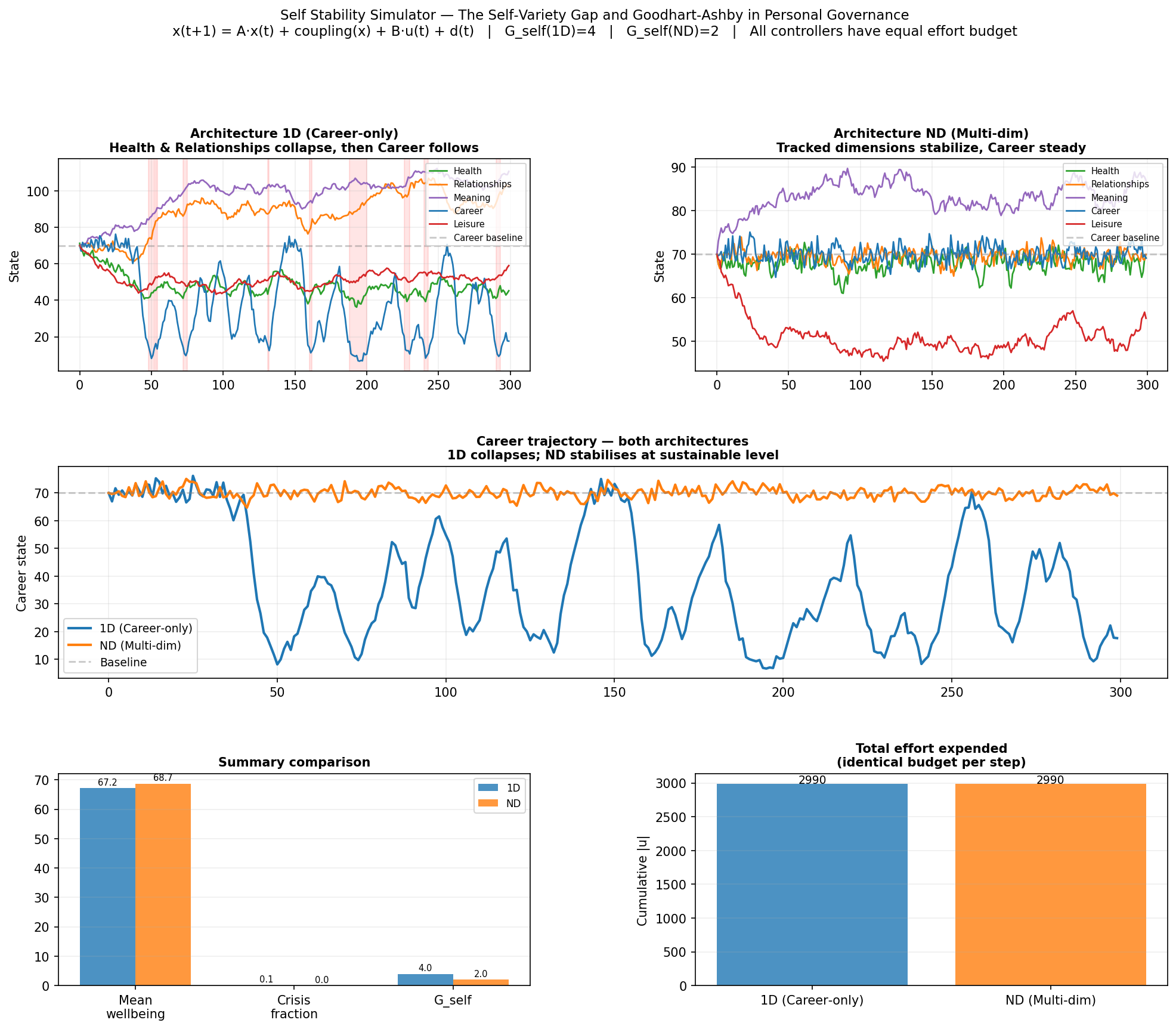
Part IV — Evidence from Psychology and Neuroscience
The self‑variety gap framework makes a core prediction: personal value architectures with low dimensionality will be associated with poorer self‑observability, greater vulnerability to unperceived deterioration in excluded dimensions, and more severe crises when those dimensions eventually breach awareness. Conversely, practices and traits that expand the effective dimensionality of self‑perception should be associated with greater resilience, earlier detection of emerging problems, and more adaptive responses to life disruption.
This part reviews four bodies of research that, while not designed to test the variety‑gap model directly, are strongly consistent with its predictions. In each case, the existing findings can be reinterpreted as instances of the more general mechanism: narrow value architectures create blind spots, and those blind spots accumulate damage until a crisis forces recognition.
4.1 Self‑Complexity Theory
Patricia Linville’s self‑complexity theory (Linville, 1985, 1987) proposes that people differ in how many distinct, relatively independent self‑aspects they use to organize their self‑knowledge. A person with high self‑complexity has multiple differentiated self‑aspects — professional self, relational self, physical self, creative self, spiritual self — each with its own set of attributes and evaluative standards. A person with low self‑complexity has fewer, more overlapping self‑aspects, so that a threat to one domain spills over more easily into global self‑evaluation.
Linville’s key finding was that people with low self‑complexity are more vulnerable to stress, depression, and illness following negative life events. The proposed mechanism is affective spillover: when self‑aspects are highly interconnected, a failure in one domain contaminates the emotional tone of all the others. High self‑complexity acts as a buffer — trouble at work stays at work, leaving the person’s sense of themselves as a parent, friend, or creative being relatively intact.
In the variety‑gap framework, self‑complexity is naturally interpreted as the effective dimensionality of the personal value architecture. A person with multiple distinct self‑aspects is tracking multiple independent dimensions of their own life. They have a richer perceptual field. When one dimension is disturbed — a career setback, a health issue — the signal is localized. It registers as a deviation in that specific domain without overwhelming the entire system. The person can perceive the problem, isolate it, and respond to it without globalizing the threat to their entire sense of self.
A person with low self‑complexity, by contrast, has a value architecture of low effective dimensionality. The disturbance in one domain propagates across the entire evaluative space because there are few independent axes to absorb it. The signal is not localized; it is everywhere. The person cannot distinguish “my career is struggling” from “I am a failure as a human being” because their value architecture lacks the dimensional resolution to separate these. The variety gap G_self is larger, and the threshold for observability collapse is lower.
Linville’s findings, interpreted through this lens, suggest that dim(V_self) — the number of independent evaluative dimensions a person tracks — is a measurable psychological variable with predictable consequences for stress vulnerability. The self‑complexity literature provides a natural starting point for empirical operationalization of the variety‑gap concept.
4.2 Cognitive Dissonance and Self‑Perception Distortion
Leon Festinger’s theory of cognitive dissonance (Festinger, 1957) describes the discomfort people experience when they hold two inconsistent beliefs, or when their behavior contradicts their self‑concept. The standard finding is that people will adjust their beliefs, distort their perceptions, or selectively attend to information to reduce dissonance — often in ways that preserve a positive self‑image at the expense of accuracy.
In the variety‑gap framework, cognitive dissonance is a signal‑degradation mechanism. The person’s value architecture has identified a certain self‑image as desirable — “I am a good person,” “I am competent,” “I made the right decision” — and treats information that contradicts that image as noise to be filtered, not as a signal to be integrated. The observation channel is systematically biased to preserve the coherence of the existing value function, even at the cost of accuracy.
This is a direct instance of the Goodhart–Ashby mechanism applied to self‑perception. The person has made “feeling consistent” or “feeling good about myself” a target, and in optimizing for that target, they destroy the information that would allow them to perceive themselves accurately. The excluded dimension — truth — degrades silently. The crisis arrives not as a moment of dissonance, which can be managed through distortion, but as an accumulation of unperceived reality that eventually overwhelms the filtering capacity. The classic “midlife reckoning,” in which a person suddenly perceives that their life has been built on choices they never fully acknowledged, is an observability collapse: the SNR of the self‑signal has fallen below unity, and the noise of self‑deception can no longer conceal the underlying state.
The therapeutic insight that follows is structural, not moralistic: the problem is not that the person is weak or dishonest, but that their value architecture selected for distortion rather than accuracy. The remedy is not simply “more honesty” but an expansion of the value architecture to include truth as an explicit dimension — a willingness to perceive discomfort as a signal rather than as noise.
4.3 Meditation, Mindfulness, and the Default Mode Network
A substantial body of neuroscientific research over the past two decades has investigated the effects of meditation and mindfulness practices on brain function. One of the most replicated findings is that meditation reduces activity in the default mode network (DMN) — a set of brain regions associated with self‑referential thought, mind‑wandering, and narrative construction about the self (Brewer et al., 2011; Garrison et al., 2015). At the same time, meditation increases functional connectivity between brain regions involved in attention, interoception, and present‑moment awareness.
In the variety‑gap framework, the DMN can be understood as the neural substrate of a low‑dimensional, highly aggregating observation channel. The DMN constructs a narrative self — a simplified, coherent story about who I am, what I value, and how I am doing — by compressing the vast stream of present‑moment experience into a manageable summary. This is an essential function; without it, a person would be overwhelmed by sensory and affective noise. But when the DMN dominates, the compression becomes the reality. The narrative self replaces the living self. The observation channel narrows to the dimensions that fit the story, and the rest — bodily sensations, emotional nuances, relational subtleties — is discarded.
Meditation, by quieting the DMN and strengthening attentional networks, can be understood as a practice that temporarily increases the effective dimensionality of self‑observation. The person becomes aware of dimensions of experience — the texture of the breath, the impermanence of thoughts, the somatic markers of emotion, the felt sense of being alive — that are normally filtered out by the narrative compression. This is not a mystical claim; it is a description of what happens when the observation channel is widened. The variety gap G_self is momentarily reduced.
The therapeutic effects of mindfulness — reduced anxiety, improved emotional regulation, greater resilience to stress — follow predictably from this model. A person who can perceive more dimensions of their own experience can detect emerging problems earlier, respond with greater precision, and avoid the accumulation of unperceived damage that leads to crisis. The practice does not change what is happening in the person’s life; it changes the dimensionality of their perception of what is happening. The variety‑gap framework provides a formal language for why this matters.
4.4 Flow States and Peak Experiences
Mihaly Csikszentmihalyi’s concept of flow (Csikszentmihalyi, 1990) describes a state of optimal experience in which a person is so fully absorbed in a challenging but manageable activity that self‑consciousness temporarily disappears. Time distorts, the boundary between self and activity blurs, and the experience is intrinsically rewarding. Abraham Maslow’s peak experiences (Maslow, 1964) describe similar states of heightened awareness, unity, and transcendence of ordinary self‑concern.
These states share a common structural feature: the ego’s usual optimization targets are temporarily suspended. The person is not monitoring their performance against a narrow set of evaluative dimensions. They are not asking “How am I doing?,” “What does this say about me?,” or “Am I happy right now?”. The observation channel is freed from the constraints of the habitual value architecture, and as a result, the person perceives a richer, more integrated field of experience.
In the variety‑gap framework, flow and peak experiences are states of temporary gap collapse. The suspension of the usual value architecture — with its characteristic dimensionality, aggregation, and discounting — allows the person to perceive dimensions of reality that are normally excluded. The experience feels transcendent not because anything supernatural is occurring, but because the perceptual field has suddenly expanded. The variety gap G_self has momentarily approached zero.
The aftereffects of flow — increased creativity, renewed motivation, a sense of meaning and perspective — can be understood as the system’s response to having briefly operated with higher observability. The person has glimpsed a wider field, and that glimpse provides information that is integrated into the ongoing self‑model. The value architecture may even be permanently expanded as a result: a person who experiences flow in a creative activity may begin to value creativity more explicitly, adding a dimension to their V_self that was previously latent.
The challenge, of course, is that flow cannot be optimized for directly. It is a byproduct of absorption in intrinsically rewarding activity, not a target that can be pursued. The person who tries to “achieve flow” is back in the optimization trap, narrowing their observation channel to a new metric — “am I in flow yet?” — that guarantees its own failure. This is the Goodhart–Ashby mechanism once again: making flow a target destroys the conditions that produce it.
4.5 The Pattern Restated
Across these four research domains — self‑complexity, cognitive dissonance, meditation, and flow — a consistent pattern emerges. Narrow, rigid, low‑dimensional personal value architectures are associated with poorer self‑observability, greater vulnerability to unperceived deterioration, and more severe crises when excluded dimensions eventually breach awareness. Practices and traits that expand the effective dimensionality of self‑perception — differentiated self‑aspects, tolerance for dissonance, mindfulness, flow — are associated with greater resilience, earlier detection of problems, and richer experience of life.
This pattern is exactly what the variety‑gap framework predicts. It does not prove the model; the studies reviewed here were not designed to test G_self directly. But the convergence is suggestive. It indicates that the formal machinery developed for governance architectures — observation channels, aggregation loss, requisite variety, Goodhart collapse — has a natural and empirically grounded extension to the self. The next part takes up the practical question that follows: if narrow personal value architectures are structurally destabilizing, what mechanisms might enable a person to consciously evolve their own values? That is the meta‑governance problem at the scale of a single life.