Country Report · South Korea

South Korea: The Tournament Trap — Consequence Coupling Under Effective Scarcity

A governance-as-engineering diagnosis of a society that became the world’s most accomplished tournament — and the structural challenge of turning capability into plurality

Executive Summary

The Paradox

South Korea is not failing. Within a single lifetime it moved from post-war poverty to the technological frontier, built a high-income democracy in a neighbourhood not known for them, and developed a state that observes, decides and acts at a speed few governments can match. In the winter of 2024–25 it demonstrated that its democracy can correct even a president who turns on the constitution: martial law was overturned within hours, and the president was impeached and removed within four months.

And yet. On one Thursday every November the country halts flights during the listening test, delays its stock market and holds its breath for an eight-hour examination, because for a large share of the young people who sit it, those hours will shape which university they attend—and the university's name will follow them into employment, into the choice between a conglomerate and a subcontractor, into whether they build a life in the capital or outside it. Families spent a record ₩29.2 trillion on private education in 2024, and eight in ten schoolchildren receive it. Governments of every political colour have spent four decades trying to cool the competition: banning tutoring, imposing cram-school curfews, rewriting admissions formulas, removing the hardest questions from the exam. The competition endures. Three governments in six years tried to expand the supply of Korea's most coveted prize, a place at medical school, and each met resistance strong enough to halt or shrink the attempt.

Paper VIII of the Governance as Engineering series estimated Korea's Variety Gap at 2.4 [1.7–3.2]—an internal pilot estimate placing it in the Approaching band with a Widening trajectory—while judging its observation architecture sophisticated and its static capacity broadly adequate. The system sees well and acts fast, and the gap still grows. This report identifies one candidate partial mechanism behind that pattern.

The Core Diagnosis: The Tournament Trap—Consequence Coupling Under Effective Scarcity

The Tournament Trap is a self-reinforcing allocation architecture in which a limited effective supply of highly valued opportunities, steep positional rewards, consequence coupling and legitimate rank-based selection channel extraordinary human capability into competition for a comparatively narrow set of pathways—while reform more readily changes how contestants are ranked than the opportunity structure that makes rank consequential.

Korea does not lack universities, jobs or cities. It lacks enough opportunities that people treat as substitutes for the few at the top: a place at a leading Seoul university or medical school, a regular position at a large firm or in the civil service, a life in the capital region where those employers and universities concentrate. Nominal supply is abundant. Effective prize supply is narrow. The prize gradient is steep, because a dual labour market rewards employer size and contract type at least as much as measured skill. Effort pays, because private tutoring measurably improves the chance of admission to a top university even where it adds little to learning. And the contests are joined: university rank propagates into employment, employment into geography, and educational stratification remains visible in partnership and family life long after formal education ends. The prize is not one prize. It is access to a bundle of correlated future options. Competitive investment is therefore individually rational, even when the aggregate contest is socially costly.

The architecture is not uniquely Korean, and this report does not claim that Koreans are culturally predisposed to compete. Taiwan and Japan share most of its components. The Korean diagnosis concerns their configuration: the way a university hierarchy, a divided labour market and a concentrated capital region reinforce one another, so that a single early ranking reaches far into adult life.

The Twin Deficits

Aspect Outer (Hardware) Inner (Operating System)
Strength Fast, sophisticated state capacity; frontier industry; strong constitutional correction capacity; world-class educational attainment Gongjeong (fairness) as a demand that privilege must not bend the rules; extraordinary collective and family commitment to effort; the gwageo ideal of advancement through open examination
Deficit Thin effective prize supply; steep dual-labour-market gradients; consequence coupling across education, employment and geography; reform that reaches the ranking more easily than the rewards One influential understanding of fairness as a single uniform race (the Legitimacy Lock); hakbeol (academic pedigree) as durable social currency; sunk investment in rank across millions of households
Manifestation Record private-education spending; half the population on an eighth of the territory; regional universities unable to fill places while the elite tier stays scarce; repeated conflict over medical-school supply High school remembered as a "life-or-death battlefield"; "spoon class" and "N-po generation" as the vernacular of inherited position and abandoned life paths; fairness disputes hardening along gender lines

The Signature Pattern: The Scarcity–Rank–Invest–Concentrate Loop

Each trap in this series has its own characteristic motion. Japan's preserves an inherited equilibrium; Sweden's drifts; Finland's stalls. Korea's competes—and much of its competitive energy flows through a small number of gates.

Effective scarcity. Few opportunities function as credible substitutes for the most valued pathways. Mass higher education coexists with severe educational scarcity, because nominal abundance does not guarantee substitutability.

Rank. Access is allocated by rankings that begin early and that government can reach by decree. This is where reform concentrates: exam content, admissions formulas, tutoring rules.

Invest. Families respond with investment, because prizes are steep and effort pays. When the discriminator changes, investment moves to whatever still moves rank.

Concentrate. Students, family spending, employers and institutional prestige converge on the top tier, which grows more attractive precisely because capability has converged on it. Concentration renews effective scarcity, and the next round of reform—aimed, once again, at the ranking—finds the same structure underneath.

Two modifiers act on the loop. Consequence coupling raises the stakes: because each rank changes several future domains, winning is worth more than the immediate prize. Rank legitimacy raises the durability: because the allocation procedure retains a distinctive claim to fairness, the loop is protected from the challenge that might otherwise break it.

The Evidence

The diagnosis rests on Korean evidence, much of it produced by Korean policy. When university enrolment limits were relaxed outside the capital region in the mid-1990s, a natural experiment showed that tutoring participation fell by roughly nine to ten percentage points—while competition for the capped metropolitan universities continued to rise. The added places relieved pressure in the contest they entered without becoming substitutes for the places at the top. Restrictions on cram-school hours, by contrast, produced effects their own evaluators called trivial. And when public institutions relocated outside the capital were required to hire local graduates, the starting-wage gap between regional and Seoul-area graduates narrowed. The evidence suggests that changing what winning buys can change behaviour considerably more than changing how contestants are ranked.

The Legitimacy Lock

Korea's political immune system is unusual. If the tournament were defended only by vested interests, reform would be conventional. But standardised examination has a distinctive fairness constituency, and its appeal rests on its narrowness: a score is visible, auditable and hard for privilege to bend. When distrust of holistic admissions sharpened in 2019, the Ministry of Education's fairness package asked sixteen leading Seoul universities to raise exam-based admissions to at least 40 percent. Faced with a demand for fairness, policy moved toward the narrower measure. This creates a genuine tension within the series' framework: Paper VI argues that narrow objective architectures exclude relevant dimensions; Paper XIII shows that legitimacy determines whether an architecture works at all. Adding dimensions to a high-stakes selector can simply create more dimensions to game. The Tournament Trap cannot be solved by selection reform alone. It requires changing what winning buys—and, in some domains, how many credible alternatives to winning exist—which in turn makes richer or less rank-resolving selection easier to sustain legitimately.

The Gender Boundary

Korea's fertility rate fell to 0.72 in 2023, then the world's lowest, and it is not evidence for the Tournament Trap. The strongest recent synthesis identifies an unusually severe career–family trade-off, rooted in inflexible work and unequal care, as the primary cause, and this report treats that mechanism as independent. The two architectures interact: steep career stakes raise the cost of interruption, the dual labour market makes re-entry costly, and unequal care assigns that cost disproportionately to women. The report's concern is option compatibility—whether stepping away from the tournament destroys too much of a person's future—not the number of births.

The Series Boundary Condition

Every country in this series suffers from a distinctive governance deficit. Most face first-order problems: an inability to execute, integrate, sense, synchronise, accumulate or calibrate. Finland and Japan were second-order cases, systems that solved the first-order problems and met a ceiling—a throughput constraint in Finland, a continuity trap in Japan. Israel and Spain showed architectures left incomplete by design or by necessity.

Korea belongs with the second-order cases, but it poses a question none of the others did. Its difficulty is not that it cannot change. It changes relentlessly—in effort, policy and political leadership. Its difficulty is that so much of that capacity for change is spent inside an opportunity architecture that the change rarely touches. Democratisation transformed who controls the Korean state and how that control is corrected; it did not transform the opportunity architecture the developmental state built. Changing the controller and changing what the system rewards are different operations, and Korea has become extraordinarily good at the first.

The Opportunity

The transition this report proposes does not abolish the tournament. It reduces how many futures depend on winning it. Four levers do the work: expand effective prize supply—not more seats but more credible futures, through regional universities, employers and life packages that capable people would choose on their merits; flatten prize gradients that rank does not justify, above all the gulf between the two sides of the dual labour market; loosen consequence coupling, so that one ranking stops propagating further than the information it contains; and increase reversibility, so that losing at eighteen is less consequential at thirty-five. Two constraints cut across all four: care compatibility, and a legitimacy test that every alternative must be at least as auditable as the system it replaces.

The transition works with the grain of Korean governance culture. Its Trojan Horse is fairness itself: decoupled recruitment as fair hiring, re-entry routes as fairness across the life course, regional opportunity as fairness of place. Its centrepiece, offered as one illustrative architecture rather than the only possible design, is a network of Opportunity Regions—designated areas outside the capital where provincial governments, universities and anchor employers build complete alternatives to the Seoul pathway, protected for a decade and evaluated by whether capable students actually choose them. Its proposed sequencing reverses the historical instinct of Korean reform: lower the stakes first, change the selector last.

The Concrete First Step: The Tournament Audit

The first step changes nothing for any family. A small, independent statutory Tournament Audit would map where a small difference in rank produces a large difference in later life, along five dimensions—prize steepness, effective supply, consequence coupling, effort responsiveness and rank legitimacy. It would require major reforms to state which lever they act on, and it would begin by coding two decades of Korean reform to test whether the discriminator treadmill helps explain Paper VIII's declining ratio of structural to symbolic reform. It would register its predictions before outcomes are known—including whether the new regional-doctor track becomes a genuine substitute or a lower tier. The audit's purpose is to add a second question to Korean public debate. Alongside how should students be ranked? it asks: what should rank buy?

The Honest Conclusion

Korea can loosen the Tournament Trap. The evidence that its links respond to policy already exists, much of it produced by Korean reforms, and the state's capacity to scale what works is formidable. But the transition is a wager. Labour-market reform has stalled before, the Opportunity Regions may fail to become substitutes, and the discriminator treadmill may simply continue. Parts of the diagnosis remain open—above all the strength of the Legitimacy Lock and whether less rank-resolving selection could ever be accepted as fair—and the Tournament Trap is offered as one candidate contributor to Korea's widening Variety Gap, not its explanation.

The tournament worked. That is why its limits are so hard to see. Korea's developmental achievement was to turn scarcity into capability. Its next achievement, if it chooses it, is to turn capability into plurality.

Series Coherence Table (Updated)

System Core Deficit Signature Pattern Cultural Anchor Transition Feasibility
Germany Execution Paralysed spending Engineering rigour Feasible
France Integration Reform‑explosion‑retreat Jacobin clarity Feasible
Sweden Feedback Drift loop (signal suppression) Saklighet Feasible
India Synchronisation Leap‑lag cycle Jugaad Feasible
EU Coherence Negotiation‑dilution Subsidiarity Feasible
UK Control‑delivery mismatch Centralise‑fail‑centralise Muddling through Feasible
Brazil Accumulation Breakthrough‑Capture Jeitinho Difficult but possible
Russia Legibility Control–Blindness–Shock Ne vysovyvaysya Impossible under current regime
USA Integration Escalate‑Block‑Bypass‑Delegitimise Bootstrap individualism Possible via sub‑federal
Finland Throughput Constraint Anticipate–Consensus–Increment–Pressure Sisu + Quiet Consensus Feasible
China Calibration Campaign–Overshoot–Abrupt Correction Míng zhé bǎo shēn Difficult; recoverable under current regime
Japan Continuity Trap (Paradigm Lock-in) Pressure–Accommodate–Preserve–Defer Wa + Kaizen + Gaman + Shouganai Feasible with controlled creative destruction
Nigeria Substrate Deficit (State–Society Dissociation) Extraction–Dissociation–Adaptation–Crisis Oga-Madam + "The National Cake" + Jugaad + Pentecostal Resilience Generational; feasible via interface-building from below
Israel Boundary Deficit (Contingency Lock-In) Threat–Mobilization–Securitization–Fragmentation–Renewed Threat Ein Breira + Balagan + Covenant Consciousness + Tikun Olam Difficult; requires constitutional settlement via incremental boundary stabilization
Spain Integrative Closure Deficit (Transition Trap) Crisis–Centralisation–Peripheral Mobilisation–EU Mediation–Accommodation Convivencia + Las Dos Españas + El Aplazamiento Feasible via orthogonal interventions; unlikely via direct constitutional reform
South Korea Tournament Trap (Consequence Coupling Under Effective Scarcity) Effective Scarcity–Rank–Invest–Concentrate Gwageo* + Hakbeol + *Gongjeong Feasible if stakes are lowered before selection is changed

South Korea is the case that asks: What happens when a society becomes extraordinarily good at competing fairly for a future—and too much of the future comes to depend on a single competition? The answer is not stagnation but relentless motion around a stable centre: effort, reform and political correction that leave the opportunity architecture recognisably intact. The task is not to make Koreans compete less. It is to build a society in which losing one tournament is survivable, because there are many credible ways to flourish.

1. The Tournament Trap


1.1 Opening: The Day the Country Holds Its Breath

On one Thursday every November, South Korea rearranges itself around a single examination. Government offices and large firms push back their opening hours so that the roads stay clear for the roughly half a million students travelling to test sites. The stock exchange opens an hour late. Police motorcycles ferry late-running candidates through traffic. During the English listening section, aircraft are held on the ground and flights already in the air are kept above a set altitude, so that no engine noise disturbs the recordings. Outside the school gates, parents wait through the day; many spend it in temples and churches, praying for a score.

The College Scholastic Ability Test—the suneung—lasts about eight hours. For a large share of the young people who sit it, those eight hours will shape which university they attend, and the university's name will follow them through their working lives: into hiring decisions, into whether they work for a conglomerate or a subcontractor, into whether they build a career in Seoul or outside it, and often enough into how they are seen by prospective partners and their families. Koreans have a word for this social currency—hakbeol, academic pedigree—and they speak of it the way other societies speak of class.

A country that grounds its air traffic for an exam has not failed to notice what the exam means. Korea notices everything. Its ministries publish detailed statistics on private tutoring expenditure, regional population loss, graduate employment outcomes and the fertility rate, which fell to 0.72 children per woman in 2023, then the lowest in the world. Its newspapers debate education reform continuously. Its governments, of every political colour, have spent four decades trying to cool the competition: banning private tutoring outright in 1980, imposing curfews on cram schools, rewriting admissions formulas, removing the hardest "killer questions" from the suneung in 2023.

And yet the tournament endures.

Nothing illustrates the pattern more compactly than medicine. Medical school is among the most coveted destinations in Korea's educational tournament, combining high income, security and professional status. In 2020 the government proposed adding 400 medical-school places a year for ten years, on top of an annual intake of 3,058, largely to address shortages in regional and essential care. Doctors and trainees struck, and the plan was shelved. In 2024 a different government proposed 2,000 additional places a year. Thousands of trainee doctors walked out of the hospitals, and the confrontation ran for more than a year before the government restored the 2026 intake to 3,058. In February 2026 a third attempt arrived, far more cautious: 3,548 places scheduled for 2027, rising to 3,671 in 2028–29 and to 3,871 from 2030 if planned new schools open, with the added places at existing schools outside Seoul routed through a regional-doctor track that carries a ten-year service obligation.

The doctors' objections were not only about scarcity. Training capacity is a real constraint; so is the maldistribution of physicians between the capital and the provinces, which more doctors would not automatically cure; so are the punishing conditions in essential specialties. But the sequence reveals something larger than a professional dispute. Three governments in six years tried to expand the supply of Korea's most coveted prize, and each met resistance strong enough to halt or shrink the attempt. The plan now scheduled for implementation does not simply create more of the prize. It creates a different prize—a medical seat with conditions attached—whose value relative to the unconditioned seat nobody yet knows. That distinction, between adding places and adding places people regard as equivalent, runs through everything that follows.


1.2 The Scarcity–Rank–Invest–Concentrate Loop

Each trap in this series has its own characteristic motion. Japan's preserves an inherited equilibrium; Sweden's drifts; Finland's stalls. Korea's competes—with an intensity and a discipline that built one of the most remarkable economies of the twentieth century and that now organises a large share of Korean life around a small number of gates. The pattern has four stages.

Effective scarcity. Korea is not short of universities; roughly seven in ten young adults hold a tertiary qualification, the highest share in the OECD. It is not short of jobs. What it is short of is opportunities that people regard as genuinely equivalent to the few at the top: a place at one of the "SKY" universities—Seoul National, Korea and Yonsei—or at a leading medical school; a regular position at a large conglomerate or in the civil service, with the pay, security and progression that small-firm and non-regular employment rarely offer; a life in the Seoul metropolitan area, where those employers, those universities and the networks around them are concentrated. Nominal supply is abundant. Effective supply, the number of outcomes accepted as substitutes for the prize, is narrow.

Rank. Access to the narrow tier is allocated by ranking, and the ranking starts early. The suneung score, the school record, the admissions formula, the civil-service examinations for which hundreds of thousands of young adults—the gongsi-jok, the "exam tribe"—prepare year after year: each converts a cohort into an ordering. This is where government intervenes most often, because the ranking mechanism is the part of the system it can reach by decree. It changes the formula, the question types, the balance between exam-based and holistic admission, the hours cram schools may stay open.

Invest. Families respond to the ranking with investment. Nearly eight in ten schoolchildren receive private tutoring, the hagwon districts—Daechi-dong in Gangnam above all—have become an economy of their own, and preparation begins in primary school. The investment is rational. A higher rank buys a better university; a better university raises the odds of a large-firm or public-sector position; that position shapes earnings, security and location for decades. When the discriminator changes, the investment moves to wherever the new discriminator can be influenced. Restrictions on cram-school opening hours produced reductions in tutoring that were statistically detectable and practically trivial.

Concentrate. The investment flows toward the same destinations, and in doing so reinforces them. Students, parental spending, employer recruitment and institutional reputation converge on the top tier, which becomes more attractive precisely because capability has converged on it. The Seoul metropolitan area now holds just over half of Korea's population on about an eighth of its territory. In 2025, forty regional universities still had unfilled places after the additional admissions round, while competition for the elite metropolitan tier shows no comparable easing. A shrinking cohort does not relax the tournament evenly; it empties the periphery and leaves the summit as scarce as before.

The next cycle begins from a steeper gradient. Concentration renews scarcity. The top grows more distinct from what lies beneath it, the reward for reaching it rises, the ranking that allocates it carries more weight, and the next round of reform—aimed, once again, at the ranking—finds the same structure underneath. Scarcity, rank, invest, concentrate. The loop does not produce stagnation. It produces motion: tireless, sophisticated, expensive motion, much of it spent changing who wins rather than how many can.

None of this requires bad faith. Students seek good futures and parents try to secure them. Universities guard their reputations, employers use credentials as cheap signals of capability, professionals defend their standards and working conditions, and governments try to balance fairness, growth and social peace. Each actor behaves reasonably. Together they reproduce an architecture that none of them would have designed from first principles.


1.3 The Tournament Trap Defined

The Tournament Trap is a self-reinforcing allocation architecture in which a narrow effective supply of highly valued opportunities, steep rewards for rank and tight coupling between one ranking and the next channel a society's extraordinary capability into competition for a comparatively small set of pathways—while reform reaches the ranking far more easily than the opportunity structure that makes ranking matter.

The word tournament is chosen deliberately, because the problem is relational. Absolute capability can rise for everyone while positional scarcity stays exactly where it was. Korea has educated its population to a level few countries have matched, but the number of places at the top of its opportunity hierarchy has not grown in proportion. Every gain in capability therefore enters the contest for the same gates and raises the price of passing through them.

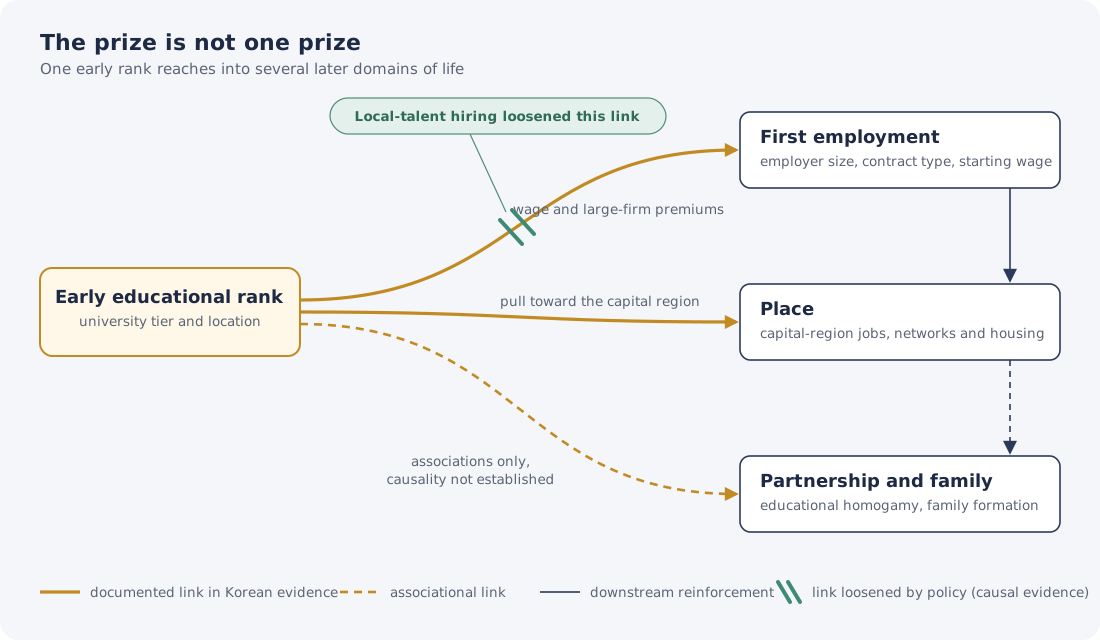
What makes the trap so tight in Korea is consequence coupling: the degree to which rank in one contest determines what becomes possible in others. A university's name affects first employment. First employment—regular or non-regular, conglomerate or subcontractor—is notoriously hard to escape in a dual labour market. Employment determines whether a life in the capital is affordable, and location, income and pedigree together shape housing, partnership and family. The prize for an eighteen-year-old's exam performance is therefore not one prize but a bundle of correlated futures, and losing the first contest narrows the options available in all the others.

Koreans do not need a governance report to tell them this; their own vocabulary has been describing it for more than a decade. Sujeo gyegeup-ron, "spoon class theory", sorts people into gold, silver and dirt spoons according to the position they inherit. "Hell Joseon" named a society in which effort felt inexhaustible and escape impossible. The "N-po generation" describes young adults who have given up, one after another, on dating, marriage, children and home ownership—less in protest than because each looked unaffordable from where they stood in the tournament. And gongjeong, fairness, has become one of the most charged words in Korean politics, most often invoked in defence of a transparent rank against discretion that might favour the well connected.

That last word identifies the feature that may make this trap harder to escape than most. The narrow ranking is not simply imposed on Koreans by incumbents. Standardised examination has a distinctive constituency of its own, and its appeal rests precisely on its narrowness: a score is visible, auditable and difficult for privilege to bend. When distrust of holistic, student-record admissions sharpened in 2019—the controversy over the admission of a justice minister's daughter crystallised it—the Ministry of Education's fairness package tightened the transparency rules for holistic admission and asked sixteen leading Seoul universities to raise the share of exam-based places to at least 40 percent. Faced with a demand for fairness, policy moved toward the narrower measure. Section 4 returns to this Legitimacy Lock, the reason the Tournament Trap cannot be escaped simply by measuring more.


1.4 The Developmental Tournament—and the Democratisation That Changed the Controller but Not the Prize

The architecture was not a mistake. For most of its history it was a spectacular success.

When Korea began its industrial ascent in the 1960s, it was among the poorest countries in the world, devastated by war and without significant natural resources. What it had was people, and the developmental state under Park Chung-hee and his successors organised them with extraordinary purpose: mass education, disciplined selection, and a pipeline that carried the most successful students into the ministries, the banks and the conglomerates leading the drive into steel, shipbuilding, chemicals, automobiles and electronics. Under those conditions individual competition and national development pointed in the same direction. Education led to skilled employment, skilled employment to industrial upgrading, upgrading to national advancement—and because industrial catch-up expanded productive opportunity rapidly, educational competition contained a much larger positive-sum component than it does today: additional capability could feed newly expanding industries as well as redistribute position. The system was never socially neutral or perfectly meritocratic, but winning more often meant joining an expanding enterprise rather than displacing someone from a fixed one.

In 1987 the June Democratic Struggle forced the developmental state to open. Korea became a competitive democracy and, over the following decades, one of the most politically responsive in Asia: power alternates between parties, civil society is dense and combative, the courts are independent, and the public is willing to fill the streets. The China report in this series treats that transition as the model case of a developmental state acquiring genuine political feedback as its economy matures, and the verdict holds.

The winter of 2024–25 demonstrated it with unusual clarity. On the night of 3 December 2024, President Yoon Suk Yeol declared martial law. Within hours, 190 legislators had made their way into the National Assembly and voted to lift it, and the declaration was withdrawn before dawn. Yoon was impeached eleven days later, and on 4 April 2025 the Constitutional Court unanimously removed him from office. A new president was elected in June. In this report's reading, the episode demonstrated unusually rapid constitutional correction of the political controller.

Here lies the paradox at the centre of this report. Korea can remove a president in four months. Yet the value of a SKY degree, the gap between regular and non-regular employment, the pull of the capital and the weight of the suneung have outlasted every administration since democratisation—conservative and progressive, reformist and restorationist—and nearly every one of them has tried to change at least one of them. Democratisation transformed who controls the state and how that control is corrected. It did not transform the opportunity architecture the developmental state had built. Changing the controller and changing what the system rewards are different operations, working through different institutions on different timescales, and Korea has become extraordinarily good at the first while the second has moved far more slowly.

Meanwhile the conditions that gave the tournament its large positive-sum component have faded. At the technological frontier, with growth slowing and the economy mature, the number of prized positions no longer expands faster than the number of capable people competing for them. Additional effort still builds skill, but a growing share of it only decides who receives a reward whose supply is roughly fixed. The tournament has kept its rules and changed its character: from mobilisation into an expanding opportunity structure to an ever more costly contest for position within a mature one.


1.5 Korea and Japan: Two Ways a Success Becomes a Ceiling

The natural comparison is Japan, and it is instructive precisely because it is so close. Both countries built post-war miracles on concentrated human-capital investment, coordinated industry and intense organisational discipline. Both now face shrinking cohorts, metropolitan concentration, divided labour markets and fertility far below replacement. The Japan report in this series diagnosed a Continuity Trap: an architecture superbly capable of optimising within its paradigm and structurally unable to replace it, cycling through pressure, accommodation, preservation and deferral.

It would be convenient to say that Japan has no tournament and Korea does. It would also be false. Japan has its juku, its elite-university sorting, its prestige wage premiums and its divided labour market. What separates the two reports is not the presence of competition but the failure mode each diagnoses. The Continuity Trap concerns how Japan's wider institutional system absorbs pressure and preserves an inherited equilibrium. The Tournament Trap concerns how strongly positional allocation structures future opportunity—how much of a life is decided by where one finishes. The lived intensity also appears to differ: in a survey cited by the OECD, more than 80 percent of Korean college students described their high-school years as a "life-or-death battlefield", against 14 percent in Japan. Where pressure meets Korean institutions, families work harder, start earlier and pay more, and governments redesign the rules of the contest. The result is a system in constant, exhausting motion around a remarkably stable centre.

The distinction matters because the remedies differ. A system trapped by continuity needs the capacity to let go of structures it has outgrown. A system trapped by a tournament has no shortage of change. What it lacks is change of the right kind: to the number and value of the prizes, and to how much of a life depends on winning one, rather than to the method of selecting the winners.

Korea is not alone in its region either. Taiwan has fertility almost as low, a pervasive cram-school culture and intense examination competition—under an industrial structure dominated by small and medium-sized firms rather than conglomerates. Whatever drives the East Asian pattern, it cannot be Korea's chaebol economy alone. This report therefore makes no claim that Korea is uniquely competitive or more extreme than its neighbours on every measure. Its claim concerns configuration: the way Korea's university hierarchy, its dual labour market and the concentration of opportunity in the capital region reinforce one another, so that a single ranking reaches far into adult life. Appendix D takes up the objection that Korea is simply one instance of a wider East Asian equilibrium.


1.6 Korea's Genuine Strengths

To describe the Tournament Trap is not to belittle what the tournament achieved. Within a single lifetime Korea moved from post-war poverty to the technological frontier, with world-leading positions in memory chips, displays, shipbuilding and batteries and a manufacturing base that competes in the most demanding markets on earth. It built a high-income democracy in a neighbourhood not known for them. Its state collects sophisticated information and acts on it quickly; its digital infrastructure and public administration are among the most advanced anywhere; and its early COVID-19 response demonstrated an unusually rapid capacity for large-scale testing, tracing and data-informed mobilisation.

The competitive intensity that exhausts Korean families also sustains extraordinary performance standards, an appetite for hard problems and a restlessness with second place that has served the country well. Competition is not the pathology, and a society without it would not become plural, fair or inventive by default. The question this report asks is narrower: how many dimensions of a life should depend on winning the same contest?


1.7 The Real Question

The series has so far diagnosed two kinds of failure. Most countries suffer first-order problems: an inability to execute, integrate, sense, coordinate or accumulate. A smaller number have solved those and hit a ceiling of a different kind—a throughput constraint in Finland's case, a continuity trap in Japan's.

Korea belongs with the second group, but it poses a question neither of the others did. Its difficulty is not that it cannot change. It changes relentlessly, and its democracy has shown that it can correct even a president who turns on the constitution. Its difficulty is that so much of its enormous capacity for adaptation is spent inside an opportunity architecture that the adaptation rarely touches. Paper VIII's pilot assessment registered the result from the outside: a Variety Gap estimate of 2.4 [1.7–3.2], in the Approaching band and widening, for a country whose observation architecture, signal fidelity and response times are all strong. The system sees well and acts fast, and the gap still grows, because technological, geopolitical and demographic disturbances are emerging faster than its architecture adapts. The Tournament Trap does not explain all of that widening. It is offered as one candidate partial mechanism: a domain in which visible reform activity can coexist with an opportunity structure that changes slowly.

The Tournament Trap therefore asks something different from "how can this system be fixed?" or even "how can it learn to let go?" It asks whether a society that became the world's most accomplished tournament can learn to need the tournament less—to keep the standards, the ambition and the excellence it produced while reducing the number of futures that hang on a single day in November.

The planes will be held on the ground again this year, and the parents will wait outside the gates again. Whether Korea can keep competing is not in doubt. The question is whether the country that turned scarcity into capability can now turn capability into plurality: enough credible routes to a good life that its young people no longer have to fight through the same few gates to reach one.


2. The Tournament Trap: Structural Mechanisms


2.1 What "Effective Opportunity" Means

Every report in this series names a capacity the country lacks. For Finland it was transformational velocity; for Japan, the capacity to replace a paradigm. For South Korea the missing capacity is subtler, because the country has never lacked opportunities in the ordinary sense. It has universities in every province, a labour market that absorbs one of the most educated workforces on earth, and cities outside the capital with world-class industry. What it lacks is enough opportunities that people treat as substitutes for the few they are actually fighting over.

This report calls that quantity effective prize supply. A new university place, job or regional pathway adds to effective supply only insofar as contestants regard it—and it subsequently functions—as a credible alternative to the outcome they are pursuing. A seat at a university whose graduates face markedly different employment prospects from those of a leading Seoul university expands nominal capacity without adding much to the prize pool. A new job expands employment without necessarily expanding the supply of positions that combine a regular contract, strong earnings, credible progression and social standing.

The distinction is the key to an apparent paradox: a society can have mass higher education and severe educational scarcity at the same time. Nominal abundance does not guarantee substitutability. And because the tournament is fought over effective rather than nominal supply, policies that add capacity can succeed or fail for reasons that have little to do with how much capacity they add.

Four further properties determine how intensely the tournament is fought and how far its results reach. Prize steepness describes how sharply outcomes change with rank. Effort responsiveness describes how far private investment can change a contestant's rank. Consequence coupling describes how far rank in one contest changes what is attainable in others. And rank legitimacy describes how acceptable the allocation procedure is compared with the alternatives. The sections that follow take these in turn. Their joint behaviour is the Tournament Trap.


2.2 The Scarcity Signal: What the 1995 Deregulation Revealed

The strongest evidence that the tournament responds to architecture rather than culture comes from Korea's own history. In the mid-1990s the government relaxed limits on university enrolment outside the capital region while keeping tighter restrictions inside it. Because the change reached different regions at different times, researchers at the Korea Development Institute were able to treat it as a natural experiment.

The effect was large. Deregulation reduced the probability that a high-school student received private tutoring by roughly nine to ten percentage points—about a third of the sample mean. Using the same reform to estimate the effect of admissions competition itself, the study found that a rise in the competition ratio from roughly four applicants per place to five would lift tutoring participation from about 32 percent to 37 or 38 percent. Falsification checks supported a causal reading. The researchers also observed that tutoring could rise even while satisfaction with school quality improved, which fits a positional explanation far better than the familiar complaint that families pay for tutors because public schools fall short.

If Korean families pursued private education out of a fixed cultural preference for study, adding university places should have made little difference to their behaviour. It made a great deal of difference. Evidence shows that the intensity of private competitive investment responds to the scarcity of the opportunity being contested.

The same evidence marks the limit of the finding. Deregulation reduced tutoring in the regions it reached, yet competition for universities in the Seoul metropolitan area, which remained under enrolment caps and faced ample demand, continued to rise. The added places relieved pressure in the contest they entered. They did not become substitutes for the places at the top. The lesson is not that Korea needs more university seats in general—the study itself cautions against transplanting a mid-1990s reform into the present—but that tournament pressure depends on the number of opportunities contestants regard as equivalent to the one they want.


2.3 The Prize Gradient: Why Winning Is Worth So Much

Scarcity alone does not explain how much effort a contest attracts. The prize must also matter, and in Korea it matters a great deal.

The OECD's term for the pattern is "golden ticket syndrome". Korea's labour and product markets are sharply divided: large firms and the public sector offer pay, security, social insurance and progression that small firms and non-regular contracts rarely match. Young people queue for the secure side of that divide, sometimes for years, and the education system becomes the race for the credentials that grant access to the queue. The OECD's 2024 review cites research finding that graduates of top-tier universities earned 24.6 percent more at labour-market entry than graduates of bottom-tier institutions, with the gap widening to 50.5 percent between the ages of forty and forty-four. KDI's recent analysis of Korean wage structure adds an important detail: Korean wages are unusually weakly related to measured cognitive skills and unusually strongly structured by tenure and firm size, with a substantial premium in firms of a thousand employees or more.

These figures are not the pure causal return to attending a particular university. Students sort into institutions by prior ability, family background and field of study, and networks matter. But the broader signal is hard to dismiss. Where one studies is associated with materially different working lives, and those working lives are distributed by an employment structure that rewards the employer's size and the contract's type at least as much as the worker's measured skill.

This is what makes the tournament rational. If the difference between two educational outcomes were merely symbolic, the scale of Korean investment in rank would be difficult to explain. When the difference changes the probability of a secure, well-paid and respected career—and, as Section 2.6 shows, much else besides—the same investment becomes individually sensible, even when the aggregate contest is socially costly. The report therefore uses prize steepness to describe how rapidly consequential outcomes change with rank. The steeper the gradient, the more it pays to improve one's position by a small margin, and the more a society will spend doing so.


2.4 Ranking Versus Learning: Effort Responsiveness

A steep prize does not create a tournament if effort cannot change the result. Lotteries have steep prizes and no preparation industry. What sustains the Korean tournament is the widely and reasonably held belief that additional investment improves one's chances.

The scale of that investment is well documented. Korean families spent a record ₩29.2 trillion on private education for school-age children in 2024, up 7.7 percent on the year before, and participation reached 80 percent. Comparable PISA 2022 data put participation in at least one form of shadow education at 69 percent in Korea, against 60 percent in Japan and 49 percent in Taiwan. Preparation begins in primary school, and the hagwon districts of southern Seoul have become an economy of their own.

KDI's review of the Korean tutoring literature draws the distinction on which this report depends. Studies of private tutoring often find limited causal effects on students' absolute academic achievement, but significant effects on the probability of admission to a top university. A meaningful share of the expenditure therefore looks like investment in ranking rather than in learning. In ordinary human-capital formation, an extra hour of study is valuable because the student knows more afterwards. In a positional tournament the hour can also be valuable because it changes who finishes ahead, and that second value exists only relative to everyone else's hours. Korea's education system contains both processes. The analytical error would be to mistake one for the other: to read the tutoring economy as a measure of Korean appetite for knowledge, when much of it is the price of position.


2.5 The Discriminator Treadmill

Effort responsiveness explains why reforms aimed at the mechanics of competition so often disappoint. Successive Korean governments have repeatedly changed the discriminator—the means by which contestants are told apart. They have imposed 10 p.m. closing times on hagwons, restricted teaching ahead of the curriculum, rebalanced exam-based and holistic admission, simplified and diversified admissions tracks, and removed the hardest "killer questions" from the suneung. The OECD's 2025 review of Korean education policy observes that the hoped-for reduction in private tutoring has not materialised.

The comparison with the 1995 deregulation is instructive. A Korean study of hagwon operating-hour restrictions found reductions in tutoring expenditure and hours that were statistically significant but, in the authors' own description, trivial. The capacity deregulation reduced tutoring participation by nine to ten percentage points. Restricting when people may compete produced a small effect; changing how scarce the prize is produced a large one. The two studies cover different periods, populations and policies, so the contrast is not a controlled experiment. But it points in the direction the mechanism predicts, and so does the aggregate record. Killer questions were removed ahead of the 2024 suneung; private-education spending reached its all-time high that same year. Spending and participation fell back in 2025, though spending per participating student rose again. The aggregate evidence does not identify a causal pathway, but it is consistent with competition persisting after a change of discriminator.

The mechanism is straightforward. As long as winning remains valuable and effort can change the probability of winning, removing one way of competing leaves the incentive to compete intact. Families redirect their investment toward whatever signals still move rank. This does not mean that an equal quantity of effort must reappear elsewhere—nothing in the evidence, or in the logic of a tournament, conserves effort in that way, and a noisier discriminator can genuinely lower it. It means only that discriminator reform acts on the surface of the contest while the forces that make the contest worth fighting remain where they were.

This report calls the result the discriminator treadmill: a cycle in which governments, facing visible public anxiety about competition, reach for the lever closest to hand, change the rules of ranking, observe that the competition persists, and reach for the lever again. Section 4 examines why that lever is so much easier to reach than the others. The present point is diagnostic. The evidence suggests that reforms which change access to attractive pathways can alter tournament behaviour considerably more than reforms confined to the mechanics of ranking. It does not yet establish a general law, and Korea has pursued genuinely structural reforms as well—labour-market packages, social-insurance expansion, vocational pathways, regional-university programmes. But the treadmill is the pattern most visible to the public, and it is the one that consumes the most political attention.


2.6 Consequence Coupling: When One Rank Changes Many Futures

The mechanisms so far describe a single contest. What makes the Korean tournament so consequential is that its contests are joined.

This report defines consequence coupling as the degree to which rank in one allocation system changes the attainable state space in other domains of life. The phrase is deliberately stronger than correlation. Two outcomes can move together without one narrowing the options associated with the other. Coupling concerns propagation: whether losing one contest merely produces a worse result there, or also closes doors elsewhere.

The first link runs from university to employment. The prestige gradient described in Section 2.3 is one strand. Geography is another. A 2026 study using the Graduate Occupational Mobility Survey and propensity-score matching found that, for students who finished high school outside the capital, attending a university in the Seoul Capital Area was associated with a significant premium both in wages and in the probability of employment at a large firm. The premium was not uniform: for some students from regions with stronger local economies it was weaker or absent. That heterogeneity matters as much as the average. It shows that the value of a Seoul degree depends on what the alternative region can offer—which is to say, on effective prize supply outside the capital.

The second link runs from employment to geography. The Seoul Metropolitan Area—Seoul, Incheon and Gyeonggi—holds 50.6 percent of Korea's population on 11.8 percent of its territory, and its share is projected to rise as the rest of the country contracts. Population concentration alone proves nothing; large metropolitan regions generate real agglomeration benefits everywhere. The relevant question is whether high-quality employment reinforces the concentration, and Korean research on graduate mobility suggests it does. The capital's labour market exerts a strong pull on graduates from other regions, and the same research indicates that stronger regional labour markets—well-paid jobs at large firms, employment security and close ties between universities and employers—can hold or attract graduates outside it. Educational opportunity, employment opportunity and metropolitan opportunity are not three separate prizes. They reinforce one another.

The third link reaches into private life. A 2026 study of Korean adults found that graduates of elite universities were especially likely to marry within the elite educational boundary, and that never-married elite graduates expressed stronger preferences for educational homogamy. A nationally representative cohort study published the same year found higher-education selectivity associated with differentiated family formation by the early thirties: among women, more selective university attendance was associated with fewer children and less marriage to less-educated partners, while men's patterns varied with occupational field. Neither study shows that university rank causes marriage or childbearing outcomes. What they show is narrower and still significant: educational stratification remains visible in partnership and family life long after formal education ends.

Put together, the links change what the tournament is about. A student competing for a prestigious university place appears to be competing for an education. But if that place shifts the probabilities of large-firm employment, higher lifetime earnings, access to the capital's networks, a secure career trajectory and particular social circles, then the visible prize understates the real one. The prize is not one prize. It is access to a bundle of correlated future options. That is why the contest commands so much effort, and why an eighteen-year-old's exam can feel, to the family paying for it, like a verdict on a whole life.

The prize is not one prize: one early rank reaches into employment, place, and partnership and family

Figure 1. Consequence coupling. University tier and location propagate into first employment and into access to the capital region; employment in turn shapes place. The link to partnership and family is associational, not shown to be causal. The mark on the employment branch shows where the local-talent hiring rule measurably loosened one link, narrowing the starting-wage gap between regional and Seoul-area graduates.

In the language of this series, Korea has allowed several dimensions of adult life to become partly projected onto the same early ranking channels. Paper VI's concern is not the number of indicators a system tracks but its effective dimensionality: many different-looking outcomes can collapse onto a few consequential axes. Korea does not have a single objective function, and its people value a great many things. But evidence shows substantial consequence coupling between educational, occupational and metropolitan rank, and the report interprets that coupling as a reduction in effective dimensionality—a society of many nominal paths in which a small number of early rankings still govern much of where those paths can lead.


2.7 Coupling Can Be Loosened: The Local-Talent Hiring Rule

If consequence coupling were a fixed feature of Korean society, the diagnosis would be a counsel of despair. It is not, and Korea has already demonstrated as much.

Under the mandatory local-talent hiring policy, public institutions relocated out of the capital were required to recruit a rising share of graduates from universities in their new regions. A 2024 difference-in-differences study using graduate microdata found that the policy significantly reduced the starting-wage gap between graduates of non-Seoul and Seoul-area universities, chiefly by raising demand for skilled graduates of regional universities.

In relation to the whole opportunity architecture the effect is small. Conceptually it is important. The government did not change the suneung. It did not exhort students to care less about prestige or restrict when they could study. It changed one downstream consequence of where a degree was earned, and in doing so changed what the degree was worth. The policy acted on coupling rather than on ranking.

That points toward a different conception of structural reform. Instead of perfecting the ranking, policy can reduce how much of the next stage of life any one ranking decides. If a graduate of a regional university can reach attractive employment without first passing through a Seoul-centred pathway, the educational tournament loses some of its downstream weight. If strong firms recruit from a wider range of institutions, the university brand matters less. If careers can be credibly restarted, an examination at eighteen carries less lifetime weight. None of this makes selection meaningless. It stops one selection event from propagating further than the information it actually contains. Section 3 develops this principle of decoupling into a design agenda.


2.8 The Gender Boundary: Where the Tournament Meets the Care Architecture

This is also where the Tournament Trap must mark the limits of what it explains.

Korea's fertility rate fell to 0.72 in 2023, then the lowest in the world, and it would be easy—and wrong—to read it as the tournament's final verdict. The most authoritative recent synthesis, the OECD and KIHASA's 2025 study Korea's Unborn Future, identifies a different primary mechanism: an unusually severe trade-off between career and family, produced by long and inflexible working practices, unequal caregiving expectations, a large gender wage gap and labour-market structures that make interruption exceptionally costly. Education and housing costs add to that pressure, but the career–family trade-off stands at its centre. That mechanism has independent causal standing, and this report treats it as such. Fertility is not evidence for the Tournament Trap.

The two architectures do interact, and the interaction is worth stating precisely. Where career trajectories are steep and re-entry is costly, stepping away carries a high price. Korea's dual labour market ensures that it does: women returning to work after childbirth disproportionately land on the weaker side of the divide, in non-regular or small-firm employment they cannot easily leave. Where care burdens are unequally distributed, that price falls disproportionately on women. And where employment rank also governs housing and financial security, a pause in the employment tournament can cost ground in several domains at once. High career stakes, costly interruption and unequal care compound one another.

The same scarcity may also be reshaping how young Koreans perceive one another. Peer-reviewed research has linked economic insecurity in Korea's dual labour market to the rise of modern sexism among some young men, and survey work finds meritocratic orientation and economic interest associated with gender conflict. When high-quality positions are scarce and the norm of fair competition is strong, disputes over who is being treated unfairly can harden along gender lines. The evidence stops there. Whether this polarisation feeds back into Korea's wider capacity for structural reform is a question the report leaves open.

What unites these strands is not fertility but option compatibility. Can someone pursue a demanding career without permanently closing off other valued futures? Can someone who steps away to care for a child return without dropping onto a different trajectory? Can a region outside the capital offer a life, not merely a job, that functions as a credible alternative? These are questions about how strongly one decision narrows the reachable state space afterward—the engineering property at the heart of consequence coupling. Treating them that way keeps the report honest about the gender mechanism's independence while showing where the two architectures meet. It also keeps the analysis where it belongs: on the structure of choices, not on the choices people make within it. Marriage and childbearing are not messages addressed to government, and this report does not read them as such.


2.9 The Cultural Operating System: Gwageo, Hakbeol and Gongjeong

Every report in the series examines the cultural operating system beneath the institutional hardware. In Korea's case the temptation is to explain the tournament by culture alone—to say that Koreans compete because Confucian societies prize education. The 1995 natural experiment is a standing rebuttal: when the architecture changed, behaviour changed with it. Culture here is better understood as the medium through which the architecture acquired legitimacy and through which it is lived.

The oldest layer is the gwageo, the state civil-service examination through which, from the tenth century until 1894, the Korean state recruited its officials. For nearly a thousand years, the examination was the legitimate route from private merit to public standing. It was never as open as its ideal, but the ideal endured: that advancement should come through a public test anyone could, in principle, prepare for. The modern examination culture can be read against that long historical experience of competitive public examinations, and against the association between examination and fairness it fostered.

The second layer is hakbeol, academic pedigree as social currency. Where the gwageo made the examination legitimate, hakbeol made its result durable. The university one attends becomes part of one's identity in hiring, in professional networks and in social introductions, and it follows a person for decades. Hakbeol gives everyday Korean language a concept for the durable social consequences of academic pedigree—a close vernacular analogue of what this report calls consequence coupling.

The third layer is gongjeong, fairness, a major contemporary discourse with more than one meaning. One influential understanding, prominent in recent Korean politics, treats fairness as a transparent, uniform rule that privilege cannot bend. The more consequential the ranking, the more intensely its procedure is scrutinised, and the more a visible score can seem safer than a judgment. This is the cultural root of the Legitimacy Lock examined in Section 4.

The costs are equally visible in the vernacular. The "spoon class" metaphor, "Hell Joseon" and the "N-po generation" introduced in Section 1 are the lived experience of the same architecture: inherited position, inexhaustible effort, and valued life paths abandoned one by one because each seemed unaffordable from where one stood. The survey result cited earlier—more than 80 percent of Korean college students remembering high school as a "life-or-death battlefield", against 14 percent in Japan—is what a steep, coupled and legitimate tournament feels like from the inside.

None of this makes the tournament a cultural destiny. It makes it a system whose rules feel both fair and inescapable, which is a more stubborn combination than rules that feel merely unfair.


2.10 How the Mechanisms Reinforce Each Other

The mechanisms are not separate problems. They form a single architecture, and the signature loop introduced in Section 1 can now be restated in terms of them.

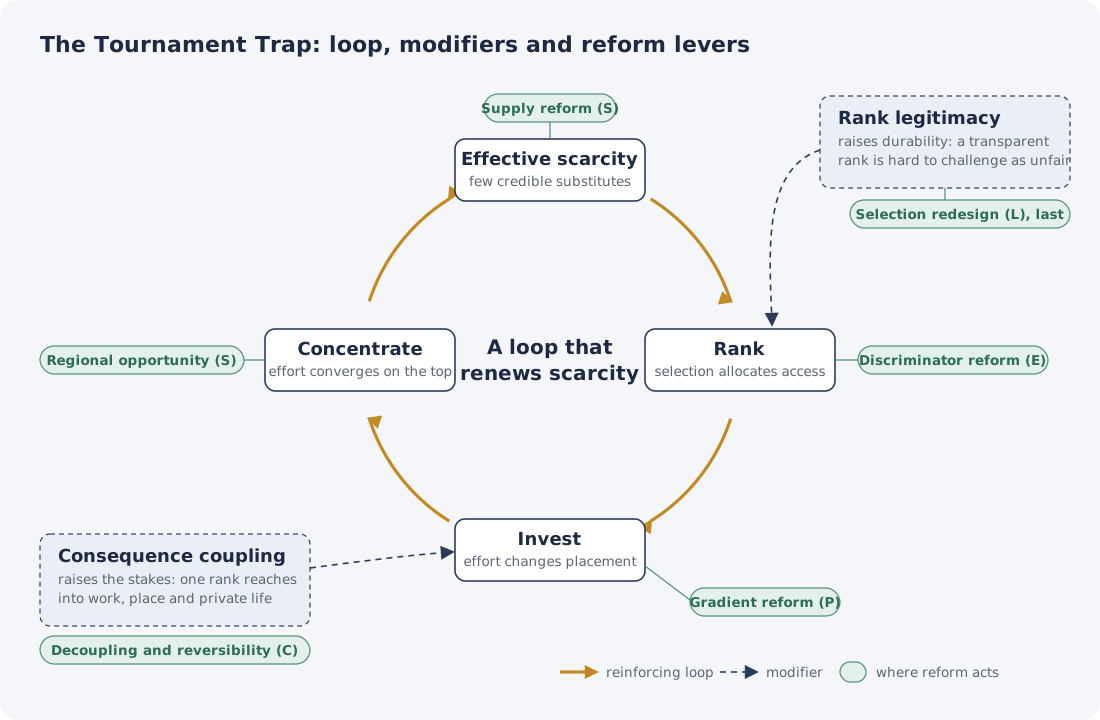
Effective scarcity means that few opportunities function as credible substitutes for the most valued pathways. Rank allocates access to them through procedures that effort can influence. Investment follows because prizes are steep and effort pays. Concentration follows because students, family spending, employers and institutional prestige orient toward the pathways that already offer the highest returns—and concentration renews effective scarcity, as the top pulls further ahead of the alternatives even while nominal capacity expands.

Two modifiers act on the loop from outside. Consequence coupling raises the stakes: because each rank changes several future domains at once, winning is worth more than the immediate prize, and the loop runs faster. Rank legitimacy raises the durability: because the allocation procedure retains a distinctive claim to fairness relative to the alternatives, the loop is protected from the challenge that might otherwise break it. Coupling explains why the contest is so intense. Legitimacy helps explain why it persists.

The Tournament Trap: a four-stage loop with two modifiers and the points where reform acts

Figure 2. The Tournament Trap. Effective scarcity, rank, investment and concentration form a reinforcing loop that renews scarcity even as nominal capacity grows. Consequence coupling raises the stakes of each ranking; rank legitimacy makes the loop durable. Green tags mark where each class of reform acts. Discriminator reform reaches only the ranking stage, and selection redesign is deliberately placed last.

For research purposes the architecture can be summarised in a diagnostic grammar:

T=f(P,  S1,  C,  E,  L)T = f(P,\;S^{-1},\;C,\;E,\;L)

where P is prize steepness, S effective prize supply, C consequence coupling, E effort responsiveness and L rank legitimacy. This is a decomposition, not an estimated equation, and its terms do different work. The first four determine how intensely the tournament is fought. Legitimacy determines, above all, how hard it is to change. No single term is sufficient. The Korean diagnosis concerns their joint configuration—which is also why Korea need not be the regional extreme on every variable. Taiwan's firm-size gradient is not flatter than Korea's on every measure; Japan's shadow-education participation is not far behind. What distinguishes the Korean case is the way university hierarchy, a divided labour market and metropolitan concentration reinforce one another, so that a single early ranking reaches far into adult life.

The grammar also sorts reforms by what they can touch. Discriminator reforms act on E, and only at the margin. Capacity reforms act on S, but only if the new capacity is substitutable. Labour-market reforms act on P. Decoupling reforms such as local-talent hiring act on C. Reforms to L are the most delicate of all, because the procedure that makes the tournament legitimate is the same one that makes it narrow.

This is where the diagnosis connects to the series' measurement programme. Paper VIII estimated that Korea's Variety Gap is widening despite sophisticated observation and fast response, and attributed that widening to disturbances emerging faster than the architecture adapts, alongside rising polarisation and a declining ratio of structural to symbolic reform. The Tournament Trap offers a candidate partial mechanism for part of that picture. Where reform concentrates on the discriminator, the opportunity structure can persist through intense and visible policy activity. And where the most legible allocation procedures are also the most legitimate, technically richer alternatives face a legitimacy cost before they face any other. Whether tournament-preserving reform actually accounts for the declining structural ratio would require coding Korea's reform portfolio over two decades, a task this report identifies but does not complete. The claim here is narrower: Korea's capacity to act is not in question. The Tournament Trap describes a domain in which that capacity is directed, again and again, at the part of the system easiest to reach.


3. What Building an Opportunity Architecture Would Look Like


3.1 The Principle: Work with Gongjeong, Not Against It

The Tournament Trap is not a product of Korean excess. It is the shadow of a Korean achievement: the conversion of scarce resources and intense collective effort into one of the most rapid ascents in modern history. Any transition that begins by attacking competition will fail twice. It will fail politically, because competition is bound up with the idea of fairness that Koreans have defended against privilege for generations. And it will fail analytically, because competition was never the problem. The problem is how much of a life depends on winning the same contest.

The organising principle follows directly from the diagnosis:

Do not abolish the tournament. Reduce how many futures depend on winning it.

This reframes the policy space. The objective is not equality of outcome, nor gentler exams, nor an exhortation to care less about rank. It is a plurality of viable pathways: enough credible routes to a good working life, a secure income and a place to live well that failing to enter one top-ranked pathway no longer collapses the options that remain. Selective universities can remain selective. Demanding firms can remain demanding. Professional standards can remain high. The question is whether the wider society offers enough alternatives that losing one contest is survivable.

Korea is unusually well placed to pursue this, because the two most powerful pieces of evidence in Section 2 are Korean policies. The 1995 capacity deregulation showed that changing effective scarcity changes behaviour at scale. The local-talent hiring rule showed that a downstream consequence of educational rank can be weakened by deliberate design. Neither required Koreans to value competition less. Both changed what winning buys. The transition architecture proposed here is the systematic extension of what Korea has already done well, in isolated cases, into a general principle of institutional design.

It must also meet a constraint that most reform agendas ignore. Every alternative to the existing ranking will be judged by gongjeong—by whether it is transparent, uniform and resistant to privilege. A reform that enriches assessment while making it more discretionary will be experienced not as progress but as a return of the backdoor. The standard every design below must meet is therefore demanding: it must widen opportunity and be at least as auditable as the system it replaces.

The grammar of Section 2 organises the options. Reforms can expand effective prize supply (S), flatten unnecessary prize gradients (P), weaken consequence coupling (C), or make early outcomes more reversible. Each is taken in turn below, followed by the two constraints that cut across all of them: care compatibility and legitimacy.


3.2 Effective Prize Supply: Another Seat, or Another Credible Future?

The first lever is the most thoroughly evidenced. When Korea expanded university capacity in the 1990s, tutoring fell substantially in the regions where capacity grew. When the added capacity failed to become a substitute for the metropolitan tier, competition for that tier continued to rise. The lesson is precise: expansion reduces the tournament to the extent that it adds substitutable opportunity.

Every capacity policy should therefore face a single test before it is adopted: does this create another seat, or another credible future? A regional university becomes a genuine substitute not when it has more places but when its graduates can reach high-quality employment, strong professional networks, serious research environments, good housing, transport and cultural life, and long-term career mobility—without first moving through Seoul. Effective prize supply is an ecosystem property. No education ministry can manufacture it alone.

Korea already has programmes whose structure is compatible with this insight. The Regional Innovation System and Education (RISE) programme shifts more university-support authority toward local governments and links it to regional development strategies. The Glocal University 30 initiative concentrates substantial multi-year investment in selected universities outside the capital, with the stated aim of creating regional institutions of genuine national standing. These are structural rather than discriminator reforms, and they deserve to be treated as such. Whether they succeed will depend on whether they raise effective supply or only nominal quality: whether their graduates' employment and career trajectories begin to converge with those of comparable capital-region graduates, and whether applicants who could choose Seoul begin to choose them instead.

The medical-school reform offers the same test in its sharpest form. The places added from 2027 onward will be routed through a regional-doctor track with a ten-year service obligation. If applications, entry scores, specialty choices and subsequent careers on that track converge with those of the unconditioned track, Korea will have expanded effective supply in its most coveted profession. If a persistent gap opens, it will have created a new tier inside the tournament rather than a new route out of it. The outcome is years away, but the prediction can be registered now, and the data to test it will exist.

The design principle generalises beyond education. Regional opportunity is not a set of subsidies for declining places; it is the construction of complete life packages—work, housing, schools, care, amenities and progression—that a capable person would choose on their merits. A few regions that genuinely meet that standard would do more to loosen the tournament than many that merely receive transfers.


3.3 Prize Gradients: Flatten What Rank Does Not Justify

The second lever acts on the value of winning. Section 2 showed that the Korean prize gradient is steep in large part because of the labour market's structure: the gulf between regular and non-regular contracts, between large firms and small ones, and a wage system that tracks tenure and employer size more closely than measured skill.

The aim is not to abolish differentiated rewards. Different work has different scarcity, difficulty and value, and a labour market that paid everyone alike would destroy information and incentive together. The aim is to ask, at each institutional boundary, whether a small difference in rank produces a much larger difference in security, benefits, progression and lifetime opportunity than the underlying difference in capability justifies. Where it does, the boundary is doing more work than its information warrants, and every family in the country has a rational reason to spend heavily to land on the right side of it.

Three directions follow. The first is to make social protection less dependent on the type of contract and the size of employer, so that security is attached more to the worker than to the badge. The second is to move pay systems away from seniority-based scales toward job- and skill-based structures. That would flatten the premium for having entered a large firm early and uninterrupted, and it would make later-demonstrated capability count for more than the credential presented at twenty-three. The third is to lower the barriers between the two sides of the dual labour market, so that a first job on the weaker side is a starting point rather than a sentence.

Korea has attempted labour-market reform repeatedly, through legislative packages, tripartite agreements and the expansion of social insurance, and it has proved among the hardest structural changes to achieve. Nothing in this report makes it easier. What the tournament diagnosis adds is a new reason to pursue it and a new metric for its success. Labour-market reform is usually justified in terms of productivity and fairness at work. It should also be evaluated by what it does upstream: whether flatter employment gradients reduce the pressure that families experience a decade earlier, in the hagwon districts and the suneung halls. The evidence that this effect exists is strong; the clean Korean test of its size has not yet been run. A reform that flattens a gradient should be designed so that the test can be run.


3.4 Consequence Coupling: One Rank, Fewer Consequences

The third lever is the one this report regards as most distinctive, because it acts on the property that makes the Korean tournament so consequential. The principle is simple:

Decouple where possible, rather than trying to perfect the original ranking.

The local-talent hiring rule is the proof of concept. It did not abolish university prestige or alter the suneung. It changed one downstream consequence of where a degree was earned, and the starting-wage gap between regional and Seoul-area graduates narrowed as a result. The same logic can be applied, and tested, at many other junctions where one rank propagates into another domain.

Korea already has instruments of this kind. Since 2017, public institutions have used blind recruitment procedures that remove university names and similar markers from applications, so that selection rests on job-relevant assessment rather than pedigree. Their effects on who is hired, and on the value of institutional brands in the wider labour market, deserve rigorous evaluation. If they work, the case for extending comparable practices to large private employers—through incentives, disclosure or procurement conditions rather than mandate—becomes strong.

Other decoupling routes include professional entry through multiple verified pathways rather than a single educational gateway; recruitment practices in large firms that weight demonstrated performance in earlier employment as heavily as the university attended; and career structures in which progression depends less on uninterrupted presence in one institutional track. In each case the question is the same: does this rank contain information relevant to this decision, or is it being used because it is available, legible and cheap?

The aim is not to erase information. A university admission does reveal something about a student's preparation and ability. The aim is to stop that single measurement, taken at eighteen, from propagating further than the information it actually contains—into hiring decisions at thirty, promotion decisions at forty, and the social judgments that follow a person for life. A tournament whose results travel less far is a tournament worth less to win, and one on which families will rationally spend less.


3.5 Reversibility: Make Losing at Eighteen Less Consequential at Thirty-Five

Consequence coupling is most costly when early outcomes are difficult to reverse. A rank at eighteen matters more if there is no credible way for the system to update its estimate of a person at twenty-five or thirty-five. A career interruption matters more if re-entry means a permanently weaker trajectory. A regional choice matters more if good employment later requires migration.

Reversibility is therefore the fourth design dimension, and it is where Korea's institutions are least developed relative to its ambitions. The routes are familiar from other systems: later entry into higher education with genuine standing rather than as a consolation; modular and stackable credentials; recognition of skills demonstrated at work; occupational conversion programmes; credible mid-career recruitment into large firms and the public sector; and structured re-entry after caregiving that restores access to the regular track rather than routing returners into non-regular employment.

Korea's vocational pathways show both the promise and the gap. Graduates of the Meister high schools, created to train skilled technicians in partnership with industry, have shown employment advantages of roughly 10 to 23 percent across six indicators compared with similar graduates of other specialised high schools, and the OECD describes Meister schools and the work-learning dual system as routes that can let young people bypass unnecessary credential competition. But participation remains small and employer demand uneven. The pathways exist. They have not yet become substitutes in the sense that matters—routes a capable, ambitious family would choose on their merits rather than accept as a fallback.

The deeper principle is that a system with high reversibility can retain demanding selection while lowering the lifetime stakes of any single selection event. That combination is precisely what Korea needs: it preserves the standards and the ambition the tournament produced while removing the terror that makes it so costly to enter.


3.6 Care Compatibility as Architecture

Section 2 established that Korea's career–family trade-off has independent causal standing and that it interacts with the tournament: steep career stakes raise the cost of interruption, dualism makes re-entry costly, and unequal care means the cost falls disproportionately on women. The design implication follows from the interaction rather than from any demographic target.

This report does not treat fertility as a quantity to be optimised or people as demographic inputs. It treats care compatibility as a structural property of the opportunity architecture: whether stepping away from the employment tournament, temporarily, destroys too much future option value. Korea has expanded family policy substantially—leave entitlements, childcare provision, cash support—and the OECD concludes that these measures have not been sufficient to make career and parenthood broadly compatible. The tournament diagnosis suggests why. Benefits paid during an interruption do not repair the damage the interruption does to a person's position in a steep, coupled and poorly reversible hierarchy.

The levers are therefore the same as those above, applied to the care boundary: flatter gradients between the regular and non-regular tracks, so that a return to work does not mean a fall between them; reversibility, so that a pause does not reset a career; working practices in which progression depends less on long, uninterrupted and inflexible presence; and a more equal distribution of care between parents, so that the cost of interruption is not structurally assigned to one of them. The objective is not more births. It is keeping more valued life paths mutually reachable—so that no one has to choose between a career and a family because the architecture has made the two incompatible.


3.7 Legitimacy and Rank Resolution: Stop Sorting Beyond the Information

Every lever above must pass the test set out in Section 3.1, and the most delicate of them concerns selection itself. The obvious reform—richer, more holistic admissions that see the whole person—runs directly into the Legitimacy Lock examined in Section 4. Korea tried it, and distrust of its discretion pushed policy back toward the exam. Any alternative selector must be at least as auditable and at least as resistant to privilege as the one it replaces.

There is a different route, and it begins from a question the tournament rarely asks: how much rank resolution does selection actually need? A national examination can distinguish between candidates at the top of the distribution to within a point or two. Whether those fine distinctions predict anything useful about later performance is an empirical question, and the answer may often be that they predict very little. Above a certain level of demonstrated competence, much of the contest may be spent resolving differences that carry more consequence than information.

One family of designs follows: establish a transparent competence threshold, verify that applicants above it are genuinely qualified, and, where fine ranking above the threshold adds little predictive value, allocate some places through a publicly auditable mechanism rather than ever finer distinctions. A lottery among qualified applicants is the purest version. It is procedurally transparent, and privilege cannot purchase its outcome. It would also remove the incentive to compete for margins beyond the threshold.

The international evidence is suggestive rather than decisive. The Netherlands used weighted lotteries for medical school admission for decades and reintroduced lottery as a permitted method in 2023, partly over concerns that qualitative selection had created unequal access. Dutch research finds that fine selection sometimes predicts somewhat better academic performance, but that among qualified applicants its advantage over lottery is often small. The Dutch experience also carries a warning: public anger at high-achieving applicants losing the draw contributed to the lottery's earlier abolition.

For Korea the decisive questions remain open. It is not known whether Korean applicants and families would regard a threshold-plus-lottery design as fair, nor whether it would reduce preparatory effort or merely shift the contest toward clearing the threshold. Both are testable, and a survey experiment comparing the perceived fairness of rank ordering, holistic selection and threshold-plus-lottery would be an inexpensive place to start. The design belongs, for now, in the category of serious experiments; Appendix B sets out the analogues. The broader principle is firmer than any particular mechanism: a system should not demand rank resolution beyond the point at which additional precision adds useful information, merely because it is capable of producing it.


3.8 Cultural Software Update: From One Fair Race to Many Fair Routes

Every transition in this series ultimately requires the cultural operating system to evolve without losing its strength. Korea's is unusually well suited to the task, because its core commitment—that advancement should be earned fairly rather than inherited or purchased—is exactly the value an opportunity architecture serves.

What must change is the scope of that commitment. Across Korea's long history of public examinations, from the gwageo to the suneung, one influential understanding of fairness has been one fair race: a single, public, uniform contest whose rules privilege cannot bend. That conception served the country well when the race led into an expanding world of opportunity. In a mature economy, where the race decides access to a bundle of futures whose supply grows slowly, it produces the exhausting fairness of the tournament: every contestant treated identically, and every contestant compelled to run.

The evolution this report proposes is from one fair race to many fair routes. Gongjeong would then mean not only that the exam is scored without favour, but that the opportunity structure offers more than one legitimate way to a good life—through a regional university that genuinely competes, a vocational route that genuinely leads somewhere, a second entry at thirty that genuinely counts. Hakbeol would give way, gradually, to a record of what a person has demonstrated over time rather than what they achieved on a single day in November. The spoon metaphor would lose some of its force, not because inheritance ceases to matter, but because losing the first contest no longer fixes one's position for life.

This is not a repudiation of the tournament's values. It is their extension. The fairest tournament is not the one with the most rigorous rules. It is the one whose loss is survivable.


4. The Political Immune System: The Legitimacy Lock


4.1 The Legitimacy Lock Defined

Every governance architecture develops an immune system: a set of institutions, incentives and norms that protect the existing order from challenge. In Germany the series found bureaucratic inertia; in Russia, the deliberate destruction of feedback channels; in the United States, a veto industry that profits from gridlock; in Japan, a Stability Bias woven through party, bureaucracy and corporate culture. In most of these cases the immune system can be traced, at least in part, to interests that benefit from the status quo and have the power to defend it.

Korea's is different in one important respect. If the Tournament Trap were sustained only by vested interests, its reform problem would be conventional: identify who benefits, change the incentives, compensate the losers where that is justified, and proceed. Vested interests exist, and Section 4.6 names them. But the architecture is protected by something more unusual as well. At least part of it is defended by the very public that bears its costs, and it is defended in the name of fairness.

This report calls the mechanism the Legitimacy Lock:

A relatively low-dimensional allocation mechanism persists partly because its simplicity makes it more auditable, and more procedurally credible, than richer alternatives.

The claim is deliberately bounded. The evidence supports the Legitimacy Lock as a real persistence mechanism; it does not establish it as the dominant reason Korea retains standardised ranking. Its importance lies less in how much it explains than in what it rules out. Any reform programme that assumes a richer conception of merit will automatically command greater legitimacy will collide with it. A tournament that feels unfair can be dismantled by political pressure. A tournament whose narrowness is the source of its perceived fairness mobilises that pressure in its own defence.


4.2 The Fairness Problem

University admissions reveal the dilemma most clearly.

A standardised examination such as the suneung cannot capture every form of human ability. It necessarily compresses variation. Creativity, collaboration, practical skill, persistence, leadership and many forms of specialised talent are hard to represent in a common score. A richer admissions architecture can observe more. Korean research bears this out: one study found that students admitted through holistic assessment performed better on several non-test dimensions than those admitted by other routes.

But a richer architecture also creates more places where judgment enters, and judgment raises a second question: who gets to judge, and who gets to shape the evidence being judged? Family resources can buy admissions consulting, extracurricular opportunities, prestigious internships, polished personal narratives, better-resourced schools and knowledge of how evaluators read ambiguous criteria. Each of these is invisible in a way a test score is not.

Korea confronted this directly in 2019. As distrust of student-record-based holistic admissions sharpened, the Ministry of Education announced a package explicitly framed around strengthening fairness and transparency in college admissions. It tightened the rules governing holistic evaluation and asked sixteen Seoul universities with heavy reliance on holistic and essay-based selection to raise the share of places allocated through the suneung to at least 40 percent. The reform had several causes, not one. But in its essential direction it is direct evidence that, in Korea, a demand for fairness can push policy toward the narrower measure.

The public mood behind that shift is real but not monolithic. A 2026 study in the Journal of Asian Studies describes transparent and objective selection through the suneung as central to ordinary Korean understandings of procedural justice in admissions, while documenting the ambivalence that accompanies it. A KEDI survey reported in June 2026 found that 25.8 percent of respondents believed the suneung should carry the greatest weight in admissions—more than chose school grades, character and service, special talents or interviews, but a plurality rather than a majority. Respondents who favoured the exam pointed to its uniformity and public scoring, and described record-based admissions as dependent on consulting, teacher discretion and the school a student happened to attend. Korean teachers, for their part, divide over whether fairness should mean reliability—the consistent application of a transparent measure—or validity, capturing a fuller picture of the student.

Koreans do not unanimously prefer exams, and this report does not claim they do. The point is structural. Standardised examination has a distinctive fairness constituency because it occupies a distinctive institutional position: its limitations are visible. Everyone knows an exam is only an exam. The procedure is explicit, the score can be audited, and the evaluator has little room to reinterpret an applicant's life after the fact. A richer process may be educationally better while making unequal access harder to see. The selector gains dimensions and can lose credibility.


4.3 Paper VI Meets Paper XIII

The Legitimacy Lock exposes a genuine tension inside the Governance as Engineering framework, and the tension is worth stating precisely because it changes what reform should aim for.

Paper VI treats an objective function as an observation architecture. A system that compresses many relevant dimensions onto a few narrow measures becomes blind to whatever those measures cannot represent. Read alone, Paper VI prescribes an obvious remedy for Korea: raise the effective dimensionality of allocation. Observe more.

Paper XIII adds a constraint. It treats legitimacy operationally, as a property of the control loop rather than a moral ornament on it. The effectiveness of governance depends partly on whether people regard institutional signals and procedures as credible enough to comply with them and report into them honestly. Legitimacy behaves like a gain parameter: when it falls, the same institutional machinery achieves less.

Put the two papers together and a higher-dimensional architecture is no longer automatically a higher-capacity one. If the added dimensions are discretionary, opaque, corruptible, inaccessible to outsiders or systematically favourable to families with more resources, the system gains information while losing legitimacy, and the net effect on its capacity to govern allocation can be negative. The design problem is therefore not a choice between low-dimensional and high-dimensional selection. It is:

How can useful dimensionality be increased without increasing gameable discretion?

The problem is sharpest where stakes are highest, and here the Legitimacy Lock connects back to consequence coupling. The more a university place determines later opportunity, the more rationally families invest in mastering whatever signals the selector accepts—and the more dimensions a selector has, the more surfaces there are to master. Increasing dimensionality in a high-stakes tournament can simply create more dimensions to game. This is why the Tournament Trap cannot be solved by improving the tournament. Reducing the stakes, through the supply, gradient, coupling and reversibility levers of Section 3, is what makes richer selection affordable in legitimacy terms. The order of operations matters: lower what winning buys, and the case for judging contestants more fully becomes far easier to make.


4.4 Why Governments Reach for the Discriminator

The immune system also explains the discriminator treadmill described in Section 2.5. Governments reach first for exam content, tutoring rules and admissions formulas not because they misunderstand the problem but because those levers have a set of properties that structural levers lack.

They are within reach. A ministry can change the suneung's question types or a hagwon closing time by administrative decision. Labour-market dualism, the geographic distribution of good employment, employers' dependence on university brand and the reversibility of early career setbacks are spread across many institutions, most of them outside the education ministry's control.

They are fast. A discriminator reform can be announced, implemented and seen within a single administration. Structural change works on the timescale of cohorts and careers. In a system where presidents serve one five-year term, the political return on a visible reform that can be completed within the term is structurally higher than on one whose effects will appear under a successor.

They are legible. A change to the exam is something every family understands immediately. A change to effective prize supply in a regional labour market is abstract until, years later, it is not.

And they are procedurally safe. Because they operate on the ranking rather than on the rewards, discriminator reforms leave the relative value of existing credentials, jobs and assets largely intact. They rarely produce identifiable losers. Structural reforms almost always do.

None of this makes procedural reform pointless. It means its expected effect should be judged against what remains unchanged beneath it. It also suggests one way the Tournament Trap may contribute to the pattern Paper VIII observed: a declining ratio of structural to symbolic reform in a state whose capacity to act is not in doubt. When the levers within reach are the ones that change least, a highly responsive government can produce a great deal of reform while the architecture it is reforming stays recognisably the same. Whether this accounts for Paper VIII's finding would require a systematic coding of Korea's reform portfolio. It is offered here as a candidate mechanism, not a demonstrated one.


4.5 Sunk Investment Without Villains

Legitimacy is not the only stabiliser. The existing architecture also contains enormous sunk investment, and that investment is distributed across millions of ordinary lives.

Families have spent money, years and a good deal of their identity on pathways whose value depends partly on the rules staying recognisable. A parent who has paid for a decade of tutoring has a rational interest in the credential that tutoring bought retaining its worth. Universities have built reputations whose value derives partly from scarcity. Employers have designed recruitment systems around familiar signals that are cheap to read. Housing markets have capitalised access to good schools and good jobs into property prices. Professionals have invested years in qualifications whose value depends partly on controlled entry.

None of these actors needs to be malicious. Each is responding to institutional assets whose value depends on continuity. The result is the classic transition problem:

A reform can improve the future equilibrium while imposing concentrated losses during the transition.

If previously scarce credentials become less decisive, their holders lose positional advantage. If regional opportunity grows, capital-region assets lose part of their premium. If labour-market dualism narrows, insiders may trade some security for a broader distribution of opportunity. If admissions become less rank-resolving, families who invested heavily in producing fine rank experience the change as a retrospective alteration of the rules—and in a society attuned to gongjeong, a rule changed after the race has been run is itself a fairness violation. Sunk investment and the Legitimacy Lock reinforce each other at exactly this point.

The medical-school disputes illustrate how these forces combine without resolving which dominates. Each attempt to expand supply met resistance that included substantive objections—training capacity, working conditions in essential specialties, the regional maldistribution that more graduates would not automatically cure—alongside the ordinary interest of any profession in the terms of its own entry. This report does not attempt to weigh those motives, and Appendix F sets out the case and its competing interpretations. The structural point stands independently of motive: when an institution tries to change the supply of a highly valued position, it collides simultaneously with legitimate concerns about quality, with the interests of incumbents, and with the expectations of everyone who has invested in the pathway as it was. That is what an immune system looks like when no one needs to be a villain for it to work.


4.6 Who Benefits from the Status Quo—Named Honestly

The series names the beneficiaries of each immune system, and Korea's deserve the same candour, with one qualification that is peculiar to this case: many of those who benefit from the tournament also pay for it.

Holders of scarce credentials benefit from their scarcity. Graduates of the most prestigious universities, and the families who invested in getting them there, hold an asset whose value depends on how few others hold it and how far it propagates into employment and social life.

The elite universities benefit from a system in which selectivity itself is a source of prestige. Their standing rests partly on the quality of their teaching and research, and partly on the number of applicants they turn away.

The private-education industry benefits directly from the intensity of the contest. An industry turning over nearly ₩30 trillion a year has an obvious stake in the continued value of fine rank distinctions, and frequent rule changes can generate new demand for preparation.

Owners of capital-region property, particularly in the neighbourhoods with the most sought-after schools and the densest access to good employment, benefit from the concentration of opportunity that the tournament reinforces.

Insiders of the dual labour market—regular employees in large firms and the public sector—benefit from the security and progression that the gradient confers, and from the barriers that keep that security scarce.

Professions with controlled entry. Controlled entry can confer scarcity value on professional credentials, alongside legitimate concerns about training quality, standards, working conditions and service capacity. This creates a potential material interest in entry rules without establishing that scarcity preservation is the motive for opposing reform.

And the qualification: these groups overlap heavily with the people the tournament exhausts. The parent in Daechi-dong who pays for three hagwons is both a beneficiary of the system's rewards and its most anxious contributor. The regular employee at a conglomerate has children entering the same contest. The immune system is not a coalition of winners against losers. It is a population that has learned to invest in the architecture because the architecture punishes those who do not, and that therefore experiences any change to it as a threat to what it has already paid. This is why reform cannot be framed as taking something away from a privileged few. In the Korean tournament, almost everyone is holding a stake.


4.7 The Real Immune System

Taken together, the Tournament Trap's persistence comes from several interacting sources rather than one. Legibility: transparent ranking can look fairer than discretionary alternatives. Sunk investment: people have built real lives around the existing rules. Signal dependence: employers and institutions use established rankings because replacing them is costly. Concentration: opportunity accumulated around top institutions and places reinforces their advantage. Transition losses: decoupling redistributes value before a new equilibrium exists.

This gives Korea's reform problem a distinctive shape. The architecture persists not because nobody sees its costs—Korea sees them with painful clarity—but because changing it threatens procedural fairness, established expectations and real institutional value at the same time. A transition that ignores those constraints will provoke resistance that is not merely self-interested but principled. A transition that respects them must do something harder than dismantling the tournament: it must build alternatives that are not only broader but at least as credible.


4.8 The Narrative Strategy

How reform is framed will determine whether it triggers the immune system or passes beneath it. Five principles follow from the analysis.

Frame reform as an extension of fairness, not a retreat from it. Any proposal presented as "reducing competition" or "easing pressure on students" will be heard as lowering standards or opening a backdoor for privilege. The case should be made in the language of gongjeong itself: the fairest system is not merely one in which a single race is run cleanly, but one in which there is more than one fair route to a good life, and in which losing at eighteen does not decide the rest.

Do not attack the winners. The elite universities, the professions and the families who invested under the existing rules did what the architecture asked of them. Reform that singles them out converts a structural problem into a moral contest and unites every stakeholder in defence. The objective is not to make the top less excellent, but to make it less exclusive as a gateway to everything else.

Lead with Korean evidence. The strongest arguments for structural reform are Korea's own: the 1995 capacity deregulation that reduced tutoring at scale, the local-talent hiring rule that narrowed the regional wage gap. These are not imported theories. They are demonstrations, on Korean ground, that changing what winning buys changes behaviour.

Protect expectations during transition. Because a rule changed after the race is itself a fairness violation, reforms to selection should be announced well ahead of the cohorts they affect, phased, and designed so that families who invested under the existing rules are not retrospectively penalised. Structural reforms to supply, gradients and coupling carry less of this risk, which is one more reason to lead with them.

Present the transition as the next stage of development. Korea's national story is one of deliberate, collective ascent. The tournament was an instrument of that ascent, and the case for changing it should be framed not as a repudiation but as the same developmental ambition applied one level higher: from mobilising a nation through scarce gates to building enough gates that its capability no longer has to crowd through them.

The immune system cannot be defeated by argument alone. But it can be reassured, and much of it can be recruited. Most of the people who defend the tournament do so because they cannot see a fair alternative. The task of the transition is to show them one.


5. Working with the Grain: Transition Architecture for South Korea


5.1 The Principle: Start Where Coupling Is Already Loosening

The Tournament Trap is formidable, but it is not uniform. Section 2 showed that the premium attached to a capital-region degree is weaker, or absent, for students from regions with strong local economies; that a single hiring rule narrowed the wage gap between regional and Seoul-area graduates; and that Meister-school graduates can outperform comparable peers in the labour market. In each case, somewhere in Korea, one link of the tournament is already looser than the national average. The transition should start there—not because those places are sufficient to transform the system, but because they provide the proof of concept, the demonstration sites and the political legitimacy that scaling requires.

The way Korea transforms itself also differs from the way Japan does. Japan's transitions, the Japan report argued, move through incremental refinement and patient consensus. Korea's developmental history suggests another pattern: designate a strategic priority, concentrate resources on a small number of demonstration efforts, and—once results are visible—scale at a speed few countries can match. Korea's developmental history repeatedly demonstrates this capacity: to designate strategic priorities, concentrate resources and scale implementation rapidly once political commitment is established. The transition architecture should use that capacity rather than fight it. Its early phase should be deliberately narrow and evidentiary; its later phase can be fast.

The immune system described in Section 4 sets one condition on the early phase. Because the tournament is defended in the name of fairness, nothing in the first wave should change how any individual student is ranked. The first wave should change what rank buys—through supply, coupling and reversibility—in places and institutions that volunteer for it. Selection itself comes last.


5.2 The Trojan Horse: Fairness Infrastructure

Every transition architecture in this series has identified a Trojan Horse: a mechanism that carries a transformative payload in familiar packaging, so that the immune system recognises it as friend rather than threat. In Japan it was kaizen applied to governance. In Finland it was a futures assessment embedded in the budget cycle.

In Korea the Trojan Horse is fairness itself. One of the most important sources of legitimacy protecting the tournament is a procedural understanding of gongjeong: the demand that privilege should not bend a common rule. A promising way to work with that constraint is to frame decoupling, reversibility and effective supply as extensions of fairness rather than departures from it—which, on the analysis of this report, they are. Korea has already done this once. Blind recruitment in public institutions was introduced and defended as a fair-hiring reform, not as an attack on university prestige, and by removing university names and similar pedigree signals from applications it is explicitly designed to weaken one channel through which educational rank propagates into hiring. Whether it has materially changed broader employment stratification requires separate evaluation. The same framing can carry much more.

A decoupled hiring practice is fair recruitment: judging applicants on what the job requires rather than on a ranking made years earlier. A re-entry pathway after caregiving is fairness across the life course: the principle that one interruption should not cost a lifetime. A regional university that genuinely competes is fairness of place: the principle that where one was born should not decide which futures are reachable. A later-entry route into higher education is second-chance fairness. None of these asks Koreans to value fairness less. Each asks them to apply the value they already hold to more of the architecture than the exam.

The framing is not a disguise. It is a translation. It renders the report's structural diagnosis in the moral vocabulary that Korean public debate already uses, so that the argument for change arrives in the same language as the argument against it.


5.3 Safe-to-Fail Pilots: Opportunity Regions

What follows is one illustrative architecture consistent with the diagnosis, not the only institutional design capable of meeting it. Its centrepiece is a small network of Opportunity Regions: designated metropolitan areas outside the capital where a coalition of provincial government, regional universities and anchor employers commits to building a complete alternative to the Seoul pathway, and to measuring whether it works.

The designation should build on what exists rather than replace it. RISE is already moving university support toward provincial governments; Glocal University 30 is already concentrating investment in selected non-capital institutions; relocated public institutions already operate local-talent hiring. An Opportunity Region would bind these instruments together around a single objective—raising effective prize supply—and add the elements they currently lack.

The package would have four parts. Decoupled recruitment: anchor employers, public and private, commit to job-relevant recruitment that does not screen on university name, and to recruiting a meaningful share of graduates from the region's own institutions. A complete life offer: housing, transport, childcare, schools and amenities planned together, because a capable graduate chooses a life, not a job. Reversibility routes: mid-career entry into anchor employers, recognised skills credentials and structured re-entry after caregiving, so that the region offers second chances the capital's tournament does not. Protected continuity: a statutory designation for at least ten years, with dedicated multi-year funding, so that the region's commitments outlast any single administration.

The candidates should be diverse by design. A research-intensive city built around its universities and laboratories, an industrial region anchored by large manufacturers in the southeast, and a smaller region with weaker starting conditions would together test whether the model works only where effective supply is already relatively high. A pilot that succeeds only where success was likely proves little.

Evaluation is what makes the pilots safe to fail, and it should measure effective supply directly rather than inputs or satisfaction. The questions are behavioural. Do capable students who could enrol in the capital choose the region's universities instead? Do the region's graduates stay? Do their wages, employer size and career progression converge with those of comparable capital-region graduates? Does private-tutoring expenditure among the region's families fall relative to similar regions? If the answers are no, the designation should be revised or ended, and the evidence published. If the answers are yes, the region becomes the most persuasive argument for structural change that Korea could produce.

A second, smaller pilot track concerns selection, and it follows the sequencing rule of Section 5.1. Before any change to how students are ranked, the fairness of alternatives should be tested directly: a national survey experiment comparing how Koreans judge rank ordering, holistic selection and competence-threshold-plus-lottery designs. Only if that evidence shows a credible legitimacy base should a university volunteer a small share of places in an oversubscribed programme for a threshold-based pilot, announced several years in advance and evaluated for both academic outcomes and preparatory behaviour.


5.4 Scaling by Attraction—and a Different Kind of Ranking

Korea's institutions compete intensely, and that competitive energy can be redirected rather than suppressed. Universities, regions and employers already watch each other closely and respond quickly to rankings of every kind. The transition can use that instinct.

The mechanism is to rank what matters. Alongside the familiar league tables of universities by selectivity and research output, the state and independent bodies could publish measures of opportunity: which regions retain and attract graduates, which employers recruit across the widest range of institutions and routes, which universities add most to their graduates' outcomes relative to their intake, which firms offer credible mid-career entry and re-entry after caregiving. These rankings apply to institutions, not to individuals. They add no new contest for students to prepare for. Instead, they make the institutions compete on the dimensions that loosen the tournament.

Success would then spread the way Korean success usually spreads. An Opportunity Region that visibly retains talent attracts employers; a large firm that recruits credibly beyond the elite universities gains access to talent its competitors overlook; a university that becomes a genuine substitute draws applicants who would once have queued for Seoul. Each demonstration raises the pressure on peers to follow, without a mandate from the centre. The state's role is to fund, measure and celebrate, and—once the evidence is strong—to scale at the speed Korea has shown it can.


5.5 Sequencing: Lower the Stakes Before Changing the Selector

The order of operations matters more in Korea than in most of the series' cases, because the Legitimacy Lock makes the most obvious reform—changing selection—the most dangerous one to begin with. Section 4.3 argued that lowering what winning buys is what makes richer or less rank-resolving selection affordable in legitimacy terms. The transition should follow that logic in four overlapping phases.

First, make the architecture visible. The Tournament Audit proposed in Section 6 establishes where prize gradients are steepest, where effective supply is thinnest and where coupling reaches furthest. It changes nothing for any family, and it creates the evidence base without which every later reform will be argued from anecdote.

Second, expand effective supply and loosen coupling where volunteers exist. Opportunity Regions, decoupled recruitment and reversibility routes act on what rank buys, not on how it is decided. They create no retrospective losers among families who invested under the existing rules, and they generate the Korean evidence that later phases will need.

Third, flatten the gradients that rank does not justify. Labour-market and pay-system reforms are the hardest politically and the slowest to show effects, but they are also the most powerful upstream lever. By this phase they can be argued not only on productivity and fairness grounds but on the measured evidence of what flatter gradients do to competition a decade earlier.

Fourth, and only then, reform selection. With stakes lowered, richer assessment is less exposed to gaming, and designs that resolve rank less finely are less threatening to families. Any change should be announced years ahead of the cohorts it affects, so that no one experiences it as a change of rules after the race has begun.

The phases overlap; none needs to wait for the previous one to finish. But the direction of travel should be clear. The historical instinct of Korean reform has been to begin with the selector, because it is the lever within reach. The transition architecture reverses that order.


5.6 The Role of the Centre: Commit Beyond the Term

The centre's most important contribution is not a programme but a commitment that survives changes of government. Structural reform of the tournament works on the timescale of cohorts: an Opportunity Region designated today will show its clearest results in the careers of students who are now in primary school. Korea's political system changes presidents every five years and has shown, as recently as 2025, that it can change them faster still. A transition that depends on one administration's enthusiasm will be abandoned by the next, and the tournament's immune system knows it.

The centre should therefore do four things. Legislate the frame, not the details: a statutory basis for Opportunity Regions and the Tournament Audit, with fixed terms and protected funding, so that they cannot be quietly defunded by a successor. Separate measurement from government: place the audit and pilot evaluations with an independent body whose publications do not require ministerial approval, so that evidence accumulates regardless of who governs. Enable rather than mandate: provide authority, funding and regulatory flexibility to regions and employers that volunteer, rather than imposing a single national model. Scale decisively once the evidence is in: when the pilots show that effective supply can be raised and coupling loosened, use the state's formidable capacity for coordinated action to extend what works nationally.

That final step is where Korea's distinctive strength returns. Few countries could take a demonstrated regional model and scale it across a nation within a decade. Korea has done comparable things before, when the goal was clear and the evidence convincing. The purpose of the transition architecture is to make the goal clear and the evidence convincing—and then to let the country's capacity for collective mobilisation do what it has always done best, aimed this time at widening the gates rather than crowding through them.


6. A Concrete First Step: The Tournament Audit


6.1 The Logic of the First Step

The Tournament Trap is a systemic condition, not a single policy failure, and no one reform will dissolve it. The first step should therefore not be the most ambitious intervention this report has described. It should be the most catalytic: the one that targets the trap's mechanisms most directly, that can pass through the immune system of Section 4 without triggering it, and that, once established, generates the evidence and the constituencies that make every later step easier.

Two tempting candidates fail that test. A new demography commission would add another body to a policy field already crowded with plans, committees and strategies—and, as Section 2.8 argued, it would aim at an outcome in which the tournament is only one of several causes. A direct reform of university admissions would walk straight into the Legitimacy Lock, changing the rules of the most scrutinised contest in the country before anyone had shown what the change would buy.

The first step proposed here does neither. It changes nothing for any family, student or employer. It asks a question Korea has never systematically answered:

What does winning actually buy—and where does a small difference in rank produce a large difference in later life?

A government that set out to "reduce competition" would immediately face the question: which competition? Some competition reveals useful capability. Some reflects genuine scarcity. Some encourages learning. Some merely resolves rank among people who are all qualified. And some looks excessive only because the rewards downstream of it are unusually steep. Before any of these can be addressed, they have to be told apart. The Tournament Audit is the instrument for telling them apart.


6.2 What the Audit Would Measure

The audit would not give Korea a single competitiveness score. It would map specific allocation systems—beginning with the passage from school through university to first employment—along the five dimensions developed in Section 2.

Prize steepness (P): how different are the downstream outcomes—earnings, contract type, employer size, benefits, progression—attached to adjacent ranks? The quantity that matters is not inequality in general but the gradient at each boundary: how much more the next rank up is worth.

Effective prize supply (S): how many outcomes function as credible substitutes for the most sought-after ones? This must be measured behaviourally, not by counting places: through application concentration, revealed preference, enrolment choices among students who could go elsewhere, transfer behaviour, graduate outcomes and willingness to relocate.

Consequence coupling (C): which other domains become easier or harder to reach after a given rank? For the educational tournament this means estimating how university rank and location propagate into employer type, earnings, occupation, region of residence, later educational access and career stability—separating, wherever the data allow, causal estimates from simple association.

Effort responsiveness (E): how far can additional private investment change rank? Tutoring expenditure, preparation time, repeated applications and strategic choices of subject or institution reveal whether families are buying real improvements in placement or spending into ever smaller marginal returns.

Rank legitimacy (L): how legitimate do those affected regard each selection procedure—not whether they are satisfied with their result, but how they judge its transparency, equal treatment, predictability, resistance to privilege and informational validity? A procedure can be unpopular because someone lost and still be regarded as fair. The audit must be able to tell the difference.

Higher education is the natural starting domain because Korea already holds an unusually rich evidence base for it. The 1995 capacity deregulation gives causal evidence on effective supply. University wage and employment studies bear on prize steepness and coupling. The national private-education expenditure survey tracks effort. The admissions controversies of the past decade bear on legitimacy. The local-talent hiring rule offers a measured instance of deliberate decoupling. Graduate mobility surveys already follow young people from university into work. Few policy domains anywhere begin with such a substrate. What is missing is not data but an institution whose job is to assemble it around one question.

The audit's central output would be a set of rank-consequence maps: for each major allocation boundary, a picture of how much a given difference in rank changes the reachable set of later outcomes, and which of the five dimensions is responsible. The maps would not declare any university too prestigious or any level of competition acceptable. They would show where rank carries information and where it carries consequences out of proportion to that information.


6.3 Classifying Reforms: What Is This Reform Able to Change?

The audit's second function would be to change how reforms are proposed and judged. Every major reform touching education, youth employment, regional policy or professional entry would be required to state which part of the tournament it acts on:

  • the discriminator—how contestants are distinguished (exam content, admissions formulas, tutoring rules);
  • prize supply—how many genuinely attractive outcomes exist;
  • prize steepness—how consequential winning is;
  • consequence coupling—how far one rank reaches into other domains;
  • reversibility—how hard it is to recover from, or re-enter after, an early outcome.

The classification would prevent very different interventions from being grouped under labels such as "education reform", and it would change the question asked of each. Instead of did the reform pass?, the question would become which causal link moved? A discriminator reform that alters exam content but leaves total competitive expenditure unchanged would yield one verdict. A regional reform that raises graduate retention and narrows the wage penalty for regional education would yield another. Over time the record would show which kinds of intervention loosen the tournament and which merely change its form.

The audit's first major task should look backwards. Paper VIII observed a declining ratio of structural to symbolic reform in Korea, and Section 4.4 suggested that the discriminator treadmill may contribute to it. That suggestion can be tested. Coding Korea's reform portfolio across education, labour and regional policy over the past two decades, using the five-way classification, would show how much reform effort has gone to each lever, how outcomes differed by lever, and whether the pattern supports or refutes the mechanism proposed in this report. It is the single most valuable piece of evidence the report cannot supply itself, and the audit is the natural institution to produce it.


6.4 Institutional Design

The audit's credibility depends on its independence, and its usefulness depends on its access to data. The design should secure both without building a large new bureaucracy.

The audit would be a small statutory unit with a fixed mandate and fixed-term leadership, appointed through a cross-partisan process so that no single administration owns it. It would draw on the capacity Korea already has—the government-funded research institutes for economics, education and vocational training, the national statistics authority, and university researchers—rather than duplicating it. It would publish its maps, its reform classifications and its evaluations without ministerial clearance, and government would be required to respond publicly to its principal findings, though never bound by them.

Data access is the hardest design problem and the most important. The audit's value lies in linking outcomes across domains—education to employment, employment to residence, career interruption to re-entry—which is precisely what consequence coupling requires. That calls for secure access to linked administrative microdata under strong privacy protections: de-identified records, controlled research environments, published access rules and independent oversight. Korea's administrative data infrastructure is among the most sophisticated in the world. The audit asks it to be used for a purpose it has not yet been assigned: making the opportunity architecture visible to the society it governs.

The design is deliberately modest. The audit has no power to change admissions, pay or regional policy. Its only instruments are measurement and publication. That modesty is what allows it to pass the immune system. No family loses anything when the audit is created. No credential is devalued, no rule changed after the race. And yet, once it exists, every future reform will be argued on the basis of what winning actually buys rather than on the basis of anecdote and anxiety.


6.5 Registered Predictions

The audit should begin by publishing predictions before outcomes are known. The practice guards against a failure common to reform evaluation: explaining results after the fact in whatever terms fit them. It also commits this report's diagnosis to the same test.

Three predictions are ready to register now. The regional-doctor track: if the places added from 2027 become genuine substitutes, applications, entry scores, specialty choices and later careers on the conditioned track will converge with those on the unconditioned track; if a persistent gap opens, the reform will have created a new tier within the tournament rather than new supply. Opportunity Regions: if they raise effective supply, capable students who could choose the capital will increasingly choose them, graduates will stay, and private-tutoring expenditure among local families will fall relative to comparable regions. Selection legitimacy: a survey experiment comparing rank ordering, holistic selection and threshold-plus-lottery will show whether a less rank-resolving design commands a credible base of perceived fairness in Korea—or whether, as the Dutch experience warns, it does not.

Each prediction can fail. That is the point. The Tournament Trap is offered as a diagnosis that evidence should be able to weaken, revise or overturn, and an audit that registers its predictions in advance gives the evidence that chance.


6.6 What the Audit Would Not Do

The audit would not determine what Koreans ought to value. It would not declare particular universities too prestigious, define an acceptable level of competition, or produce a technocratic formula for allocating people's lives. It would not convert correlations into causal judgments without the evidence to support them.

Its purpose is narrower: to make the opportunity architecture visible, so that political choices can distinguish between fundamentally different problems. If excessive effort is driven mainly by thin effective supply, supply becomes the priority. If the main driver is prize steepness, the labour market moves to the centre. If coupling is the problem, decoupling mechanisms matter most. If an alternative selector fails because it lacks legitimacy, redesign must address auditability rather than simply adding dimensions. The audit does not choose among these. It shows which choice the evidence is about.


6.7 How to Measure Success

The audit's own success should be judged on a five-year horizon, by whether it changes how Korea argues about its tournament rather than by any direct change in competition.

Five markers would indicate that it is working. The retrospective coding of the reform portfolio has been published and debated. Baseline rank-consequence maps exist for the passage from school to first employment. Major reform proposals routinely state which lever they act on. At least one structural reform—an Opportunity Region, a decoupled recruitment scheme or a reversibility route—has been evaluated against the audit's measures. And public debate has begun to ask not only how students should be ranked but what their rank should buy.

That last marker matters most. The discriminator treadmill persists partly because the question Korean public debate asks, cycle after cycle, is how to make the contest fairer. The Tournament Audit exists to add a second question alongside it. Once a society begins to ask what winning buys, and has the evidence to answer, the case for making winning buy less becomes something it can argue about in the open—and, in time, something it can decide.


7. Coda: The Champion of the Tournament at the Frontier of Plurality


7.1 The Wealth That Matters

South Korea is rich in something most societies struggle to produce: the capacity to direct the effort of an entire people toward a shared purpose, and to sustain that effort across generations. Families invest in their children with a seriousness that has few parallels. Institutions mobilise quickly and execute with discipline. The state observes, decides and acts at a speed that many richer democracies cannot match. And beneath all of it runs a moral commitment that has survived dynasties, colonisation, war, dictatorship and democratisation alike: the conviction that advancement should be earned fairly, through a contest anyone can enter, rather than inherited or bought.

These are not small assets. They are the reason the Tournament Trap is a story of success confronting its limits rather than a story of failure. Korea's tournament converted a poor, war-damaged country into a technological frontier economy and a combative democracy with strong capacity for constitutional correction within a single lifetime. It did so by asking an extraordinary amount of its people—and by giving them, for most of that period, a reasonable expectation that the effort would be rewarded, and that the rewards would grow as the country grew.

But the wealth that matters in the next era is not only the capacity to mobilise effort. It is the capacity to give that effort somewhere to go. A society that can make its people run harder than almost any other must also be able to offer them more than one finish line. Korea has mastered the first capacity. The second is the frontier.


7.2 The Shift

The shift this report describes is not a change of exam format, admissions formula or tutoring rule. Korea has made those changes many times, and the tournament has absorbed them. The shift is in what the society asks of its opportunity architecture: from allocating scarce futures fairly to making good futures less scarce.

The developmental architecture was built for a specific historical task: to mobilise a nation into rapidly expanding productive opportunity under conditions of acute scarcity. For that task, relatively legible and competitive selection mechanisms had substantial functional advantages: they could mobilise effort, allocate scarce educational and administrative opportunities, and align individual advancement with an expanding developmental project. They were never socially neutral or perfectly meritocratic, but they contained a much larger positive-sum component than the mature tournament does today. The task has changed. Korea is no longer catching up. It is a mature society at the technological frontier, and the number of highly prized positions no longer grows faster than the number of capable people competing for them. Under those conditions the same ranking, run with the same fairness, produces a different result: ever greater effort spent on deciding who receives rewards whose supply is roughly fixed, and ever more of a life made to depend on the outcome.

This is not a repudiation of the developmental legacy. It is the extension of its deepest logic. The architects of Korea's ascent did not inherit an opportunity structure and defend it. They built one—deliberately, at speed, with a clear view of what the conditions of their time required. The task now is to do the same again, one level higher: not to concentrate a nation's capability through a few gates, but to build enough gates that its capability no longer has to crowd through them.


7.3 The Wider Significance

Korea's tournament is not unique, and this report has been careful not to claim that it is. Taiwan has fertility almost as low, a cram-school culture almost as pervasive and an industrial structure that shows the pattern does not depend on conglomerates. Japan has its own examination hierarchy, its own divided labour market and its own shrinking cohorts. Mainland China has popularised its own word—neijuan, "involution"—for competition that intensifies without producing more of what is being competed for. The components of the Korean tournament are shared across much of East Asia, and increasingly beyond it, wherever mass higher education meets a mature economy and a slowly growing supply of secure, well-rewarded positions.

What makes Korea significant is that it shows the configuration with unusual clarity. In Korea the links are visible: a causal natural experiment connecting the scarcity of university places to private tutoring, a measured policy that loosened one link between university location and wages, a fairness politics that pushed admissions toward the narrower measure precisely because it was harder to game. Korea is therefore not only a case of the trap. It is a laboratory for the escape. If a society with Korea's state capacity, its democratic responsiveness and its commitment to fair competition can show that raising effective supply, flattening gradients and loosening coupling reduce the tournament's cost without sacrificing its standards, it will have produced a model that every credential-intensive society will need. If it cannot, the implication for its neighbours is sobering.


7.4 The Honest Conclusion

This report has proposed a diagnosis, and it must be honest about what the diagnosis does and does not establish.

The core of it rests on solid ground. The scarcity of competitively valued university places causally affects private-tutoring demand in Korea. Educational rank and location are associated with substantially different employment outcomes. Opportunity is heavily concentrated in the capital region. Standardised ranking has a distinctive fairness constituency, and fairness concerns have pushed policy toward it. At least one link between educational rank and later reward has been measurably loosened by deliberate policy.

Other parts remain open. The Legitimacy Lock is a supported persistence mechanism, not an established dominant cause. The claim that structural reforms outperform discriminator reforms is suggestive, not proven. Whether less rank-resolving selection would be accepted as fair in Korea is unknown. Korea's career–family trade-off has independent causes that this report does not claim to explain. And the Tournament Trap is offered as one candidate partial mechanism behind the widening Variety Gap that Paper VIII estimated—not as its explanation. The Tournament Audit and its registered predictions exist precisely so that these open questions can be settled by evidence rather than by the persuasiveness of a diagnosis.

Korea can loosen the Tournament Trap. The evidence that its links respond to policy already exists, much of it produced by Korean reforms. The state capacity to scale what works is formidable. The fairness commitment that protects the tournament is also the commitment most likely, once extended, to reshape it. But the transition is a wager, not a certainty. The Opportunity Regions may fail to become substitutes. Labour-market reform may stall, as it has before. The discriminator treadmill may simply continue, each new government reaching once more for the lever closest to hand while the architecture beneath stays recognisably the same. That outcome is possible. In many ways it is the default.

It is not inevitable. Korea has repeatedly done what its circumstances seemed to forbid. The question is whether it will treat the tournament's limits as a fact to be endured, one exam season at a time, or as a design problem of the kind it has solved before.


7.5 A Final Word

In November the planes will be held on the ground again. The parents will wait outside the gates, the police motorcycles will carry the late candidates through traffic, and for eight hours the country will hold its breath around a single examination. There is something magnificent in that: a nation that treats the futures of its young people as a matter of collective concern, and that has built an examination fair enough to deserve the attention.

The problem is not that the day matters. It is that it matters too much—that too many futures have come to depend on a single contest, and that the society's extraordinary capacity for effort has been channelled into one race when it could be building many routes. Korea's developmental achievement was to turn scarcity into capability. Its next achievement, if it chooses to pursue it, is to turn capability into plurality: a society in which losing one tournament is survivable because there are many credible ways to a good life, and in which fairness means not only that the race is run cleanly, but that the race is not the only way forward.

The tournament worked. That is why its limits are so hard to see, and so hard to transcend. The champion of the tournament now stands at the frontier of plurality. What it does next will matter not only to the students who sit the exam this November, but to every society that has learned, as Korea did, to ask its people to compete for a future—and must now learn to offer them more than one.


Appendix A: Value Systems and Policy Mindsets — A Guide for the Korean Context

A Note on This Appendix

The main body of this report avoids specialised terminology from developmental psychology or cultural theory. It speaks the language of governance architecture, effective prize supply and consequence coupling. This appendix offers a complementary lens for readers who wish to understand the value-system dynamics beneath the Tournament Trap. It is optional, but it makes the report's underlying logic transparent.

A.1 The Basic Insight

Different institutions and political cultures operate from different centres of gravity in how they think about governance, resources and change. These are not personality types or party affiliations, though they correlate loosely with both. They are underlying value systems—ways of constructing what feels real, legitimate and important. Each is a coherent response to particular life conditions, and none is better in any absolute sense. Each has characteristic strengths under some conditions and characteristic blind spots under others. The framework used here draws on Spiral Dynamics integral theory, and what follows is a simplified map of the systems most relevant to the Korean tournament.

A.2 The Value Systems in the Korean Arena

Kinship and Belonging (sometimes called "Purple") — the Family as the Competing Unit. In Korea the contestant in the tournament is rarely the individual alone. It is the family: parents who move house for a school district, grandparents who contribute to tutoring costs, siblings whose opportunities are weighed against one another. This familism is a source of extraordinary resilience and intergenerational commitment. Its blind spot is that it converts a collective design problem into millions of private family strategies, each rational, none able to change the rules. A family can win the tournament for its child. It cannot, by itself, make the tournament cost less.

Order and Procedure (sometimes called "Blue") — the Examination State. From the gwageo to the suneung and the civil-service examinations, Korea has one of the world's longest traditions of legitimate advancement through a uniform public test. This is the value system of gongjeong understood as procedure: the same rules for everyone, applied without favour and open to audit. Strengths: resistance to nepotism, a credible path from private effort to public standing, and deep legitimacy. Blind spots: a tendency to equate fairness with uniformity, and to treat any departure from a single measure as an opening for privilege. The Legitimacy Lock is, in value-system terms, Blue proceduralism protecting itself.

Achievement and Strategy (sometimes called "Orange") — the Developmental Miracle. Korea's ascent is one of the purest expressions of Orange-driven modernisation in history: strategic industrial policy, relentless upgrading, national champions competing at the global frontier, and an ethic of measurable achievement that runs from the boardroom to the hagwon. Strengths: dynamism, ambition, speed and a refusal to accept second place. Blind spots: a tendency to measure worth by rank, and to treat the costs of competition as the private burden of those who lose. The private-education industry is Orange at its most efficient—and at its most self-perpetuating.

Inclusion and Care (sometimes called "Green") — the Democratic Civil Society. The candlelight protests, the long struggle for democratisation, the critiques of hakbeol and inherited privilege, and the growing attention to wellbeing, care and gender equality express a Green value system that asks what the tournament costs the people inside it. Strengths: moral clarity about exclusion, and a willingness to question the terms of success. Blind spots: proposals that soften competition can be heard by Blue as lowering standards and by Orange as abandoning excellence—and, when they introduce discretion, as a backdoor for the very privilege Green opposes. The 2019 admissions reversal is the clearest instance: a reform in the spirit of richer, more humane assessment lost legitimacy to a Blue demand for procedural fairness.

Integrative and Systemic (sometimes called "Yellow") — the Architecture View. This mindset asks not whether competition is good or bad but how the system that allocates opportunity is designed, and what its design produces. In Korea it is visible in pockets: the KDI research that identified the causal effect of university scarcity on tutoring, the regional-innovation and local-talent policies that acted on consequence coupling, and the evaluative culture of Korea's policy research institutes. Its blind spot is that architectural arguments can seem abstract beside the concrete anxieties of an exam season.

A.3 The Tournament Trap as a Value-System Lock

The Tournament Trap is sustained by an unusually tight alliance of three value systems. Purple familism supplies the motivation: every family fights for its own child. Orange achievement supplies the machinery: the preparation industry, the ranking of institutions, the steep rewards of the developmental economy. Blue proceduralism supplies the legitimacy: the conviction that a uniform test, however narrow, is the fairest possible arbiter. Each reinforces the others. Green critique, which could loosen the alliance, is systematically disadvantaged, because its proposals tend to add discretion, and discretion is exactly what Blue distrusts.

The transition architecture proposed in this report is designed to speak to all four. It leaves the Blue commitment to fair procedure intact and extends it from the exam to the wider opportunity structure. It gives Orange ambition more routes to success rather than fewer. It lowers the stakes that Purple families bear alone. And it grounds Green's concerns about the human cost of competition in evidence and design rather than exhortation. The Tournament Trap is not the failure of any single value system. It is the absence of the integrative capacity that would allow them to evolve together—from one fair race to many fair routes.


Appendix B: International Analogues and Precedents

The proposals in this report are not without precedent, though none transfers directly. The following examples illustrate mechanisms relevant to the Korean case. They are design analogues, not prescriptions, and each would require testing against Korean conditions and Korean judgments of fairness.

B.1 The Netherlands: Lottery Among the Qualified

The Netherlands is the principal international precedent for limiting rank resolution above a competence threshold. For decades Dutch medical schools admitted students through a weighted lottery in which higher school grades raised an applicant's chances without guaranteeing a place. Political anger at high-achieving applicants who lost the draw contributed to the lottery's abolition in favour of decentralised selection. In 2023 Dutch law reintroduced lottery as a permitted admission method, partly in response to concerns that qualitative selection procedures had created unequal access. Institutions may now use lottery, qualitative selection or a combination.

The research evidence is instructive in both directions. Students with very high pre-university grades tend to perform better, and some multifaceted selection procedures identify students who perform somewhat better. But a Dutch comparison of selected students with rejected applicants who later entered through the lottery found no significant differences on several completion and dropout outcomes, and a broader review concludes that selection generally yields only small gains over lottery among qualified applicants. The Dutch experience therefore establishes that a threshold-plus-lottery design is institutionally feasible and that fine selection above a threshold often adds little. It also establishes that such designs can lose public legitimacy—which is why this report treats them as an experiment to be tested for fairness in Korea before any adoption.

B.2 Taiwan: A Tournament Without Conglomerates

Taiwan is the most important boundary case for this report. It shares much of the Korean pattern—fertility of 0.885 in 2024, widespread cram-school participation and intense competition for prestigious educational placements—under a very different economic structure. Small and medium-sized enterprises employed about 79 percent of Taiwan's workers in 2024, and recent employer-employee research attributes a much smaller share of Taiwanese wage inequality to firm-specific effects than the Korean firm-size gradient would suggest. Research on Taiwan's higher-education expansion finds that it materially reduced the university wage premium for younger cohorts.

Taiwan therefore teaches two things. First, the East Asian credential tournament does not depend on a conglomerate economy, which is why this report makes no claim that Korea's chaebol structure causes it. Second, some of the tournament's links are alterable: expanding higher education and a less dualised employment structure appear to have weakened the premium attached to generic institutional prestige. For Korea, Taiwan is less a model than a demonstration that the configuration can differ, and that differences in the configuration matter.

B.3 Japan: The Same Components, a Different Failure Mode

Japan has juku, elite-university sorting, prestige wage premiums and a divided labour market, and its demographic contraction is producing the same asymmetry described in Section 2.6: by 2024, 59.2 percent of Japanese private universities were below their enrolment capacity, while competition at the top remained meaningful. The Japan report in this series diagnosed a Continuity Trap—the preservation of an inherited equilibrium—rather than a tournament trap, and the difference is one of the governing failure mode rather than the presence of competition. The comparison matters for Korea chiefly as a warning. A shrinking cohort does not dissolve a tournament; it hollows the periphery while the summit stays scarce.

B.4 Switzerland and Germany: Vocational Routes with Real Standing

Switzerland and Germany offer the clearest examples of vocational pathways that function as genuine substitutes rather than consolation prizes. In Switzerland a large majority of young people enter vocational education and training after compulsory schooling, and the system is built with permeable routes into higher education, so that the vocational choice at fifteen or sixteen does not close later options. Germany's dual system similarly combines workplace training with schooling under strong employer involvement. Both demonstrate the combination this report calls effective supply plus reversibility: a route that capable, ambitious families choose on its merits, with bridges back into academic pathways. Korea's Meister schools and work-learning dual system are built on similar principles; the Swiss and German experience suggests that their standing, not merely their existence, is what determines whether they loosen the tournament.

B.5 France: A Legitimacy Lock in a Western Democracy

France's concours—the competitive examinations that govern entry to the grandes écoles and much of the senior civil service—form a close Western analogue to the Korean tournament. They are defended in the language of republican meritocracy: anonymous, uniform and, in principle, blind to birth. They have also been criticised for reproducing social privilege through the preparation they require. French reform debates reproduce the Korean dilemma almost exactly: efforts to diversify recruitment through contextual or holistic criteria run into the objection that they compromise the impartiality that gives the concours its legitimacy. France confirms that the Legitimacy Lock is not a peculiarity of East Asian culture. It is a structural feature of any high-stakes allocation system whose fairness rests on a uniform, visible rule.

B.6 Korea's Own Precedents

The most important analogues are Korean. The mid-1990s deregulation of non-capital university enrolment is the strongest causal evidence in this report that effective supply changes competitive behaviour. The local-talent hiring rule is its strongest evidence that consequence coupling can be loosened by design. And the institutional machinery for setting medical-workforce numbers adopted before the 2026 plan—an estimation panel of independent experts, excluding government officials, reporting to a deliberative committee that sets the overall figure—offers a domestic template for the kind of evidence-first institution the Tournament Audit would be. These precedents matter strategically as well as analytically: the case for structural reform is strongest when it can be made from Korean experience.


Appendix C: The Governance as Engineering Connection

C.1 The Architectural Foundation

This report draws on the Governance as Engineering series, a set of formal analyses that model governance institutions as feedback control systems using mathematics from control theory, information theory and cybernetics. The series is technical; this appendix summarises the parts that underpin the Tournament Trap diagnosis, and it distinguishes explicitly between what the papers establish and what this report infers from them.

C.2 The Papers in Brief

Paper II — Fractality as Stability shows that no single-scale controller can stabilise a system facing simultaneous fast, medium and slow disturbances. Korea's political system has demonstrated formidable speed at the fast end: it can correct even a president within months. The disturbances the Tournament Trap generates—the scarcity of substitutable opportunity, the gradient of the dual labour market, the concentration of the capital region—evolve over cohorts and careers. This report draws only a cautious inference: that the institutions capable of acting on those slow variables need mandates and protection matched to their timescale, which is why the Opportunity Regions and the Tournament Audit are designed to outlast single administrations. It does not claim that the five-year presidential term alone produces a timescale mismatch; the presidency is one controller among many.

Paper VI — The Variety Gap treats objective functions as observation architectures. What a system optimises determines what it can see, and dimensions excluded from the objective eventually return as disturbances. The paper's key concept for this report is effective dimensionality: many nominal indicators or life paths can collapse onto a few consequential axes. The Tournament Trap is interpreted as a reduction in effective dimensionality—not a single Korean objective function, but a society of many nominal paths in which a small number of early rankings govern much of where those paths lead. Consequence coupling is the mechanism of that compression.

Paper VIII — Measuring the Variety Gap piloted estimates of the gap for several countries. It placed South Korea at 2.4 [1.7–3.2], in the Approaching band with a Widening trajectory (moderate confidence), while assessing its observation architecture as sophisticated and its static parameters as broadly adequate. It attributed the widening to technological, geopolitical and demographic disturbances emerging faster than adaptation, alongside rising polarisation and a declining ratio of structural to symbolic reform. This estimate is internal to the series and should not be read as an established national statistic. It is the prior this report inherits and attempts to explain in part.

Paper XIII — Legitimacy treats legitimacy as an operational gain parameter: the willingness of the governed to comply and to report honestly, which multiplies the effectiveness of every institutional choice. Paper XIII is what turns the Legitimacy Lock from a sociological observation into an engineering constraint. Read together with Paper VI, it implies that raising the dimensionality of a selector can lower the system's effective capacity if the added dimensions are seen as gameable.

Paper XXV — Where Reform Pushes Down, Strategy Pushes Back examines when suppressing pressure in one channel forces it to reappear in another. Its most important contribution to this report is disciplinary. It establishes that a strong relocation claim requires an identified conserved or lower-bounded quantity, a relocation mechanism and a boundary—and that none follows automatically from the existence of a tournament. This report therefore claims only that discriminator reform leaves the incentive to compete intact while prizes remain valuable and effort remains effective. It does not claim that suppressed competitive effort is conserved. Whether a bounded quantity can be identified—the value of the prize spread is the most promising candidate—remains an open research question.

C.3 The Tournament Trap and the Distinction Between Controller and Objective

The series has diagnosed first-order failures—of execution, integration, sensing, synchronisation—and second-order ceilings in systems that have solved them. Korea adds a distinction the series had not drawn so sharply: between the capacity to correct the controller and the capacity to revise what the system optimises.

In control-theoretic terms, Korea's political architecture exhibits high gain on the controller: citizen feedback can replace governments, remove a president and redirect policy with a speed few democracies match. Its observation architecture is sophisticated, and its response latency is low where capacity has been built. What the Tournament Trap describes is a lower-gain loop on the opportunity architecture itself—on how many futures are coupled to early rank, and on what winning buys. Reform activity is abundant, but much of it acts on the discriminator, the variable closest to hand, while effective supply, prize gradients and coupling change slowly.

The report's GaE bridge is deliberately bounded. It identifies two channels with meaningful empirical support: persistent opportunity structure, in which visible reform coexists with an unchanged allocation architecture; and legitimacy-constrained adaptation, in which technically richer alternatives face a legitimacy cost. A third channel, transition load—the concentrated losses that decoupling imposes across multiple domains—remains a hypothesis. The Tournament Trap is therefore a candidate domain-level contributor to Paper VIII's widening gap, not an explanation of it. The retrospective reform coding proposed for the Tournament Audit is the test that could strengthen or refute the bridge.

The diagnostic grammar used in the report, T = f(P, S⁻¹, C, E, L), is a decomposition rather than an estimated equation. Its terms do different work: prize steepness, effective supply, consequence coupling and effort responsiveness govern the tournament's intensity, while rank legitimacy governs above all its durability. Formalising the grammar—and in particular identifying whether any of its terms defines a quantity that is bounded in the sense Paper XXV requires—is a natural candidate for a future paper in the series.

The Korea report thus extends the framework in one direction. Paper VI showed that objective functions are observation architectures. Korea shows that an objective architecture can be protected not only by those who benefit from it, but by the legitimacy of the procedure that administers it—and that the meta-governance capacity Paper VI calls for, the ability to revise a value architecture as conditions change, must be built so that it is at least as credible as what it revises.


Appendix D: Anticipated Objections

D.1 "Korean competitiveness is cultural. No redesign of institutions will change it."

The strongest evidence in this report answers this directly. When Korea relaxed university enrolment limits outside the capital region, private-tutoring participation among affected students fell by roughly nine to ten percentage points—about a third of the sample mean. If the intensity of Korean competition were a fixed cultural trait, a change in the number of university places should have made little difference. It made a large one. Culture shapes how the tournament is experienced and legitimated, as Section 2.9 describes. But the intensity of competition responds to the architecture of opportunity, and architecture can be changed.

D.2 "The suneung is the fairest system Korea has. Loosening it will open the door to privilege."

The report agrees that this concern is legitimate and treats it as a binding design constraint, not an obstacle to be overcome. Nothing in the transition architecture begins by changing how students are ranked. The first phases act on what rank buys—effective supply, prize gradients, coupling and reversibility—and create no retrospective losers among families who invested under the existing rules. Any later change to selection must be at least as auditable and resistant to privilege as the exam, announced years ahead, and tested for perceived fairness before adoption. The report's argument is not that the exam is unfair. It is that too much depends on it.

D.3 "Korea's real crisis is its fertility rate. This report is a distraction from it."

Korea's fertility rate is a serious concern, and the report does not treat it as evidence for the Tournament Trap. The most authoritative recent synthesis identifies the career–family trade-off, rooted in inflexible work and unequal care, as its primary cause, and this report treats that mechanism as independent. The two architectures interact: steep career stakes, costly re-entry and unequal care compound one another. Reducing the lifetime cost of stepping away from the employment tournament is therefore one route by which structural reform could make career and family more compatible. But the report's aim is option compatibility, not a demographic target, and it does not claim that loosening the tournament would by itself reverse the decline.

D.4 "Taiwan and Japan have the same competition. This is an East Asian phenomenon, not a Korean diagnosis."

The components of the tournament are shared across East Asia, and the report says so. Taiwan in particular shows that ultra-low fertility and intense credential competition can coexist with a small-firm economy, which rules out any explanation centred on Korea's conglomerates. But a country diagnosis does not require uniqueness. It requires that the mechanism be demonstrated in the country concerned, and that its configuration there be understood. In Korea the links between university rank, employment, geography and later life are substantially evidenced, and some of them have been shown to respond to policy. Cross-national comparison determines the diagnosis's scope and distinctiveness, not its validity.

D.5 "The concentration of talent in Seoul and in large firms is a source of Korea's competitiveness. Flattening it will cost growth."

Agglomeration and scale are real sources of productivity, and the report does not propose to dismantle either. It proposes to flatten gradients that rank does not justify: differences in security, benefits and progression between the two sides of the dual labour market that are larger than the underlying differences in capability. There is reason to expect such reforms to support growth rather than cost it. A labour market that rewards employer size and tenure more than skill misallocates talent; a tournament that consumes large private resources in positional competition diverts them from productive investment; and a country whose regions cannot offer credible alternatives to the capital leaves much of its capacity underused.

D.6 "The doctors' objections were legitimate. Using the medical dispute as an example misrepresents them."

The report agrees that the doctors raised substantive objections—training capacity, working conditions in essential specialties, and the regional maldistribution that more graduates would not automatically cure—and it explicitly declines to attribute their resistance to the preservation of scarcity. The medical case is used for a narrower purpose: to show what happens when government tries to change the supply of a highly valued position, and how supply, quality, geography and professional structure become entangled. Appendix F sets out the competing interpretations. The report's prospective prediction about the regional-doctor track is designed so that evidence, not interpretation, will show whether the new places become genuine substitutes.

D.7 "This analysis is interesting, but it will never be implemented. The immune system is too strong."

The immune system is strong, and the default outcome is the continuation of the discriminator treadmill. But the Korean immune system has a feature that most do not: it is built on a commitment to fairness that the transition itself serves. Much of the tournament is defended by people who cannot see a fair alternative. The Tournament Audit changes nothing for any family and makes the architecture visible; the Opportunity Regions build alternatives before asking anyone to give anything up. Korea has a long record of scaling what it can see working. The task is to make the alternative visible first.


Appendix E: About the Author and Method

The Author

This report was written from a position of comparative engagement with governance systems across many countries, but not from within Korea's institutional life. The author is not Korean, does not live in Korea and does not claim the authority of lived experience within the Korean tournament. The perspective offered here draws on a background in engineering physics and mathematical optimisation, and on sustained engagement with complexity science, developmental psychology, governance theory and control-theoretic approaches to institutional design. The most useful diagnoses sometimes come from outside the system being diagnosed, where questions can be asked that insiders have learned not to hear. The corresponding limitation is equally real: much of the texture of Korean family life, school culture and policy-making is inaccessible from outside, and Korean readers will see what this report misses.

The author has also contributed to governance design through the Global Governance Frameworks, the Governance as Engineering whitepaper series and the Country Reports for Systemic Change. The report is offered in the spirit of collaborative sense-making, not definitive pronouncement. Feedback, criticism and dialogue are welcomed.

A Note on Method

This report was developed through a structured, multi-model synthesis process in which several large language models analysed Korea's governance architecture from different angles, and their contributions were compared, challenged for contradictions and integrated by the author. The AI served as a research partner and a perspective engine; the editorial judgment and the intellectual responsibility are entirely human.

The Korea report added an evidentiary discipline that earlier reports in the series applied less formally. The diagnosis began as a hypothesis and was tested against an explicit falsification matrix before drafting. Three evidence passes revised it substantially: an early version centred on fertility was demoted when the evidence identified career–family incompatibility as the primary mechanism; a version claiming that Korea is more extreme than its neighbours on every gradient was retired when Taiwanese and Japanese comparisons contradicted it; and a claim that suppressed competition is conserved was withdrawn as unsupported. The surviving claims were recorded in a claim-and-evidence ledger, which assigned each one a status—established, supported, provisional or internal to the series—and a ceiling on the wording the report could use. The draft was held to that ledger: it could become simpler than the evidence, but not more certain. After the report was rewritten into the narrative form used across the country-report series, a second claim audit identified factual material and stronger interpretations introduced during rewriting. Claims added at that stage were independently sourced or weakened to the level the evidence supports; the resulting ledger (v1.1) supersedes the pre-draft version.

Two consequences follow for the reader. First, where the report says "evidence shows", it refers to external empirical findings; where it says "the report interprets", it refers to synthesis within the Governance as Engineering framework; and where it cites Paper VIII, it refers to an internal pilot estimate. Second, the report registers predictions that could weaken or overturn its diagnosis, and it proposes an institution designed to test them. Like any work of synthesis, it is provisional. It claims only that its lens merits testing against reality.

The Country Reports Series

This report is the seventeenth in the series of Country Reports for Systemic Change. The earlier reports examined Germany through the lens of an execution deficit, France through an integration deficit, Sweden through a feedback deficit, India through a synchronisation deficit, the European Union through a coherence deficit, the United Kingdom through a control-delivery deficit, Brazil through an accumulation deficit, Russia through a power-vertical deficit, the United States through an integration deficit, Finland through a throughput constraint, China through a calibration deficit, Japan through a continuity trap, Nigeria through a substrate deficit, Israel through a boundary deficit, Spain through a transition trap, and Switzerland through a boundary-expansion deficit.

Together, the reports form a diagnostic framework spanning first-order deficits of execution and integration, second-order constraints of velocity and paradigm lock-in, the foundational challenge of substrate construction and the challenge of constitutional incompleteness. South Korea adds a further category: a system that can correct its controllers with remarkable speed while the opportunity architecture beneath them changes slowly. The series does not claim to be complete. South Korea, the champion of the tournament at the frontier of plurality, is the case that asks how a society that learned to compete fairly for a future can learn to offer its people more than one.


Appendix F: The Medical-School Capacity Case

F.1 Why This Case

The disputes over medical-school admissions are used in this report as an anchor episode, not as a verdict on the medical profession. Medical school is among the most coveted destinations in Korea's educational tournament, combining high income, security and professional status. The case therefore shows, in compact form, what happens when government tries to change the supply of a highly valued position.

F.2 The Sequence

2020. The government proposed adding 400 medical-school places a year for ten years—4,000 in total—on top of an annual intake of 3,058, with much of the expansion aimed at regional and public-health needs. Doctors and trainees took industrial action, and the plan was put on hold.

2024–25. A different government proposed a much larger increase of 2,000 places a year. Thousands of trainee doctors left their posts, and the confrontation ran through 2024 and into 2025. The increase for the 2025 intake was reduced from the original plan, and in 2025 the government restored the 2026 intake to the pre-dispute level of 3,058.

2026. In February 2026 the government adopted a more gradual plan, derived through a revised institutional process in which an estimation panel of independent experts reviewed workforce projections before a deliberative committee chaired by the health minister set the overall figure. The intake is scheduled to rise to 3,548 in 2027, to 3,671 in 2028–29 and to 3,871 from 2030 if planned new public and regional schools open. Places above the old 3,058 baseline at existing schools outside Seoul are assigned to a regional-doctor track, with public support for students and a ten-year obligation to serve in regional and public healthcare after graduation. The Korean Medical Association criticised the plan, and its president left the decisive meeting in protest.

F.3 Competing Interpretations

The disputes admit several readings, and the report does not choose among them.

Capacity and quality. Medical education depends on clinical training places, faculty and hospital capacity that cannot expand at the pace of an admissions decision. A large, sudden increase could degrade training quality, particularly when combined with students returning from the strike or from military service.

Distribution rather than supply. Korea's physician shortages are concentrated in regions and in essential specialties such as emergency medicine, paediatrics and obstetrics. More graduates would not necessarily flow to those places or specialties without changes to working conditions, compensation and career structure.

Professional interest. Any profession has an interest in the terms of its own entry, and a larger supply of physicians could affect incomes and working conditions. This interest is ordinary rather than sinister, and it coexists with the substantive objections above.

Process and legitimacy. Part of the conflict concerned how the numbers were set. The 2026 plan's reliance on an independent estimation panel can be read as an attempt to give workforce decisions a more credible evidentiary basis—a small instance of the Legitimacy Lock working in a constructive direction.

F.4 What the Case Shows

Whatever the weight of these interpretations, the case illustrates three structural points. First, nominal and effective supply differ: a new seat with conditions attached is not the same opportunity as an existing unconditioned seat. Second, supply, quality, geography, professional structure and legitimacy are entangled, so that changing one provokes conflict over all of them. Third, the attempt to change the supply of a highly valued position meets resistance of a different order from the attempt to change how candidates for it are ranked.

F.5 The Prospective Test

The regional-doctor track is a natural experiment in whether conditioned supply becomes effective supply. The report registers the prediction in Section 6.5. If applications, entry scores, specialty choices and subsequent careers on the regional track converge with those on the unconditioned track, Korea will have expanded effective supply in its most coveted profession. If a persistent gap opens, the reform will have created a new tier within the tournament. The first cohorts enter in 2027; the answer will emerge over the following decade.


Share this

GitHub Discord E-post RSS Feed

Built with open source and respect for your privacy. No trackers. This is my personal hub for organizing work I hope will outlive me. All frameworks and writings are offered to the commons under open licenses.

© 2026 Björn Kenneth Holmström. Content licensed under CC BY-SA 4.0, code under MIT.