1. The Variety Gap: The Structural Mismatch
1.1 What Twenty‑One Reports Demonstrate
Over the course of two years, this series has examined twenty‑one governance systems. Sixteen nation‑states—Germany, France, Sweden, India, the European Union, the United Kingdom, Brazil, Russia, the United States, Finland, Japan, Nigeria, Israel, Spain, and two others—and five organisational domains: frontier AI labs, healthcare systems, universities, central banks, and courts. The cases span continents, levels of development, political regimes, and institutional functions. They share almost nothing in their surface characteristics. A petrostate in West Africa bears little superficial resemblance to a Nordic welfare state. A central bank’s monetary policy committee has almost nothing institutionally in common with a university’s tenure review process. An AI lab operating at the frontier of technological capability appears to inhabit a different universe from a court applying legal precedent developed in the nineteenth century.
And yet the same structural patterns recur across every case. The same mechanisms of failure appear, dressed in different institutional costumes but performing identical functions. Observation channels that systematically exclude the dimensions of reality most consequential for institutional outcomes. Variety gaps between what institutions can perceive and what determines the results of their actions. Immune systems that convert the appearance of reform into a substitute for structural change. Feedback loops that are corrupted, suppressed, or extinguished before they can trigger correction. Oscillation dynamics that produce recurrent cycles of overcorrection, instability, and retrenchment. Bypass architectures that emerge around blocked institutional cores. And performative adaptation—the mechanism through which institutions adopt the language and symbols of reform while leaving the underlying architecture essentially unchanged.
This recurrence is the central empirical finding of the series. It is not a claim that all governance systems are identical, or that context does not matter, or that the differences between a Nordic welfare state and a Nigerian petrostate are insignificant. It is a more precise claim: that beneath the surface diversity of governance institutions, a common set of structural constraints on institutional perception operates across all domains, and that these constraints produce characteristic failure patterns that are visible wherever the constraints are present. The mechanisms are invariant. The institutional costumes differ. The recurrence is the evidence.
1.2 The Competent Failure Paradox
The most unsettling finding of the series is not that governance systems fail. It is that they fail while being operated by competent, well‑intentioned people.
The Federal Reserve’s economists are among the best in the world. Their models are technically sophisticated. Their data infrastructure is unparalleled. Their commitment to evidence‑based decision‑making is genuine. And the architecture through which they perceive the economy systematically excluded the financial stability risks that produced the 2008 crisis, excludes the distributional consequences of monetary policy that have generated political backlash, and excludes the climate risks that will determine the trajectory of the economy they are charged with governing. The economists are not incompetent. They are operating within an observation architecture of very low dimensionality—inflation, output, employment—that cannot perceive the dimensions of the economy that most determine the outcomes of their actions.
The judges serving on constitutional courts are thoughtful, principled, and deeply committed to the rule of law. Their legal reasoning is rigorous. Their procedural integrity is genuine. And the architecture through which they perceive the cases before them—the rules of evidence, the adversarial process, the doctrine of precedent—is calibrated to resolve individual disputes and structurally blind to the systemic consequences of their decisions across the class of cases they adjudicate. The judges are not incompetent. They are operating at a resolution—the individual case—that cannot perceive the governance architecture their decisions collectively build.
The clinicians working in modern healthcare systems are dedicated professionals who chose their careers to help other human beings. Their clinical knowledge is extensive. Their diagnostic skills are refined. And the architecture through which they deliver care—the payment systems, the electronic health records, the performance dashboards—compresses their clinical observations into administrative categories that systematically destroy the information needed for individualised care. The clinicians are not incompetent. They are operating within an observation architecture that rewards volume and throughput while excluding the clinical complexity that determines patient outcomes.
This pattern—competent actors, well‑designed institutions, genuine commitment to the mission, and systematic failure—recurs across every domain the series has examined. The universities are filled with brilliant scholars who cannot collaborate across disciplinary boundaries because the incentive architecture rewards specialisation and punishes synthesis. The AI labs are staffed by extraordinary engineers who cannot maintain alignment coherence because the capital architecture rewards deployment velocity and penalises the deliberation that safety requires. The central banks are operated by skilled technocrats who cannot perceive the systemic consequences of their decisions because the Pretence of Knowledge treats the limits of their models as technical challenges to be refined rather than architectural constraints to be addressed.
The implication is uncomfortable but important: governance failure is not primarily a moral problem. It is a structural one. The people operating the institutions are not, for the most part, corrupt, incompetent, or indifferent. They are responding rationally to the incentive structures they inhabit, perceiving the dimensions of reality their observation architectures reveal, and failing to perceive the dimensions those architectures exclude. The problem is not that the wrong people are in charge. The problem is that the right people are operating within architectures that systematically prevent them from perceiving the consequences of their own actions. The deepest claim of the series is not that institutions fail. It is that institutional competence at one resolution necessarily produces blindness at another.
1.3 The Primitives Stated
Across all twenty‑one reports, eight structural primitives recur with sufficient regularity to be treated as cross‑domain invariants of coordination failure. They are not a theory. They are an empirical catalogue—a description of what the series has found, offered as a diagnostic vocabulary for anyone who wishes to examine a governance system through this lens.
Observation channel degradation. The mechanisms through which institutions lose contact with the reality they govern. In healthcare, the payment architecture and the electronic health record compress clinical complexity into billing codes and performance metrics. In courts, the rules of evidence and the adversarial process select for the facts of the specific dispute and exclude the systemic patterns that the accumulation of disputes generates. In central banks, the inflation target and the DSGE models perceive deviations of consumer prices from target with high fidelity and exclude the financial, distributional, and ecological dimensions of the economy. In every domain, the observation channel is the architecture through which the institution perceives the world it governs—and in every domain, that architecture systematically excludes dimensions that are causally consequential for the outcomes the institution is mandated to achieve.
Variety mismatch. The gap between the dimensionality of the disturbance environment and the dimensionality of the institution’s perceptual apparatus. The economy has an effective dimensionality far larger than the two or three variables the central bank’s framework can process. The clinical reality of a patient with multiple chronic conditions has a dimensionality far larger than the diagnostic codes and throughput metrics the healthcare system’s payment architecture can register. The governance challenges that courts are called upon to address—market structure, regulatory capacity, democratic legitimacy—have dimensionalities that vastly exceed the observation architecture of the individual case. The variety mismatch is the fundamental diagnostic: the institution cannot perceive the dimensions of reality that determine whether its actions will achieve their intended effects.
Frequency mismatch. The gap between the velocity of environmental change and the processing speed of institutional decision‑making. A court operating on a five‑year appeal cycle cannot govern an AI algorithm updating weekly. A central bank meeting every six weeks and relying on quarterly data cannot preempt high‑frequency algorithmic market contagion operating on microsecond timescales. A university’s tenure cycle operating on a six‑year horizon cannot reallocate intellectual resources fast enough to address emerging problems that span disciplines. The frequency mismatch is the temporal dimension of the variety gap: even if the institution could perceive all relevant dimensions of the disturbance environment, it could not process them fast enough to respond before the environment has changed.
Feedback failure. The corruption, suppression, or extinction of the signals that should trigger correction. In courts, the Epistemic Black Hole—the settlement mechanism that extinguishes over ninety percent of civil disputes before they can generate public precedent—deletes the feedback that would reveal doctrinal failure. In central banks, the Pretence of Knowledge treats model limitations as technical challenges rather than architectural constraints, suppressing the feedback that would trigger fundamental reconsideration of the modelling framework. In universities, the Performative Reform Trap converts external pressure for interdisciplinarity into symbolic gestures—centres without tenure lines, initiatives without budgets—that relieve pressure without generating the feedback that would force structural change.
Immune systems. The adaptive stabilisation mechanisms that absorb threats without resolving underlying contradictions. Every domain develops institutional machinery—cultural norms, professional identities, incentive structures, procedural requirements—that protects the existing order from challenge. The immune system is not an obstacle added onto a functional governance architecture. It is an output of that architecture, generated by the same structures that produce the institution’s competence. It is the mechanism through which the variety gap and Resolution Lock‑In become self‑sustaining.
Oscillation dynamics. The recurrent patterns of overcorrection, instability, and retrenchment that characterise governance systems operating below requisite variety. The Stability–Instability Spiral in central banking: successful stabilisation encourages risk‑taking, which generates financial fragility, which produces crisis, which triggers emergency intervention, which restores stability from a more fragile baseline. The Alignment–Deployment Oscillation Loop in AI governance: competitive pressure accelerates deployment, alignment concerns escalate, a safety intervention triggers crisis, a temporary accommodation restores velocity, the cycle repeats. The Crisis–Centralisation–Peripheral Mobilisation–Accommodation Loop in Spanish territorial governance. These are not random fluctuations. They are the dynamic signatures of systems whose observation architectures cannot perceive the dimensions that would enable stable equilibrium.
Bypass architectures. The workarounds that emerge around blocked institutional cores. When the formal governance architecture cannot perceive or respond to a disturbance dimension, actors in the environment develop alternative mechanisms. The Shadow University—AI labs, independent institutes, Substack intellectuals—performs the integrative functions that the university’s disciplinary architecture prevents. Fintech platforms and decentralised finance route around the blocked channels of the traditional banking system. Community health workers and patient networks route around the fragmentation of the formal healthcare system. Bypasses are neither good nor bad in themselves. They are information about where the formal architecture is blocked—and they create both opportunities for reform (demonstrating that alternatives are possible) and risks (relieving pressure on the blocked core, enabling its dysfunction to persist).
Performative adaptation. The conversion of the appearance of reform into a substitute for structural change. This is the most common form that immune responses take. The institution adopts the language, symbols, and procedural forms of reform while leaving the underlying architecture essentially unchanged. The university establishes an interdisciplinary centre without giving it tenure lines. The central bank publishes climate stress tests as research while leaving its asset purchase framework unchanged. The AI lab hires safety researchers while denying them the authority to constrain deployment. The court expands standing rules while maintaining the adversarial process that excludes systemic evidence. Performative adaptation is the mechanism through which institutions satisfy the demand for change without producing it—and it is one of the most important findings of the series, because it explains why intelligent reform repeatedly disappears into institutions without altering their trajectories.
1.4 The Variety Gap Defined
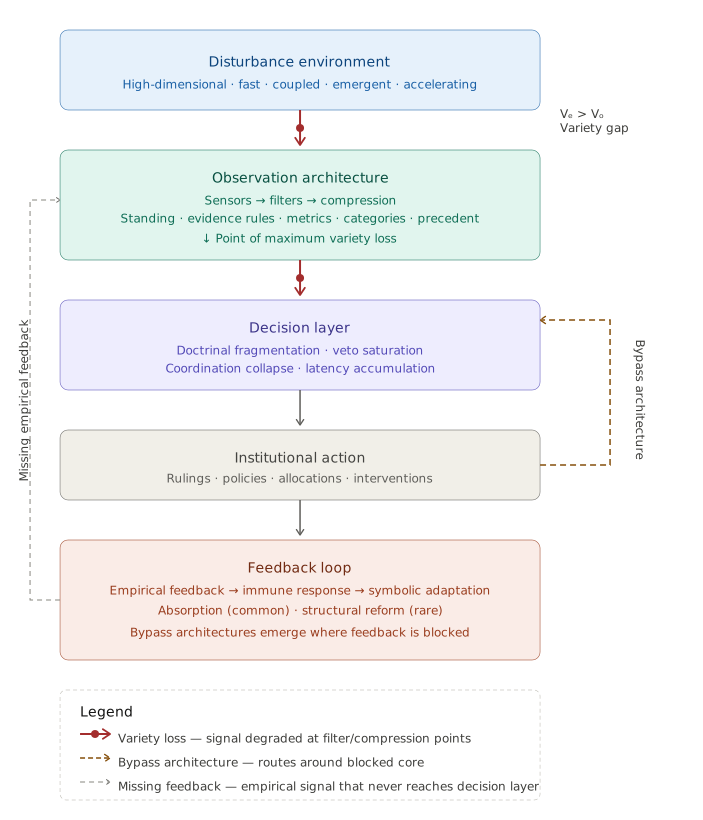
The Variety Gap is the structural mismatch between the dimensionality of the disturbance environment (Vₑ) and the dimensionality of the institution’s observation architecture (Vₒ). It is the fundamental diagnostic of institutional fragility—the single variable that most powerfully predicts whether a governance system will perceive the threats that eventually destabilise it.
The disturbance environment of any governance domain is the set of independent dimensions along which the governed system can be pushed away from desired states. For a central bank, this includes inflation dynamics, output fluctuations, employment levels, asset price trajectories, private‑sector leverage, cross‑border capital flows, distributional effects, climate exposure, and the recursive consequences of monetary policy itself. For a healthcare system, it includes the physiological condition of individual patients, their genetic profiles, their medication regimens and adherence, their mental health, their social circumstances, the quality of clinical reasoning, the coordination between specialists, and the long‑run determinants of population health. For a court, it includes the specific facts of the dispute, the applicable legal rules, the behavioural responses of regulated actors, the aggregate effects of doctrinal frameworks across the class of cases, the distributional consequences of alternative legal rules, and the long‑run trajectories of the governance domains that judicial decisions shape.
The effective dimensionality of these disturbance environments is large—far larger than any finite institution can fully perceive. The institution’s observation architecture selects a subset of these dimensions as operationally relevant. The inflation target selects consumer price movements; it excludes asset price trajectories, distributional effects, and climate exposure. The payment architecture selects diagnostic codes, procedure volumes, and throughput metrics; it excludes clinical complexity, care coordination, and patient‑reported outcomes. The adversarial process selects the facts of the specific dispute; it excludes systemic patterns, aggregate effects, and the interests of populations that lack standing.
The dimensions that fall outside the observation architecture do not cease to operate. They generate effects that cross into the observed dimensions in distorted form—as unexplained volatility, as “exogenous” shocks, as crises that seem to have no obvious cause within the institution’s interpretive framework. The institution’s own optimisation logic cannot attribute these effects correctly, because the dimensions from which they originate are not part of its perceptual field. The institution continues to optimise for the outcomes it can measure, blind to the growing gap between those outcomes and the reality it must govern, until the gap manifests as a crisis that the observation architecture cannot explain.
The Variety Gap is always positive—no finite institution can perceive everything—but it is not static. It widens when the dimensionality of the disturbance environment grows faster than the dimensionality of the observation architecture. The information revolution, global economic integration, technological acceleration, and ecological disruption have all increased Vₑ dramatically over the past half‑century, while Vₒ has remained largely unchanged. The institutions that evolved to govern industrial‑era economies are operating with observation architectures designed for a lower‑dimensional world. The gap between what they can perceive and what determines the outcomes of their actions is not a temporary dysfunction. It is a structural condition that will persist until the architectures are redesigned.
1.5 The Legibility Compression Principle
The Variety Gap is a specific instance of a more general mechanism that the series has identified across every domain it has examined. Call it the Legibility Compression Principle: every governance system reduces environmental dimensionality to remain computationally tractable. The compression is necessary—no finite institution can perceive everything—but it is lossy. The information lost in compression accumulates as externalities until it forces itself into visibility through crisis.
The principle is most visible in domains where the compression is explicit and quantified. The central bank’s Taylor Rule compresses the vast heterogeneity of the economy into two variables: the deviation of inflation from target and the deviation of output from potential. The compression ratio is enormous—an economy of millions of households, firms, and transactions, reduced to two numbers. The healthcare system’s DRG codes compress the clinical complexity of a patient with multiple chronic conditions into a set of diagnostic categories designed for billing. The university’s citation metrics compress the intellectual contribution of a scholar’s career into a single number. The court’s binary outcome—liable or not liable, constitutional or unconstitutional—compresses the multi‑dimensional reality of the dispute into a single determination. In each case, the compression is necessary, the compression is lossy, and the lost information accumulates until it forces a reckoning.
The Legibility Compression Principle is the most generalisable insight the series has produced. It connects central bank GDP targeting to healthcare billing codes to university rankings to AI benchmark culture to electoral polling to ESG scoring. It reveals a unified mechanism of governance failure operating across domains that are normally treated as separate. And it provides the diagnostic foundation for the series’ central claim: that the institutions governing the most consequential dimensions of contemporary life are operating with observation architectures that systematically exclude the information they most need to perceive.
1.6 From Empirical Observation to Structural Necessity
The twenty‑one reports in this series demonstrate that the primitives recur empirically. The Governance as Engineering working papers explain why they must recur structurally.
The formal results are precise. Paper I demonstrates that centralised governance systems operating on aggregated signals destroy spatial information—the averaging problem. Paper II demonstrates that no single‑scale controller can stabilise a system facing simultaneous fast, medium, and slow disturbances—the fractality requirement. Paper III demonstrates that representation chains deeper than two or three layers destroy the signal of citizen preferences before it reaches the policy layer—the constitutional unobservability threshold. Paper IV demonstrates that governance systems with low‑dimensional observation channels cannot stabilise high‑variety resource systems—the commons collapse dynamic. Paper V demonstrates that the four failure modes do not add; they multiply—the coordination failure tax. And Paper VI demonstrates that objective functions are observation architectures, and that low‑dimensional value functions systematically exclude the disturbance dimensions that eventually destabilise the systems they govern—the Goodhart–Ashby synthesis.
These are not interpretive claims. They are structural results that follow from Ashby’s Law of Requisite Variety, Shannon’s channel capacity theorem, and the control‑theoretic constraints on feedback systems operating below requisite variety. A governance system whose observation architecture has lower dimensionality than the disturbance environment it governs will, as a matter of formal necessity, produce the failure modes the reports document. The relationship is not probabilistic. It is not a tendency, a risk, or a correlation. It is a mathematical consequence of the architecture. The specific form the failure takes—the Stability–Instability Spiral rather than the Case‑by‑Case–Doctrinal Fragmentation Loop—depends on the institutional context. That failure will occur, in some form, is structurally guaranteed.
This is the move that elevates the series from comparative governance analysis to governance theory. The country reports and organisational reports provide the empirical evidence: the same primitives recur across twenty‑one cases spanning radically different domains. The engineering papers provide the explanation: the primitives must recur, because they are the observable signatures of governance architectures operating below requisite variety. The combination of empirical recurrence and structural necessity is what distinguishes the framework from the many other diagnostic approaches that identify institutional dysfunction without explaining why it is so persistent, so generalisable, and so resistant to reform. The framework does not merely describe governance failure. It identifies the architectural conditions under which governance failure is structurally unavoidable—and, by implication, the architectural conditions under which it might be overcome.