What Palantir Gets Right—And Where the Path Forks
Published: April 24, 2026
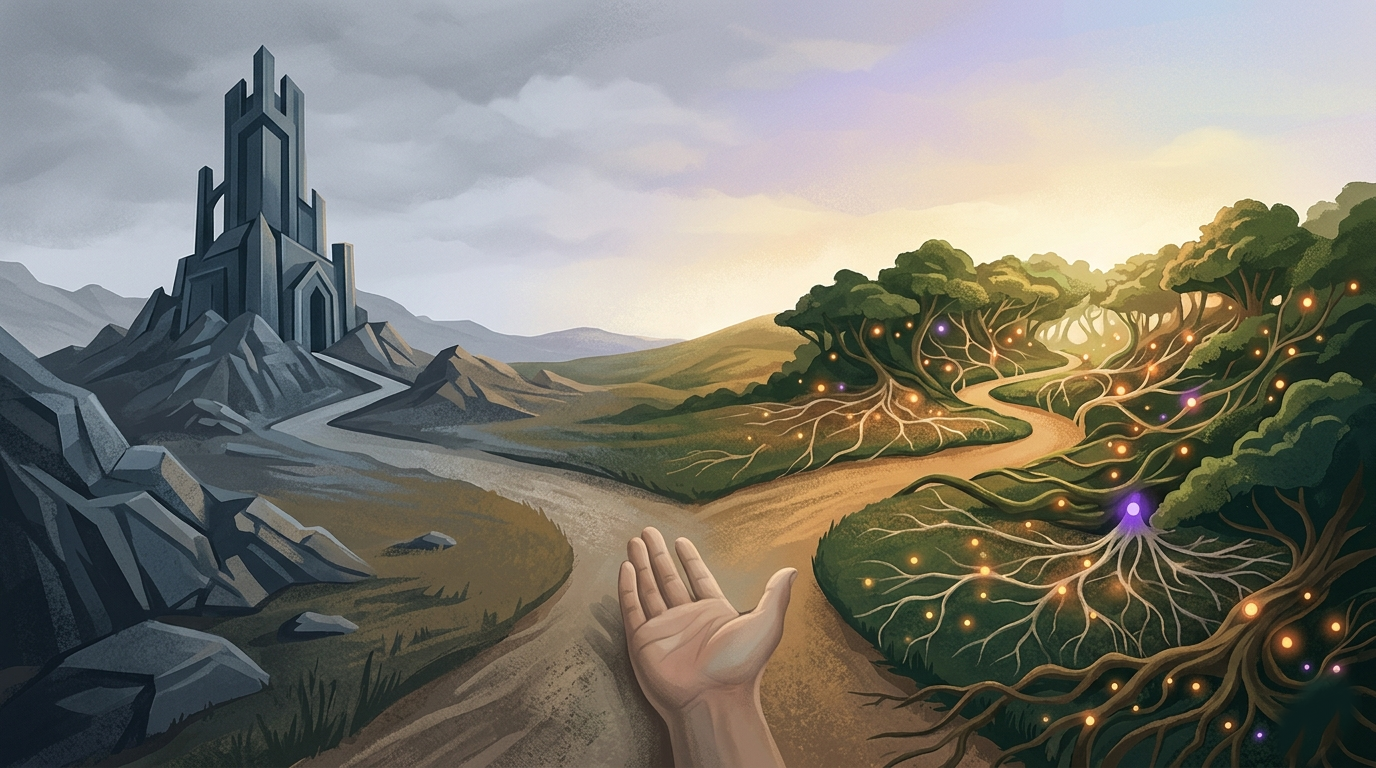
What Palantir Gets Right—And Where the Path Forks
Palantir’s recent manifesto, distilled from The Technological Republic, has provoked predictable reactions. The Guardian calls it “the ramblings of a supervillain.” Critics demand the company be stripped of its NHS contracts.
I read it differently. Not because I agree with its conclusions—I don’t, mostly—but because it articulates something real. A yearning that the “supervillain” framing cannot see and therefore cannot answer.
The Genuine Diagnosis
Beneath the manifesto’s martial language, Palantir names several truths that the progressive establishment has struggled to face:
1. Consumer tech has failed to deliver meaning. “Free email is not enough.” This is true. Silicon Valley promised connection and delivered addiction. It promised empowerment and delivered surveillance. The apps were supposed to set us free. Instead, they ate our attention and sold it to the highest bidder.
2. The West has lost a sense of shared purpose. When Karp writes that “the decadence of a culture… will be forgiven only if that culture is capable of delivering economic growth and security,” he is pointing at a genuine vacuum. Something has hollowed out. People feel it. They just don’t agree on what to fill it with.
3. Technology is not neutral. “The question is not whether A.I. weapons will be built; it is who will build them and for what purpose.” True. The tools are coming. The only question is governance: under whose authority, for whose benefit, constrained by what values?
4. Public service has been degraded. The manifesto’s critique of how government treats its employees—“any business that compensated its employees in the way that the federal government compensates public servants would struggle to survive”—will resonate with anyone who has navigated the bureaucratic machine as a supplicant or an employee.
These are not the observations of a cartoon villain. They are the observations of someone who sees that the current operating system is failing and wants to replace it.
Where the Path Forks
The fork is this: What do we replace it with?
Palantir’s answer is a form of centralized, corporate-military remobilization. Engineers serve the nation-state. Hard power is built on software. National service is a universal duty. The “postwar neutering” of Germany and Japan must be undone. Cultural relativism must give way to a renewed assertion of Western civilizational confidence.
It is a vision with a certain internal coherence. It speaks to a genuine hunger for purpose, sacrifice, and seriousness. But it is not the only path.
There is another fork. It says:
The problem is not just that we lack purpose. It’s that the architecture of our economy and governance makes purpose structurally difficult to pursue. When survival depends on market participation, when care work is invisible to the metrics that govern policy, when communities have no real authority over the decisions that shape their lives—purpose becomes a luxury.
The alternative is not centralized military remobilization. It is distributed regenerative coordination.
This is the path the Global Governance Frameworks (GGF) attempts to articulate.
| Palantir’s Path | The GGF Path |
|---|---|
| Engineers serve the nation-state. | Engineers serve bioregions, communities, and the commons. |
| Hard power built on software. | Resilience built on subsidiarity: local food, local energy, local care. |
| National military service. | Universal contribution: care, ecological restoration, community building. |
| Cultural reassertion. | Cultural renewal grounded in meaning infrastructure and right relationship. |
| Centralized data integration for state power. | Distributed sensemaking for community governance. |
| AI for military advantage. | AI for ecological monitoring, care verification, and coordination. |
These paths are not mirror opposites. They share a common starting point: the old system is dying, and we must build something new.
The difference is in what “new” looks like. Palantir envisions a vertical remobilization—power flowing upward to the state, guided by a renewed elite, defended by hard technology. The GGF envisions a horizontal regeneration—power flowing downward to bioregions and communities, guided by participatory governance, enabled by protocols that value care and ecology alongside security.
Not an Enemy. A Future Friend?
I don’t see Palantir as an enemy. I see them as a potential future friend who hasn’t yet encountered the alternative.
The engineers inside Palantir are not evil. They are talented people who want their work to matter. They have been offered a story: serve the nation, defend the West, build hard things. It’s a compelling story. It fills the purpose vacuum.
But stories can evolve. The same engineer who builds AI for military logistics could build AI for ecological restoration. The same data scientist who integrates intelligence for state security could integrate sensemaking for community wellbeing. The skills are transferable. The question is the mission.
The GGF’s posture should be the open hand, not the clenched fist. We don’t need to defeat Palantir. We need to build something so compelling that, when the cathedral cracks—as all cathedrals eventually do—the engineers and the dreamers and the purpose-hungry have somewhere else to go.
The Quiet Work
This post is not a call to arms. It’s not a manifesto to rival Karp’s. It’s a flag planted in the ground, visible to those who are looking.
The GGF is not a company. It doesn’t have a PR department. It’s a set of protocols, frameworks, and patterns—an open-source operating system for a regenerative civilization. It’s being built quietly.
This is the mycelial work. It doesn’t make headlines. It doesn’t need to.
But when the moment comes—when the yearning for purpose meets a viable architecture for distributed regeneration—the mycelium will already be there, beneath the surface, ready to fruit.
The Global Governance Frameworks are open-source protocols for a regenerative civilization. They include models for unconditional basic income (AUBI), bioregional governance (BAZs), complementary currencies for care and ecology (Hearts/Leaves), and a meaning infrastructure protocol for cultural renewal. All are freely available at globalgovernanceframeworks.org. The door is open.