Meeting the IRC Fundraiser – I Said No, But Felt I Could Still Do Something
Published: April 10, 2026
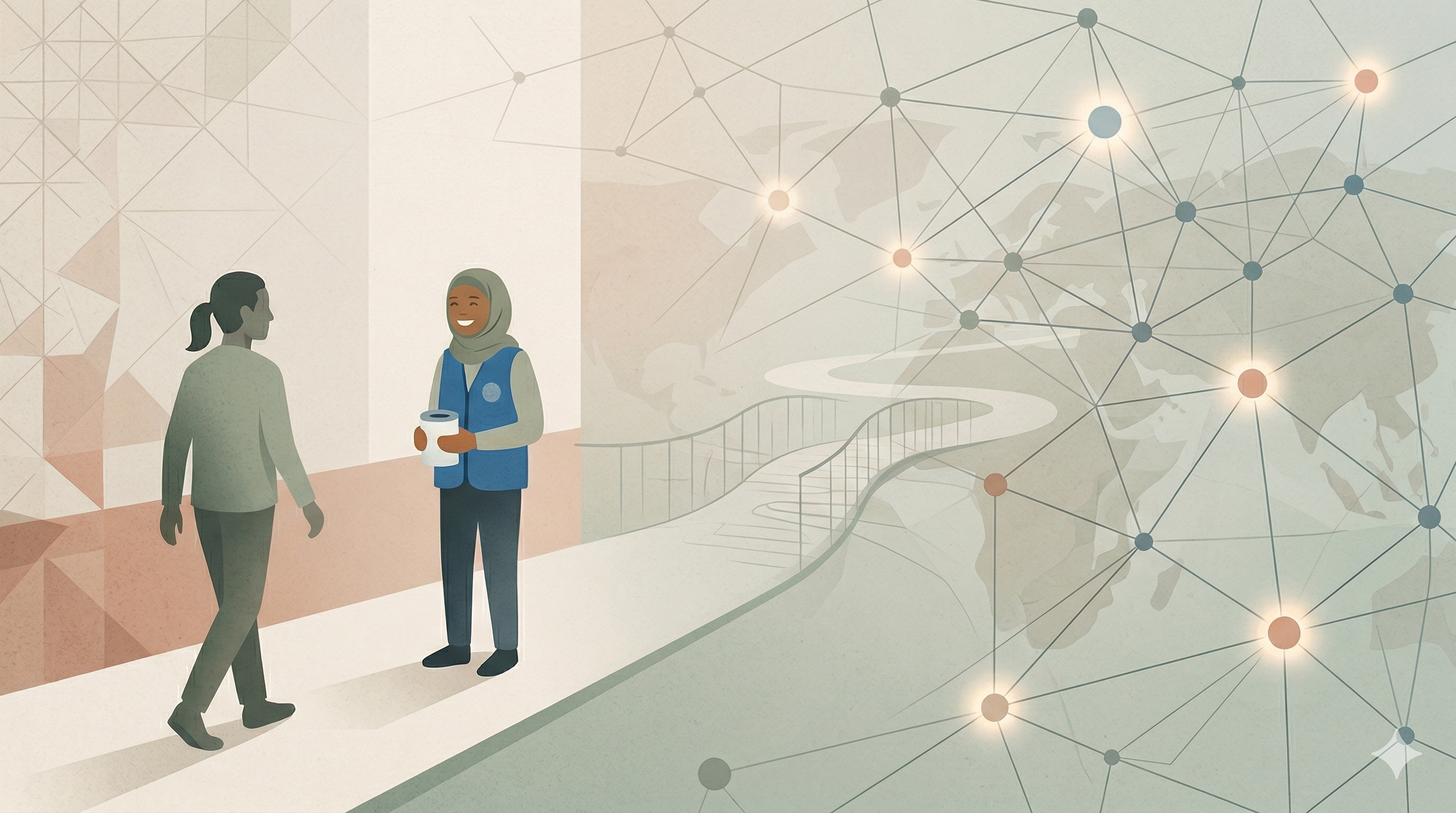
Today I was on my way home from Gnistan, the daily activity center where I spend one day a week. On the sidewalk stood a woman with a smartphone and a friendly smile. She was recruiting monthly donors for the International Rescue Committee (IRC).
I stopped. We talked for a while. She told me about the IRC’s work. Important things. Things I deep down want to support.
But when she asked if I would consider becoming a monthly donor, I shook my head. “I can’t afford it, I’m on financial assistance,” I said. “I can’t.”
She offered a smaller donation amount which I also declined, then she smiled understandingly and didn’t want to take up any more of my time. We parted ways.
The hesitation that led to something further
As I walked away, I felt a sense of hesitation. I had stood up for my own financial boundaries, but could I have afforded it anyway?
But the further I walked, the more another thought began to take shape. A thought that wasn’t about me or my wallet, but about the system itself.
Why should an individual on a street in Sweden bear the responsibility for solving crises on the other side of the world? Why is this how we organize solidarity—by expecting a person with precarious finances to give a small sum to a massive, centralized organization that then routes the money through Geneva and London before it arrives?
And above all: what happens to the power, the decisions, and the money along the way?
From hesitation to systems thinking
Over the past year, I have immersed myself in the principle of subsidiarity—the idea that decisions should be made as close to the people affected as possible. It is as relevant to Swedish aged care and energy policy as it is to international aid.
Because what is the international aid system, if not a monument to the absence of subsidiarity?
- Funding is controlled from Geneva, London, and Stockholm.
- Strategies are formulated at headquarters far from the field.
- Local staff implement the programs—but with limited decision-making authority.
- And by the time the money finally arrives, large portions have gotten stuck in intermediaries and administration.
The numbers speak for themselves: despite commitments like the Grand Bargain from 2016, still only 1–4% of humanitarian aid goes directly to local and national actors. The rest is filtered through international middlemen.
The system is not solely designed to strengthen local capacity. It is also designed to maintain a global aid industry.
From a no to a concrete pledge
So what do you do with that realization? You can become cynical. You can shrug your shoulders and think, “that’s just how it is.” Or you can try to build something.
I chose the third option.
Together with the AI tool DeepSeek (and with valuable feedback from both Grok and Gemini), I have developed a subsidiarity pledge for international NGOs. It is not just another vague “localization” document. It consists of six concrete, measurable, time-bound commitments that shift power, resources, and responsibility downwards—for real.
The six commitments in brief:
- 50% local leadership by 2030—with safeguards against elite capture of resources in the capital.
- 25% direct funding to local organizations—and an increasing share as unrestricted core funding.
- Participatory budgeting—pilot in year one, scaling to 25% of programs within five years.
- Exit strategy as a measure of success—not how long we stay, but how quickly we can hand over.
- Downward transparency with accountability for feedback—including an independent local ombudsman office.
- Data sovereignty and epistemic subsidiarity—data from communities belongs to the communities. Success is defined locally.
The pledge also contains a special foreword aimed directly at Swedish aid organizations: Sweden often talks about local ownership. Here is the yardstick. Who dares to sign?
From guilt to action
I might not be able to give 120 kronor a month to the IRC right now. My finances are precarious. But I can give something else: a tool to change the playing field itself.
This pledge is not an attack on individual aid workers—they often do heroic work under impossible conditions. It is a challenge to the system: to the headquarters, to the donors, to the large institutional structures that cling to power despite all the beautiful rhetoric about local ownership.
If a single large NGO signs and begins reporting according to these commitments, we have moved the needle. If ten do it, we have started a movement.
What you can do
If you work at an NGO: Read the pledge. Take it to the next management meeting. Ask: Which of these commitments could we pilot already this year?
If you are a donor or a foundation: Ask the organizations you support if they can report according to these six principles. Consider making funding conditional on progress.
If you are an ordinary citizen: The next time someone knocks on your door or stands on the street asking for a monthly donation—ask them: How many of your country directors are local citizens? What percentage of your budget goes directly to local organizations? Your question means more than your one-time donation.
Read the full pledge and download as a PDF →
This post is a personal reflection. The pledge itself is a public asset—free to use, adapt, and distribute by anyone who wants to shift power within the aid sector.
Thanks to the woman on the street who made me think. And thanks to Gnistan for reminding me that real change begins in the small, local, and relational.