Occupational Therapy for Adults: Why Sweden's Work Principle Has Blinders On
Published: March 5, 2026
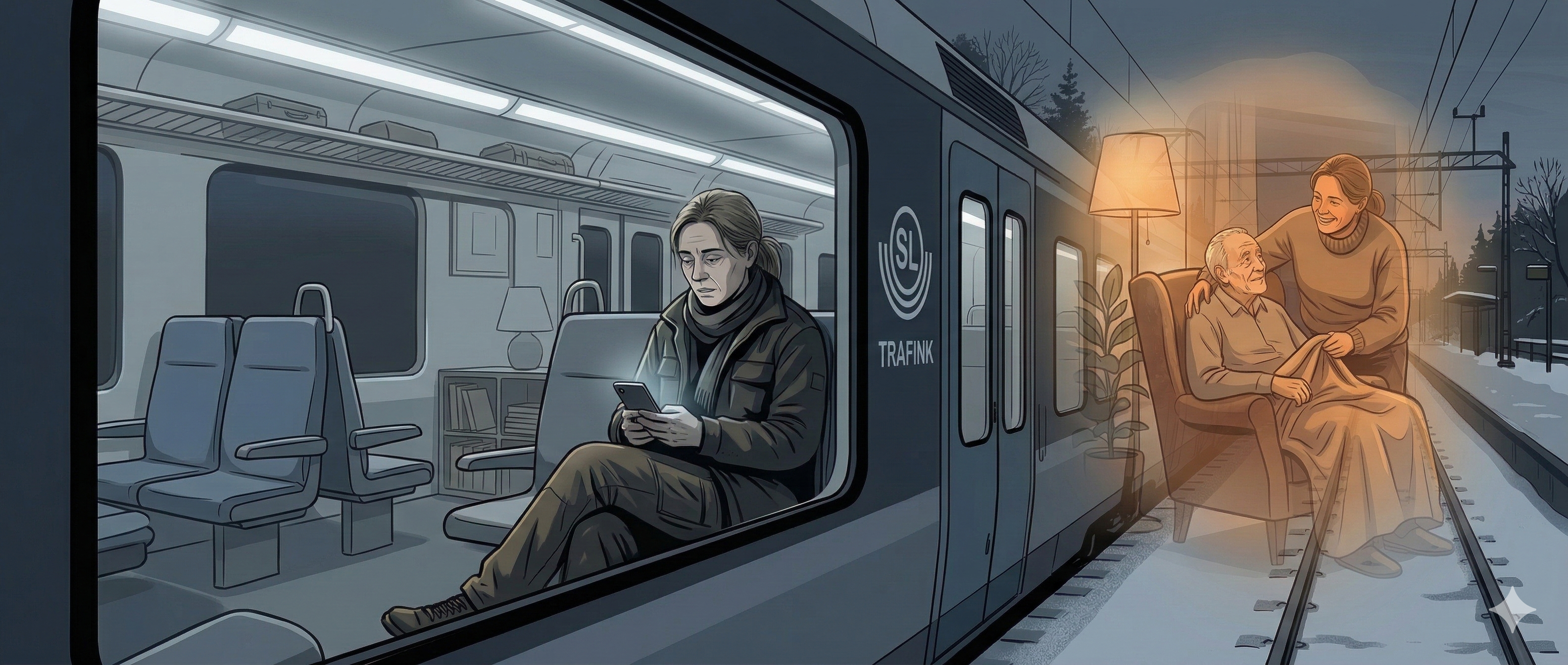
Occupational Therapy for Adults
I recently took a course at the Labor Market Unit (Arbetsmarknadsenheten) in Upplands Väsby. The instructor said something that stuck with me: “If you can solve the matching problem, you’ll be rich.”
I have no interest in getting rich. But I do like solving problems.
And the more I thought about it, the more I realized that the matching problem isn’t actually a matching problem. It’s a problem of blinders.
The Great Paradox
Sweden has hundreds of thousands of unemployed people. At the same time, Sweden has thousands of vacant jobs that no one can fill. It sounds like a logistics problem. Like it should be solvable with a better Excel spreadsheet at the Public Employment Service (Arbetsförmedlingen).
But think about it for a moment.
If you stay home and take care of your aging mother—cook, talk to her, make sure she doesn’t fall—according to the system, you are unproductive. You are a burden. You aren’t pulling your weight.
If, on the other hand, you commute 45 minutes to a municipal office and fill out a spreadsheet measuring KPIs for elderly care facilities that take care of other people’s mothers—then you are a taxpayer. The backbone of society. A hero.
The only difference between being a burden and a hero is sitting in traffic.
It’s quite impressive, if you think about it. We have managed to build a system that, with surgical precision, values the form of work over its substance.
The Sacred Work-First Principle
The work-first principle (arbetslinjen) isn’t really a policy anymore. It’s a religion.
Both the right and the left in Sweden kneel at its altar. The strange thing is that no one really remembers when it happened—when “it’s important that people work” slipped into “formal, taxable, full-time work is the only way to be a fully validated human being.”
And like all religions, the work-first principle has its priests (the Public Employment Service), its rituals (activity reports), and its sinners (the burned-out artist who now has to take a six-week CV course to become a junior logistics coordinator at a warehouse that will be automated in three years anyway).
I’m not saying this to be mean to the people working at the Public Employment Service—most of them genuinely try to help people in difficult situations. I’m saying it because the system they are tasked with administering sometimes resembles a bureaucratic perpetual motion machine: we create jobs so people can have jobs, tax them, and use the money to fund more jobs whose primary function is to make sure people have jobs.
What the System Cannot See
Here is what bothers me the most.
The system is designed to see one thing: formal employment. It’s like having a camera that can only photograph in a single, narrow spectrum. Everything outside that spectrum—all of actual human life—is invisible. It doesn’t count. It essentially doesn’t exist.
Helping neighbors. Cultural creation. Holding a local community together. Restoring an ecosystem. Taking proper, thorough care of your children. Helping someone with mental illness stay afloat. All of this is economically invisible.
And yet—if you ask people what they actually need from each other, it is rarely more junior logistics coordinators.
The Human Cost
I want to be honest here for a moment, because there is a dark side to this that deserves to be said out loud.
There are people—many of them—who get caught in the gears of the system not because they are lazy or unwilling, but because they are exhausted. Sick. Wired differently. Traumatized. And the system, which is designed to produce taxpayers, interprets their struggle as a flaw in them rather than a flaw in the architecture.
Three in the morning, staring at a Social Insurance Agency (Försäkringskassan) form on the screen, feeling like your benefits are about to be zeroed out. That isn’t laziness. That is terror.
And the tragedy is that in that situation, we are sometimes forced to medicate away the parts of ourselves that protest against an environment that doesn’t fit us—not because we need help with our minds, but because our mind is the only thing we control when everything else is locked down.
It is not the fault of the individuals. It isn’t even the fault of individual caseworkers. It is a system design problem.
What if We Asked a Different Question
Instead of: “How do we get more people to fit into the jobs that exist?”
What if we asked: “How do we match human ability and willingness with what society actually needs?”
It’s not the same question. The first question has the work-first principle as its answer. The second question has a much more interesting answer.
Because if we look honestly at what society needs—more care, more community, more ecological recovery, more human presence—and at what people actually want to do with their lives, given the chance—the gap isn’t that wide.
The gap is not a capacity problem. It is a recognition problem. We have not learned to see the value in work that doesn’t show up on a tax return.
A Curious Conclusion
I have started sketching out a small tool—a “resonance matcher”—that tries to do exactly that: match people’s abilities with everything society needs, not just the jobs the national job bank (Platsbanken) happens to have right now. Including community needs, ecological projects, and caregiving roles that are economically invisible today.
It’s a small experiment. Maybe it leads nowhere. But I figure that if we don’t even try to ask a better question, we are doomed to keep getting the same answer.
And the answer we have now—hundreds of thousands of people outside the system, while society’s real needs remain unmet—is not enough.
Do you have thoughts on this? Do you work with labor market issues, municipal operations, or do you have your own experiences of being invisible in the system? I would love to hear from you.