The Polycrisis: A Blueprint for Action — Turning Diagnosis into Empowered Change
Published: September 25, 2025
In Part 1, we named the polycrisis—a tangled web of amplifying risks—and diagnosed its five core flaws, acknowledging they stem from deeper drivers like energy-capital dynamics and historical traumas.
Returning to that initial frustration, let’s turn diagnostic clarity into action. We’ll start with the highest-leverage shift and build toward a pathway that scales from personal to global, with self-amplifying feedback to match the crisis’s urgency.
Confronting Reality: The “Entrenched Interests” Problem
Before we lay out the blueprint for action, we must be clear-eyed about the landscape. The systemic flaws we diagnosed in Part 1 are not accidents; they are the logical outcomes of a system designed to serve specific entrenched interests—financial institutions that thrive on short-term speculation, industries that externalize their environmental costs, political classes that benefit from division.
A viable solution cannot ignore this reality. Our pathway forward, therefore, is not a politically naive plan that assumes good faith from all actors. It is a strategic approach designed to build new systems so effective and compelling that they create the power to make the old ones obsolete, while incorporating tactics to navigate or challenge resistance where necessary.
This is a strategy of displacing and replacing. We build the new model in the cracks of the old, demonstrating a better way and creating the power to make the old system obsolete.
Shifting the Paradigm: A High-Leverage Action
You’ve likely tried individual actions—recycling, voting, or supporting a cause. These are vital sparks, but they often feel like drops in an ocean because the polycrisis demands more than isolated fixes. Superficial solutions (e.g., pharmaceuticals for mental health without addressing alienation) or standalone efforts (e.g., recycling without systemic reform) get trapped in the same flawed system.
Systems thinkers like Donella Meadows argue that shifting a paradigm—its deepest-held goals and beliefs—is one of the highest leverage points for transforming a system. The “mindset shift” is not a soft prerequisite; it is one such high-leverage action we can take, creating self-amplifying feedback loops as new perspectives spread virally through communities and networks.
The Inner Shift
This mindset shift empowers immediate change and counters the polycrisis’s exponential loops:
Embrace Holistic, Systemic Views: Ask, “How are these issues linked?” when reading the news.
Adopt Long-Term Horizons: Evaluate decisions through a seven-generation lens.
Redefine Progress: Track what enriches life—well-being, equity, ecological health—not just GDP.
This mindset shift doesn’t replace direct action; it makes our activism smarter and more sustainable. It acts as a navigation system that ensures we target root causes, not just symptoms, and provides the resilience needed to sustain the long journey without burnout.
Cultural Foundations
This mindset fuels cultural change: revise values to prioritize connection and care; foster radical collaboration across disciplines; and tell new stories through art and media that envision thriving futures. These cultural shifts create amplifying loops, as shared narratives inspire more people to join.
A Pathway Forward: Building a “Poly-Solution” Through Experimentation and Reform
The good news? A “poly-solution” is possible—interconnected actions at every scale, starting small but scaling through learning. Building on your mindset “beta-test,” expand to collective experiments that incorporate high-leverage interventions and power-aware strategies.
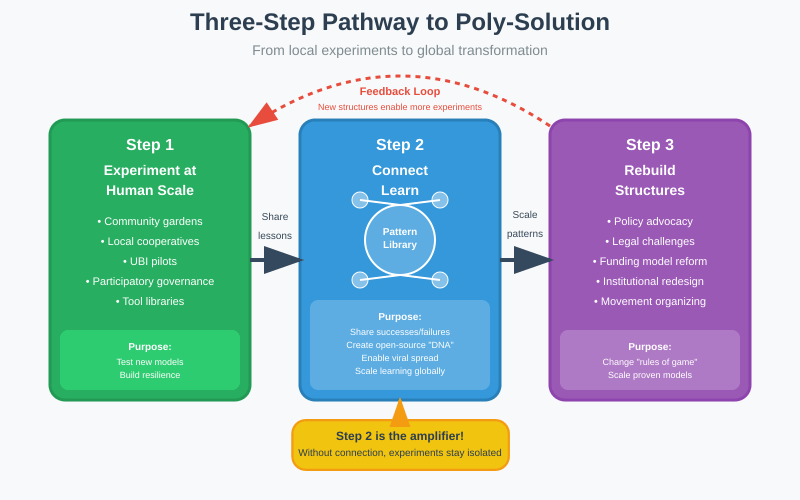
The pathway from local experiments to global transformation requires strategic progression through experimentation, networking, and structural reform, with feedback loops that accelerate change.
Step 1: Experiment at Human Scale
Don’t wait for top-down perfection. Launch “beta-tests” like community gardens, local cooperatives, UBI pilots, or participatory governance in cities. These build resilience, test new models, and serve as labs for proving alternatives to the old system’s flaws.
Step 2: Connect and Learn
Step 2 is the amplifier. Without it, Step 1 remains a beautiful but isolated project. With it, Step 1 becomes a data point for a global revolution. This is how we overcome the “Silo Problem”—not by everyone knowing everything, but by everyone being connected to the network where the knowledge lives.
Share successes and failures globally via networks, creating a “Pattern Library of Solutions”—an open-source collection of what works, like the “DNA” of a food security model from one region adapted for water scarcity elsewhere. A “pattern” could be as simple as a “Cooperative Start-Up Model,” with a checklist for legal structures, a template for community buy-in, and case studies from successful co-ops. This “DNA” can then be adapted by any community for any purpose.
This is already happening. The “Transition Town” movement, for example, is a living pattern library for community-led resilience, with towns around the world adapting and implementing its principles.
You can contribute now by joining or starting a network to share ideas, fostering viral amplification as patterns spread and inspire broader adoption.
Step 3: Rebuild Structures by Scaling Patterns
The “Pattern Library” is not just a collection of nice stories. It becomes a portfolio of proven models that can be presented to policymakers, used in advocacy campaigns, or leveraged in direct actions like strikes or legal challenges. This process of building compelling alternatives creates its own power base—through collective purchasing power, organized votes, and mobilized communities—that can demand change from, or create bypasses around, entrenched interests.
The goal is to use evidence from successful local experiments to advocate for changes in the larger “rules of the game”—funding models, regulations, institutional designs, and corporate accountability measures.
This isn’t overwhelming—it’s liberating. Start where you are, and watch how interconnected actions create momentum, with built-in feedback loops that accelerate change exponentially.
An Invitation to Build — Starting with Your Own Contribution
That initial frustration wasn’t dysfunction—it was a signal that we know a better world is possible. For me, it led to channeling energy into the Global Governance Frameworks (GGF)—an open-source effort to prototype new decision-making models, just one example of the experimental “beta-testing” we need, designed to scale while addressing power imbalances. (But I realize I’ve been building in relative isolation, and I’m actively seeking connections with others working on complementary pieces of this puzzle.)
You don’t need to architect a global system. Meet yourself where you are with these tiers of engagement, and let’s seize this opportunity to evolve together—building self-amplifying networks that challenge and replace the old power structures:
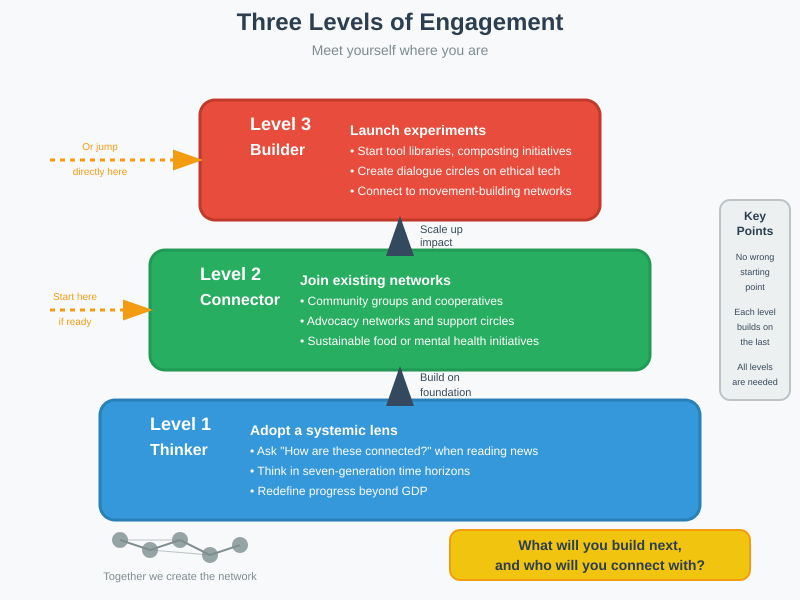
Three levels of engagement allow readers to contribute meaningfully regardless of their current capacity, with each level building on the foundation of the previous one while recognizing that all levels are essential.
Level 1 (Thinker)
Adopt a systemic lens—ask “how are these connected?” when you read the news.
Level 2 (Connector)
Join a local community group, co-op, or advocacy network focused on one piece of the puzzle, like a sustainable food initiative or mental health support circle.
Level 3 (Builder)
Launch your own small-scale experiment—a tool library, a community composting initiative, a dialogue circle on ethical tech—and crucially, connect it to networks that are building the political power needed to protect and scale these new models against resistance from the old system, such as through alliances with activist groups or policy campaigns.
The polycrisis demands millions of us building “poly-solutions” at every level. The question isn’t “Can we change?” but “What will you build next, and who will you connect with to build it?”