The Polycrisis: Why Everything Feels Like It's Falling Apart — And What It Really Means
Published: September 23, 2025
I spent a lot of this day frustrated again—not at one specific thing, but at everything. The world has so many issues, and they are all interconnected. It feels like impending doom everywhere, all at once. But what if this isn’t just a bad day or random bad luck? What if this feeling has a name—and a structure? It does: it’s called a polycrisis.
This isn’t about predicting an apocalypse—it’s about understanding complexity so we can navigate it skillfully and build a better world. It’s a diagnosis, not a eulogy. The goal isn’t to foster despair, but to provide the clarity needed for effective action.
If you’re feeling this too—the weight of interconnected disasters—know that it’s not weakness or paranoia. It’s a rational response to a deeply flawed global system. And recognizing it is the first step toward turning frustration into fuel for change.
In this post, we’ll name the chaos and diagnose its roots. In Part 2, we’ll map a practical path forward—not with silver bullets, but with a “poly-solution” as multifaceted as the problem itself.
Defining the Polycrisis: The Tangled Web of Interconnected Crises
A polycrisis isn’t just multiple crises piling up. It’s a cluster of interrelated global risks where each one amplifies the others, creating a whole far more dangerous than the sum of its parts.
Imagine not a line of falling dominoes, but a tangled web. A tug on one strand—like a climate disaster—strains the entire structure, disrupting supply chains (economic inequality), triggering mass migrations (geopolitical instability), and overwhelming health systems (global pandemics). We’re not facing separate problems; we’re dealing with one interconnected failure of our global system design.
This interconnectedness creates the risk of cascading failure. For example, a climate-driven drought (Climate Change) can strain agricultural water resources (Water Crisis), leading to crop failures. This creates food shortages (Food Security) that disrupt global supply chains (Economic Inequality) and spark social unrest (Geopolitical Instability), which is then amplified by misinformation online (Trust Collapse). One crisis cascades into five. This is why the polycrisis demands urgent, systemic action.
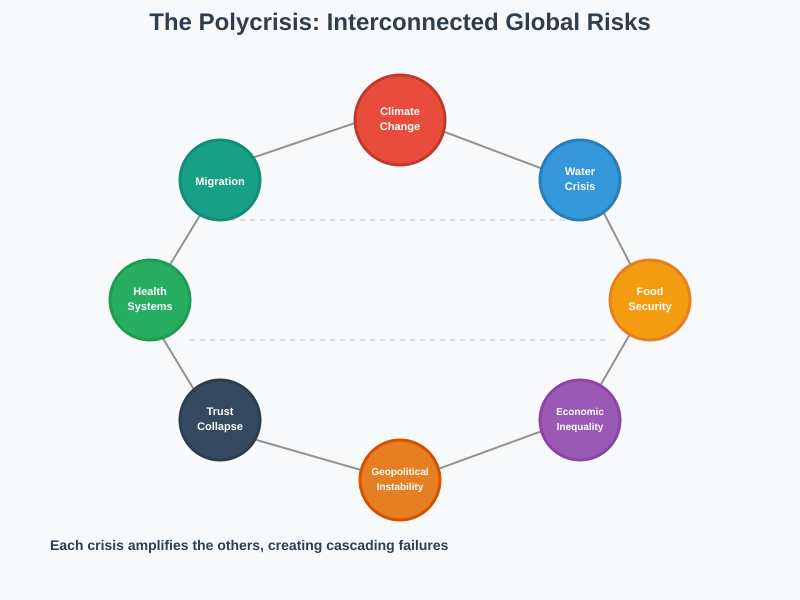
The polycrisis web shows how individual crises amplify each other through interconnected feedback loops, creating cascading failures that are far more dangerous than isolated problems.
This explains why individual efforts—like recycling or voting—often feel like drops in an ocean. The polycrisis requires us to address the web as a whole.
This interconnected web of crises also reveals what some call the metacrisis—our collective inability to make wise decisions at the scale and speed these challenges demand. The same systems that create climate change and inequality also shape how we perceive and respond to them. Healing both the external crises and our capacity for collective wisdom is essential.
The Diagnosis: Unpacking the System’s Core Flaws
So if the polycrisis is one interconnected failure of system design, what are the flaws in that design? The polycrisis isn’t random bad luck—it’s the predictable output of a system running on flawed “software” that actively perpetuates failure. These five flaws are themselves symptoms of even deeper historical and structural drivers—like our civilization’s relationship with energy and capital. But they represent the most powerful and actionable leverage points we have for redesigning our social and economic “software.”
Here are its five core design flaws, along with the regenerative principles to replace them, each feeding into the visible crises we see daily (like climate change, inequality, and tech risks):
1. The Growth Trap
A relentless mechanism locking us into infinite economic expansion on a finite planet, dumping true costs like environmental destruction and resource depletion onto society—driving biodiversity loss and supply chain fragility.
Sound familiar? You’re not imagining the strain of a system that demands “more” at all costs.
Regenerative Principle: Design economies that serve life, prioritizing ecological and social health over endless growth.
2. The Short-Term Prison
A confining cycle imprisoning institutions in quarterly profits and election timelines, blocking long-term investments and normalizing risks—fostering complacency, regulatory capture, and failures in pandemic preparedness.
Sound familiar? You’ve seen leaders lurch from crisis to crisis with no long-term vision.
Regenerative Principle: Adopt seven-generation time horizons for decision-making, planning for future resilience.
3. The Value Inversion
A distorting force flipping priorities upside down, devaluing essential care work, community, and nature (systematically exploiting animals and ecosystems as commodities) while inflating rewards for extraction and superficial innovation—fueling mental health crises, trust erosion, and ethical lapses in tech and agriculture.
Sound familiar? You feel the disconnect when profit trumps care for people and planet.
Regenerative Principle: Redefine value to prioritize connection, care, and coexistence with nature.
4. The Trust Collapse
An eroding dynamic dismantling social capital, supercharged by algorithmic outrage and political polarization—intensifying conflict, extremism, and a crisis of purpose.
Sound familiar? You’re not alone in feeling distrust in media and institutions.
Regenerative Principle: Rebuild trust through transparency, collaboration, and shared narratives.
5. The Silo Problem
A fragmenting barrier isolating expertise and institutions, blocking holistic views and enabling “tragedy of the commons” exploitation—worsening threats from antimicrobial resistance to geoengineering risks.
Sound familiar? You’ve noticed how siloed “experts” miss the bigger picture.
Regenerative Principle: Foster holistic, interdisciplinary approaches to problem-solving.
If this feels heavy, that’s okay—it’s meant to validate your sense of systemic dysfunction, not add to it. Naming these flaws shows they’re designed, not inevitable, and thus can be redesigned. For me, seeing the system laid out like this was a turning point. It helped me move from a feeling of chaotic, personal frustration to a sense of diagnostic clarity. The problem wasn’t me; it was the design. And if it’s designed, it can be redesigned.
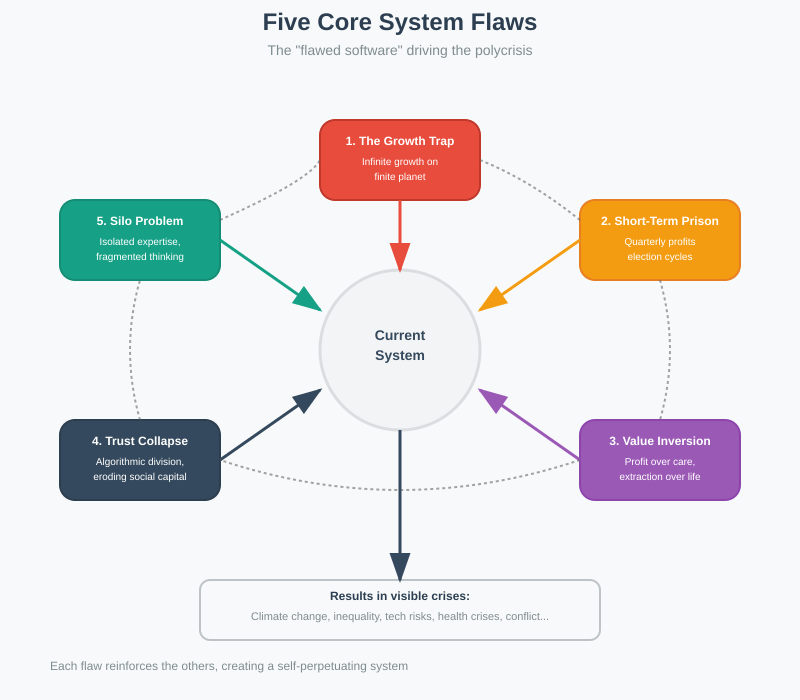
The five core system flaws reinforce each other in a self-perpetuating cycle, feeding into the visible crises we experience daily. Understanding these interconnections reveals the most powerful leverage points for change.
A Glimmer of Hope: The Possibility of a “Poly-Solution”
A diagnosis this comprehensive can feel daunting. If the problems are this deep and interconnected, is there any hope? Absolutely. Because an interconnected problem allows for an interconnected solution—a “poly-solution” built from thousands of actions that reinforce each other.
The answer doesn’t lie in a single silver bullet, but in upgrading the flawed software itself—starting with a fundamental upgrade to our own “inner operating system”—our mindset. This is the first and most critical patch to the flawed software we’ve been running. From there, it expands into practical, small-scale experiments in our communities. And finally, it scales into the rebuilding of our global structures.
This is not a utopian dream; it is a practical, achievable pathway.
Now that we’ve diagnosed the system’s core flaws, we have a clear map of what needs to be redesigned. In Part 2, we will walk through the blueprint for action: from the personal mindset shifts that unlock new possibilities to the on-the-ground experiments and structural reforms that can build a regenerative future.