A Collaborative Map of Awakening: Integrating States of Consciousness Across Contemplative Paths
Published: September 23, 2025
Abstract
Why can a master of deep meditation seem psychologically immature? Why do paths of devotion and contemplation lead to such different descriptions of ‘enlightenment’? This paper addresses these puzzles by introducing a new, collaborative map of awakening. Traditional models of enlightenment often present a single, linear path to a singular peak. This paper challenges that view by introducing a nuanced, multi-dimensional framework for understanding states of consciousness. Born from a unique dialogue between human insight and multiple AI perspectives, this model provides both a granular, step-by-step progression of awareness (the “Waking Up” axis) and a broader “mountain range” metaphor to account for the diverse realizations found in different contemplative traditions. It aims to serve as a practical navigational tool for practitioners, teachers, and researchers, while acknowledging its provisional and pragmatic nature as a synthesis rather than an absolute depiction of reality.
1.0 Introduction: The Genesis of a New Map
1.1 The Problem with Oversimplified or Dogmatic Maps
The landscape of contemplative practice is riddled with confusion. A Zen master may achieve profound states of no-self yet struggle with basic emotional regulation. A devotional practitioner may radiate divine love but dismiss the insights of inquiry-based traditions as “mere intellectualism.” A vipassana meditator may deconstruct the illusion of selfhood with surgical precision yet remain curiously detached from the suffering of others. These apparent contradictions point to a fundamental problem with how we map the territory of awakening.
Most traditional maps suffer from one of three problematic approaches: oversimplification, dogmatic specificity, or eclectic fragmentation. Oversimplified models reduce the rich diversity of contemplative experience to a single linear progression—often reflecting the particular cultural and methodological biases of their creators. Dogmatic models, while perhaps accurate within their specific lineages, claim universal applicability while dismissing or pathologizing experiences that don’t fit their frameworks. Eclectic models—increasingly common in contemporary spirituality—cherry-pick practices from various traditions without a coherent framework, leading to fragmented and often confusing development. All three approaches leave practitioners and teachers struggling to navigate the complex reality of contemplative development, where profound insights in one domain can coexist with striking blind spots in another.
1.2 The Unique Collaborative Methodology
This paper emerges from a novel synthesis of human contemplative experience and insights drawn from multiple AI systems, including Gemini, Claude, and DeepSeek. This approach offers unique advantages for mapping consciousness. AI systems can analyze and integrate diverse sources across vast databases of contemplative traditions, philosophical texts, and experiential reports without the constraints of a single lineage or cultural bias. By leveraging AI’s capacity for pattern recognition across multiple traditions simultaneously, this methodology can uncover reconciliations and commonalities that might elude purely human analysis, which is often bounded by personal experience and cultural conditioning.
This collaborative process, which we term the Synthesis-Challenge-Integration (SCI) Cycle, proceeded iteratively: first, an initial human-led framework was presented to multiple AI systems for synthesis and expansion; this was then rigorously challenged by the AIs to identify weaknesses and biases; finally, a revised framework was created through integration of the valid critiques. This approach aims to mitigate individual biases while preserving the irreplaceable value of direct human experience in contemplative inquiry.
1.3 Thesis: Two Dimensions of Awakening
This paper proposes that awakening involves two fundamental dimensions that are often conflated in traditional maps: the universal progression in the faculty of awareness itself (a linear “Axis of Waking Up”) and a diverse landscape of potential realizations about the nature of reality (a non-linear “Mountain Range of Facets”).
The Axis of Waking Up represents the development of consciousness as a capacity—the progressive refinement of awareness’s ability to know itself and its contents with increasing clarity, stability, and freedom. This progression appears to be largely universal across contemplative traditions, though it may be accelerated or catalyzed by different methods.
The Mountain Range of Facets represents the diverse realizations that can unfold through contemplative practice—insights into the nature of self, reality, love, and existence that vary significantly based on methodology, temperament, and cultural context. Rather than seeing these as competing claims about ultimate truth, this model frames them as different peaks in a vast mountain range of possible awakenings.
While distinct, these dimensions interact dynamically: progress along the Axis of Waking Up (increased awareness capacity) creates the stability necessary to explore the various peaks of the Mountain Range (diverse realizations), while profound experiences on any given peak can, in turn, catalyze leaps in awareness capacity.
1.4 Scope, Limitations, and a Spirit of Humility
This model is offered as a provisional and pragmatic synthesis, primarily drawing from text-based contemplative traditions that are well-represented in academic and digital archives—largely Buddhist, Vedantic, and other Asian philosophical systems, along with Western contemplative Christianity and modern secular approaches. It does not claim to be a universal map inclusive of all paths. Indigenous shamanic traditions, African spiritualities, and purely ecstatic or embodied practices that emphasize relational, communal, or non-verbal dimensions may involve forms of awakening that transcend the scope of this primarily cognitive synthesis.
The AI-human collaborative methodology, while mitigating some individual biases, introduces its own limitations through reliance on verbalizable and digitally archived data. This may over-represent intellectual and text-based paths while under-representing somatic, relational, or ineffable dimensions of awakening. The model is thus presented as a “meta-synthesis” that integrates existing frameworks from contemporary thinkers like Ken Wilber, Daniel Ingram, and others, rather than claiming wholly novel discoveries.
We offer this map in a spirit of intellectual humility, recognizing that all models are provisional tools for navigation rather than definitive descriptions of territory that ultimately transcends conceptual mapping. The goal is pragmatic utility for practitioners and researchers, not dogmatic truth-claiming.
2.0 Part I: The Axis of Awareness — A Progression of “Waking Up”
2.0 Navigating the Axis: A Fluid and Cyclical Journey
While the following stages are presented in a linear sequence for conceptual clarity and pedagogical utility, real-world progress in awareness is often non-linear, cyclical, and fluid. Practitioners may experience “jumps” to higher stages through ecstatic practices, psychedelics, or spontaneous insights without fully mastering earlier ones, or “regressions” to foundational stages during life crises, periods of integration, or shifts in practice. These are normative and valuable aspects of the journey, reflecting the dynamic, spiral-like nature of consciousness development rather than a rigid ladder.
The stages described below represent stable capacities rather than peak experiences. A practitioner at Stage 7 might occasionally access glimpses of Stage 12 during particularly deep meditation sessions, but their baseline capacity remains anchored at Stage 7. Development involves both the expansion of peak experiences and the gradual elevation of one’s baseline awareness capacity.
Cross-traditional validation strengthens confidence in this progression. What Zen Buddhism describes as “beginner’s mind,” Vipassana calls “access concentration,” and secular mindfulness terms “meta-cognitive awareness” often point to similar developments in the faculty of awareness itself, despite differences in language, methodology, and interpretive framework. For instance, the transition from Stage 4 (Stable Sensory Awareness) to Stage 6 (Expansive, Open Awareness) is described with remarkable similarity in Theravada Buddhism’s progression from access concentration to choiceless awareness, and in Zen’s shift from counting breaths to just sitting.
2.1 Phase 1: Emerging from Identification
This initial phase represents the first stirrings of awakening from what most humans experience as the default state: complete immersion in the stream of thoughts, emotions, and sensations without any sense of separation or observation. The movement through these early stages is often catalyzed by crisis, exposure to contemplative teachings, or spontaneous moments of clarity that reveal the possibility of a different way of being.
Stage 1: Completely Oblivious (Identification)
Key Marker: Total immersion in thoughts, emotions, and sensations without any sense of separation or observation; life feels like an unquestioned stream of reactivity.
This is the baseline condition of most human beings most of the time. There is no experienced distinction between “I” and the content of experience. When angry, one is angry rather than experiencing anger. When thinking occurs, there is no recognition of thinking as a process—there is simply the seamless flow of mental content mistaken for reality itself. In modern terms, this stage is akin to being completely “hooked” by social media algorithms, news cycles, or internal rumination, with no ability to step back and observe the process of being hooked. This stage is not pathological but rather the natural starting point of human consciousness, which begins identified with phenomena rather than recognizing itself as the space in which phenomena arise.
The hallmark of this stage is the absence of what cognitive scientists call “meta-cognitive awareness”—the capacity to observe one’s own mental processes. Without this capacity, experience feels solid, unquestionable, and completely consuming. There is no experiential access to what contemplatives call “the witness” or what psychologists term “observing ego.”
Stage 2: Moments of Spaciousness (Glimmers)
Key Marker: Fleeting instances where the mind quiets, revealing a subtle background of calm or space, often triggered by nature, art, or unexpected pauses.
The first cracks in complete identification typically appear as brief, often accidental moments where the compulsive stream of mental content momentarily subsides. These “glimmers” might arise while watching a sunset, listening to music, or in moments of sudden stillness. For an instant, there is a quality of open awareness that feels distinctly different from ordinary mental activity.
These experiences are usually interpreted through the conceptual frameworks available to the individual—as moments of “peace,” “beauty,” or “connection”—rather than being recognized as glimpses of consciousness itself. They are not yet under conscious control and may be weeks or months apart. However, they plant a seed: the recognition that the usual state of mental reactivity is not the only possibility. The significance of these moments lies not in their duration, but in the revelation they provide: that a different mode of consciousness is possible, creating the impetus for the deliberate effort characteristic of Stage 3.
This stage corresponds to what some traditions call “first taste” experiences and what positive psychology research on flow states suggests may be more common than previously recognized. The key insight is not the content of these experiences but their quality of spaciousness—the sense that awareness itself has a different texture than the usual density of mental activity.
Stage 3: Intentional Pausing
Key Marker: Ability to deliberately stop and breathe, creating brief gaps in mental chatter, though these require conscious effort and are easily disrupted.
Building on the recognition that spaciousness is possible, practitioners begin to develop the capacity for intentional intervention in the stream of reactivity. This might manifest as remembering to take three conscious breaths before responding to an email, deliberately pausing when noticing emotional reactivity, or creating brief moments of stillness throughout the day.
The gaps created at this stage are still fragile and require significant effort to maintain. A phone notification, strong emotion, or challenging situation can immediately collapse the space back into identification. However, the practitioner has developed what meditation teacher Jon Kabat-Zinn calls “the space between stimulus and response”—a fundamental capacity that underlies all subsequent contemplative development. This principle is also foundational to many therapeutic modalities, including Cognitive Behavioral Therapy and Acceptance and Commitment Therapy, which aim to create this very gap between stimulus and response.
This stage often corresponds to the beginning of formal practice, whether meditation, prayer, or other contemplative disciplines. The recognition that consciousness can be intentionally directed, even briefly, marks a crucial threshold in development.
Stage 4: Stable Sensory Awareness (Grounding)
Key Marker: Consistent anchoring in present-moment sensations (e.g., body, breath) without being pulled away by distractions for extended periods.
The capacity to intentionally create gaps in reactivity gradually stabilizes into the ability to sustain attention on present-moment anchors—typically the breath, bodily sensations, or environmental sounds. This represents the foundational skill of most contemplative traditions: the ability to redirect attention away from mental content and toward immediate sensory experience.
At this stage, practitioners can typically maintain focus on their chosen anchor for several minutes at a time, noticing when attention has wandered and gently returning it without harsh self-judgment. The quality of awareness becomes more stable and less reactive to the normal fluctuations of thought and emotion. This is the “grounding” that enables deeper contemplative inquiry.
This stage corresponds to what Theravada Buddhism calls “initial concentration” and what secular mindfulness research identifies as the threshold for measurable benefits in attention regulation and emotional reactivity. It represents the transition from merely glimpsing spaciousness to developing it as a reliable capacity.
2.2 Phase 2: Mastering the Field of Attention
With basic stability established, the second phase involves learning to work skillfully with attention itself. Rather than simply anchoring awareness in sensation to escape mental activity, practitioners begin to develop sophisticated control over the scope, intensity, and object of attention. This phase builds the foundation for the more advanced practices of contemplative inquiry.
Stage 5: Able to Direct Awareness (Focused Attention)
Key Marker: Sustained focus on a chosen object (e.g., breath or mantra) with minimal wandering, allowing for deeper concentration practices.
The stabilization of sensory awareness develops into genuine concentration—the ability to sustain attention on a single object for extended periods with minimal distraction. Whether focusing on the breath, a mantra, a visualization, or a contemplative question, practitioners can now maintain continuous attention for 20-30 minutes or longer.
This stage is characterized by what cognitive scientists call “sustained attention” and what contemplative traditions recognize as the foundation for deeper inquiry. The mind becomes like a steady flame in a windless room rather than the flickering candle of earlier stages. Thoughts and emotions may still arise, but they no longer automatically capture attention.
This capacity appears across traditions: Zen’s “single-pointed concentration,” Sufism’s “focused remembrance,” Christian contemplation’s “prayer of simplicity,” and secular attention training all point to this fundamental development in the faculty of awareness itself.
Stage 6: Expansive, Open Awareness (Monitoring)
Key Marker: Awareness expands to hold multiple phenomena simultaneously, like sounds and thoughts, without fixation on any one element.
A significant shift occurs as practitioners move from the narrow beam of focused attention to what meditation research calls “open monitoring”—a spacious, receptive awareness that can hold multiple phenomena simultaneously without becoming fixated on any particular one. Instead of concentrating on the breath, awareness becomes a wide-open field in which breath, sounds, thoughts, and sensations all appear and pass.
This represents a fundamental shift in the practitioner’s relationship to experience. Rather than using concentration to exclude distractions, awareness becomes inclusive and panoramic. Thoughts are no longer interruptions to be eliminated but simply more content arising in the field of awareness, no different from sounds or physical sensations.
This stage corresponds to Zen’s “just sitting” (shikantaza), Dzogchen’s “rigpa,” Vipassana’s “choiceless awareness,” and the “open focus” techniques developed in neurofeedback research. The common thread is the development of awareness as a spacious container rather than a focused beam.
Stage 7: Meta-Awareness (Noticing the Container)
Key Marker: Recognition of awareness as the “space” in which contents arise, with the ability to observe the process of attention itself.
The field of open awareness begins to reveal its own nature. Practitioners develop what cognitive scientists call “meta-cognitive awareness”—not just awareness of phenomena, but awareness of awareness itself as the context in which all phenomena appear. This is the dawning recognition of consciousness as distinct from its contents.
At this stage, practitioners can observe not just their thoughts and emotions, but the process of attention itself. They notice when awareness is spacious versus contracted, clear versus cloudy, agitated versus calm. Consciousness begins to be experienced as the unchanging background against which all changing phenomena appear.
This stage represents what many traditions consider the real beginning of contemplative inquiry. In Vedanta, it corresponds to the initial recognition of “the witness”; in Buddhism, to the development of “mindfulness of mindfulness”; in neuroscience research, to the emergence of what Judson Brewer calls “effortless awareness.”
2.3 Phase 3: Turning Awareness Upon Itself
This phase represents a fundamental shift in contemplative development: the capacity to investigate not just the contents of consciousness but consciousness itself. While the “witness” is a central developmental milestone in many non-dual paths, it is important to note that it may be a culturally constructed artifact and not a necessary stage in all traditions, particularly more embodied, enactive, or relational approaches where awareness is seen as inherently embedded rather than detached.
Stage 8: Peripheral Self-Sensing (Glimpsing the Witness)
Key Marker: Subtle intuition of a “witnessing” presence behind experiences, though it feels distant or intermittent.
At this stage, practitioners begin to sense something observing their experience—a subtle background presence that seems to be watching thoughts, emotions, and sensations arise and pass. This witnessing quality is initially quite subtle and may be dismissed as imagination or conceptual overlay. The sense of a witness appears intermittently, often during formal practice but rarely during daily activities.
This corresponds to what Ramana Maharshi called the “I-thought” beginning to turn back on itself, what Kashmir Shaivism describes as “the light of consciousness beginning to recognize itself,” and what developmental psychology identifies as the emergence of what Robert Kegan terms “self-authoring consciousness.” The common thread across traditions is the dawning recognition that there is something aware of experience that is not itself an experience.
Stage 9: Able to Notice Awareness Itself (Recognition)
Key Marker: A direct, non-conceptual knowing of consciousness as a distinct, luminous space, separate from its contents.
The intermittent glimpses of Stage 8 crystallize into clear recognition. Practitioners can now directly access awareness as awareness—not as a concept or theory, but as a lived, immediate reality. This often involves what traditions describe as a “pointing out” moment where consciousness recognizes its own nature. There is a clear experiential distinction between the space of awareness and the phenomena arising within it.
This stage corresponds to what Dzogchen calls “introduction to rigpa,” what Advaita Vedanta terms “recognition of the Self,” and what neuroscience researcher Judson Brewer calls “effortless awareness.” The recognition is often accompanied by qualities of luminosity, spaciousness, and an odd sense of familiarity—as if remembering something that was always present but overlooked.
Stage 10: Stabilizing in Witness Consciousness (Abidance)
Key Marker: Effortless resting as the unchanging witness, with experiences arising and passing without identification.
The clear recognition of awareness becomes a stable capacity. Practitioners can rest as witness consciousness for extended periods, both in formal practice and increasingly in daily life. Thoughts, emotions, and sensations are experienced as temporary appearances in the unchanging space of awareness, like clouds passing through an empty sky.
This stage represents what many traditions consider a major threshold. In Vedanta, it corresponds to “sahaja nirvikalpa samadhi”—natural absorption in the Self. In Buddhism, it aligns with certain jhanic states and the development of strong “mindfulness of mind.” In developmental psychology, it represents what Ken Wilber calls “causal” awareness—identification with consciousness rather than its contents.
A crucial insight often emerges at this stage: the witness itself has no qualities or characteristics. It is pure knowing without an object, awareness aware of itself as awareness. This can be both liberating and destabilizing, as the familiar anchors of personality and narrative are revealed to be insubstantial, forcing a radical reorientation of identity.
Stage 11: Embodied Presence (Integration)
Key Marker: Witnessing permeates daily life, blending with bodily sensations and actions for a grounded, present-centered existence.
The witness consciousness of Stage 10 begins to integrate with embodied existence. Rather than maintaining a detached observer stance, awareness becomes fully present in and as the body-mind while retaining its essential spaciousness. This represents the embodiment of witness consciousness rather than its transcendence of form.
This integration addresses a common critique of witness-based spirituality: the tendency toward dissociation or spiritual bypassing. At Stage 11, the witness is not separate from the world but is the very presence through which the world is experienced. This corresponds to what somatics calls “embodied presence” and what tantric traditions describe as “the union of awareness and manifestation.” This integrated presence, where awareness is fully at home in the world, creates the stable foundation from which the more radical dissolutions of subject-object duality in Phase 4 can be explored without leading to dissociation.
2.4 Phase 4: The Spectrum of Unification (Samādhi)
The samādhi states represent profound unifications of consciousness that transcend the subject-object duality maintained even in stable witness consciousness. These states are often temporary peak experiences that provide glimpses of non-dual reality, though the highest forms can become permanent attainments.
Stage 12: Intermittent Unity (Glimpses of Non-Duality)
Key Marker: Brief moments where subject-object duality dissolves, revealing a taste of oneness, often spontaneous.
The stable witness consciousness occasionally gives way to moments where even the witness-witnessed duality collapses. These are typically brief experiences where there is simply knowing without a knower, seeing without a seer, or being without a separate being who is. These glimpses often occur spontaneously during meditation, in nature, or in moments of great beauty or crisis.
These experiences correspond to what zen calls “kensho” or initial awakening, what Sufism describes as “fana” or dissolution in the divine, and what neuroscience researcher Robin Carhart-Harris associates with the “relaxed beliefs under psychedelics” hypothesis—the temporary suspension of the brain’s predictive models that maintain self-other distinctions.
Stage 13: Access Concentration / Savikalpa Samādhi (Absorption with Form)
Key Marker: Deep immersion in a meditative object with subtle conceptual boundaries still present, leading to joy and equanimity.
Through sustained concentration practice, consciousness becomes completely unified with its object of focus. Whether concentrating on breath, a mantra, a visualization, or a contemplative question, the sense of effort disappears and there is simply the object and the knowing of it, with minimal sense of a separate knower. Conceptual thought ceases, replaced by profound stillness, joy, and equanimity.
This corresponds to the classical jhānas in Buddhism, particularly the first through fourth jhānas, where consciousness becomes progressively more unified and refined. In Hindu yoga, this is savikalpa samādhi—absorption with form. While deeply blissful and transformative, subtle duality remains between consciousness and its object.
Stage 14: Deep Absorption / Nirvikalpa Samādhi (Absorption without Form)
Key Marker: Complete dissolution into formless unity, with no sense of time, space, or self remaining during the absorption.
The object of meditation dissolves entirely, leaving only pure, undifferentiated consciousness. There is no experience of time, space, body, or separate self—only infinite, luminous awareness without center or periphery. This is often described as “consciousness without an object” or “the Self knowing itself as itself.”
Upon emerging from such states, practitioners often report that “nothing happened” because there was no experiencer present to register experience, yet there is an unmistakable knowing that something profound occurred. In Vedanta, this is nirvikalpa samādhi. In Buddhism, it corresponds to certain formless absorptions (arūpajhānas) and cessation events.
These states often catalyze profound shifts in understanding about the nature of self and reality, though their temporary nature means that ordinary consciousness usually reasserts itself afterward.
Stage 15: Sahaja Samādhi (Natural, Abiding Unity)
Key Marker: Non-dual awareness persists effortlessly in all activities, as the natural state without need for maintenance.
The profound unity accessed temporarily in nirvikalpa samādhi becomes the permanent, natural condition. There is no longer any effort required to access non-dual awareness—it is simply the baseline from which all experience unfolds. Walking, talking, working, and sleeping all occur within and as this unified awareness.
This represents what many traditions consider the culmination of the spiritual path. In Advaita Vedanta, it is sahaja samādhi—natural absorption. In zen, it corresponds to what some lineages call “great death and great rebirth.” The wave has realized it was never separate from the ocean, even while appearing as a wave.
At this stage, the entire progression described in earlier stages is recognized as movements within awareness that never disturbed its essential nature. The whole journey is seen to have been consciousness exploring and recognizing itself.
2.5 Phase 5: The Transcendent Cessation (The Unconditioned)
Unlike the stages of samādhi which represent deepenings of consciousness through unification and absorption, nirodha samāpatti marks a distinct phase: a temporary cessation of conditioned consciousness itself. This is not a further refinement of experience but a radical suspension of all perceptual, emotional, and cognitive processes, allowing a direct, experiential realization of the Unconditioned—a core element in traditions like Theravada Buddhism, emphasizing liberation beyond all states.
Stage 16: The Formless Attainments
Key Marker: Abiding in infinite space, infinite consciousness, or nothingness, transcending even subtle forms of duality.
Before complete cessation, practitioners may access what Buddhism calls the four formless absorptions: the sphere of infinite space, the sphere of infinite consciousness, the sphere of nothingness, and the sphere of neither-perception-nor-non-perception. These represent progressively more refined dissolutions of even the subtlest aspects of experience.
These states demonstrate consciousness’s capacity to transcend not just subject-object duality but even the most fundamental categories of experience—space, knowing, and existence itself. They serve as preparatory stages for the complete cessation that follows, showing consciousness its own capacity for radical transcendence.
Stage 17: Cessation (Nirodha Samāpatti / The Candle Unlit)
Key Marker: Complete stoppage of all mental formations, emerging with profound insight into the nature of reality as empty and unconditioned.
In nirodha samāpatti, all conditioned mental activity—perception, sensation, cognition, and even the subtlest consciousness—completely ceases. This is not unconsciousness in the ordinary sense, nor is it a void. It is what the Buddha called the “cessation of perception and feeling,” a direct encounter with what lies beyond all conditioned phenomena.
Upon emerging from cessation—which may last minutes or hours—practitioners report a radical shift in understanding. Having directly experienced the stopping of all that was previously taken to be fundamental to existence, there is an unshakeable knowing of what the Buddhist tradition calls “the deathless element” or “the unconditioned.” This is not a state of consciousness but the recognition of what remains when all states have ceased.
Clarification: Nirodha samāpatti represents the temporary cessation of all conditioned phenomena (perception, feeling, consciousness) and the direct experience of the Unconditioned (Nibbāna). It is not properly speaking a state of consciousness at all, but rather the suspension of conditioned consciousness that reveals what was never born and therefore cannot die.
This attainment is considered extremely rare and represents the culmination of insight practice in certain Buddhist lineages. It demonstrates consciousness’s ultimate transcendence of itself, revealing the unconditioned nature that underlies all conditioned experience.
3.0 Part II: The Mountain Range of Realization — The Facets of Awakening
3.1 The Metaphor: A Range of Peaks, Not a Single Summit
Having mapped the development of awareness capacity in Part I, we now turn to the diverse landscape of contemplative realizations—the profound insights about the nature of self, reality, and existence that emerge through sustained practice. Traditional models often present these different realizations as competing claims about ultimate truth, leading to sectarian disputes and hierarchical rankings of traditions. This paper proposes a radically different approach: understanding these varied insights as different peaks in a vast mountain range of possible awakenings.
We use the metaphor of a “mountain range,” a concept used effectively in this context by contemporary thinkers like Leo Gura, to illustrate the variety of spiritual realizations. Just as the Himalayas contain numerous distinct peaks—Everest, K2, Annapurna—each with its own character, challenges, and summit views, the territory of awakening contains multiple facets of realization. A climber who summits Everest has not thereby invalidated the reality or value of K2; similarly, a practitioner who realizes the emptiness of self has not negated the validity of God-realization or the primacy of love.
These facets include but are not limited to:
- No-Self (Anatta): The realization that the separate self is a construct with no inherent existence
- God-Realization: The direct experience of divine consciousness or ultimate reality as personal and relational
- Universal Love: The recognition that love is the fundamental fabric of reality
- Non-Duality (Advaita): The insight that all apparent duality is illusory and consciousness is one without a second
- Emptiness (Śūnyatā): The understanding that all phenomena lack inherent existence
- Impermanence (Anicca): The deep acceptance that all conditioned existence is in constant flux
- The Nature of Time/Eternity: The recognition of timeless awareness or the eternal present that transcends sequential time
Each facet represents a valid and profound insight into the nature of reality, accessible through different methodological approaches and often reflecting different temperamental orientations of practitioners.
3.2 The Doorways to the Peaks: Mapping the Primary Contemplative Paths
The four paths presented here are offered as archetypes for clarity, but in practice, they are often interwoven and interdependent. Buddhist traditions frequently describe samatha (concentration) and vipassanā (investigation) as “two wings of the same bird,” essential for balanced progress. Similarly, the boundaries between these paths are fluid, and most mature practitioners eventually integrate multiple approaches.
The Path of Investigation (Vipassanā): Deconstructing the Self
Primary Methodology: Systematic analysis of experience to reveal the constructed nature of selfhood and phenomena.
Core Practice: Mindfulness meditation, noting practice, contemplative inquiry into the nature of thoughts, sensations, and perceptions.
Typical Realizations: No-Self (anatta), Impermanence (anicca), Emptiness (śūnyatā), the dissolution of subject-object duality through analytical deconstruction.
Key Insight: What we take to be solid, continuous, and inherently existing is revealed through careful investigation to be a constantly changing stream of interdependent processes. The “self” that seems to be the center of experience is discovered to be a mental construct with no substantial reality.
Potential Risks: The analytical approach can sometimes lead to “dry insight”—intellectual understanding without emotional integration—or disconnection from the relational and embodied dimensions of existence. Over-reliance on deconstruction may result in nihilistic interpretations that miss the freedom and peace that genuine insight brings.
This path corresponds most closely to the analytical traditions of Buddhism, particularly Theravada Vipassanā and Tibetan Prasangika Madhyamaka. Modern secular approaches like Mindfulness-Based Stress Reduction and the work of teachers like Sam Harris and Joseph Goldstein also embody this investigative orientation.
Prerequisites from the Axis: Investigation requires at least Stage 4 (Stable Sensory Awareness) to sustain analytical attention, and often benefits from Stage 7 (Meta-Awareness) to observe mental processes clearly.
The Path of Devotion (Bhakti): Surrendering to Love
Primary Methodology: Cultivation of love, surrender, and relationship with the divine or ultimate reality conceived as personal.
Core Practice: Prayer, chanting, ritual, devotional meditation, surrender practices, cultivation of the heart qualities.
Typical Realizations: God-Realization, Universal Love, Divine Union, the recognition of reality as fundamentally relational and loving.
Key Insight: Ultimate reality is not an impersonal absolute but a living presence characterized by infinite love, wisdom, and compassion. The ego is not analyzed away but surrendered to this greater love, leading to union rather than dissolution.
This path encompasses traditions such as Bhakti Yoga, Sufi mysticism, Christian contemplation, and devotional Buddhism. Contemporary teachers like Ram Dass, Amma, and various Sufi masters exemplify this orientation.
Prerequisites from the Axis: Devotional practice can begin at any stage but deepens significantly with Stage 6 (Open Awareness) to feel the heart’s expansion. While profound devotional surrender can occur at earlier stages through grace or intense emotional opening, Stage 10 (Witness Consciousness) provides the clarity of “what” is surrendering “to what,” enabling devotional practice to become stable and intentional rather than dependent on peak emotional states.
The Path of Concentration (Samatha): Unifying the Mind
Primary Methodology: Progressive refinement of attention leading to profound states of absorption and mental unity.
Core Practice: Single-pointed concentration, jhāna practice, mantra repetition, visualization, breath meditation.
Typical Realizations: Mastery of consciousness states, profound peace and equanimity, the malleable nature of experience, temporary escape from suffering through transcendence.
Key Insight: The mind has vast capacity for refinement and unification. Through sustained concentration, consciousness can be purified of its normal agitation and experience progressively more subtle and blissful states of absorption.
This path is exemplified in the jhāna traditions of Buddhism, Raja Yoga’s samādhi practices, and various forms of concentrative meditation found across traditions. Teachers like Leigh Brasington and Culadasa (John Yates) represent modern approaches to this path.
Prerequisites from the Axis: Concentration practice requires at least Stage 5 (Directed Awareness) and flourishes with the progressively unified states of Stages 13-15 in the Samādhi spectrum.
The Path of Contemplation (Jñāna): Inquiring into Reality
Primary Methodology: Direct inquiry into the nature of consciousness and reality through self-investigation and philosophical contemplation.
Core Practice: Self-inquiry (“Who am I?”), contemplation of non-dual teachings, direct investigation of the nature of awareness itself.
Typical Realizations: Non-Duality (Advaita), recognition of consciousness as the only reality, the illusion of separation, the discovery that awareness is what one fundamentally is.
Key Insight: The ultimate nature of reality is non-dual consciousness, and what one essentially is is this very awareness rather than any object appearing within it. All seeking is revealed to be the movement of consciousness trying to find itself.
This path is embodied in Advaita Vedanta, Zen’s direct pointing traditions, Kashmir Shaivism, and modern non-dual teachers like Ramana Maharshi, Nisargadatta Maharaj, and contemporary figures like Rupert Spira and Francis Lucille.
Prerequisites from the Axis: Contemplative inquiry is most effective from Stage 7 (Meta-Awareness) onward, as it requires the capacity to investigate awareness itself rather than just its contents.
The Role of Psychedelics: An Unstructured Catalyst
Methodology: Chemical alteration of consciousness through various plant medicines and synthetic compounds.
Typical Experiences: Profound mystical experiences often encompassing multiple facets simultaneously—ego dissolution, divine encounter, universal love, and non-dual recognition may all occur within a single session.
Key Characteristic: Psychedelics can provide glimpses across multiple facets of the mountain range but lack the structured stability of traditional paths. They offer “helicopter rides” to various peaks but don’t build the climbing capacity represented by the Axis of Awareness.
Integration Challenge: The profound insights accessed through psychedelics often fade without sustained contemplative practice to integrate and stabilize the realizations. They serve as powerful catalysts and teachers but require combination with traditional methods for lasting transformation.
3.3 The Interplay of Axis and Range
The “Axis of Awareness” (Part I) represents the capacity or “climbing skill” developed through progressive stages, while the “Mountain Range” represents the territory of diverse realizations. These dimensions interact in complex and dynamic ways.
Role of Temperament in Path Selection
Practitioners naturally gravitate toward different paths based on their psychological constitution and life circumstances:
- Intellectual types often resonate with Investigation (analytical deconstruction) or Contemplation (philosophical inquiry)
- Relational and emotional types may prefer Devotion (heart-centered surrender)
- Achievement-oriented individuals might be drawn to Concentration (mastery of states)
- Intuitive and artistic temperaments may favor non-conceptual approaches like zen or certain forms of Contemplation
This temperamental matching is not absolute—many practitioners eventually explore multiple paths—but it explains why different approaches appeal to different people and why forcing a mismatched path often leads to frustration or spiritual dryness.
Prerequisites and Synergies
Certain stages on the Axis create foundations that enable or enhance particular paths:
- Stage 4 (Stable Sensory Awareness) enables deep Investigation practices by providing the stability to observe mental processes
- Stage 7 (Meta-Awareness) supports Contemplative self-inquiry by offering access to awareness as an object of investigation
- Stage 10 (Witness Consciousness) creates optimal conditions for Devotional surrender, as there is a clear sense of “what” is surrendering “to what”
- Stages 13-15 (Samādhi spectrum) represent the natural fruition of Concentration practices
Dynamic Interactions and Cross-Pollination
Paths often amplify and inform each other when skillfully combined:
- Devotion enhancing Concentration: Emotional connection to the meditation object (loving devotion to a deity or teacher) can create powerful motivation for sustained attention
- Investigation supporting Contemplation: Analytical deconstruction of mental phenomena can prepare the ground for direct recognition of awareness itself
- Concentration stabilizing Investigation: The mental stability developed through samatha provides the calm clarity needed for precise vipassanā analysis
Historical examples of successful integration include:
- Sufi traditions combining Devotional practices (dhikr, sama) with Contemplative inquiry into the nature of self and God
- Tibetan Buddhism systematically integrating Concentration (śamatha), Investigation (vipassanā), and elements of Devotion (guru yoga)
- Kashmir Shaivism weaving together non-dual Contemplation with aesthetic devotion and subtle body practices
Potential Risks and Imbalances
However, certain combinations or imbalances can create problems that practitioners might explore through self-inquiry:
- Over-reliance on Concentration without Investigation may lead to blissful stagnation—the ability to access refined states without the wisdom to understand their impermanent nature. Self-inquiry: “Am I using refined states to avoid engaging with unresolved psychological patterns?”
- Investigation without heart development can result in dry intellectualism or nihilistic interpretations of emptiness. Self-inquiry: “Has my analytical practice opened my heart or closed it?”
- Devotion without discernment may lead to spiritual materialism, bypassing, or unhealthy guru dependency. Self-inquiry: “Does my devotional practice increase my autonomy and discernment or diminish them?”
- Contemplative insight without embodiment can create detached, dissociated spiritual identity. Self-inquiry: “Are my insights translating into greater presence and engagement with life?”
3.4 Navigating Paradox: The Tension and Synergy Between Facets
One of the most sophisticated aspects of this mountain range model is how it handles apparent contradictions between different realizations. Rather than dismissing these tensions as errors or ranking them hierarchically, this framework explores how seemingly incompatible insights can be generative paradoxes that reflect the deepest inquiries of contemplative traditions.
Case Study: No-Self versus God-Realization
The Buddhist realization of anatta (no-self) and the theistic experience of God-realization appear fundamentally incompatible. How can the self be both illusory (Buddhism) and capable of union with the divine (theism)?
The Tension: Investigation-based practitioners often dismiss God-realization as a subtle form of ego-inflation or spiritual materialism. Devotional practitioners may view no-self teachings as nihilistic or missing the relational dimension of ultimate reality.
The Reconciliation: Both insights may be valid from different vantage points:
- No-self accurately describes the conventional ego-self as constructed and empty of inherent existence
- God-realization points to the true Self (Ātman) or pure consciousness that remains when the ego-construct is seen through
- The “union” in God-realization may not be between two separate entities but the recognition that what one always was is divine consciousness
Historical precedents include qualified non-dualism (Viśiṣṭādvaita) in Vedanta and the work of integrative mystics like Meister Eckhart, who spoke of both the “death of self” and “union with God.”
Case Study: Emptiness versus Fullness
Emptiness traditions (Madhyamaka Buddhism) emphasize the lack of inherent existence in all phenomena, while fullness traditions (Kashmir Shaivism, certain Vedantic schools) celebrate the plenitude of consciousness as the source and substance of all experience.
The Paradox: How can reality be both empty of inherent characteristics and full of conscious presence?
The Integration: These may describe the same reality from different angles:
- Emptiness accurately points to the absence of the solid, independent existence we normally impute to things
- Fullness recognizes that this emptiness is not a blank void but the pregnant openness of awareness itself
- What is empty of constructed characteristics may simultaneously be full of conscious presence
The Generative Nature of Paradox
Rather than resolving these tensions through intellectual synthesis, this model suggests that holding the creative tension between facets can lead to more comprehensive and nuanced understanding. The practitioner who has accessed both No-Self and God-Realization, both Emptiness and Fullness, develops a more flexible and complete appreciation for the mystery of consciousness.
This approach aligns with post-metaphysical spirituality’s embrace of perspectivalism while avoiding the trap of spiritual relativism. Not all perspectives are equally valid, but multiple profound insights may simultaneously point toward truths that exceed conceptual capture. This embrace of creative tension mirrors the paper’s collaborative, synthetic approach, which seeks not to erase differences but to find a larger framework that contains them.
4.0 Navigating the Terrain: Valleys, Plateaus, and Integration
Having mapped both the progressive development of awareness capacity (the Axis) and the diverse landscape of possible realizations (the Mountain Range), we must address the lived reality of contemplative practice: the inevitable descents, periods of stagnation, and complex challenges of integrating profound insights into ordinary life. No authentic map of awakening can ignore these “valley experiences” that are as much a part of the journey as the peak moments.
4.1 The “Dark Night”: Spiritual Dryness and Necessary Descents
Almost all sustained contemplative practice eventually encounters what St. John of the Cross termed “the dark night of the soul”—periods of spiritual dryness, disillusionment, or profound disorientation that can last months or even years. Rather than indicating failure or pathology, these experiences often represent necessary purifications or transitions between stages and facets. These periods frequently occur during transitions between the stages of the Axis or when moving from exploration of one Facet to another, as the psyche reorganizes at a deeper level.
Common Manifestations of Valley Experiences
Loss of Previous Capacities: Practitioners may find that meditation states or insights that were once easily accessible become elusive or impossible to reach. This can be particularly disorienting for those who have developed stable concentration or witness consciousness.
Spiritual Dryness: Practices that once felt nourishing and alive may become mechanical or empty. The sense of connection to the divine, to love, or to meaning may disappear entirely, leaving practitioners feeling abandoned or “God-forsaken.”
Existential Disorientation: As old identity structures dissolve without new ones yet being established, practitioners may experience profound confusion about who they are, what they believe, or what their life means. This can manifest as depression, anxiety, or a sense of meaninglessness.
Integration Crises: Profound realizations may feel impossible to integrate into ordinary life, creating a split between “spiritual” peak experiences and mundane daily existence.
The Developmental Function of Dark Nights
These difficult passages serve several crucial functions in the contemplative journey:
Purification: They often clear away spiritual materialism, subtle ego-attachments to states and experiences, and immature motivations for practice.
Deepening: They force practitioners to find motivation and stability that doesn’t depend on peak experiences or positive feelings, developing what Zen calls “don’t-know mind” and what Christianity terms “faith in the midst of darkness.”
Transition: They frequently mark the liminal space between developmental stages or the movement from one facet of realization to another.
Integration: They create pressure to embody insights rather than simply experiencing them, forcing spiritual realization to meet psychological and practical reality.
Navigating Dark Nights Skillfully
Normalize the Experience: Understanding that spiritual dryness is a predictable part of development rather than personal failure can provide crucial perspective.
Maintain Practice Without Attachment: Continue contemplative discipline without grasping for previous experiences or trying to force states to arise.
Seek Guidance: Work with experienced teachers who can distinguish between productive dark nights and clinical depression or spiritual emergency.
Address the Whole Person: Use this period to attend to neglected areas—psychological healing, relational repair, creative expression, or service.
4.2 The Challenge of Lopsided Realization
One of the most common problems revealed by the Axis-Range model is lopsided development: profound advancement in one dimension (high awareness capacity or deep realization in one facet) combined with significant underdevelopment in others. This creates characteristic imbalances that can limit further growth and create interpersonal difficulties.
The Samādhi Master with Emotional Immaturity
Profile: High development on the Axis (Stages 13-15) through intensive concentration practice, but minimal exploration of other facets and limited psychological integration.
Manifestation: Ability to access profound states of absorption and peace, but reactive, immature, or manipulative behavior in relationships. May use spiritual authority to avoid accountability.
Integration Challenge: The refined states achieved through concentration can become a refuge from the messiness of emotional and relational life, creating a split between “on the cushion” and “off the cushion” development.
Corrective Approaches: Investigation practices to examine psychological patterns, heart-opening practices to develop empathy and relational capacity, therapy or shadow work to address unresolved trauma.
The Brilliant Analyst with a Closed Heart
Profile: Deep realization of No-Self and Emptiness through vipassanā practice (Investigation path), but minimal development in the heart qualities or devotional dimensions.
Manifestation: Sophisticated understanding of the constructed nature of selfhood and the impermanent nature of phenomena, but emotional coldness, difficulty with intimacy, or nihilistic interpretations of emptiness.
Integration Challenge: The analytical clarity that reveals the “emptiness” of conventional experience may be misinterpreted as the ultimate truth, missing the “fullness” of love and connection that other facets reveal.
Corrective Approaches: Devotional practices, loving-kindness meditation, service to others, therapy focused on attachment and intimacy.
The Devotional Romantic with Poor Boundaries
Profile: Profound heart opening and experiences of divine love (Devotion path), but limited development of discriminating wisdom or psychological boundaries.
Manifestation: Beautiful capacity for love and surrender, but poor discernment about teachers or relationships, tendency toward spiritual bypassing, or inflation through identification with divine states.
Integration Challenge: The unconditional love accessed through devotional practice may be confused with psychological fusion or may be used to avoid difficult truths about specific relationships or situations.
Corrective Approaches: Investigation practices to develop discernment, boundary-setting work, grounding practices, psychological therapy to address trauma or attachment issues.
The Non-Dual Philosopher with No Practical Application
Profile: Clear intellectual understanding or even direct recognition of non-dual awareness (Contemplation path), but little integration into daily life or service.
Manifestation: Sophisticated capacity to recognize consciousness as the ultimate reality and to see through the illusion of separation, but detached from practical concerns, relationships, or social engagement.
Integration Challenge: The recognition that “everything is already perfect” or that “there is no one to do anything” can become a sophisticated form of spiritual bypassing that avoids engagement with relative reality.
Corrective Approaches: Embodiment practices, service activities, engagement with social justice issues, practices that emphasize the unity of absolute and relative perspectives.
Guiding Question: “If everything is consciousness, how can this realization express itself as compassionate, skillful action in this specific situation?”
4.3 A Map, Not the Territory: Mitigating Spiritual Materialism
Perhaps the greatest risk in presenting any systematic map of contemplative development is that it will become a new form of spiritual materialism—the ego’s co-optation of spiritual concepts and experiences for its own aggrandizement. This model must be held lightly and used skillfully to avoid several common traps.
The Checklist Problem
The Trap: Treating the stages and facets as achievements to be collected or levels to be attained, turning contemplative practice into a form of spiritual video game where practitioners try to “level up” or “unlock” new experiences.
The Antidote: Remember that all stages are movements within awareness that never disturb its essential nature. The goal is not to achieve stages but to recognize what you already are. Practice for the sake of practice itself, not for what it might produce.
Practical Application: Use the map as a mirror for understanding present experience rather than a ladder for future attainment. Ask “What is this?” rather than “What stage am I?”
The Comparison Problem
The Trap: Using the model to rank oneself or others, creating hierarchies of spiritual development that reinforce subtle forms of pride or inadequacy.
The Antidote: Recognize that development is non-linear, highly individual, and that there are forms of wisdom and realization that don’t appear on any map. A simple person with an open heart may embody more wisdom than someone with sophisticated attainments.
Practical Application: Use the model for self-reflection and understanding rather than comparison with others. Remember that maps describe general patterns, not individual journeys.
The Reification Problem
The Trap: Mistaking the model for reality itself, becoming attached to particular interpretations or experiences that match the descriptions, or forcing experience to fit the map.
The Antidote: Hold all models as provisional tools for navigation rather than accurate descriptions of territory that ultimately transcends conceptual capture. Be willing to abandon or revise the map when it doesn’t serve understanding.
Practical Application: Regularly return to direct experience without conceptual overlay. Practice “don’t-know mind” and maintain what Zen calls “beginner’s mind” regardless of supposed attainment.
The Bypassing Problem
The Trap: Using spiritual insights or experiences to avoid dealing with psychological, relational, or practical challenges. Spiritual realization becomes a substitute for rather than a foundation for human maturation.
The Antidote: Remember that awakening includes rather than transcends human development. Use insights to engage more fully and skillfully with life rather than to escape from it.
Practical Application: Ask regularly: “How is my practice translating into greater kindness, wisdom, and engagement with life?”
5.0 Conclusion: A Navigational Tool and a Call for Further Integration
5.1 Summary of the Model’s Value
This collaborative map addresses several persistent puzzles in contemplative discourse by introducing a bi-dimensional framework that distinguishes between the development of awareness capacity and the diversity of contemplative realizations. The Axis of Awareness provides a universal progression that appears across traditions—from complete identification with mental content through the recognition of awareness itself to profound states of unification and even transcendent cessation. The Mountain Range of Facets explains why different methodological approaches (Investigation, Devotion, Concentration, Contemplation) lead to different types of insights while maintaining that these apparent contradictions may be complementary rather than competitive.
For individual practitioners, this model offers:
- Clear markers for recognizing developmental stages and capacities
- Understanding of why different practices appeal to different temperaments
- Guidance for balancing development across multiple dimensions
- Normalization of difficult passages and integration challenges
- A framework for understanding their own journey without excessive comparison to others
For teachers and guides, this framework provides:
- A language for discussing development that honors multiple traditions
- Tools for recognizing and addressing lopsided development
- Understanding of how different paths interact and support each other
- Guidance for helping students navigate dark nights and integration challenges
- A meta-framework for understanding their own lineage in relation to others
For contemplative science, this model suggests:
- A more nuanced approach to studying meditation and consciousness that accounts for different types of realization
- Potential research questions about the relationship between awareness capacity and insight content
- A framework for understanding apparent contradictions in contemplative research
- Hypotheses about the neural correlates of different facets of awakening
5.2 Acknowledging the Limits
This map describes states and stages of consciousness, but this represents only one dimension of full human flourishing. The most profound spiritual insights mean little if they don’t translate into greater wisdom in relationships, more skillful engagement with practical challenges, increased capacity for service, and deeper integration of shadow material. A person at Stage 15 (Sahaja Samādhi) who remains emotionally immature, relationally destructive, or ethically compromised cannot be considered fully developed, regardless of their contemplative attainments.
Moreover, this model emerges from primarily text-based, individual contemplative traditions and may miss forms of awakening that are inherently communal, somatic, shamanic, or culturally embedded. Indigenous traditions that emphasize relationship with land and ancestors, African spiritualities centered on community and rhythm, and other approaches that don’t fit neatly into the four archetypal paths described here may offer equally valid but unmappable dimensions of human spiritual potential. These traditions may emphasize forms of knowing and being—such as relational accountability, ancestral connection, or rhythmic embodiment—that are essential correctives to the potentially individualistic and cognitive bias of the paths described here.
Finally, the model cannot capture the unmappable qualities that may be most essential to the contemplative journey: mystery, surrender, humility, faith, and grace. These elements thrive in “not-knowing” and may be diminished by too much systematic mapping.
5.3 Pointing Toward Holistic Integration
The recognition of these limitations points toward the need for a more comprehensive, integral framework that contextualizes contemplative development within the broader spectrum of human maturation. The development of awareness capacity and the exploration of contemplative facets must be balanced with psychological maturation, emotional development, somatic integration, ethical embodiment, and cultural engagement. The forthcoming second paper in this series will explore how “Waking Up” integrates with “Growing Up,” “Cleaning Up,” “Opening Up,” and “Showing Up” to create a truly holistic approach to human flourishing.
5.4 A Compassionate Framework for the Journey
By moving beyond the myth of a single peak toward a mountain range model, this collaborative map offers a more compassionate and accurate framework for understanding the diverse, profound, and uniquely personal journey of awakening. Rather than forcing practitioners into predetermined molds or creating hierarchies that privilege certain approaches over others, it suggests that there may be as many valid paths to truth as there are human temperaments to walk them.
The goal is not to eliminate the beautiful diversity of contemplative traditions but to provide a meta-framework that allows practitioners to understand their own path while maintaining respect and curiosity for others. In a world increasingly fractured by ideological and sectarian divisions, such understanding seems both necessary and urgent.
5.5 Future Directions: An Ongoing Collaborative Inquiry
This model represents a preliminary synthesis rather than a final statement. To validate and refine these insights, we call for empirical testing through surveys of practitioners across different traditions, phenomenological studies of developmental transitions, cross-cultural validation of the proposed stages, and longitudinal research tracking how contemplative development unfolds over time. For example, the model predicts that practitioners who combine a primary path with a complementary path (e.g., Investigation with Devotion) will demonstrate greater psychological integration and well-being than those who specialize in a single path.
Most importantly, we invite the global contemplative community to engage with this framework—not as a dogma to be accepted or rejected wholesale, but as a starting point for ongoing collaborative inquiry. Just as this map emerged from the dialogue between human insight and artificial intelligence, its refinement will require the wisdom of many minds, hearts, and lived experiences.
The ultimate test of any contemplative map is not its theoretical elegance but its practical utility: Does it help beings suffer less and love more? Does it reduce confusion and increase clarity? Does it support the flourishing of both individuals and communities? By these measures, we offer this collaborative map as a contribution to the ancient and ongoing human quest for understanding the nature of consciousness and the possibilities of awakening.
In the spirit of the Buddha’s final teaching—“Work out your salvation with diligence”—we close with an invitation: Use these maps skillfully, hold them lightly, and never forget that the territory of awakening ultimately transcends all attempts to capture it in concepts. The finger pointing at the moon is not the moon itself, but for those still learning to look up, even an imperfect finger may serve.
6.0 Visual Aids
Diagram 1: The Axis of Awareness - Linear Progression
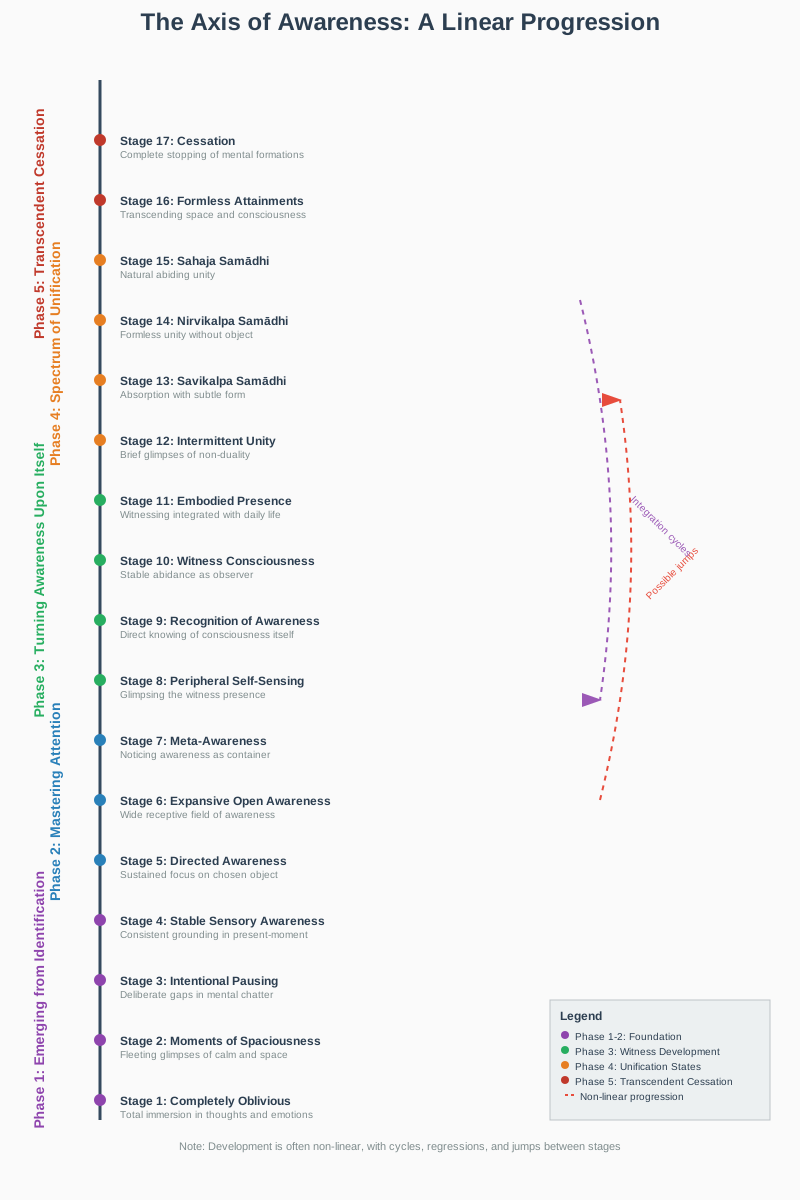 [A vertical diagram showing the 17 stages from “Completely Oblivious” at the bottom to “Cessation” at the top, with phases clearly marked and annotations indicating potential non-linear jumps, cycles, and regressions for added realism.]
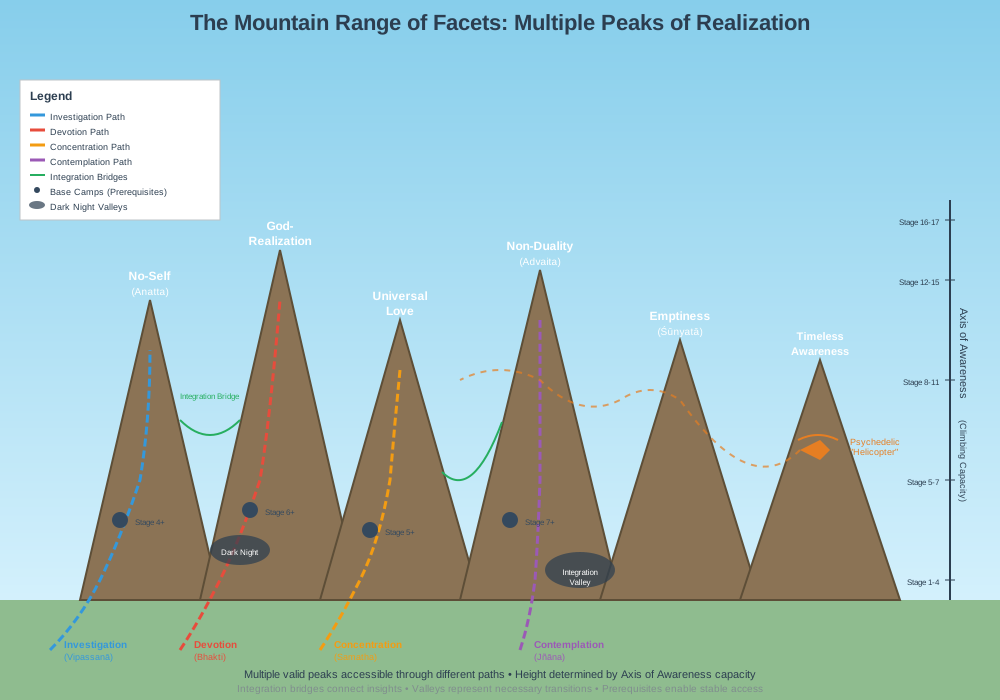
Diagram 2: The Mountain Range of Facets - Topographical Map
[A 3D topographical representation showing different peaks (No-Self, God-Realization, Universal Love, Non-Duality, etc.) with various paths (Investigation, Devotion, Concentration, Contemplation) shown as trails leading to them. The diagram includes valleys representing ‘Dark Nights,’ bridges representing integrative insights, basecamps representing foundational stages from the Axis, and rugged ridges representing tensions and synergies between facets. The vertical scale represents the Axis of Awareness - the higher one’s capacity, the higher one can climb on any peak.]
7.0 Glossary
Anatta: Buddhist concept meaning “no-self” or the absence of a permanent, unchanging self
Axis of Awareness: The universal progression in consciousness capacity described in Part I, representing how the faculty of awareness itself develops
Bhakti: The path of devotion and surrender, emphasizing love and relationship with the divine
Dark Night: Periods of spiritual dryness, disorientation, or difficulty that often mark transitions between developmental stages
Facet: A particular type of contemplative realization or insight (e.g., No-Self, God-Realization, Universal Love)
Jñāna: The path of contemplative inquiry and self-investigation, seeking direct recognition of one’s true nature
Mountain Range: The metaphor used to describe the diverse landscape of possible contemplative realizations
Nirodha Samāpatti: Complete cessation of conditioned consciousness, considered the ultimate attainment in certain Buddhist lineages
Samādhi: States of profound concentration and unification of consciousness
Samatha: The contemplative path emphasizing concentration, mental stability, and refined states of consciousness
SCI Cycle: Synthesis-Challenge-Integration methodology used in this collaborative research
Vipassanā: The path of investigation and analytical insight into the nature of experience
Witness Consciousness: The recognition of awareness as distinct from its contents, often experienced as an unchanging observer of changing phenomena