Beyond the Duopoly: A Playbook for Post-Polarized Politics
Published: September 15, 2025
1. Executive Summary
Political polarization isn’t a moral failure—it’s a design failure. This paper diagnoses polarization as a breakdown in democracy’s three core systems: its Hardware (electoral rules), Heart (civic culture), and Nervous System (decision-making processes). We propose practical interventions at each level, culminating in Community Solution Labs where communities can test integrative approaches to divisive issues.
The urgency is clear: public confidence in Congress hovers around 10% according to recent Gallup polling, while economic gridlock costs trillions in lost productivity. But the deeper crisis is epistemological—we cannot think together, so we cannot act together. Our political dysfunction reflects a broader inability to process complex information collectively, leaving us vulnerable to authoritarian capture and societal breakdown.
This paper offers a different approach. Rather than another partisan critique or technocratic fix, we present a systematic framework for rebuilding democracy’s capacity for collective wisdom. The solution requires simultaneous work on structures, culture, and consciousness—a complete system upgrade designed to help communities navigate complexity without resorting to tribal warfare.
The framework centers on three integrated interventions: electoral reforms that reward cooperation over division (Hardware), civic education that builds shared reality-testing capacity (Heart), and deliberative processes that break complex issues into manageable parts (Nervous System). These aren’t separate reforms but components of a unified system designed to counteract the cognitive traps that make smart people susceptible to polarized thinking.
The practical centerpiece is Community Solution Labs—monthly community forums where citizens apply integrative decision-making tools to divisive local issues. These labs serve as training grounds for a new civic culture while generating a library of “both/and” solutions that transcend traditional left-right divides. Success at local scale provides the foundation for regional and national renewal.
Implementation targets the “Coalition of the Uncomfortable”—politically homeless citizens who find existing partisan options inadequate. This includes frustrated civic entrepreneurs, independent politicians, business leaders suffering from gridlock, and community organizers seeking more effective tools. The strategy begins with structural reforms that have broad appeal while building cultural capacity for more sophisticated approaches to collective problem-solving.
2. Introduction: Intelligent People, Broken System
Consider this exchange from a recent online forum discussion among personal development enthusiasts—people committed to growth, self-awareness, and transcending limiting beliefs:
Participant A: “I’m so tired of the left-right paradigm. Both sides have valid points, but the moment you acknowledge that, you get attacked by both tribes. How do we move beyond this binary thinking?”
Participant B: “Exactly! It’s like being forced to choose between two incomplete worldviews. But every time I try to find middle ground, I end up feeling politically homeless.”
Participant C: “The problem is that the system rewards extremism. Moderate voices get drowned out because outrage drives engagement. We need structural changes, not just better intentions.”
Participant D: “But what structural changes? Every reform proposal gets labeled as secretly serving one side or the other. It feels impossible to have honest conversations about fixing the system.”
This conversation, replicated across countless forums, dinner tables, and community meetings, illustrates our central problem: polarization persists even among people who consciously recognize its limitations and actively seek to transcend it. These aren’t ignorant partisans or tribal warriors—they’re thoughtful individuals trapped within a system that makes polarized thinking the only viable strategy for political engagement.
Their frustration reflects a broader crisis in American democracy. Independent voters now comprise over 40% of the electorate, yet our political system operates as if only two perspectives exist. Trust in institutions has collapsed, with Congress approval ratings consistently below 20%. Economic productivity suffers as policy uncertainty and gridlock create an environment where long-term planning becomes impossible.
But the crisis runs deeper than dissatisfaction with politicians or policies. We face what we might call an epistemological crisis—a fundamental breakdown in our collective capacity to distinguish truth from falsehood, to weigh evidence fairly, to hold complexity without collapsing into oversimplification. We cannot think together, so we cannot act together.
This isn’t primarily about bad actors or irreconcilable differences between left and right. It’s about a political machine with flawed incentives that predictably produces polarization regardless of the good intentions of people within it. Binary electoral choices force citizens into artificial camps. Adversarial media formats reward the most provocative voices while marginalizing thoughtful analysis. Primary systems incentivize appeals to partisan bases rather than broader constituencies. Gerrymandered districts eliminate genuine competition, making ideology more important than competence.
The result is a system that makes intelligent people behave in unintelligent ways. Nuanced thinkers adopt simplistic positions. Collaborative individuals engage in zero-sum competition. People committed to truth prioritize tribal loyalty. The forum participants quoted above aren’t failing to transcend polarization due to personal limitations—they’re struggling against systematic design flaws that make polarized thinking the only rational strategy within current structures.
Previous reform efforts have failed because they addressed symptoms rather than root causes. Campaign finance reform, term limits, and ethics rules all tackle specific dysfunctions without addressing the underlying architecture that produces those dysfunctions. It’s like treating a fever without addressing the infection—the symptoms may temporarily improve, but the disease continues spreading.
Our approach is different. We diagnose polarization as a systems failure requiring systematic solutions. Just as engineers don’t fix a malfunctioning machine by moral exhortation, we can’t fix democracy by hoping people will suddenly start behaving better within broken systems. We need to redesign the machine itself.
This paper introduces a framework for that redesign: treating democracy as a living system with three interconnected components—Hardware, Heart, and Nervous System. Each component serves essential functions, and dysfunction in any one creates cascading failures throughout the whole.
The Hardware consists of the formal rules and structures: electoral systems, legislative procedures, constitutional frameworks. When these reward division over cooperation, the entire system tilts toward conflict.
The Heart encompasses civic culture and shared epistemology: how citizens relate to truth, evidence, and each other across difference. When this breaks down, we lose the capacity for democratic dialogue altogether.
The Nervous System includes the processes through which communities sense problems and coordinate responses: how information flows, how decisions get made, how collective intelligence emerges or fails to emerge.
Current dysfunction stems from failures across all three levels, reinforcing each other in destructive feedback loops. But this also means that coordinated interventions across all three levels can create positive feedback loops that strengthen rather than undermine democratic capacity.
The urgency extends beyond frustration with gridlock. Polarized democracies prove vulnerable to authoritarian capture precisely because their citizens lose faith in democratic institutions’ capacity to address serious challenges. When people conclude that the system cannot think collectively about complex problems, they become susceptible to leaders who promise simple solutions through concentrated power.
Our current moment presents both maximum danger and maximum opportunity. The pervasive sense of crisis—political, social, ecological—creates openness to fundamental redesign that wouldn’t exist during periods of complacency. People are desperate for a new playbook precisely because the old one has so obviously failed.
This paper provides that playbook: a systematic approach to rebuilding democracy’s capacity for collective wisdom in an age of complexity. The goal isn’t eliminating disagreement but transforming it from zero-sum conflict into collaborative problem-solving. The method involves simultaneous work on structures, culture, and consciousness—recognizing that sustainable change requires all three levels working in concert.
The work begins locally with Community Solution Labs where communities can practice integrative decision-making on immediate challenges while building capacity for larger-scale applications. But the principles are scalable: the same patterns that heal division in a town council can inform approaches to state, national, and international governance.
The stakes couldn’t be higher. Democracy’s future depends not on finding perfect solutions but on rebuilding the capacity to seek solutions together across difference. This paper charts a path toward that renewal.
3. Why Smart People Get Trapped: The Consciousness Problem
Before proposing structural solutions, we must understand why polarization persists even among people who consciously recognize its limitations. The forum participants quoted in our introduction aren’t failing due to personal shortcomings—they’re encountering predictable cognitive responses to a poorly designed system. Binary electoral choices and adversarial debate formats systematically trigger psychological mechanisms that make rational discourse difficult even for highly rational people.
Understanding these mechanisms is crucial because structural reforms alone cannot solve problems rooted in how human consciousness processes political information. If we redesign electoral systems without addressing the cognitive dynamics that make citizens susceptible to tribal thinking, we’ll simply create new venues for the same dysfunctional patterns.
3.1 The Cognitive Load Problem
Modern political issues exceed the processing capacity of any individual mind. Climate change involves atmospheric chemistry, economic modeling, international relations, technological assessment, and social psychology—all interconnected in ways that no single person can fully comprehend. Healthcare policy requires understanding insurance markets, medical outcomes research, budget analysis, regulatory frameworks, and demographic trends. Immigration involves legal precedents, economic impacts, cultural dynamics, security considerations, and moral philosophy.
Faced with this complexity, citizens develop what psychologists call “cognitive shortcuts”—mental rules of thumb that allow quick decision-making without exhaustive analysis. In well-designed systems, these shortcuts generally produce good outcomes. But our political system creates perverse incentives that make ideological shortcuts more reliable than careful analysis.
Consider healthcare policy. A citizen attempting independent analysis must synthesize thousands of pages of technical research, navigate competing expert claims, and somehow weigh economic efficiency against moral imperatives. This is cognitively exhausting and often inconclusive. By contrast, adopting their preferred political tribe’s position requires minimal cognitive effort and provides immediate social benefits—tribal belonging, identity confirmation, and moral clarity.
The system rewards this shortcut because political success depends more on mobilizing partisan bases than convincing independent analysts. Politicians face strong incentives to present complex issues in simple, emotionally compelling terms that activate tribal loyalties rather than careful reasoning. Media organizations discover that tribal conflict generates more engagement than nuanced analysis. The entire information ecosystem evolves to serve tribal consumption rather than independent thought.
Intelligent people aren’t immune to this dynamic—they may simply develop more sophisticated rationalizations for positions they’ve adopted through tribal loyalty rather than analysis. A highly educated liberal might marshal impressive evidence for progressive healthcare policies without seriously engaging conservative concerns about implementation costs. A thoughtful conservative might present compelling arguments for market solutions while dismissing progressive concerns about equity. Both believe they’re thinking independently when they’re actually performing tribal reasoning.
The cognitive load problem explains why many smart people report feeling “politically homeless.” They recognize that neither major party’s package of positions results from coherent reasoning about interconnected challenges. But developing genuinely independent positions requires cognitive resources that most people cannot sustain while managing careers, families, and other life demands.
3.2 The Identity Protection Mechanism
Political positions serve psychological functions beyond policy preferences—they become identity markers that define who we are and which communities we belong to. This transforms policy disagreements into identity threats that trigger defensive responses designed to protect self-concept rather than seek truth.
Research in social psychology demonstrates that humans will distort perception, memory, and reasoning to maintain coherent self-narratives. When confronted with evidence that challenges core beliefs, people typically experience cognitive dissonance—psychological discomfort that motivates belief adjustment. However, when those beliefs are tied to identity and community belonging, the discomfort is resolved by rejecting challenging evidence rather than revising beliefs.
This mechanism operates regardless of intelligence or education. Highly intelligent people may simply become more creative at defending positions that protect their identity rather than more open to evidence that threatens it. The lawyer who builds ingenious arguments for predetermined conclusions demonstrates intellectual capability while exemplifying motivated reasoning.
Political systems that organize around stable tribal identities systematically exploit this mechanism. When “being conservative” or “being progressive” becomes central to self-concept, citizens face psychological pressure to adopt whatever positions their tribe currently endorses, regardless of the quality of reasoning behind those positions. Changing political views feels like betraying not just abstract principles but fundamental aspects of who you are.
The forum participants quoted earlier exemplify this trap. They recognize intellectually that both major political tribes offer incomplete worldviews, but they struggle to develop alternative positions that don’t leave them socially isolated. “Feeling politically homeless” reflects the psychological cost of maintaining independent thought in a system designed around tribal loyalty.
This explains why exposure to opposing viewpoints often strengthens rather than weakens partisan convictions. When tribal identity is at stake, encountering challenging arguments activates defensive responses that make people more committed to their original positions. The “backfire effect” demonstrates that correcting factual errors can actually increase belief in false information when that information supports identity-relevant conclusions.
3.3 The Framework Prison
Perhaps most frustratingly for thoughtful people, recognizing these cognitive traps doesn’t automatically provide escape routes. Meta-cognitive awareness—knowing that you’re susceptible to bias—helps but doesn’t eliminate the underlying psychological mechanisms. Even people who understand polarization’s limitations often find themselves defaulting to tribal thinking when under stress or time pressure.
This creates what we term the “framework prison”—the situation where people can see the bars of their cognitive cage but cannot find the door. They recognize that left-right thinking is inadequate for addressing complex challenges, but they lack alternative frameworks for organizing political thought that are both intellectually coherent and socially viable.
The prison has several reinforcing walls. First, binary electoral systems offer only two viable options regardless of citizens’ actual preference distributions. People may want positions that combine fiscal conservatism with environmental protection, or social liberalism with national security concerns, but they must choose between packages that bundle positions in ways that don’t match their values.
Second, media formats are optimized for conflict rather than complexity. Nuanced positions don’t fit into soundbites or debate segments. Attempts to present “both/and” solutions get criticized by both sides for being insufficiently committed to tribal priorities. The structural incentives of political communication reward simplification over sophistication.
Third, social networks become echo chambers that reinforce rather than challenge existing beliefs. Even people who deliberately seek diverse perspectives often discover that their social media algorithms, friend groups, and information sources gradually converge around their established preferences. The framework prison becomes social isolation from alternative perspectives.
Fourth, the psychological comfort of tribal belonging makes framework-transcendence emotionally costly even when it’s intellectually satisfying. Humans are social animals who experience literal pain when excluded from groups. Maintaining political independence requires ongoing tolerance for social discomfort that most people find unsustainable.
3.4 The Self-Assessment Challenge
To encourage reflection on these dynamics, consider this diagnostic question: When was the last time a political debate changed your mind on a significant issue? If your answer is “rarely” or “never,” it likely signals systemic entrapment rather than exceptional wisdom or stubbornness on your part.
Healthy cognitive systems regularly update beliefs based on new evidence and arguments. When political cognition becomes rigid, it suggests that identity protection mechanisms have overridden truth-seeking motivations. This isn’t a personal failing—it’s a predictable response to systems that punish independent thought while rewarding tribal loyalty.
The diagnostic applies equally to people across the political spectrum. Progressive intellectuals who haven’t modified any significant political beliefs after encountering conservative arguments are demonstrating the same cognitive rigidity as conservative intellectuals who remain unmoved by progressive evidence. The content of beliefs matters less than the process by which beliefs are maintained and revised.
This rigidity helps explain why even highly intelligent, well-intentioned people often talk past each other in political discussions. They’re not engaged in collaborative truth-seeking but in competitive identity defense. The goal becomes winning arguments rather than improving understanding, which makes genuine learning unlikely for all participants.
3.5 Toward a More Mature Public Epistemology
These cognitive traps are not immutable features of human nature but predictable responses to specific environmental pressures. The same psychological mechanisms that produce tribal thinking in political contexts produce collaborative problem-solving in contexts with different incentive structures. Scientists, doctors, engineers, and other professionals regularly transcend personal preferences to pursue accurate understanding because their professional environments reward truth-seeking over tribal loyalty.
The key insight is that consciousness shapes systems, but systems also shape consciousness. Individual efforts to transcend polarization will remain limited as long as the structural environment systematically rewards tribal thinking. But structural reforms that ignore consciousness dynamics will fail because they don’t address the psychological mechanisms that make people susceptible to demagogic manipulation.
Effective solutions must work on both levels simultaneously—redesigning systems to support rather than undermine truth-seeking while cultivating cognitive practices that enable citizens to navigate complexity without defaulting to tribal shortcuts. This requires what we might call a “more mature public epistemology”—a better collective relationship with truth, evidence, and uncertainty.
Such an epistemology would normalize intellectual humility, curiosity about opposing viewpoints, and comfort with provisional conclusions. It would distinguish between different types of disagreements—factual disputes that can be resolved through evidence, values conflicts that require moral reasoning, and definitional debates that need conceptual clarification. Most importantly, it would create social rewards for independent thinking rather than tribal loyalty.
Building this epistemology requires conscious design of the institutions, processes, and cultural practices that shape how citizens encounter political information. The next sections outline specific interventions across three levels—electoral structures, civic culture, and decision-making processes—that work together to support rather than undermine collective intelligence.
The goal isn’t eliminating cognitive shortcuts or tribal psychology—these serve important functions in human life. Instead, we aim to channel these mechanisms toward collaboration rather than conflict, toward truth-seeking rather than identity protection, toward collective problem-solving rather than zero-sum competition. This is possible, but it requires deliberate system design based on realistic understanding of how consciousness actually operates under different environmental conditions.
4. The Triumvirate: Three Levels of Intervention
The cognitive traps outlined in the previous section are not immutable features of human nature but predictable responses to specific environmental pressures. The same psychological mechanisms that produce tribal thinking in political contexts enable collaborative problem-solving in environments with different incentive structures. Scientists transcend personal preferences to pursue accurate findings because peer review rewards evidence over ideology. Emergency response teams coordinate across diverse backgrounds because crisis situations create shared stakes that override tribal divisions.
The key insight is that systems shape consciousness as much as consciousness shapes systems. While individual efforts to transcend polarization remain limited within structures that reward tribal thinking, systematic redesign can channel human psychology toward collaboration rather than conflict.
This requires coordinated intervention across three levels that reinforce each other like the organs of a living system:
4.0 Designing for Collective Intelligence
The electoral, cultural, and procedural reforms that follow are not arbitrary policy proposals but integrated components designed specifically to counteract the cognitive traps that make intelligent people susceptible to polarized thinking. They create an environment where a more mature civic epistemology can emerge—one that rewards truth-seeking over tribal loyalty.
The Hardware addresses Identity Protection by removing zero-sum triggers that force citizens into artificial camps, instead rewarding politicians who build bridges across difference.
The Heart addresses the Framework Prison by providing citizens with tools to navigate complexity without defaulting to ideological shortcuts, fostering intellectual humility and curiosity.
The Nervous System addresses Cognitive Load by breaking complex challenges into manageable deliberative processes that enable collective intelligence rather than individual overwhelm.
These interventions work synergistically. Electoral reforms create space for nuanced candidates, but those candidates need citizens capable of appreciating nuance. Civic education builds that capacity, but it requires decision-making processes that reward rather than punish complexity. Each component enables the others while remaining insufficient alone.
4A. The Hardware: Rules of the Game (Electoral System Reform)
Democratic hardware consists of the formal rules that determine how citizens choose representatives and how those representatives make decisions. Current hardware systematically rewards division over cooperation through mechanisms that most citizens never consciously consider but that shape every political interaction.
The Core Problem: Zero-Sum Competition
First-past-the-post voting creates artificial scarcity where candidates succeed by defeating opponents rather than solving problems. This incentivizes negative campaigning, tribal mobilization, and extremist positioning that activates partisan bases. The candidate who most effectively demonizes opponents often defeats the candidate with the best policy solutions.
Gerrymandering intensifies this dynamic by creating “safe” districts where general election competition disappears, making primary elections the only meaningful contests. Since primary voters tend toward partisan extremes, politicians face strong incentives to adopt increasingly polarized positions that alienate median voters but energize activist bases.
The two-party duopoly emerges naturally from these structural features, creating false binary choices that force citizens to choose between packages of positions that may not reflect their actual preferences. Someone who supports fiscal conservatism and environmental protection, or social liberalism and strong defense, finds no viable electoral expression for their worldview.
The Solution: Cooperation-Rewarding Systems
Ranked-Choice Voting eliminates the “lesser evil” dynamic that traps voters between unsatisfactory options. Candidates must appeal beyond their base because they need second and third-choice support from voters whose first choice is someone else. This rewards coalition-building over tribal mobilization.
Maine’s implementation faced initial resistance and voter confusion, but subsequent elections showed increased satisfaction and more civil campaigns. Critics argued it would confuse voters or advantage extreme candidates, but evidence demonstrates the opposite: voters adapt quickly and moderate candidates benefit from broader appeal.
Nonpartisan Primaries like those adopted in Alaska and several other states create incentives for candidates to appeal across party lines rather than just to partisan bases. When all candidates compete in a single primary with the top vote-getters advancing regardless of party affiliation, politicians must develop positions that attract diverse coalitions.
Independent Redistricting removes the conflict of interest that allows politicians to choose their voters rather than voters choosing politicians. States like Michigan that have implemented independent commissions show increased electoral competition and reduced polarization as politicians must appeal to genuinely diverse constituencies.
These reforms work together to create what electoral systems scholars call “centripetal incentives”—structural pressures that pull politicians toward the median voter rather than toward partisan extremes. The hardware doesn’t determine specific policy outcomes but creates conditions where collaborative problem-solving becomes more politically viable than tribal warfare.
4B. The Heart: Cultivating Civic Epistemology
While electoral reforms address structural incentives, they cannot succeed without cultural changes that enable citizens to engage productively with political complexity. The Heart encompasses civic epistemology—how communities collectively process information, weigh evidence, and distinguish between different types of disagreements.
The Core Problem: Epistemological Breakdown
Current civic culture conflates different types of disagreements in ways that make productive dialogue nearly impossible. Factual disputes (What are the unemployment rates?) get mixed with values conflicts (Should economic growth or environmental protection take priority?) and definitional debates (What constitutes “fair” taxation?). When everything becomes a values fight, evidence becomes irrelevant and compromise becomes betrayal.
Media incentives exacerbate this confusion by treating all political questions as binary conflicts between opposing teams. Nuanced analysis doesn’t fit into soundbites or debate formats optimized for dramatic confrontation. Citizens learn to consume political information as entertainment rather than developing skills for collaborative truth-seeking.
The result is widespread epistemic learned helplessness—the belief that ordinary citizens cannot meaningfully evaluate complex policy questions and must rely on tribal authorities to tell them what to think. This creates vulnerability to demagogic manipulation while undermining the civic capacity that democratic self-governance requires.
The Solution: Epistemic Literacy for Democratic Citizenship
Distinguishing Types of Disagreement represents the foundational skill for democratic dialogue. Citizens need tools to recognize when they’re having factual disputes that can be resolved through evidence, values conflicts that require moral reasoning and negotiation, or definitional debates that need conceptual clarification.
Training in these distinctions could be integrated into civic education at all levels. Students would practice identifying the type of disagreement occurring in political debates and applying appropriate resolution methods for each type. Adults could access similar training through community workshops, online courses, or integration into existing civic organizations.
Epistemic Humility as a civic virtue involves normalizing intellectual uncertainty and curiosity about opposing viewpoints. This doesn’t mean abandoning strong convictions but rather holding them lightly enough to engage seriously with challenges. Citizens would learn to distinguish between confidence in core values and confidence in specific policy implementations.
Evidence-Based Reasoning skills help citizens evaluate information sources, understand statistical claims, and recognize logical fallacies without requiring technical expertise. The goal isn’t turning everyone into policy analysts but providing basic tools for distinguishing credible from manipulative information.
Perspective-Taking Practices build capacity to understand how intelligent people can reach different conclusions from the same evidence. This involves learning to “steel-man” opposing arguments—presenting them in their strongest form rather than attacking weak versions—and recognizing the legitimate concerns that motivate different political positions.
These skills can be developed through accessible resources and practical application. Julia Galef’s “The Scout Mindset” provides an excellent introduction to epistemic humility for general audiences. Online platforms like Coursera offer courses in critical thinking and evidence evaluation. Local libraries and community centers could host workshops on productive political dialogue.
The key insight is that epistemological skills are learnable and that practicing them in low-stakes contexts builds capacity for applying them during high-stakes political decisions. Citizens who develop these capabilities become more resistant to demagogic manipulation while more capable of collaborative problem-solving.
4C. The Nervous System: Architecture of Decision-Making
Even with improved electoral incentives and civic epistemology, democracy requires decision-making processes that enable collective intelligence rather than just aggregating individual preferences. The Nervous System encompasses the institutions and procedures through which communities sense problems, generate solutions, and coordinate responses.
The Core Problem: Institutional Sclerosis
Current legislative processes were designed for simpler times when problems could be addressed through separate policy domains and representatives could develop genuine expertise in specific areas. Contemporary challenges cross multiple domains, change rapidly, and involve technical complexity that exceeds individual cognitive capacity.
The result is institutional paralysis where legislators vote on bills they haven’t read, written by lobbyists representing narrow interests, addressing symptoms rather than systemic causes. Committee structures fragment complex problems into artificial pieces while partisan competition makes collaborative problem-solving politically dangerous for individual politicians.
The Solution: Deliberative Democracy at Scale
Citizen Assemblies provide a proven alternative to conventional legislative processes for addressing complex, contentious issues. Ireland’s successful use of randomly selected citizens to develop recommendations on abortion and same-sex marriage demonstrates that ordinary people can engage productively with difficult questions when provided with appropriate information and facilitation.
The key innovation is sortition—random selection that creates diverse groups without the self-selection biases that affect volunteer committees or the electoral pressures that constrain politicians. Citizens chosen by lottery have no constituencies to appease and no careers to protect, enabling them to focus on collaborative problem-solving rather than political positioning.
Assemblies work through structured deliberation that presents diverse expert testimony, facilitates small-group discussion across difference, and builds toward recommendations that must be supported by supermajority consensus. The process rewards listening and learning rather than debating and winning.
Long-Term Mandates for key leadership positions reduce the constant campaign pressures that force politicians to prioritize short-term electoral considerations over long-term governance challenges. Single six-year terms for presidents and governors, with enhanced accountability mechanisms, could enable more strategic thinking about complex problems.
Evidence-Based Policy Offices modeled on the Congressional Budget Office could provide nonpartisan analysis of policy proposals across multiple domains, helping legislators and citizens understand systemic implications rather than just immediate political benefits. These offices would maintain credibility through transparent methodology and diverse expert input.
Structured Integration Methods help communities navigate complex decisions through processes that honor both technical expertise and democratic values. The next section introduces one such method—the Paradox Decision Canvas—that enables groups to find “both/and” solutions to apparently binary choices.
4D. Scalable Principles: From Local Labs to National Renewal
The most frequent critique of deliberative democracy proposals involves scalability: “This might work for a town of 5,000, but how does it scale to a nation of 330 million?” The answer lies in understanding that healthy patterns are fractal—the same principles that enable productive dialogue in small groups can inform design of larger-scale institutions.
Community Solution Labs serve as culture generators and training grounds for the kind of citizens and leaders who can then operate analogous systems at state and federal levels. A city council member who learns integrative decision-making in a municipal context brings those skills to regional coordination efforts. A citizen who practices epistemic humility in neighborhood discussions becomes more capable of productive engagement with national political questions.
The Labs aren’t just problem-solving venues but educational institutions that build civic capacity. Participants develop skills in perspective-taking, evidence evaluation, and collaborative solution-finding that they apply across all areas of their civic engagement. Over time, this creates constituencies who demand and can participate in more sophisticated approaches to collective decision-making.
At the same time, national institutions can adopt deliberative principles appropriate to their scale. Citizen Assemblies can address specific complex issues like climate adaptation or healthcare reform, providing recommendations that legislators vote on without amendment. Legislative committees can adopt structured integration methods when addressing cross-cutting challenges. Executive agencies can implement evidence-based policy offices that provide nonpartisan analysis.
The principle is subsidiarity: empower local solutions to local problems while enabling coordination on challenges that cross jurisdictional boundaries. This reduces the cognitive load on national politics by addressing many issues at scales where direct participation remains possible while building capacity for effective engagement with genuinely national challenges.
Most importantly, the transformation occurs through demonstration rather than imposition. Communities that successfully implement integrative approaches create examples that other communities want to replicate. Politicians who learn collaborative methods gain competitive advantages over those who remain trapped in adversarial patterns. Citizens who experience productive political dialogue demand higher standards from their representatives.
The pathway to national renewal runs through local experimentation, cultural development, and gradual scaling of proven approaches rather than attempting immediate systemic transformation. This evolutionary approach builds sustainable change from the ground up while remaining compatible with existing democratic institutions.
5. The Paradox Decision Canvas: A Practical Tool
The epistemological crisis outlined in previous sections requires more than structural reforms—it demands practical tools that enable citizens to navigate complexity without defaulting to tribal shortcuts. The Paradox Decision Canvas provides such a tool: a structured methodology for finding “both/and” solutions to apparently binary choices, serving as training wheels for the kind of integrative thinking that post-polarized politics requires.
5.1 Beyond Either/Or: The Logic of Integration
Most political debates present false binary choices that force citizens into artificial camps. Should we prioritize economic growth or environmental protection? Individual freedom or collective responsibility? Security or civil liberties? These framings assume that advancing one value necessarily requires sacrificing another, creating zero-sum competitions that generate more heat than light.
The Canvas challenges this assumption by revealing how apparent contradictions often mask deeper complementarities. Environmental protection and economic growth conflict only within short-term, extractive economic models—but sustainable prosperity requires healthy ecosystems. Individual freedom and collective responsibility appear opposed only when we ignore how personal autonomy depends on functional social institutions. Security and civil liberties seem contradictory only if we assume that true security can be achieved through authoritarian means.
This isn’t naive optimism but rigorous systems thinking. Complex challenges rarely yield to simple solutions, and sustainable progress usually requires integrating rather than choosing between legitimate competing values. The Canvas provides a structured process for discovering these integrations while remaining grounded in practical constraints and power realities.
5.2 The Four-Step Process
Step 1: Map the Poles
Begin by clearly articulating the opposing positions without caricature or dismissal. This requires what Julia Galef calls “steel-manning”—presenting each side in its strongest, most compelling form rather than attacking weak versions. The goal is not to prove one side right but to understand why intelligent, well-intentioned people can reach different conclusions about complex issues.
For each pole, identify:
- The core concerns driving this position
- The values being protected or advanced
- The fears about what might be lost if the other side prevails
- The evidence and reasoning supporting this approach
This mapping process often reveals that opponents share more common ground than initially apparent. Progressive concerns about inequality and conservative concerns about economic dynamism both reflect desires for a society where people can flourish through their efforts. Liberal emphasis on inclusion and conservative emphasis on tradition both seek communities where people feel they belong.
Step 2: Discover the Shared Deeper Goal
Most political disagreements involve different strategies for achieving similar ultimate aims rather than fundamental conflicts over values. Citizens across the political spectrum generally want safe communities, economic opportunity, functional institutions, and a society that works for their children. The Canvas helps identify these shared deeper goals that both poles are attempting to serve.
This step requires moving beyond surface-level policy preferences to uncover underlying motivations. Why do people support particular approaches to education, healthcare, or economic policy? What are they hoping to achieve? What problems are they trying to solve? What vision of human flourishing motivates their political engagement?
The shared goal isn’t always obvious and may require several iterations to articulate clearly. But this process creates the foundation for collaborative problem-solving by establishing common criteria for evaluating potential solutions.
Step 3: Design the Third Way
With clear understanding of both poles and their shared deeper goal, the Canvas guides users toward solutions that honor legitimate concerns from multiple perspectives. This isn’t splitting the difference or finding mushy middle ground but rather transcending the original binary through creative reframing.
Effective third-way solutions often operate at different levels than the original debate. If two communities disagree about centralized versus decentralized approaches to education, the integration might involve subsidiarity—empowering local innovation within shared standards. If citizens debate individual versus collective approaches to healthcare, the solution might combine personal responsibility with social insurance in ways that strengthen rather than undermine each other.
The key insight is that many apparent contradictions dissolve when we zoom out to see larger patterns or zoom in to address specific implementation details. What looks like either/or at one level often becomes both/and at another level.
Step 4: Power-Proof the Solution
Even elegant integrative solutions fail if they ignore power dynamics or lack safeguards against misuse. The final step subjects proposed solutions to rigorous reality-testing by asking: Who benefits from this approach? What could go wrong? How might this be gamed or captured by narrow interests? What safeguards are necessary to ensure the solution serves its intended purpose?
This power analysis isn’t cynical but realistic. History demonstrates that even well-intentioned reforms can be subverted by concentrated interests or produce unintended consequences that harm the people they were designed to help. Sustainable solutions must account for human psychology, institutional incentives, and the tendency of power to concentrate unless deliberately counterbalanced.
5.3 Worked Example: Local School Funding Debate
Consider a common local controversy: how to fund schools when property tax revenues create inequities between wealthy and poor districts while bonds require voter approval that may reflect racial or class divisions rather than educational priorities.
Mapping the Poles:
Position A (Equity Focus): Current funding mechanisms perpetuate systemic inequalities that deny equal educational opportunity. Wealthy districts spend significantly more per student while poor districts struggle with overcrowded classrooms and inadequate resources. This reflects and reinforces broader patterns of structural racism and class stratification. Solutions must prioritize equal outcomes and redistribute resources to historically underserved communities.
Position B (Local Control): Education works best when communities control their schools and parents can choose approaches that match their values. Property tax funding reflects local investment and democratic engagement with education policy. State or federal redistribution undermines accountability while imposing one-size-fits-all solutions on diverse communities. Quality education emerges from parental involvement and local innovation, not bureaucratic equality mandates.
Shared Deeper Goal: Both sides want all children to have access to excellent education that prepares them for productive, fulfilling lives while strengthening community cohesion and democratic participation.
Third Way Solution: Implement a dual-track system combining guaranteed baseline funding with local enhancement opportunities. The state ensures that every district receives sufficient resources for excellent basic education (high-quality teachers, safe facilities, essential programs) while allowing communities to fund additional programs through local bonds or parental contributions.
This approach includes several innovative elements:
- Weighted funding formulas that provide extra resources for students facing additional challenges (poverty, language barriers, special needs)
- Regional partnerships that allow smaller districts to share specialized programs and resources
- Transparent reporting systems that help communities understand how funds translate into student outcomes
- Parent academies that build engagement across all communities rather than just wealthy ones
Power-Proofing: The solution includes specific safeguards against predictable failure modes. Anti-gerrymandering provisions prevent wealthy areas from seceding into separate districts. Sunset clauses require periodic review and reauthorization. Community oversight boards include diverse representation and rotating membership. Regular auditing ensures funds reach classrooms rather than administrative overhead.
5.4 Scaling the Methodology: National Immigration Example
The Canvas methodology scales from local to national challenges while maintaining its integrative logic. Consider immigration policy, where traditional debates pit border security against humanitarian concerns in ways that make comprehensive solutions politically impossible.
Mapping the Poles:
Position A (Humanitarian Priority): Immigration restrictions reflect xenophobia and ignore America’s moral obligations to people fleeing violence and poverty. Current enforcement policies separate families, violate human rights, and ignore economic realities about labor needs. Solutions must prioritize human dignity, family unity, and pathways to citizenship for people already contributing to American communities.
Position B (Security/Rule of Law Priority): Uncontrolled immigration undermines national sovereignty, strains social services, and creates unfair competition for American workers. Legal immigration must be distinguished from illegal entry, and enforcement must be consistent to maintain public confidence in democratic institutions. Solutions must secure borders first while creating orderly processes for legal immigration.
Shared Deeper Goal: A prosperous, secure America that attracts global talent while maintaining social cohesion and democratic legitimacy, with immigration policies that serve both humanitarian values and national interests.
Third Way Solution: Implement responsive immigration pathways that expand legal channels while strengthening border management through technology and international cooperation rather than just enforcement. This includes:
- Skills-based visas that adapt to labor market needs while protecting American worker wages
- Regional pilot programs for temporary worker arrangements with source countries
- Streamlined asylum processes that reduce backlogs while maintaining due process
- Community sponsorship programs that distribute integration support across willing communities
- Investment in origin-country development that addresses root causes of forced migration
Power-Proofing: The solution anticipates political pressures through automatic adjustment mechanisms tied to economic indicators and community capacity. Bipartisan oversight commissions include business, labor, and community representatives. Regular evaluation processes assess outcomes against stated goals. Constitutional safeguards protect due process while enabling efficient administration.
5.5 The Canvas as Epistemic Training
Beyond producing better policy solutions, using the Canvas builds the cognitive habits necessary for post-polarized citizenship. Regular practice in steel-manning opponents develops intellectual humility and curiosity about different perspectives. The search for shared deeper goals cultivates empathy without requiring agreement on specific policies. Designing integrative solutions exercises creative problem-solving muscles that atrophy under binary thinking. Power analysis develops realistic assessment of institutional dynamics.
These skills transfer across contexts. Citizens who learn integrative thinking through local school board decisions become more capable of sophisticated engagement with national policy debates. Community leaders who practice perspective-taking on municipal issues develop capacity for regional coordination efforts. The Canvas serves as civic education in the deepest sense—training in the arts of democratic citizenship that enable collective wisdom rather than just individual opinion.
5.6 Implementation Resources
Take Action: The interactive Paradox Decision Canvas is available now at globalgovernanceframeworks.org/resources/paradox-canvas — a practical tool you can use immediately on any divisive issue in your community.
Future development could include facilitation guides for community workshops, downloadable templates for offline use, and a library of case studies documenting successful applications across different contexts. Such resources would enable broader adoption while maintaining quality control over the methodology’s implementation.
Local organizations can adapt the Canvas for their specific needs while maintaining its core integrative logic. Community groups, faith congregations, business associations, and civic organizations all provide natural venues for practicing these methods on issues that matter to participants while building broader capacity for constructive political engagement.
The goal isn’t replacing traditional political processes but complementing them with tools that enable more sophisticated collective thinking. As more citizens develop comfort with integrative approaches, they create constituencies that demand and can support more nuanced approaches to public challenges at all levels of governance.
6. Community Solutions Labs: Testing Ground for Integration
The Paradox Decision Canvas provides a methodology for integrative thinking, but methodology alone cannot transform political culture. Citizens need venues to practice these approaches on real challenges with genuine stakes while building the social trust that enables collaborative problem-solving. Community Solutions Labs serve this function—monthly community forums where residents apply integrative decision-making tools to divisive local issues, creating both immediate policy improvements and long-term civic capacity.
6.1 The Core Proposal: Democracy R&D at Community Scale
Community Solutions Labs operate as “civic research and development” hubs where communities experiment with post-polarized approaches to contentious issues. Unlike traditional town halls that often devolve into partisan performance or public comment sessions that provide catharsis but little progress, Labs structure dialogue specifically to generate actionable solutions that transcend either/or thinking.
These Labs effectively become the new Nervous System for the community—a dedicated, recurring process for sensing problems, deliberating on them, and coordinating responses, feeding healthy input into the formal Hardware of government.
Each Lab session addresses one divisive local issue through a carefully designed process:
Pre-Session Preparation: Community members submit issues through an online portal that asks them to identify the core tension rather than advocate for specific solutions. A steering committee selects monthly topics based on community interest, policy urgency, and educational value for practicing integrative methods.
Facilitated Dialogue Process: Trained facilitators guide 20-40 participants through the Paradox Canvas methodology over a structured 3.5-hour session. The process moves systematically from mapping competing positions to discovering shared goals to designing integrative solutions to power-proofing implementation.
Documentation and Follow-Through: Each session produces written recommendations that are formally presented to relevant decision-making bodies (city council, school board, county commissioners). A tracking system monitors which recommendations get adopted, modified, or rejected, creating feedback loops that improve both the Lab process and policy outcomes.
Capacity Building: Beyond addressing specific issues, Labs explicitly develop participant skills in perspective-taking, evidence evaluation, and collaborative solution-finding. Regular participants become community resources for productive dialogue across contexts.
6.2 Specific Structure and Methodology
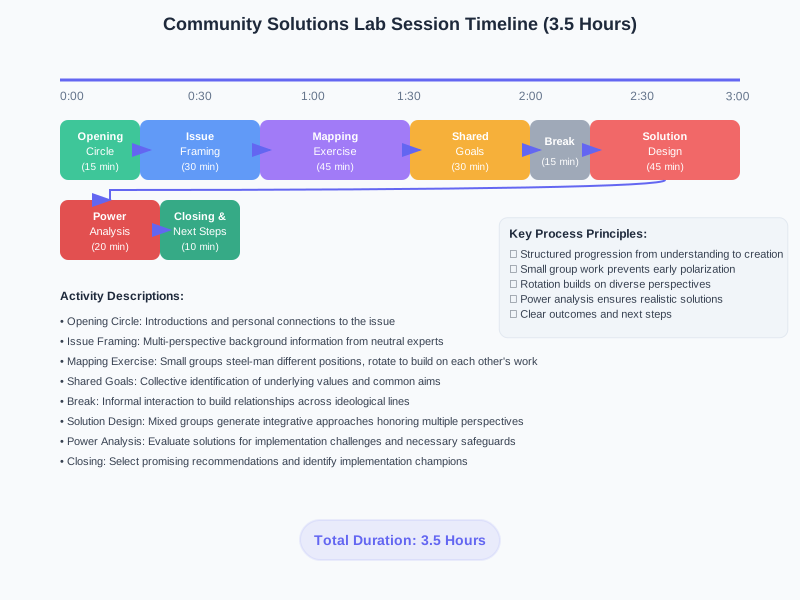
Session Design (3.5 hours):
Opening Circle (15 minutes): Participants introduce themselves and share their connection to the issue, establishing human relationships before engaging policy disagreements.
Issue Framing (30 minutes): Facilitators present background information from multiple perspectives, drawing on neutral expert sources and agreed-upon data. For complex technical issues, this may require partnerships with universities, professional associations, or retired experts who can provide trusted, non-partisan analysis.
Mapping Exercise (45 minutes): Small groups apply Step 1 of the Canvas, identifying and steel-manning different positions. Groups rotate to build on each other’s work, preventing early polarization around initial framings.
Shared Goals Discovery (30 minutes): Participants work collectively to identify underlying values and aims that different positions are attempting to serve, often revealing surprising common ground.
Break (15 minutes): Informal interaction helps build personal relationships across ideological lines.
Solution Design (45 minutes): Mixed groups generate integrative approaches that honor legitimate concerns from multiple perspectives. The emphasis is on creative problem-solving rather than political positioning.
Power Analysis (20 minutes): Participants evaluate proposed solutions for implementation challenges, unintended consequences, and necessary safeguards.
Closing and Next Steps (10 minutes): The group selects the most promising recommendations for formal presentation to decision-makers and identifies volunteers to champion implementation.
Facilitation Requirements:
Labs require trained facilitators who understand both the methodology and group dynamics. Effective facilitators maintain strict neutrality on policy content while being directive about process. They interrupt unproductive patterns (grandstanding, personal attacks, false dichotomies) while amplifying constructive contributions (evidence-based reasoning, genuine curiosity, creative integration).
Training programs for community facilitators could be developed through partnerships with conflict resolution organizations, universities, or civic leadership programs. The key skills include active listening, reframing techniques, group process management, and familiarity with local governance structures.
6.3 Examples of Lab Applications
Municipal Budget Allocation: A mid-sized city faces budget pressures requiring difficult choices between infrastructure investment and social services. Traditional budget processes pit road repair advocates against housing program supporters in zero-sum competition.
Lab Process: Participants map the legitimate concerns driving each priority—economic development depends on functional infrastructure while community stability requires addressing homelessness. The shared goal emerges: sustainable prosperity that works for all residents.
Integrative Solution: A phased approach that uses infrastructure investment as economic stimulus to generate revenue for expanded social services. Road improvements prioritize commercial corridors that create employment opportunities for housing program participants. Public works projects include job training components that build local workforce capacity.
Power-Proofing: Performance metrics track both infrastructure quality and social outcomes. Business leaders commit to local hiring quotas. Regular community input sessions monitor implementation against stated goals.
Climate Adaptation vs. Economic Development: A coastal community debates sea-level rise adaptation measures that could restrict development and reduce property tax revenue.
Lab Process: Environmental advocates emphasize scientific evidence about flooding risks while business leaders highlight economic costs of overregulation. The shared goal becomes long-term community resilience that preserves both environmental health and economic viability.
Integrative Solution: Green infrastructure approaches that provide both flood protection and economic development opportunities. Wetland restoration creates eco-tourism assets. Building elevation requirements stimulate construction employment. Tax increment financing for resilience improvements generates revenue for further adaptation.
Power-Proofing: Scientific advisory committee provides ongoing risk assessment. Business impact studies track economic effects. Regular evaluation allows policy adjustments based on evidence and changing conditions.
School Technology and Privacy: Parents debate district technology policies, with some demanding enhanced digital learning tools while others worry about student privacy and screen time.
Lab Process: Participants explore concerns about educational equity and technological literacy alongside fears about data collection and developmental impacts. The shared goal is educational excellence that prepares students for digital citizenship while protecting their wellbeing.
Integrative Solution: Age-appropriate technology integration with strong privacy protections. Elementary focus on digital literacy rather than device dependence. Middle school project-based learning with explicit privacy education. High school advanced technology access with student-controlled data policies.
Power-Proofing: Parent oversight committee monitors implementation. Regular assessment of learning outcomes and digital wellness. Technology vendor contracts include strict data protection requirements.
6.4 Success Metrics and Evidence Base
Measuring Lab effectiveness requires tracking both immediate policy outcomes and long-term civic capacity building:
Policy Impact Metrics:
- Percentage of Lab recommendations adopted by formal decision-making bodies
- Speed of implementation compared to traditional policy processes
- Stakeholder satisfaction with adopted solutions
- Reduced litigation and conflict over contentious issues
Civic Capacity Metrics:
- Participant retention and engagement across multiple sessions
- Skill development in perspective-taking and integrative thinking (pre/post assessments)
- Cross-cutting relationship building (social network analysis)
- Community-wide confidence in local governance (periodic surveys)
Broader Democratic Health Indicators:
- Increased voter turnout in local elections
- Higher quality candidates seeking local office
- Reduced partisan polarization in local political discourse
- Enhanced civic knowledge and engagement among participants
Early evidence from similar initiatives provides encouraging precedents. Ireland’s Citizens’ Assemblies demonstrated that randomly selected citizens can engage productively with contentious issues when provided with appropriate information and facilitation. The participatory budgeting movement shows that communities can make complex resource allocation decisions collaboratively. Deliberative polling research confirms that structured dialogue improves both individual reasoning and collective judgment.
6.5 Implementation Logistics and Scaling
Startup Requirements:
Organizational Capacity: Labs require modest organizational infrastructure—a coordinator, meeting space, basic technology for documentation and communication. Many communities already have suitable venues through libraries, community centers, or faith congregations.
Facilitator Training: Initial implementation requires 2-3 trained facilitators per community. Training programs could be delivered through online modules plus in-person practice sessions, reducing barriers to widespread adoption.
Participant Recruitment: Success requires diverse participation beyond the “usual suspects” of civic engagement. The 3.5-hour commitment represents a significant barrier that must be strategically addressed to ensure genuine community representation. Effective strategies include:
- Participation stipends that honor civic contribution as valuable work while removing financial barriers for hourly workers
- Comprehensive support including free childcare, simple meals, and accessible transportation
- Targeted outreach combining open registration with intentional recruitment across demographic and ideological groups
- Partnership with existing organizations (unions, faith communities, professional associations, neighborhood groups) to embed within established networks
- Clear messaging that frames the time commitment as respect for the issue’s importance rather than bureaucratic inefficiency
The extended format is necessary for the depth of cognitive and relational work required to move from conflict to collaboration. Shorter sessions often fail because they don’t allow sufficient time for trust-building, perspective-taking, and creative solution development.
Community Buy-In: Success depends on participation from diverse stakeholders including elected officials who commit to seriously considering Lab recommendations. Early outreach should target community leaders who already recognize the limitations of current approaches.
Funding Models: Pilot Labs could operate on modest budgets ($15,000-25,000 annually) covering facilitation, materials, and documentation. Funding sources include local foundations, civic organizations, or municipal governance budgets. Successful pilots create evidence for larger-scale investment.
Scaling Strategy:
Phase 1 (Pilot Stage): Launch Labs in 5-10 communities with varying demographics and political cultures. Focus on building proof-of-concept while developing replicable methodologies and training materials.
Phase 2 (Network Development): Connect successful Labs through online platforms for sharing solutions and best practices. Develop standardized facilitator certification programs and evaluation metrics.
Phase 3 (Institutional Integration): Partner with municipal governance structures to formalize Lab recommendations in decision-making processes. Create regional networks for addressing challenges that cross jurisdictional boundaries.
6.6 Addressing Predictable Challenges
Participation Barriers: The 3.5-hour format creates inherent access challenges that must be proactively addressed. Without strategic intervention, Labs risk self-selection by participants with flexible schedules (retirees, students, professionals) while excluding hourly workers, parents, and caregivers. Mitigation requires treating participation as valuable civic work deserving compensation and support.
Alternative Format Testing: Communities struggling with the full format might pilot 90-minute “Community Dialogue” sessions focusing only on mapping exercises and shared goal discovery. These shorter sessions can build familiarity with integrative methods while creating appetite for full Labs when complex solutions are needed.
Facilitator Quality: Poorly trained facilitators can undermine the entire process by allowing grandstanding, failing to maintain neutrality, or rushing through crucial steps. Robust training programs with ongoing support and evaluation help ensure consistent quality.
Political Resistance: Elected officials may view Labs as threats to traditional authority or party politics. Success requires demonstrating that Labs enhance rather than replace formal governance while generating politically beneficial outcomes for leaders who engage constructively.
Issue Selection: Some topics may be too abstract, technical, or emotionally charged for productive Lab dialogue. Careful issue curation focuses on problems with clear local stakes and realistic solution possibilities while building capacity for more complex challenges.
Capture by Activists: Well-organized advocacy groups might attempt to dominate Lab processes to advance predetermined agendas. Strong facilitation protocols and diverse recruitment help prevent capture while welcoming legitimate advocacy perspectives.
6.7 Labs as Culture Generators
Beyond solving specific policy problems, Labs serve as generators of civic culture that values curiosity over certainty, collaboration over competition, and evidence over ideology. Regular participants develop what might be called “civic muscles”—the psychological and social capacities necessary for democratic citizenship in complex societies.
These capacities transfer across contexts. A city council member who learns integrative decision-making in Labs brings those skills to formal governance processes. A parent who practices perspective-taking on school issues becomes more effective in neighborhood associations. Business leaders who experience collaborative problem-solving seek similar approaches in professional contexts.
Over time, communities with active Labs develop reputational advantages that attract residents and businesses seeking functional governance. The civic infrastructure created through Labs—trained facilitators, experienced participants, documented solutions—represents valuable community capital that strengthens democratic capacity across all policy domains.
Most importantly, Labs demonstrate that political differences need not be politically destructive. Citizens who experience productive dialogue across ideological lines become more resistant to demagogic manipulation while more capable of sophisticated engagement with complex challenges. This creates constituencies that demand and can support more mature approaches to collective decision-making at all levels of governance.
The ultimate goal is not eliminating disagreement but transforming it from zero-sum conflict into collaborative problem-solving. Labs provide venues where communities can practice this transformation on immediate challenges while building capacity for larger-scale democratic renewal.
7. Implementation Strategy: The Coalition of the Uncomfortable
The most sophisticated framework for democratic renewal means nothing without a realistic pathway to implementation. Who would champion these reforms? How do we move from white paper to working system? The answer lies in building what we call the “Coalition of the Uncomfortable”—the politically homeless citizens and leaders who find existing partisan options inadequate and are actively seeking alternatives.
7.1 The Target Constituency: Civic Entrepreneurs
The primary early adopter for this framework is the Civic Entrepreneur—frustrated local leaders who recognize that current approaches aren’t working and have both the motivation and authority to try something different. These are not abstract political theorists but practical problem-solvers who encounter polarization’s costs daily in their work.
The Frustrated City Council Member: Elected on promises to address infrastructure, housing, or economic development, they find themselves trapped in partisan theatre that prevents substantive progress. They see colleagues voting against good ideas simply because they came from the wrong party. They’re exhausted by public meetings that generate heat without light. They want tools that enable collaborative problem-solving rather than competitive positioning.
The Community Foundation Director: Responsible for improving regional outcomes, they watch the same issues resurface year after year because political dysfunction prevents systematic solutions. They fund pilot programs that can’t scale due to political gridlock. They see community divisions undermining efforts to address poverty, education gaps, or environmental challenges. They need approaches that build rather than exploit social capital.
The University Civic Engagement Chair: Tasked with preparing students for democratic citizenship, they struggle to model productive political dialogue when public discourse is dominated by tribal warfare. They see young people becoming cynical about democratic participation. They seek methods for teaching civic engagement that transcend left-right thinking while remaining politically realistic.
The Local Business Alliance Leader: Representing businesses that suffer from policy uncertainty and infrastructure neglect, they’re frustrated by political leaders who prioritize partisan positioning over economic development. They need governance that can address long-term challenges like workforce development, transportation planning, and regulatory coherence. They would support reforms that enable more strategic, collaborative approaches to regional prosperity.
The Community Organizer: Working on issues like affordable housing, environmental justice, or immigrant rights, they see how adversarial politics often undermines the communities they serve. They want methods that can address power imbalances while building broader coalitions for systemic change. They’re interested in approaches that center community voice while remaining effective at scale.
These civic entrepreneurs share several characteristics that make them ideal early adopters:
- Direct experience with polarization’s costs in their professional roles
- Authority to experiment with new approaches in their spheres of influence
- Pragmatic orientation toward what works rather than ideological purity
- Existing networks that can spread successful innovations
- Success metrics that align with community wellbeing rather than partisan advancement
7.2 Entry Strategy: Start with Broadly Appealing Reforms
Political transformation requires strategic sequencing. We begin with structural reforms that have broad appeal across party lines, using success to build momentum for more sophisticated cultural and procedural changes.
Phase 1: Electoral Hardware Reforms
Anti-gerrymandering initiatives provide an ideal entry point because they appeal to fairness concerns that transcend partisan divides. Citizens across the political spectrum recognize that politicians shouldn’t choose their voters. Recent successes in Michigan, Virginia, and other states demonstrate that independent redistricting can win at the ballot box when properly framed.
Ranked-choice voting offers another broadly appealing reform, especially at the local level where partisan labels matter less. Municipal elections provide natural laboratories for demonstrating how RCV reduces negative campaigning while encouraging coalition-building. Success stories from cities like San Francisco and Minneapolis help overcome initial skepticism.
Campaign finance reforms targeting “dark money” and foreign interference appeal to both progressive concerns about corporate influence and conservative concerns about transparency and accountability. Local campaign finance ordinances provide achievable targets that build capacity for larger-scale efforts.
Phase 2: Community Solutions Lab Pilots
With initial structural reforms creating openings, civic entrepreneurs can launch Community Solutions Labs as practical demonstrations of post-polarized problem-solving. The Labs provide immediate value by addressing pressing local issues while building longer-term civic capacity.
Pilot Labs should focus on issues where:
- Political dysfunction has prevented obvious solutions
- Multiple stakeholder groups share frustration with status quo
- Success would be visible and measurable within 1-2 years
- The challenge requires integration across traditional partisan divides
Examples include infrastructure funding that balances fiscal responsibility with investment needs, economic development approaches that serve both business interests and community equity, or educational policies that honor both excellence and inclusion values.
Phase 3: Scaling and Institutionalization
Successful pilots create demonstration effects that enable broader adoption. Communities that implement Community Solutions Labs effectively become recruitment tools for other regions. Civic entrepreneurs who master integrative decision-making become ambassadors for the approach in professional networks and governance roles.
Regional networks of Labs can address challenges that cross municipal boundaries—transportation planning, economic development, environmental protection. State-level applications might include citizen assemblies on contentious issues like redistricting, tax policy, or climate adaptation.
National scaling occurs through federalism rather than federal mandate. States and regions that successfully implement integrative approaches create competitive advantages that other jurisdictions want to replicate. The goal is organic spread through demonstrated effectiveness rather than top-down imposition.
7.3 Specific Incentives for Key Actors
Understanding why different groups would join the Coalition requires analyzing their specific pain points and how the framework addresses them:
Local Foundations and Civic Organizations:
- Pain Point: Repeated funding of initiatives that can’t achieve sustainable impact due to political dysfunction
- Framework Benefit: Community Solutions Labs create more effective pathways for community investment by addressing root causes rather than symptoms
- Incentive: Opportunity to fund innovation in democratic governance that could be replicated nationally
Independent and Third-Party Politicians:
- Pain Point: Marginalization within two-party system despite representing growing independent voter constituency
- Framework Benefit: Integrative approaches provide platform that transcends left-right divides while remaining politically viable
- Incentive: Opportunity to build non-partisan constituencies around effective governance rather than ideological positioning
Business Leaders and Chambers of Commerce:
- Pain Point: Economic uncertainty and infrastructure underinvestment due to political gridlock
- Framework Benefit: More strategic, collaborative approaches to economic development and regulatory coherence
- Incentive: Governance systems that prioritize long-term prosperity over short-term political cycles
Community Organizers and Advocacy Groups:
- Pain Point: Adversarial politics that often undermines the communities they serve while failing to address systemic issues
- Framework Benefit: Power analysis components and collaborative methods that can build broader coalitions for progressive change
- Incentive: More effective tools for community organizing that don’t rely on perpetual conflict
Academic and Research Institutions:
- Pain Point: Difficulty bridging research and policy due to political dysfunction and anti-expertise sentiment
- Framework Benefit: Evidence-based policy processes that value expert input while maintaining democratic legitimacy
- Incentive: Opportunity to demonstrate university community engagement while advancing democratic innovation
Reform-Minded Elected Officials:
- Pain Point: Pressure to engage in partisan theatre that prevents substantive governance
- Framework Benefit: Political cover for collaborative approaches through Community Solutions Lab recommendations
- Incentive: Enhanced effectiveness and citizen satisfaction that provides electoral advantages
7.4 The Resistance: Acknowledging the Polarization Economy
Some actors profit from polarization and have strong incentives to resist democratic renewal. Understanding this resistance helps develop more effective implementation strategies.
The Polarization Industrial Complex includes:
- Partisan media outlets that profit from outrage and tribal conflict
- Political consultants specializing in negative campaigning and base mobilization
- Fundraising platforms that rely on crisis narratives to generate donations
- Social media algorithms that amplify divisive content for engagement
- Interest groups that maintain influence through adversarial positioning
These actors won’t be convinced by better arguments about democratic health. The strategy is to make their business model irrelevant by building larger, more engaged constituencies that demand and create alternative approaches.
Competitive Displacement Strategy:
Rather than directly confronting polarization profiteers, we create superior alternatives that gradually starve them of attention and resources. Community Solutions Labs generate more effective policy solutions than adversarial politics. Integrative approaches produce better outcomes than zero-sum competition. Citizens who experience productive political dialogue lose interest in tribal warfare entertainment.
The goal is not to eliminate disagreement but to channel it toward collaborative problem-solving rather than destructive conflict. As more communities demonstrate that post-polarized approaches work better, the market for polarization decreases while demand for integration increases.
Institutional Protection:
Successful implementation requires safeguards against capture or subversion by polarization actors. Community Solutions Labs need strong facilitation protocols that prevent grandstanding or manipulative participation. Independent redistricting commissions require selection processes that resist partisan gaming. Ranked-choice voting systems need robust voter education to prevent confusion-based opposition campaigns.
These protections aren’t paranoid but realistic. History shows that even well-intentioned reforms can be subverted by concentrated interests that benefit from dysfunction. Sustainable change requires designing systems that remain effective even when some participants attempt to game them.
7.5 Answering the Critics
Anticipating and addressing predictable objections strengthens the framework’s credibility while preventing bad-faith attacks from derailing implementation.
From the Left: “This Ignores Power and Structural Inequality”
This critique argues that the framework treats politics as a mere misunderstanding while ignoring fundamental conflicts over resources and power. The response requires demonstrating how integrative approaches actually make power dynamics more visible and addressable.
Community Solutions Labs don’t ignore power—they make it a central part of analysis through the “power-proofing” step. By creating transparent, deliberative spaces, they force direct confrontation with issues of structural inequality rather than allowing them to be hidden behind partisan rhetoric. The Paradox Canvas explicitly requires analysis of who benefits from proposed solutions and what safeguards are necessary to prevent capture.
Moreover, adversarial politics often serves existing power structures by channeling legitimate grievances into tribal conflicts that don’t threaten fundamental arrangements. When progressive and conservative working-class communities fight each other over cultural issues, they’re not challenging the economic systems that create their shared struggles. Integrative approaches can build broader coalitions for addressing root causes rather than symptoms.
From the Right: “This Is Social Engineering and Utopian Thinking”
This critique argues that the framework represents naive attempts to change human nature through technocratic manipulation rather than accepting political conflict as inevitable.
The response emphasizes that the framework is deeply conservative in its means—prioritizing localism, deliberation, and stable institutions—while being adaptive in its ends. We’re not trying to eliminate human nature but to design systems that channel it toward collaboration rather than destructive conflict.
The framework builds on traditional conservative values: subsidiarity (handling challenges at the most local level possible), prudence (careful analysis of unintended consequences), and institutional wisdom (learning from what works rather than imposing abstract theories). The goal is building resilient communities capable of self-governance, not creating utopian societies through central planning.
From Cynics: “People Are Too Polarized and This Won’t Work”
This critique argues that Americans are too divided and tribal for collaborative approaches to succeed, especially on contentious issues.
The response points to extensive evidence that polarization is less deep than it appears. Research consistently shows that Americans have more moderate, complex views than political discourse suggests. The extremes dominate attention while the center remains politically homeless. Community Solutions Labs provide venues for this silent majority to engage productively across difference.
Moreover, the framework doesn’t require eliminating all political conflict but transforming it from zero-sum competition into collaborative problem-solving. Even deeply divided communities can work together on shared challenges when provided with appropriate structures and facilitation.
7.6 Building the Coalition: Practical Next Steps
Implementation begins with connecting isolated civic entrepreneurs who share frustration with current approaches but lack networks and tools for alternatives.
Phase 1: Network Building and Quick Wins (Months 1-12)
- Create online platform for sharing resources, case studies, and best practices among civic entrepreneurs
- Host regional convenings for isolated reformers to connect and learn from successful experiments
- Develop Community Solutions Lab starter kits including facilitation guides, evaluation tools, and first-follower protection strategies
- Build partnerships with existing organizations (community foundations, chambers of commerce, civic groups) to embed Labs within established missions rather than creating parallel structures
- Launch electoral reform campaigns in accessible jurisdictions (municipal RCV, local redistricting, campaign finance) to build momentum and demonstrate effectiveness
Phase 2: Pilot Projects (Months 6-24)
- Launch Community Solutions Labs in 5-10 diverse communities with different demographic and political profiles
- Implement electoral reforms in accessible jurisdictions (municipal RCV, local redistricting, campaign finance)
- Document successes and failures to refine methodologies and build evidence base
- Train cohort of facilitators and local champions who can support expansion
Phase 3: Demonstration and Scaling (Months 18-48)
- Showcase successful pilots through media coverage, academic research, and policy networks
- Connect successful communities to share learnings and coordinate on regional challenges
- Develop certification programs for facilitators and evaluation frameworks for measuring impact
- Engage with larger reform networks and political movements to mainstream successful approaches
Immediate Action Steps for Civic Entrepreneurs:
- Start a Community Solutions Lab using the framework provided in Section 6, beginning with one divisive local issue and documenting the process
- Advocate for electoral reforms like ranked-choice voting or independent redistricting in upcoming local elections
- Build local networks of like-minded leaders across sectors who share frustration with partisan approaches
- Experiment with the Paradox Canvas on organizational or community challenges to build familiarity with integrative methods
- Connect with the broader movement through online platforms and regional networks focused on democratic renewal
The Coalition of the Uncomfortable succeeds not through grand political campaigns but through demonstration projects that prove better approaches are possible. Each successful Community Solutions Lab becomes a recruitment tool. Each elected official who learns integrative methods becomes an ambassador. Each civic entrepreneur who experiences collaborative problem-solving becomes a advocate for scaling.
The transformation occurs through organic spread of superior practices rather than ideological conversion. Communities and leaders adopt integrative approaches because they work better, not because they’re convinced by abstract arguments about democratic theory. This creates sustainable change rooted in practical effectiveness rather than temporary political enthusiasm.
8. Conclusion: A Scalable Blueprint for Healthier Democracy
The political crisis consuming American democracy is not primarily about policy disagreements or irreconcilable values. It is a design failure—a breakdown in the systems that enable collective thinking and collaborative problem-solving. We cannot think together, so we cannot act together. The result is not just gridlock but a dangerous erosion of democratic capacity that leaves us vulnerable to authoritarian capture and societal breakdown.
This paper has diagnosed polarization as a systems failure across three interconnected levels: Hardware (electoral rules that reward division), Heart (civic culture that has lost the capacity for shared truth-seeking), and Nervous System (decision-making processes that fragment complex challenges into artificial either/or choices). The solution requires coordinated intervention across all three levels—a complete system upgrade designed to restore democracy’s capacity for collective wisdom.
8.1 The Integrated Framework: Greater Than the Sum of Its Parts
The Hardware, Heart, and Nervous System reforms outlined in this paper are not separate policy proposals but components of a unified system designed to counteract the cognitive traps that make intelligent people susceptible to polarized thinking.
Electoral reforms like ranked-choice voting and independent redistricting eliminate the zero-sum triggers that force citizens into artificial camps while rewarding politicians who build bridges across difference. But these structural changes alone cannot succeed without citizens capable of appreciating nuance and complexity.
Civic epistemology training builds that capacity by helping citizens distinguish between different types of disagreements, evaluate evidence fairly, and engage opposing viewpoints with intellectual humility. But these skills remain merely academic without decision-making processes that reward rather than punish such sophistication.
Community Solutions Labs provide those processes, creating venues where citizens can practice integrative thinking on real challenges with genuine stakes. The Labs serve as training grounds for post-polarized citizenship while generating immediate policy improvements that demonstrate the framework’s effectiveness.
The Paradox Decision Canvas ties these elements together by providing a practical methodology that any group can use to navigate complexity without defaulting to tribal shortcuts. The Canvas is both tool and training—each use builds cognitive muscles that transfer across all areas of civic engagement.
This integration is crucial. Past reform efforts failed because they addressed isolated symptoms rather than the underlying disease. Campaign finance reform cannot fix a system where voters reward partisan extremism. Civic education remains ineffective when electoral incentives punish independent thinking. Deliberative processes fail when participants lack the epistemological skills to engage productively across difference.
Our framework succeeds because it treats democracy as a living system where each component enables the others. Electoral reforms create space for nuanced candidates, civic education builds citizens capable of appreciating that nuance, and deliberative processes reward collaborative problem-solving over tribal warfare.
8.2 From Local Labs to National Renewal: The Fractal Principle
The most frequent objection to deliberative democracy proposals involves scale: “This might work for a town of 5,000, but how does it scale to a nation of 330 million?” The answer lies in understanding that healthy patterns are fractal—the same principles that heal division in small groups can inform institutional design at larger scales.
Community Solutions Labs serve as more than local problem-solving venues. They are culture generators that train citizens and leaders in the arts of democratic engagement. A city council member who learns integrative decision-making in Labs brings those skills to regional coordination efforts. A citizen who practices epistemic humility in neighborhood discussions becomes more capable of productive engagement with state and national politics.
The pathway to national renewal runs through local experimentation and cultural development rather than top-down systemic transformation. This evolutionary approach builds sustainable change from the ground up while remaining compatible with existing democratic institutions.
At larger scales, the same principles manifest differently but retain their essential logic. Citizen Assemblies can address specific complex issues like climate adaptation or healthcare reform, providing recommendations that legislators vote on without amendment. Legislative committees can adopt structured integration methods when addressing cross-cutting challenges. Executive agencies can implement evidence-based policy processes that provide nonpartisan analysis while maintaining democratic accountability.
The key insight is subsidiarity: empowering local solutions to local problems while enabling coordination on challenges that cross jurisdictional boundaries. This reduces the cognitive load on national politics by addressing many issues at scales where direct participation remains possible while building capacity for effective engagement with genuinely national challenges.
Most importantly, transformation occurs through demonstration rather than imposition. Communities that successfully implement integrative approaches create examples that other communities want to replicate. Politicians who learn collaborative methods gain competitive advantages over those trapped in adversarial patterns. Citizens who experience productive political dialogue demand higher standards from their representatives at all levels.
8.3 Beyond Left and Right: The Meta-Political Solution
This framework transcends traditional political categories because it operates at a different level than conventional policy debates. Instead of advocating for specific ideological positions, it provides tools for improving how we collectively process information, weigh evidence, and coordinate responses to shared challenges.
The Framework is simultaneously conservative and progressive—conservative in its means (localism, deliberation, institutional wisdom) and progressive in its ends (adaptive capacity, inclusive participation, evidence-based policy). It appeals to conservative values of community self-governance while addressing progressive concerns about power dynamics and structural inequality. It satisfies libertarian desires for reduced federal involvement while enabling more effective collective action on shared challenges.
This meta-political positioning is not centrist compromising but genuine transcendence. The Framework doesn’t split differences between left and right but provides superior alternatives to zero-sum thinking. Communities that implement integrative approaches discover solutions that serve legitimate concerns from multiple perspectives rather than forcing false choices between competing values.
The result is not the elimination of political disagreement but its transformation from destructive conflict into collaborative problem-solving. Citizens will continue debating the proper balance between individual freedom and collective responsibility, between economic growth and environmental protection, between security and civil liberties. But these debates can occur within frameworks that reward truth-seeking over tribal loyalty, evidence-based reasoning over ideological purity, and collaborative solution-finding over competitive positioning.
8.4 The Urgency of Now: Crisis as Opportunity
The pervasive sense of crisis—political, social, ecological—is not just a problem but a unique window for fundamental redesign. People are desperate for new approaches precisely because the old ones have so obviously failed. This creates openness to systematic change that wouldn’t exist during periods of complacency.
But the window won’t remain open indefinitely. Democratic societies under stress often choose authoritarian simplicity over collaborative complexity. The appeal of strongman leadership grows when citizens lose faith in democracy’s capacity to address serious challenges. Our current moment presents both maximum danger and maximum opportunity for democratic renewal.
The stakes extend beyond American democracy. Polarization is a global phenomenon affecting established democracies worldwide. The solutions developed through American experimentation with integrative approaches could influence democratic development across diverse political cultures. Success in restoring America’s capacity for collective wisdom would demonstrate that democracy can adapt to 21st-century challenges rather than being replaced by more authoritarian alternatives.
The urgency also stems from accelerating technological and environmental changes that require collective responses. Climate adaptation, artificial intelligence governance, biotechnology regulation, and other emerging challenges exceed the capacity of any individual nation while requiring coordination across diverse political systems. Building capacity for integrative decision-making within democratic societies creates prerequisites for effective international cooperation on global challenges.
8.5 The Coalition of the Uncomfortable: Your Role in Democratic Renewal
The transformation outlined in this paper will not emerge from existing political institutions or established interest groups. It requires action from the Coalition of the Uncomfortable—citizens and leaders who find current political options inadequate and are willing to experiment with alternatives.
If you recognize yourself in the forum discussion that opened this paper—intelligent, frustrated with polarization, politically homeless despite good intentions—you are a potential catalyst for change. The Framework provides tools, but tools remain powerless without people willing to use them.
For Civic Entrepreneurs: Start a Community Solutions Lab in your community. Choose one divisive local issue and guide stakeholders through the Paradox Decision Canvas process. Document what works and what doesn’t. Connect with other experimental communities through emerging networks of democratic innovators.
For Elected Officials: Advocate for electoral reforms like ranked-choice voting or independent redistricting that create incentives for collaboration over division. Experiment with citizen assemblies for contentious local issues. Model integrative decision-making in your own governance practices.
For Community Leaders: Adopt Canvas methodology for organizational challenges. Host workshops on productive political dialogue. Build bridges across ideological divides within your professional and civic networks.
For Educators: Integrate epistemological literacy into civic education curricula. Create opportunities for students to practice perspective-taking and evidence evaluation. Model intellectual humility and curiosity about opposing viewpoints.
For Citizens: Practice the frameworks outlined in this paper in your daily political engagement. Support candidates who demonstrate integrative thinking rather than tribal loyalty. Demand higher standards of discourse from media sources and political representatives.
The change begins with individual commitment to post-polarized thinking and spreads through demonstration of superior effectiveness. Each person who develops capacity for integrative decision-making becomes a resource for their community. Each community that successfully addresses divisive challenges through collaborative methods becomes a model for others.
8.6 The Health of Democracy: Diagnosis, Treatment, Recovery
Democracy, like health, is better maintained than restored. The Framework outlined in this paper provides both preventive medicine and intensive care for democratic systems under stress.
The preventive elements—civic education, electoral reforms, deliberative processes—build systemic resilience that enables societies to address challenges before they become crises. Communities with strong civic epistemology are less susceptible to demagogic manipulation. Electoral systems that reward collaboration produce more effective governance. Decision-making processes that integrate diverse perspectives generate more sustainable solutions.
The therapeutic elements—Community Solutions Labs, Paradox Canvas methodology, Coalition of the Uncomfortable—provide specific interventions for healing existing divisions while building capacity for future challenges. These tools can help even deeply polarized communities find common ground and collaborative solutions.
The recovery process involves gradual rebuilding of democratic muscle memory—the cultural practices and institutional habits that enable collective wisdom. This cannot happen overnight but requires sustained commitment to superior approaches that prove themselves through practical effectiveness.
Like physical health, democratic health operates on multiple scales simultaneously. Individual citizens develop cognitive fitness through epistemological training. Communities build social fitness through productive dialogue across difference. Institutions develop structural fitness through reforms that align incentives with democratic values. The health of each level supports and reinforces the others.
8.7 The Promise: Democracy Worthy of This Century’s Challenges
The Framework outlined in this paper offers more than crisis management—it provides a pathway toward democracy worthy of 21st-century challenges. Citizens trained in integrative thinking become capable of sophisticated engagement with complex global issues. Communities experienced in collaborative problem-solving can adapt rapidly to changing circumstances. Institutions designed for collective wisdom can coordinate effectively across scales and sectors.
This is not utopian thinking but practical wisdom applied to democratic design. The same cognitive and social capacities that enable effective governance at local scale can inform approaches to regional, national, and international challenges. The principles of evidence-based reasoning, perspective-taking, and integrative solution-finding are scalable across all levels of human organization.
The promise extends beyond improved policy outcomes to enhanced human dignity and agency. Citizens who experience genuine democratic participation—collaborative engagement with consequential decisions affecting their communities—develop stronger civic identity and greater resilience against manipulation. Democracy becomes not just a political system but a way of life that honors both individual autonomy and collective wisdom.
Most fundamentally, success in restoring democracy’s capacity for collective thinking addresses the existential question facing human civilization: Can we learn to coordinate effectively on challenges that exceed individual comprehension while preserving the diversity and freedom that drive innovation and adaptation?
The Framework provides one answer to that question. It demonstrates that humans can transcend tribal limitations through conscious design of institutions and practices that channel our social nature toward collaboration rather than conflict. The proof lies not in perfect theory but in practical experimentation—communities that choose to implement these approaches and document their effectiveness.
8.8 Next Steps: From Playbook to Practice
This playbook concludes where real work begins. The Framework exists on paper, but its value lies in implementation. The next chapter must be written by civic entrepreneurs willing to test these approaches in their own communities while building networks of mutual support and shared learning.
The immediate priorities are clear:
Launch Community Solutions Labs in diverse communities to build evidence base and refine methodology. Document successes and failures to improve future implementations.
Advocate for electoral reforms that create structural incentives for collaborative governance. Start with achievable local targets and build momentum for larger-scale changes.
Develop training programs for facilitators, civic entrepreneurs, and citizens interested in integrative approaches. Create certification processes and quality standards for implementation.
Build Coalition networks connecting isolated reformers across regions and sectors. Provide platforms for sharing resources, coordinating strategies, and amplifying successful innovations.
Measure and evaluate outcomes across multiple dimensions—policy effectiveness, civic capacity building, democratic health indicators. Generate research that informs scaling strategies and attracts additional investment.
The transformation from polarized to post-polarized democracy will not happen through grand political campaigns but through accumulation of successful local experiments that prove better approaches are possible. Each Community Solutions Lab becomes a recruitment tool. Each successful policy innovation becomes evidence for broader adoption. Each trained facilitator becomes a resource for democratic renewal.
The goal is not converting true believers but demonstrating practical alternatives that work better than current approaches. Communities and leaders will adopt integrative methods because they produce superior outcomes, not because they’re convinced by abstract arguments about democratic theory.
This creates sustainable change rooted in effectiveness rather than ideology. The Framework succeeds by being useful rather than just inspiring, practical rather than just principled, effective rather than just elegant.
The health of democracy, like the health of any living system, depends on the same core principles at every scale. The patterns that heal a divided neighborhood are the same patterns that can heal a nation. The work begins where you are, with the tools provided in this playbook, applied to the challenges your community faces today.
Democracy’s future depends not on finding perfect solutions but on rebuilding the capacity to seek solutions together across difference. This paper charts a path toward that renewal. The walking begins now.
8. Conclusion: A Scalable Blueprint for Healthier Democracy
The political crisis consuming American democracy is not primarily about policy disagreements or irreconcilable values. It is a design failure—a breakdown in the systems that enable collective thinking and collaborative problem-solving. We cannot think together, so we cannot act together. The result is not just gridlock but a dangerous erosion of democratic capacity that leaves us vulnerable to authoritarian capture and societal breakdown.
This paper has diagnosed polarization as a systems failure across three interconnected levels: Hardware (electoral rules that reward division), Heart (civic culture that has lost the capacity for shared truth-seeking), and Nervous System (decision-making processes that fragment complex challenges into artificial either/or choices). The solution requires coordinated intervention across all three levels—a complete system upgrade designed to restore democracy’s capacity for collective wisdom.
8.1 The Integrated Framework: Greater Than the Sum of Its Parts
The Hardware, Heart, and Nervous System reforms outlined in this paper are not separate policy proposals but components of a unified system designed to counteract the cognitive traps that make intelligent people susceptible to polarized thinking.
Electoral reforms like ranked-choice voting and independent redistricting eliminate the zero-sum triggers that force citizens into artificial camps while rewarding politicians who build bridges across difference. But these structural changes alone cannot succeed without citizens capable of appreciating nuance and complexity.
Civic epistemology training builds that capacity by helping citizens distinguish between different types of disagreements, evaluate evidence fairly, and engage opposing viewpoints with intellectual humility. But these skills remain merely academic without decision-making processes that reward rather than punish such sophistication.
Community Solutions Labs provide those processes, creating venues where citizens can practice integrative thinking on real challenges with genuine stakes. The Labs serve as training grounds for post-polarized citizenship while generating immediate policy improvements that demonstrate the framework’s effectiveness.
The Paradox Decision Canvas ties these elements together by providing a practical methodology that any group can use to navigate complexity without defaulting to tribal shortcuts. The Canvas is both tool and training—each use builds cognitive muscles that transfer across all areas of civic engagement.
This integration is crucial. Past reform efforts failed because they addressed isolated symptoms rather than the underlying disease. Campaign finance reform cannot fix a system where voters reward partisan extremism. Civic education remains ineffective when electoral incentives punish independent thinking. Deliberative processes fail when participants lack the epistemological skills to engage productively across difference.
Our framework succeeds because it treats democracy as a living system where each component enables the others. Electoral reforms create space for nuanced candidates, civic education builds citizens capable of appreciating that nuance, and deliberative processes reward collaborative problem-solving over tribal warfare.
8.2 From Local Labs to National Renewal: The Fractal Principle
The most frequent objection to deliberative democracy proposals involves scale: “This might work for a town of 5,000, but how does it scale to a nation of 330 million?” The answer lies in understanding that healthy patterns are fractal—the same principles that heal division in small groups can inform institutional design at larger scales.
Community Solutions Labs serve as more than local problem-solving venues. They are culture generators that train citizens and leaders in the arts of democratic engagement. A city council member who learns integrative decision-making in Labs brings those skills to regional coordination efforts. A citizen who practices epistemic humility in neighborhood discussions becomes more capable of productive engagement with state and national politics.
The pathway to national renewal runs through local experimentation and cultural development rather than top-down systemic transformation. This evolutionary approach builds sustainable change from the ground up while remaining compatible with existing democratic institutions.
At larger scales, the same principles manifest differently but retain their essential logic. Citizen Assemblies can address specific complex issues like climate adaptation or healthcare reform, providing recommendations that legislators vote on without amendment. Legislative committees can adopt structured integration methods when addressing cross-cutting challenges. Executive agencies can implement evidence-based policy processes that provide nonpartisan analysis while maintaining democratic accountability.
The key insight is subsidiarity: empowering local solutions to local problems while enabling coordination on challenges that cross jurisdictional boundaries. This reduces the cognitive load on national politics by addressing many issues at scales where direct participation remains possible while building capacity for effective engagement with genuinely national challenges.
Most importantly, transformation occurs through demonstration rather than imposition. Communities that successfully implement integrative approaches create examples that other communities want to replicate. Politicians who learn collaborative methods gain competitive advantages over those trapped in adversarial patterns. Citizens who experience productive political dialogue demand higher standards from their representatives at all levels.
8.3 Beyond Left and Right: The Meta-Political Solution
This framework transcends traditional political categories because it operates at a different level than conventional policy debates. Instead of advocating for specific ideological positions, it provides tools for improving how we collectively process information, weigh evidence, and coordinate responses to shared challenges.
The Framework is simultaneously conservative and progressive—conservative in its means (localism, deliberation, institutional wisdom) and progressive in its ends (adaptive capacity, inclusive participation, evidence-based policy). It appeals to conservative values of community self-governance while addressing progressive concerns about power dynamics and structural inequality. It satisfies libertarian desires for reduced federal involvement while enabling more effective collective action on shared challenges.
This meta-political positioning is not centrist compromising but genuine transcendence. The Framework doesn’t split differences between left and right but provides superior alternatives to zero-sum thinking. Communities that implement integrative approaches discover solutions that serve legitimate concerns from multiple perspectives rather than forcing false choices between competing values.
The result is not the elimination of political disagreement but its transformation from destructive conflict into collaborative problem-solving. Citizens will continue debating the proper balance between individual freedom and collective responsibility, between economic growth and environmental protection, between security and civil liberties. But these debates can occur within frameworks that reward truth-seeking over tribal loyalty, evidence-based reasoning over ideological purity, and collaborative solution-finding over competitive positioning.
8.4 The Urgency of Now: Crisis as Opportunity
The pervasive sense of crisis—political, social, ecological—is not just a problem but a unique window for fundamental redesign. People are desperate for new approaches precisely because the old ones have so obviously failed. This creates openness to systematic change that wouldn’t exist during periods of complacency.
But the window won’t remain open indefinitely. Democratic societies under stress often choose authoritarian simplicity over collaborative complexity. The appeal of strongman leadership grows when citizens lose faith in democracy’s capacity to address serious challenges. Our current moment presents both maximum danger and maximum opportunity for democratic renewal.
The stakes extend beyond American democracy. Polarization is a global phenomenon affecting established democracies worldwide. The solutions developed through American experimentation with integrative approaches could influence democratic development across diverse political cultures. Success in restoring America’s capacity for collective wisdom would demonstrate that democracy can adapt to 21st-century challenges rather than being replaced by more authoritarian alternatives.
The urgency also stems from accelerating technological and environmental changes that require collective responses. Climate adaptation, artificial intelligence governance, biotechnology regulation, and other emerging challenges exceed the capacity of any individual nation while requiring coordination across diverse political systems. Building capacity for integrative decision-making within democratic societies creates prerequisites for effective international cooperation on global challenges.
8.5 The Coalition of the Uncomfortable: Your Role in Democratic Renewal
The transformation outlined in this paper will not emerge from existing political institutions or established interest groups. It requires action from the Coalition of the Uncomfortable—citizens and leaders who find current political options inadequate and are willing to experiment with alternatives.
If you recognize yourself in the forum discussion that opened this paper—intelligent, frustrated with polarization, politically homeless despite good intentions—you are a potential catalyst for change. The Framework provides tools, but tools remain powerless without people willing to use them.
For Civic Entrepreneurs: Start a Community Solutions Lab in your community. Choose one divisive local issue and guide stakeholders through the Paradox Decision Canvas process. Document what works and what doesn’t. Connect with other experimental communities through emerging networks of democratic innovators.
For Elected Officials: Advocate for electoral reforms like ranked-choice voting or independent redistricting that create incentives for collaboration over division. Experiment with citizen assemblies for contentious local issues. Model integrative decision-making in your own governance practices.
For Community Leaders: Adopt Canvas methodology for organizational challenges. Host workshops on productive political dialogue. Build bridges across ideological divides within your professional and civic networks.
For Educators: Integrate epistemological literacy into civic education curricula. Create opportunities for students to practice perspective-taking and evidence evaluation. Model intellectual humility and curiosity about opposing viewpoints.
For Citizens: Practice the frameworks outlined in this paper in your daily political engagement. Support candidates who demonstrate integrative thinking rather than tribal loyalty. Demand higher standards of discourse from media sources and political representatives.
The change begins with individual commitment to post-polarized thinking and spreads through demonstration of superior effectiveness. Each person who develops capacity for integrative decision-making becomes a resource for their community. Each community that successfully addresses divisive challenges through collaborative methods becomes a model for others.
8.6 The Health of Democracy: Diagnosis, Treatment, Recovery
Democracy, like health, is better maintained than restored. The Framework outlined in this paper provides both preventive medicine and intensive care for democratic systems under stress.
The preventive elements—civic education, electoral reforms, deliberative processes—build systemic resilience that enables societies to address challenges before they become crises. Communities with strong civic epistemology are less susceptible to demagogic manipulation. Electoral systems that reward collaboration produce more effective governance. Decision-making processes that integrate diverse perspectives generate more sustainable solutions.
The therapeutic elements—Community Solutions Labs, Paradox Canvas methodology, Coalition of the Uncomfortable—provide specific interventions for healing existing divisions while building capacity for future challenges. These tools can help even deeply polarized communities find common ground and collaborative solutions.
The recovery process involves gradual rebuilding of democratic muscle memory—the cultural practices and institutional habits that enable collective wisdom. This cannot happen overnight but requires sustained commitment to superior approaches that prove themselves through practical effectiveness.
Like physical health, democratic health operates on multiple scales simultaneously. Individual citizens develop cognitive fitness through epistemological training. Communities build social fitness through productive dialogue across difference. Institutions develop structural fitness through reforms that align incentives with democratic values. The health of each level supports and reinforces the others.
8.7 The Promise: Democracy Worthy of This Century’s Challenges
The Framework outlined in this paper offers more than crisis management—it provides a pathway toward democracy worthy of 21st-century challenges. Citizens trained in integrative thinking become capable of sophisticated engagement with complex global issues. Communities experienced in collaborative problem-solving can adapt rapidly to changing circumstances. Institutions designed for collective wisdom can coordinate effectively across scales and sectors.
This is not utopian thinking but practical wisdom applied to democratic design. The same cognitive and social capacities that enable effective governance at local scale can inform approaches to regional, national, and international challenges. The principles of evidence-based reasoning, perspective-taking, and integrative solution-finding are scalable across all levels of human organization.
The promise extends beyond improved policy outcomes to enhanced human dignity and agency. Citizens who experience genuine democratic participation—collaborative engagement with consequential decisions affecting their communities—develop stronger civic identity and greater resilience against manipulation. Democracy becomes not just a political system but a way of life that honors both individual autonomy and collective wisdom.
Most fundamentally, success in restoring democracy’s capacity for collective thinking addresses the existential question facing human civilization: Can we learn to coordinate effectively on challenges that exceed individual comprehension while preserving the diversity and freedom that drive innovation and adaptation?
The Framework provides one answer to that question. It demonstrates that humans can transcend tribal limitations through conscious design of institutions and practices that channel our social nature toward collaboration rather than conflict. The proof lies not in perfect theory but in practical experimentation—communities that choose to implement these approaches and document their effectiveness.
8.8 Next Steps: From Playbook to Practice
This playbook concludes where real work begins. The Framework exists on paper, but its value lies in implementation. The next chapter must be written by civic entrepreneurs willing to test these approaches in their own communities while building networks of mutual support and shared learning.
The path to democratic renewal is the deliberate redesign of our collective operating system: upgrading the Hardware of our institutions to reward collaboration, transplanting a new Heart of civic epistemology capable of compassion and clear-eyed truth-seeking, and installing a new Nervous System of processes that allow us to sense, deliberate, and respond to challenges with agility and wisdom. This is not a minor patch but a full system upgrade for a new century.
The transformation from polarized to post-polarized democracy will not happen through grand political campaigns but through accumulation of successful local experiments that prove better approaches are possible. Each Community Solutions Lab becomes a recruitment tool. Each successful policy innovation becomes evidence for broader adoption. Each trained facilitator becomes a resource for democratic renewal.
The goal is not converting true believers but demonstrating practical alternatives that work better than current approaches. Communities and leaders will adopt integrative methods because they produce superior outcomes, not because they’re convinced by abstract arguments about democratic theory.
This work does not begin with the certainty of success, but with the certainty of purpose. We may not know how to solve every problem, but we can build a system that is better at learning how. We begin not with a blueprint for a perfect world, but with a better process for building a better world, together.
Democracy’s future depends not on finding perfect solutions but on rebuilding the capacity to seek solutions together across difference. This paper charts a path toward that renewal. The first step is to choose, in one conversation, on one issue, in one community, to think together differently. The rest will follow.