Beyond States: Weaving the Five Streams of Holistic Co-Flourishing
Published: September 29, 2025
Abstract
The first paper in this series detailed a map of “Waking Up” to different states of consciousness. This paper argues that such a map is insufficient for holistic co-flourishing—defined as the integrated well-being of individuals, communities, and ecologies that arises from their mutual reinforcement. True integration requires the dynamic, interdependent development of five streams: Waking Up (the foundational context of consciousness states), Cleaning Up (shadow healing), Growing Up (psychological maturity), Opening Up (heart capacity), and Showing Up (embodied expression). This paper provides a comprehensive framework, identifying common pitfalls and offering tools for balanced practice. It introduces the Personal Integration Compass as a heuristic for self-reflection, envisioning a life where these streams converge to create profound meaning, resilience, and service.
1.0 A Note on Safety: This is Not a Substitute for Clinical Care
This paper is for educational and reflective purposes only. It is not a replacement for professional therapeutic or medical advice. If you are experiencing mental health challenges (e.g., depression, trauma symptoms like flashbacks or dissociation), please consult a licensed mental health professional before applying any practices described herein.
1.1 Recap of the “Waking Up” Model from Paper 1
The first paper in this series introduced a collaborative map of awakening that distinguished between two fundamental dimensions often conflated in traditional contemplative models: the universal progression in the faculty of awareness itself (the “Axis of Waking Up”) and the diverse landscape of potential realizations about the nature of reality (the “Mountain Range of Facets”).
The Axis of Waking Up traced seventeen stages of consciousness development, from complete identification with mental content through the recognition of awareness itself, culminating in profound states of unification and transcendent cessation. This progression appears largely universal across contemplative traditions, representing the refinement of consciousness as a capacity—the progressive development of awareness’s ability to know itself and its contents with increasing clarity, stability, and freedom.
The Mountain Range of Facets mapped the diverse realizations that can unfold through contemplative practice—insights into the nature of self, reality, love, and existence that vary significantly based on methodology, temperament, and cultural context. Rather than competing claims about ultimate truth, these were framed as different peaks in a vast mountain range of possible awakenings, accessible through archetypal paths of Investigation, Devotion, Concentration, and Contemplation.
This bi-dimensional framework resolved several persistent puzzles in contemplative discourse: why masters of deep meditation might seem psychologically immature, why different traditions lead to seemingly contradictory descriptions of enlightenment, and how to honor the diversity of contemplative realizations without falling into relativism.
1.2 The Problem in Practice: Case Studies in Lopsided Development
However, even this more nuanced understanding of consciousness development reveals its limitations when we examine the lived reality of contemplative practitioners. Consider these all-too-common scenarios:
The Emotionally Immature Meditation Master: A teacher with decades of practice who can access profound states of samādhi and eloquently describe non-dual awareness, yet becomes reactive and manipulative when challenged, uses spiritual authority to avoid accountability, and leaves a trail of damaged relationships. Their consciousness development is genuine but exists in isolation from emotional and relational maturity.
The Brilliant Analyst with a Closed Heart: A vipassanā practitioner who has achieved clear insight into the constructed nature of selfhood and can deconstruct any experience with surgical precision, yet remains emotionally cold, struggles with intimacy, and interprets the “emptiness” of phenomena in nihilistic rather than liberating ways. Their investigative clarity has not opened their heart.
The Devotional Romantic with Poor Boundaries: A bhakti practitioner who radiates divine love and can access states of profound surrender, yet consistently chooses unhealthy relationships, bypasses psychological healing with premature forgiveness, and confuses spiritual openness with poor discernment. Their heart development lacks the container of psychological wisdom.
The Awakened Philosopher Who Can’t Function: A non-dual realization master who has clearly recognized consciousness as the ultimate reality and can see through the illusion of separation, yet remains unable to maintain relationships, hold employment, or care for their basic needs. Their profound insights exist in a dissociated bubble, disconnected from practical embodiment.
These examples point to a fundamental insight: consciousness development, however profound, does not automatically translate into psychological maturity, emotional intelligence, relational capacity, or skillful engagement with practical life. In each case, a high degree of development in one stream (Waking Up) not only failed to produce development in the others but, in some cases, seemed to enable the stagnation, creating a more spiritually sophisticated but equally problematic version of the original wounding. The “Waking Up” dimension, while foundational, is insufficient for the holistic flourishing of human beings embedded in relationships, communities, and ecosystems.
1.3 Thesis: The Five Streams of Holistic Co-Flourishing
True integration requires the dynamic, interdependent development of five essential streams, with Waking Up serving as both the riverbed and water itself—the fundamental context in which the other four streams flow and find expression. These streams are interwoven currents, where progress in one enhances or depends on progress in others, forming a holistic tapestry of co-flourishing across individual, communal, and ecological dimensions.
Waking Up: The Foundational Context
The development of consciousness states and awareness capacity mapped in Paper 1. This stream provides the foundational clarity and stability that allows the other streams to flow without getting lost in unconscious reactivity or identification. Like a riverbed that shapes the flow of water, Waking Up creates the container for conscious development across all dimensions.
Cleaning Up: Healing the Past’s Hold on the Present
The integration of repressed psychological material—what Carl Jung called “shadow work”—and the healing of trauma that arrests present-moment awareness. This stream addresses how unresolved wounds from the past continue to unconsciously drive behavior, emotional reactivity, and relational patterns, preventing the embodiment of whatever insights have been gained through Waking Up practices.
Growing Up: Psychological Maturity
The development of increasingly sophisticated capacities for perspective-taking, meaning-making, and worldview complexity. This stream encompasses both cognitive development (how we think) and values development (what we care about), ensuring that consciousness insights are interpreted through mature rather than narcissistic or fundamentalist frameworks.
Opening Up: The Path of the Heart
The expansion from awareness-as-perception to awareness-as-love, developing the capacity for empathy, compassion, and genuine care for others. This stream ensures that consciousness development serves not just individual liberation but the flourishing of all beings, moving from self-centered spirituality to genuinely universal compassion.
Showing Up: Embodied Expression
The translation of inner development into outer expression through ethical action, creative manifestation, and service to the world. This stream bridges the gap between inner realization and outer engagement, ensuring that spiritual insights find grounded expression in relationships, work, and contribution to collective well-being.
These streams are not separate developmental lines but interdependent currents that enhance and depend on each other. Neglect any single stream, and development becomes lopsided; the resulting imbalance often manifests as the very pathologies that give spirituality a bad name—bypassing, hypocrisy, or ineffectiveness. For example, profound Waking Up experiences may be impossible to integrate without sufficient Growing Up to interpret them wisely, while Opening Up naturally flows from the security created by Cleaning Up childhood attachment wounds. Similarly, authentic Showing Up requires the stability of Waking Up, the self-awareness of Cleaning Up, the perspective-taking of Growing Up, and the motivational force of Opening Up.
1.4 Methodology: Reaffirming the Collaborative AI-Human Synthesis
This framework emerges from the same Synthesis-Challenge-Integration (SCI) Cycle methodology employed in Paper 1, where human contemplative experience and insights drawn from multiple AI systems (Gemini, Claude, and DeepSeek) engage in iterative dialogue. This collaborative approach offers unique advantages for mapping the complexity of human development by leveraging AI’s capacity for pattern recognition across vast databases of psychological, contemplative, and developmental literature while preserving the irreplaceable value of direct human experience.
The synthesis presented here integrates diverse psychological and contemplative models—from Ken Wilber’s integral theory to Internal Family Systems therapy, from Buddhist developmental psychology to attachment theory—not as an eclectic grab-bag but as a coherent framework that honors the insights of multiple traditions while addressing their individual limitations.
This collaborative methodology also serves as a form of cognitive humility, acknowledging that any single perspective—whether human or artificial—is insufficient for mapping the full complexity of human flourishing. By engaging multiple viewpoints in ongoing dialogue, we aim to mitigate individual biases while creating a framework robust enough to honor the diversity of human development paths.
1.5 The Vision of Holistic Co-Flourishing
Imagine a life where profound awareness (Waking Up), healed wounds (Cleaning Up), mature perspective-taking (Growing Up), boundless compassion (Opening Up), and purposeful action (Showing Up) flow together like tributaries converging into a mighty river. Such a person might access states of samādhi with the same ease that they navigate complex family dynamics. They could hold paradox and uncertainty without losing their center, love deeply without losing their boundaries, and serve powerfully without losing their humility.
This is not a fantasy of perfection but a vision of integration—a human being who has developed across multiple dimensions simultaneously, creating a life of profound meaning, resilience, and service. Their spiritual insights inform but don’t bypass their psychological healing; their emotional intelligence enhances rather than conflicts with their contemplative depth; their service to others emerges naturally from rather than compensating for their inner development.
Such integrated development serves not just individual flourishing but collective transformation. Communities composed of individuals developing across all five streams would naturally tend toward greater wisdom, compassion, and effectiveness in addressing the complex challenges facing our world. This is the vision of co-flourishing: individual development that inherently serves the well-being of the larger whole.
1.6 Cultural and Contextual Considerations
The expression of these streams varies significantly across cultural, social, and individual contexts, and it is crucial to acknowledge this diversity to avoid subtle forms of cultural imperialism or developmental elitism. What constitutes skillful “Showing Up” might emphasize community leadership and collective harmony in collectivist cultures, while focusing on individual achievement and self-expression in more individualistic contexts. Similarly, “Growing Up” might prioritize elder wisdom and traditional knowledge in some societies while emphasizing critical thinking and innovation in others.
Models like Spiral Dynamics, which appear in the Growing Up section, must be understood as culturally contingent tools rather than universal laws. While they may offer useful frameworks for understanding worldview development within certain contexts, they risk subtle elitism by ranking worldviews hierarchically and may not adequately represent the sophisticated meaning-making systems of non-Western cultures.
Non-Western paradigms offer equally valid and often more comprehensive visions of holistic development. The African philosophy of Ubuntu (“I am because we are”) emphasizes the fundamentally relational nature of human flourishing in ways that challenge individualistic assumptions about development. The Andean concept of Sumak Kawsay (Buen Vivir) integrates personal well-being with community health and ecological balance, offering a model of co-flourishing that extends beyond human concerns to include the natural world.
Indigenous wisdom traditions often embed what this framework separates into distinct streams. Shamanic practices may simultaneously address healing (Cleaning Up), community role (Growing Up), spiritual connection (Waking Up), heart opening (Opening Up), and service to the tribe and land (Showing Up) in integrated rather than sequential ways. Such traditions offer crucial correctives to any framework that risks over-intellectualizing or individualizing human development.
This paper’s framework should thus be understood as one possible map among many, offering particular utility for individuals within modern, psychologically-oriented cultures who are seeking to integrate contemplative insights from mainly Buddhist and Vedantic traditions with Western developmental psychology. Its applicability to other contexts may vary significantly, and such variation is not a limitation but a recognition of the beautiful diversity of human developmental possibilities.
The goal is not to impose a single developmental model but to provide a framework sophisticated enough to honor diversity while identifying some potentially universal patterns in human flourishing. By acknowledging these cultural limitations from the outset, we hope to avoid the colonial appropriation of wisdom traditions while still benefiting from their insights in creating more integrated approaches to human development.
2.0 The “Cleaning Up” Stream: Healing the Past’s Hold on the Present
For conceptual clarity, this stream is presented separately from Growing Up, but in practice, they are deeply interdependent, as unresolved shadows can arrest developmental progress, often requiring simultaneous therapeutic or contemplative work.
The stream of Cleaning Up addresses what psychologist Carl Jung called “the shadow”—the repressed, denied, or disowned aspects of our psyche that continue to unconsciously drive behavior despite our conscious intentions. This includes not only traumatic experiences but also the adaptive strategies, defense mechanisms, and survival patterns that once served us but now limit our capacity for authentic relationship and present-moment awareness.
Without adequate attention to this stream, even profound spiritual insights remain vulnerable to unconscious sabotage. The meditator who can access witness consciousness for hours may still fly into rage when criticized because unhealed childhood wounds around shame remain untouched. The devotional practitioner who feels divine love in prayer may still choose relationships that replicate familiar patterns of abandonment or control. The non-dual realization master who clearly sees through the illusion of separation may still be driven by unconscious needs for recognition or power.
Cleaning Up is not about becoming perfect or eliminating all psychological reactivity—such a goal would itself be a form of spiritual materialism. Rather, it involves developing an honest, compassionate relationship with our wounds and patterns such that they become consciously available rather than unconsciously compulsive. The goal is integration rather than elimination: bringing the disowned aspects of ourselves into the light of awareness where they can be met with understanding and gradually transformed.
2.1 Defining the Shadow: Integrating Repressed Psychological Material
Jung’s concept of the shadow encompasses everything we have learned to hide, both from ourselves and others, in order to maintain our idealized self-image or to survive in our family and cultural environment. This includes not only obviously negative traits like anger, greed, or selfishness, but also positive qualities that were deemed unacceptable in our early environment—our brilliance, power, sensuality, or creativity.
The shadow operates through projection (seeing our disowned qualities in others), reaction formation (expressing the opposite of what we truly feel), and compulsive behavior patterns that seem to have a life of their own. The shadow therefore contains our greatest unlived potential as much as our repressed fears and angers. A person who prides themselves on being “spiritual” may project their anger onto others, seeing the world as full of “angry, unconscious people” while remaining blind to their own suppressed rage. Someone who learned that expressing needs was dangerous may develop a compulsive caretaking pattern, giving endlessly to others while being unable to receive.
Key Characteristics of Shadow Material:
- Unconscious autonomy: Shadow elements operate outside conscious control, creating behaviors that contradict our conscious values
- Emotional charge: Shadow material carries intense emotional energy—we feel triggered, activated, or emotionally hijacked when it’s constellated
- Projection tendency: We readily see our shadow qualities in others while remaining blind to them in ourselves
- Repetitive patterns: Shadow dynamics create recurring relationship patterns, career struggles, or life circumstances
- Developmental arrest: Unintegrated shadow material can keep us psychologically stuck at the age when the original wound or adaptation occurred
Beyond Personal Shadow: While Jung focused primarily on personal shadow, contemporary approaches recognize collective and cultural shadows—the disowned aspects of entire groups, nations, or civilizations. The spiritual community’s shadow might include materialism, power dynamics, or sexuality. A culture’s shadow might include its history of violence, oppression, or environmental destruction. Cleaning Up work increasingly includes reckoning with these larger shadow dynamics in which we participate.
2.2 Trauma and the Contemplative Path: Healing as a Prerequisite for Awakening
Trauma—whether acute incidents or chronic relational wounds—creates fragmentation in the psyche that can profoundly impact contemplative practice. Unhealed trauma often manifests as:
Dissociation in Meditation: What appears to be “spacious awareness” may actually be dissociation from the body and emotions, a survival strategy that prevents genuine embodied presence. The practitioner may mistake numbness for equanimity or detachment for non-attachment.
Spiritual Bypassing: Using spiritual concepts, practices, or experiences to avoid dealing with psychological wounds. Premature forgiveness, obsession with “positive thinking,” or using meditation to escape rather than engage with difficult emotions all represent forms of bypassing.
Re-traumatization through Practice: Certain contemplative practices can inadvertently trigger trauma responses. Extended silent retreats may overwhelm someone with unprocessed grief; concentration practices might intensify anxiety for those with PTSD; inquiry practices could destabilize someone without adequate ego structure.
Frozen Developmental Stages: Severe early trauma can arrest psychological development, leaving an adult with the emotional regulation capacity of a child. An adult who experienced severe neglect as an infant might, despite profound spiritual insights, still lack the basic neural circuitry for self-soothing, requiring specific developmental repair work. No amount of spiritual insight can substitute for the basic developmental tasks that were interrupted by trauma.
The Window of Tolerance: Trauma therapy emphasizes the importance of maintaining an optimal zone of arousal—neither overwhelming activation nor numbing shutdown—for healing to occur. Contemplative practices must be adapted to respect this window, sometimes requiring preliminary stabilization work before deeper practices become beneficial.
Post-Traumatic Growth: When approached skillfully, healing trauma can actually accelerate spiritual development. The shattered assumptions about self and reality that trauma creates can become openings for profound awakening. Many traditions recognize suffering as a primary catalyst for spiritual seeking and transformation.
2.3 Practices for Shadow Work: A Taxonomy of Approaches
Shadow work requires tremendous care and often benefits from professional guidance, as attempting to excavate repressed material without adequate support can lead to re-traumatization or psychological destabilization. The following approaches represent different but often complementary pathways to integration:
Psychotherapeutic Methods
Cognitive Behavioral Therapy (CBT): Examines the relationship between thoughts, emotions, and behaviors, helping identify and modify unconscious patterns. Particularly effective for anxiety, depression, and trauma-related symptoms through structured intervention.
Internal Family Systems (IFS): Developed by Richard Schwartz, this approach views the psyche as containing multiple “parts”—different aspects of personality that developed to handle various life challenges. Shadow work involves getting to know these parts, understanding their protective functions, and helping them release outdated roles. IFS is particularly effective because it approaches shadow material with curiosity rather than judgment.
Somatic Experiencing: Developed by Peter Levine, this trauma-healing modality recognizes that trauma is stored in the body’s nervous system. Through attention to physical sensations and natural movement, trapped survival energy can be safely discharged, allowing the nervous system to return to regulation.
Psychodynamic Therapy: Drawing from psychoanalytic traditions, this approach explores how early relationship patterns continue to shape current behavior. Through the therapeutic relationship, unconscious dynamics can be brought into awareness and gradually transformed.
EMDR (Eye Movement Desensitization and Reprocessing): This evidence-based treatment helps process traumatic memories by engaging the brain’s natural information processing mechanisms, allowing disturbing experiences to be integrated rather than remaining as isolated trauma fragments.
Contemplative Practices
Mindfulness-Based Shadow Integration: Using meditation techniques to observe arising patterns without immediately trying to change them. This includes noting practices that track emotional states, body-based awareness practices that reveal held tension, and loving-kindness meditation directed toward disowned aspects of self.
Tonglen (Taking and Giving): This Tibetan Buddhist practice involves breathing in suffering and breathing out relief, gradually expanding the capacity to be present with difficult emotions rather than avoiding them. It can be adapted for shadow work by consciously breathing in one’s own rejected qualities.
Dream Work: Dreams often reveal shadow material through symbolic imagery. Keeping a dream journal and working with dream content—either individually or with guidance—can provide rich material for integration.
Active Imagination: Jung’s technique of consciously engaging with unconscious material through guided fantasy, artistic expression, or dialogue with inner figures. This allows shadow aspects to be encountered and integrated creatively rather than analytically.
Creative and Expressive Approaches
Expressive Writing: Regular journaling, particularly stream-of-consciousness writing without editing, can reveal unconscious patterns and provide a safe space for exploring difficult emotions.
Art Therapy: Creative expression often bypasses mental defenses, allowing unconscious material to emerge through color, form, and imagery. This can be particularly healing for those who struggle with verbal processing.
Movement and Dance: The body holds traumatic memories and emotional patterns that may be inaccessible through talking alone. Authentic movement, dance therapy, or martial arts can help release and integrate this material.
Voice Work: Singing, toning, or vocal expression can help access and release emotional material held in the throat and chest, areas often constricted by trauma and shame.
Integration Considerations
Titration: Shadow work must be approached gradually, working with manageable amounts of material rather than attempting to process everything at once. Shadow work is like eating an elephant—it can only be done one bite at a time. Attempting to process too much too quickly leads to spiritual indigestion, preventing genuine integration and often creating overwhelm that can set back healing for months or years.
Resourcing: Building positive resources—supportive relationships, spiritual practices, creative outlets—provides the stability needed to safely explore shadow material.
Professional Support: While some shadow work can be done independently, deeper trauma healing typically requires professional guidance to ensure safety and prevent re-traumatization.
2.4 The Alchemical Role of Suffering: Embracing Challenges as Teachers
A sophisticated understanding of Cleaning Up recognizes that suffering (dukkha in Buddhism, fitna in Sufism) is often a primary vehicle for awakening, not merely an obstacle to be eliminated. This perspective requires careful articulation to avoid spiritual bypassing while honoring the transformative potential inherent in difficult experiences.
Suffering as Revelation: Our wounds often reveal our deepest conditioning and most fundamental attachments. The areas of greatest suffering frequently point toward the places where our sense of separate self is most invested, making them powerful doorways for awakening. A person’s chronic anxiety about approval might reveal their deep belief in being fundamentally unworthy—a belief that, once seen clearly, can be investigated and released.
The Crack Where Light Enters: Rumi’s famous line—“The wound is the place where the Light enters you”—points to how psychological and spiritual opening often occur simultaneously. The ego’s protective structures, built to avoid pain, must often be cracked open by life circumstances before deeper truth can be accessed. This is not to romanticize suffering but to recognize its potential for catalyzing growth.
Processing vs. Wallowing: There is a crucial distinction between consciously processing difficult emotions as part of healing and unconsciously wallowing in them as a form of identity. Skillful shadow work involves feeling our feelings fully while gradually developing the capacity to hold them within a larger context of awareness and meaning.
Grief as Gateway: Unprocessed grief—whether from obvious losses or subtler disappointments—often underlies many psychological symptoms. Learning to grieve fully, allowing the heart to break open rather than building armor around it, frequently leads to profound emotional and spiritual opening. The person who learns to cry deeply often discovers their capacity to love deeply.
Shame as Spiritual Emergency: Core shame—the belief that one is fundamentally flawed or unworthy—represents one of the most devastating forms of psychological wounding. Yet when approached with skilled support, healing shame can become a direct pathway to recognizing one’s inherent worth and connection to the sacred. Healing core shame often requires the stable witnessing capacity developed in the Waking Up stream to finally observe the shame story without being consumed by it—to see the belief “I am fundamentally flawed” as simply another arising in awareness rather than as an unquestionable truth about reality.
The Integration of Dark and Light: Mature shadow work moves beyond the simple goal of “healing” toward a more sophisticated appreciation of the full spectrum of human experience. This includes recognizing how our wounds often carry gifts—how sensitivity born from early wounding might become compassion, how experiences of powerlessness might develop humility, how encounters with death might awaken appreciation for life.
Avoiding Spiritual Materialism: It is crucial to distinguish between genuinely transformative engagement with suffering and the spiritual ego’s tendency to collect difficult experiences as badges of authenticity. The goal is not to seek out suffering but to meet whatever arises with presence, wisdom, and appropriate action.
This alchemical perspective on suffering provides essential balance to therapeutic approaches that focus primarily on symptom reduction. While relief from psychological pain is certainly valuable, the deeper goal of Cleaning Up involves learning to transform our relationship to difficulty itself, discovering how our wounds can become sources of wisdom, compassion, and service to others who struggle with similar challenges.
3.0 The “Growing Up” Stream: Psychological Maturity
For conceptual clarity, this stream is presented separately from Cleaning Up, but in practice, they are deeply interdependent, as unresolved shadows can arrest developmental progress, often requiring simultaneous therapeutic or contemplative work.
The Growing Up stream addresses what developmental psychologists call “psychological maturity”—the progressive capacity to take increasingly complex perspectives, make meaning from experience in sophisticated ways, and navigate the world with greater wisdom and flexibility. This involves both cognitive development (how we think) and values development (what we care about), ensuring that whatever insights emerge from Waking Up practices are interpreted through mature rather than narcissistic, fundamentalist, or simplistic frameworks.
Without adequate development in this stream, even profound spiritual experiences can be misinterpreted in ways that actually increase rather than decrease suffering. The practitioner who achieves a glimpse of non-dual awareness but interprets it through a Conformist (E4) worldview might conclude “God chose me specifically,” leading to spiritual grandiosity. The meditator who experiences ego dissolution but lacks the developmental capacity for paradox might swing between “I don’t exist” and “I am everything” without finding the mature middle ground of “I am both real and empty simultaneously.”
Growing Up is not about accumulating knowledge or becoming intellectually sophisticated—indeed, some of the most psychologically mature individuals are quite simple in their presentation. Rather, it involves developing the capacity to hold complexity, ambiguity, and paradox without premature closure; to consider multiple perspectives simultaneously; and to respond to life’s challenges with wisdom rather than mere reaction.
3.1 The Critical Distinction: States vs. Stages
One of the most important insights from developmental psychology is the difference between temporary experiences (states) and stable capacities (stages). This distinction, crucial to understanding the relationship between Waking Up and Growing Up, was introduced in Paper 1 but requires deeper exploration in the context of psychological maturity.
States are temporary experiences that can arise at any level of development: a profound mystical experience, an insight into the nature of mind, a moment of universal love, or an experience of ego dissolution. These states can be triggered by meditation, psychedelics, crisis, beauty, or grace, and they provide glimpses of possibilities that may not yet be stably integrated.
Stages are stable capacities for meaning-making and perspective-taking that persist across different life circumstances. They represent how we consistently interpret experience, solve problems, and relate to others. Unlike states, stages cannot be bypassed through technique or triggered by external circumstances—they must be earned through actual psychological development.
The Relationship Between States and Stages: Higher states can provide a preview of developmental possibilities and often serve as powerful catalysts for growth. However, states are always interpreted through the lens of whatever stage is active. This creates the possibility of profound misinterpretation:
- A person at a narcissistic developmental stage might interpret a unity experience as confirmation of their special status
- Someone at a fundamentalist stage might interpret ego dissolution as “Satan trying to destroy their soul”
- A practitioner at a rationalist stage might dismiss profound mystical experiences as “just brain chemistry”
- An individual at a pluralistic stage might interpret non-dual recognition as “one of many equally valid perspectives”
The goal of integrating Growing Up with Waking Up is to develop sufficient stage maturity to accurately interpret and integrate whatever states arise, while using state experiences as fuel for continued stage development.
3.2 A Map of Worldviews: Spiral Dynamics
Spiral Dynamics, developed by Clare Graves and popularized by Don Beck and Chris Cowan, offers one useful framework for understanding how worldviews develop over time. It is presented here as a culturally contingent tool rather than a universal hierarchy, recognizing that different cultures may emphasize different developmental pathways and that the model itself emerges from Western academic psychology.
Important Caveats: Spiral Dynamics risks cognitive elitism by appearing to rank worldviews hierarchically, potentially devaluing traditional or communal ways of being that may embody profound wisdom. The model should be understood as describing the complexity of worldviews rather than their value, and practitioners should be cautious about using it to judge themselves or others. Indigenous wisdom traditions, for example, may embody sophisticated awareness that doesn’t fit neatly into these categories.
The model describes worldviews as emerging in response to life conditions, with each level including and transcending previous levels while adding new capacities:
Beige (Survival/Instinctual): Basic biological drives, immediate needs for food, water, safety. Present in newborns, severe senility, late-stage mental illness, or extreme survival situations.
Purple (Tribal/Magical): Animistic worldview where spirits, ancestors, and magical forces govern reality. Strong tribal bonds, ritual, and tradition. Present in many indigenous cultures and in early childhood developmental stages.
Red (Power/Impulsive): Might makes right; the world is a jungle where the strong dominate the weak. Immediate gratification, emotional expression, and personal power are primary values. Healthy expression includes entrepreneurship, emergency response, and creative breakthrough.
Blue (Order/Traditional): Life has meaning through higher purpose and moral order. Strong emphasis on duty, hierarchy, and absolute truth. Healthy expression includes law and order, religious devotion, and institutional stability.
Orange (Achievement/Modern): Scientific materialism and rational achievement. Success, progress, and individual accomplishment are central values. Healthy expression includes scientific discovery, technological innovation, and meritocratic advancement.
Green (Pluralistic/Postmodern): Sensitivity to others and environmental awareness. Emphasis on equality, consensus, and multiple perspectives. Healthy expression includes environmentalism, social justice, and multicultural appreciation. Potential Pitfall: Can lead to relativistic thinking, anti-hierarchy bias, and difficulty making decisive judgments when clear action is needed.
Yellow (Integral/Systemic): Acceptance of natural hierarchies and systems thinking. Ability to see the value in all previous levels while transcending their limitations. Healthy expression includes complex problem-solving and integral approaches to development.
Turquoise (Holistic/Global): Collective consciousness and universal perspective. Unity of being with paradoxical thinking. Synthesis of spiritual and material dimensions.
Key Insights from Spiral Dynamics:
- Each level emerges to solve problems that previous levels cannot handle
- Healthy development includes and transcends rather than discards previous levels
- Regression to earlier levels can occur under stress
- Most individuals have a “center of gravity” in one level while accessing others situationally
- Problems can only be solved from a level of complexity equal to or greater than the level that created them
The Tier 1/Tier 2 Distinction: A Qualitative Leap in Development
The most significant insight from Spiral Dynamics involves the distinction between “first tier” (Beige through Green) and “second tier” (Yellow and Turquoise) thinking. This represents not just another developmental step but a qualitative transformation in how individuals relate to the entire spectrum of worldviews.
Tier 1 Limitations: Each first-tier level tends to view itself as the correct way of being and sees other levels as wrong, misguided, or inferior. A Blue traditional thinker may dismiss Orange achievement orientation as “selfish materialism,” while an Orange rational person might view Blue moral concerns as “primitive superstition.” Green pluralistic individuals often reject all previous levels as “hierarchical oppression.” This creates what Spiral Dynamics calls “healthy at their level, but pathological when forced on others.”
The Second Tier Emergence: Yellow (Integral) and Turquoise (Holistic) thinking transcend this limitation by recognizing the partial truth and necessity of all previous levels. Rather than seeing development as a ladder to be climbed and left behind, second-tier thinking understands it as a spiral where each level includes and transcends previous ones while remaining available when circumstances require their capacities.
Relevance to This Paper: The five-stream framework itself represents second-tier thinking applied to human development. Rather than privileging one approach (pure consciousness development, or pure psychological healing, or pure heart opening), it recognizes that each stream addresses genuine human needs while being insufficient alone. The integration we’re proposing requires the kind of meta-perspective that can hold multiple developmental frameworks simultaneously without needing to rank them hierarchically.
The Integration Challenge: Reaching second-tier thinking appears to require significant development across multiple streams. Someone might achieve Yellow intellectual sophistication but lack the emotional integration (Cleaning Up) or heart development (Opening Up) necessary to embody integral wisdom in relationships. This exemplifies why the five-stream approach may be necessary for stable second-tier functioning.
3.3 A Map of Meaning-Making: Susanne Cook-Greuter’s Ego Development Theory
While Spiral Dynamics focuses on worldviews and values, ego development theory examines how individuals make meaning from their experience. Susanne Cook-Greuter’s extension of Jane Loevinger’s work provides a complementary lens for understanding psychological maturity.
This model traces the development of the ego—not as something to be eliminated (as in some spiritual traditions) but as the organizing center of personality that becomes increasingly sophisticated over time:
Impulsive Stage (E2): Simple dichotomous thinking (good/bad, me/not-me). Present in early childhood and some forms of mental illness. Immediate needs and impulses dominate awareness.
Self-Protective Stage (E3): Beginning of self-awareness and social rules. “Don’t get caught” mentality. Learning to control impulses to avoid punishment or gain rewards.
Conformist Stage (E4): Strong identification with group norms and social roles. Right and wrong are determined by what the group approves. Strong need for belonging and acceptance.
Self-Aware Stage (E4/5): Beginning of introspection and awareness of individual differences. Recognition that people have different perspectives, though still largely conformist in orientation.
Conscientious Stage (E5): Development of inner standards and self-criticism. Strong sense of responsibility and duty. Beginning ability to think in terms of long-term goals and ideals.
Individualistic Stage (E5/6): Increased tolerance for individual differences and complexity. Recognition that life situations are complex and that rules have exceptions.
Autonomous Stage (E6): Ability to hold paradox and tolerate ambiguity. Respect for individual autonomy while maintaining connection to others. Comfort with conflict and complexity.
Construct-Aware Stage (E7): Recognition that much of reality is socially constructed. Ability to see one’s own meaning-making process and to hold multiple frameworks simultaneously.
Ego-Aware Stage (E8): Beginning transcendence of the ego while still maintaining its functional capacity. Awareness of the ego as a useful tool rather than one’s fundamental identity.
Unitive Stage (E9): Rare stage characterized by unity consciousness and transcendence of subject-object duality while maintaining practical functionality in the world. This stage represents the stable integration of the highest Waking Up realizations (e.g., Sahaja Samādhi from Paper 1) with full psychological functionality, embodying what Cook-Greuter calls the integration of “being and becoming.”
Key Insights from Ego Development Theory:
- Each stage represents a qualitatively different way of making meaning from experience
- Development is generally forward-moving but can include regression under stress
- Higher stages are not necessarily “better” but are more complex and flexible
- Each stage has its own logic and cannot be skipped through instruction alone
- The later stages (E7-E9) represent what Cook-Greuter calls “post-conventional” development where individuals transcend but include conventional meaning-making
3.4 Clarifying the Models: How Spiral Dynamics and Ego Development Relate
While both models describe developmental progression, they examine different aspects of psychological maturity and can be used complementarily rather than competitively:
Spiral Dynamics focuses on worldviews and values—what people care about and how they understand the world’s basic structure. It asks: “What is the nature of reality and what should we value within it?”
Ego Development Theory focuses on meaning-making process—how people construct their sense of self and make sense of their experience. It asks: “How do I understand myself and my relationship to my experience?”
Practical Differences: A person might operate from Green values (care for equality and environment) while functioning at a Conformist ego stage (following group norms without much self-reflection). Conversely, someone might have Construct-Aware meaning-making capacity while still being primarily motivated by Orange achievement values.
Integration Possibilities: The most mature development appears to involve both sophisticated values (incorporating but transcending the partial truths of earlier worldviews) and sophisticated meaning-making (ability to hold paradox and see one’s own constructive process).
Cultural Considerations: Both models emerge from Western academic psychology and may not adequately capture wisdom traditions that emphasize different forms of development. For example, many indigenous cultures embody profound ecological awareness (similar to Green values) while maintaining traditional social structures (similar to Blue) and sophisticated understanding of consciousness (similar to Turquoise) in ways that don’t fit linear developmental models.
3.5 The Interaction of States and Stages: How High States Can Be Distorted by Lower Stages
Understanding how states and stages interact is crucial for avoiding the spiritual materialism and misinterpretation that plague many contemplative communities. This interaction explains many of the puzzling phenomena observed in spiritual circles: why profound experiences don’t automatically translate into wisdom, why advanced meditators can behave immaturely, and why the same experience can be interpreted in radically different ways by different practitioners.
Case Study: Stage 14 (Nirvikalpa Samādhi) Interpreted Through Different Stages
Consider a practitioner who achieves the profound state described in Paper 1 as Stage 14—complete dissolution into formless unity with no sense of time, space, or separate self. The experience itself is identical, but how it is interpreted and integrated depends entirely on the individual’s developmental stage:
Conformist Stage (E4) Interpretation: “God chose me specifically for this special experience. This proves that my religious tradition is the only true path. Others who don’t have such experiences are less spiritually advanced.”
Self-Aware Stage (E4/5) Interpretation: “This was an amazing personal experience that has changed my life. I wonder if others in my spiritual community have had similar experiences. Maybe I should share this to help others.”
Conscientious Stage (E5) Interpretation: “This experience has shown me that there is much more to reality than I previously understood. I have a responsibility to integrate this insight and live more ethically as a result.”
Individualistic Stage (E5/6) Interpretation: “This is one of many possible spiritual experiences. Different people may have different types of profound experiences based on their practice, temperament, and cultural background.”
Autonomous Stage (E6) Interpretation: “This experience reveals something fundamental about the nature of consciousness itself. It challenges my assumptions about the nature of self and reality while also requiring integration with my practical life responsibilities.”
Construct-Aware Stage (E7) Interpretation: “This state reveals the constructed nature of ordinary subject-object experience. Even this interpretation is itself a construction, and the ‘enlightenment’ it seems to promise may be another spiritual concept rather than ultimate truth.”
Case Study: Stage 12 (Glimpses of Non-Duality) with Low Ego Development
A practitioner accessing the non-dual glimpses described in Paper 1 as Stage 12 but operating from a Self-Protective stage (E3) might interpret the experience as:
“I am everything and everything is me, so normal rules don’t apply to me. I can take what I want and do what I want because there’s no real difference between me and others anyway. People who talk about ethics and boundaries just don’t understand the truth of oneness.”
This represents a classic case of “spiritual bypassing”—using spiritual insights to justify immature behavior rather than allowing them to catalyze genuine growth.
Enhancement Through Stage Development: Conversely, high stage development can significantly enhance the integration of even relatively simple states. A practitioner at the Autonomous Stage (E6) might experience a simple moment of mindfulness (Stage 4 from Paper 1) but be able to integrate it into a sophisticated understanding of impermanence and compassion, deriving more transformative value from it than a lower-stage practitioner might from a profound peak experience. This demonstrates how developmental maturity creates a more fertile ground for spiritual growth across all levels of practice.
The Integration Challenge: The goal is not to suppress states until stages catch up, but to use states as catalysts for stage development while developing sufficient stage maturity to integrate states wisely. This requires:
Ongoing Self-Reflection: Regular honest assessment of one’s motivations, behaviors, and interpretations. “How am I using this experience? Is it making me more humble or more grandiose? More compassionate or more self-centered?”
Community Feedback: Engagement with mature practitioners and teachers who can offer perspective on how insights are being integrated. Isolation often enables misinterpretation.
Study of Developmental Models: Understanding frameworks like those presented here can provide useful mirrors for recognizing one’s own developmental edges and blind spots.
Emphasis on Embodiment: Focusing on how insights translate into daily life, relationships, and service rather than collecting experiences as spiritual trophies.
Therapeutic Support: Working with skilled therapists who understand both psychological development and contemplative practice can help identify and address developmental arrests that may distort spiritual interpretation.
The ultimate goal is what might be called “vertical integration”—the alignment of high-state capacities with high-stage meaning-making. This represents a primary goal of holistic development, ensuring that spiritual insights translate into genuine wisdom rather than spiritualized pathology. Such integration creates the foundation for the remaining streams: the heart opening of Opening Up, and the authentic expression of Showing Up.
4.0 The “Opening Up” Stream: The Path of the Heart
The Opening Up stream represents the progressive expansion from awareness-as-perception to awareness-as-love, developing the capacity for empathy, compassion, and genuine care that extends beyond the boundaries of personal concern. While Waking Up develops the clarity to see through the illusion of separation, Opening Up develops the emotional and relational capacity to feel our fundamental interconnectedness and to act from that recognition.
Without adequate development in this stream, spiritual insights can remain cold, detached, or self-serving. The meditation master who clearly sees the constructed nature of selfhood but treats students with cruelty demonstrates high Waking Up with low Opening Up. The philosopher who understands non-dual reality intellectually but remains emotionally unavailable to family members shows how contemplative insight without heart development creates sophisticated but loveless spirituality.
Opening Up is not about becoming emotionally unregulated or losing appropriate boundaries—such confusion represents immature heart development rather than genuine opening. Rather, it involves the progressive expansion of one’s circle of care and concern, moving from narrow self-interest through familial love, community care, and ultimately to what various traditions call universal love, boundless compassion, or divine love.
This stream naturally interfaces with the other four: Waking Up provides the stable awareness within which heart opening can occur without overwhelming the nervous system; Cleaning Up removes the emotional armor and defensive patterns that block natural compassion; Growing Up ensures that love expresses itself through wise rather than naive action; and Showing Up translates heart opening into concrete service and ethical behavior.
4.1 Moving from Awareness-as-Perception to Awareness-as-Love
Most contemplative traditions begin with developing what could be called “awareness-as-perception”—the capacity to observe thoughts, emotions, sensations, and phenomena with clarity and stability. This perceptual awareness is foundational and corresponds to much of the progression described in the Waking Up stream of Paper 1. However, many practitioners become subtly stuck at this level, developing sophisticated observational capacity while remaining relationally distant or emotionally disconnected.
The transition to “awareness-as-love” represents a fundamental shift in the quality of awareness itself. Rather than consciousness experiencing itself as a detached observer of phenomena, it begins to recognize its own nature as love, care, and connection. This shift often occurs spontaneously as practice deepens, but it can also be cultivated through specific heart-opening practices.
The Perceptual Trap: Pure observation without heart development can lead to what Buddhist teacher David Loy calls “spiritual materialism of emptiness”—using insights into the constructed nature of experience to justify emotional disconnection or relational irresponsibility. The practitioner might say, “Since the self is an illusion, I don’t need to care about anyone’s feelings,” missing the deeper truth that seeing through the separate self naturally reveals our fundamental interconnectedness.
Love as Recognition, Not Emotion: Opening Up involves recognizing love as the fundamental nature of awareness itself rather than as an emotional state that comes and goes. When awareness recognizes its own nature as love, emotions like anger, sadness, or fear can be held within a larger context of care without being suppressed or acted out unconsciously. This represents what Christian mystics call “divine love” and what Buddhist traditions term “boundless compassion.”
The Paradox of Boundaries: Genuine heart opening actually requires strong psychological boundaries rather than emotional fusion. The practitioner who can’t say “no” or who takes on others’ emotions indiscriminately demonstrates weak boundaries masquerading as compassion. True Opening Up involves what might be called “boundless love with skillful boundaries”—the capacity to care deeply while maintaining the psychological integrity necessary for effective action.
Integration with Witness Consciousness: The witness consciousness developed in higher stages of Waking Up provides the stable container within which the heart can open safely. Without adequate witness development, heart opening can become overwhelming, leading to emotional instability or spiritual bypassing. With sufficient witness capacity, even intense emotions like grief or rage can be held within the spacious awareness that remains undisturbed by emotional weather.
4.2 A Progression of the Heart: Four Stages of Opening Up
While heart development is more fluid and less linear than the stages of consciousness outlined in Paper 1, certain general patterns can be observed across traditions and individuals. These stages represent expanding circles of care and increasing sophistication in how love expresses itself through human relationships and action.
Stage 1: Self-Centered Compassion
Key Marker: Feeling love primarily for family, friends, and those who support one’s own well-being; compassion is conditional and often transactional.
This represents the natural starting point of emotional development, where care and concern are organized around personal survival and the welfare of one’s immediate tribe. Love at this stage is genuine but limited—parents naturally feel profound love for their children, friends care deeply about each other, and communities develop strong bonds of mutual support.
Characteristics:
- Strong in-group loyalty combined with indifference or hostility toward out-groups
- Compassion contingent on reciprocity or personal connection
- Difficulty extending care to those who threaten one’s interests or identity
- Love often mixed with attachment, possession, or control
Potential Shadows: Tribal prejudice, nationalistic fervor, or religious fundamentalism that justifies harming outsiders in the name of protecting insiders. Family loyalty that enables destructive behavior rather than encouraging growth.
Healthy Expression: Strong family bonds, loyal friendships, community care, and collective action for shared values. This stage provides the foundation of trust and security necessary for further heart development.
Stage 2: Expanding Empathy
Key Marker: Acts of kindness without expectation of reward; ability to feel genuine concern for strangers and those outside one’s immediate circle.
The circle of care begins to expand beyond personal relationships to include people with whom one has no direct connection. This might manifest as volunteering for charity, feeling moved by news of distant suffering, or spontaneous acts of kindness toward strangers. The expansion often occurs gradually, moving from immediate family to extended community to broader humanity.
Characteristics:
- Spontaneous helping behavior without expectation of reward
- Ability to be moved by others’ suffering even when it doesn’t affect oneself directly
- Growing appreciation for diversity and different ways of being human
- Beginning recognition that others’ well-being is connected to one’s own
Development Catalysts: Travel, exposure to different cultures, reading literature that develops empathy, service work, meditation practices focused on loving-kindness, or life experiences that reveal common human vulnerability.
Potential Shadows: “Bleeding heart” syndrome where empathy becomes overwhelming and leads to burnout or poor boundaries. Savior complexes that create dependency rather than empowerment. Premature forgiveness that bypasses necessary accountability.
Integration Challenges: Learning to feel others’ pain without taking it on as one’s own; developing the capacity to act skillfully rather than just feeling deeply; maintaining emotional regulation while remaining open to difficult emotions.
Stage 3: Universal Love
Key Marker: Genuine care for all beings, including adversaries; love that is not dependent on personal connection, reciprocity, or shared values.
The heart’s capacity expands to include even those who are hostile, threatening, or completely different from oneself. This represents what many traditions consider the hallmark of spiritual maturity—the ability to love unconditionally without naive or enabling behavior.
Characteristics:
- Compassion for enemies and those who cause harm
- Recognition of fundamental interconnectedness beyond surface differences
- Love that remains stable regardless of others’ behavior toward oneself
- Natural arising of what Buddhist traditions call “loving-kindness without attachment”
Examples from Traditions: Jesus’s teaching to “love your enemies,” the Dalai Lama’s compassion for Chinese occupiers of Tibet, Gandhi’s love for British colonizers, or Nelson Mandela’s forgiveness of apartheid oppressors.
The Challenge of Skillful Expression: Universal love must be distinguished from spiritual bypassing or enabling harmful behavior. Loving someone unconditionally doesn’t mean accepting abuse or failing to set appropriate boundaries. This stage requires the integration of love with wisdom—caring for all beings while acting skillfully to prevent harm.
Potential Misunderstandings: Confusing universal love with indiscriminate acceptance, using spiritual concepts to avoid necessary confrontation, or believing that feeling loving automatically translates into effective action.
Stage 4: Embodied Wisdom-Compassion
Key Marker: Compassionate decisions in complex situations; love that expresses itself through skillful action tailored to each situation’s needs.
The highest development of Opening Up involves love that has become fully integrated with wisdom, expressing itself through precisely appropriate action rather than generic goodwill. This represents what Tibetan Buddhism calls “wisdom-compassion” and what Christian mysticism terms “divine love in action.”
Characteristics:
- Ability to act with love in ways that may not appear conventionally compassionate
- Integration of fierce compassion (saying “no” when necessary) with tender compassion
- Skillful means that adapt love’s expression to each unique situation
- Recognition that sometimes love requires causing temporary discomfort for long-term benefit
Examples: A teacher who fails a student to motivate genuine learning, a parent who refuses to enable an addicted child, a leader who makes difficult decisions for collective well-being, or a therapist who maintains boundaries despite a client’s pleas.
The Dance of Love and Wisdom: At this stage, love is no longer a feeling to be expressed but a capacity that informs all decision-making. Actions emerge from a deep attunement to what each situation requires for the flourishing of all beings involved, even when this conflicts with immediate emotional preferences.
Integration with Other Streams: This stage requires significant development across all other streams—the clarity of Waking Up to see situations accurately, the psychological maturity of Growing Up to hold complexity, the emotional healing of Cleaning Up to act from wholeness rather than wounds, and the embodied capacity of Showing Up to translate love into effective action.
4.3 Connection to Psychological Models
The Opening Up progression aligns with and integrates several established psychological frameworks, though it extends beyond their typical scope by including what might be called “transpersonal” dimensions of emotional development.
Attachment Theory
John Bowlby’s attachment theory provides crucial insight into how early relational experiences shape our capacity for connection throughout life. The progression from insecure attachment patterns (anxious, avoidant, or disorganized) toward secure attachment represents foundational heart development.
Secure Attachment as Foundation: Individuals with secure attachment patterns—whether developed in childhood or through therapeutic healing—demonstrate the emotional regulation, trust, and interpersonal skills necessary for Opening Up development. They can be intimate without fusion and independent without isolation.
Healing Insecure Patterns: Much Opening Up work involves healing the attachment wounds that create defensive patterns around love. The anxiously attached person who clings desperately to relationships and the avoidantly attached person who fears intimacy both require specific therapeutic work before they can develop genuine universal love.
Beyond Personal Attachment: While attachment theory focuses on dyadic relationships, Opening Up extends this capacity to increasingly large circles of care, ultimately transcending the attachment system entirely in favor of what might be called “universal secure attachment”—the capacity to relate to all beings with the security, care, and appropriate boundaries characteristic of healthy attachment.
Buddhist Metta (Loving-Kindness) Practice
The traditional Buddhist progression of metta meditation provides a systematic method for developing Opening Up:
- Self-love: “May I be happy, may I be peaceful, may I be free from suffering”
- Loved ones: Extending the same wishes to family and close friends
- Neutral people: Including strangers or acquaintances toward whom one feels neither attraction nor aversion
- Difficult people: Offering loving-kindness to enemies, critics, or those who have caused harm
- All beings: Expanding to include all sentient life
This progression directly maps onto the stages described above, moving from self-centered compassion through expanding empathy to universal love. The practice also reveals the psychological obstacles to heart opening—resentment, fear, judgment—that require healing before genuine love can flow freely.
Christian Agape
The Christian concept of agape—often translated as “divine love” or “unconditional love”—represents love that flows from God through humans rather than love generated by human effort. This points to an important dimension of Opening Up: the recognition that the highest forms of love often feel like grace rather than personal achievement.
Love as Divine Nature: From this perspective, developing Opening Up involves removing the obstacles to love’s natural expression rather than manufacturing loving feelings through willpower. This aligns with contemplative approaches that emphasize surrendering the ego’s control over emotional states.
Service as Love: The Christian emphasis on love expressing itself through service to others, particularly the poor and marginalized, highlights the connection between Opening Up and Showing Up. Genuine heart development naturally moves toward concrete action rather than remaining as internal feeling.
Developmental Psychology Research
Research on moral development (Kohlberg), prosocial behavior, and empathy development provides scientific support for the general progression outlined here:
Empathy Development: Studies show that empathy naturally develops from personal concern (caring for family) through sympathy for similar others to what researchers call “universal empathy”—concern for all humans and even other species.
Prosocial Motivation: Research distinguishes between different motivations for helping others—from reciprocal altruism (helping those who might help you) to what researchers call “pure altruism” (helping without any expectation of return).
Neuroplasticity of Compassion: Neuroscience research by Richard Davidson and others demonstrates that compassion meditation literally changes brain structure, increasing activity in areas associated with empathy and emotional regulation while decreasing reactivity in fear centers.
4.4 The Shadow of the Heart: Potential Distortions and Bypassing
Like all developmental streams, Opening Up has characteristic shadows and distortions that can masquerade as genuine heart development while actually serving ego needs or avoiding deeper growth challenges.
Spiritual Materialism of Love
Using heart opening practices or experiences to enhance one’s spiritual identity rather than genuinely caring for others. This might manifest as collecting compassionate experiences, using loving behavior to gain approval or spiritual status, or becoming attached to being seen as a “loving person.”
Example: A practitioner who meditates on loving-kindness primarily to feel good about themselves or to prove their spiritual advancement, rather than developing genuine care for others’ well-being.
Antidote: Regular honest self-inquiry: “Am I using this practice to feel loving or to actually serve others? What am I hoping to get from appearing compassionate?”
Premature Forgiveness
Using spiritual concepts about unconditional love to bypass necessary boundary-setting, accountability, or grief processing. This represents love without wisdom—genuine care that lacks the discrimination necessary for effective action.
Example: A person who immediately “forgives” an abusive partner without requiring behavior change, using spiritual teachings about unconditional love to avoid the difficult work of setting boundaries or leaving the relationship.
Antidote: Distinguishing between forgiveness as an internal release of resentment (which can be immediate) and reconciliation (which requires trustworthy behavior from the other person). Understanding that love sometimes requires saying “no” or taking protective action.
Emotional Bypassing
Using heart opening to avoid dealing with difficult emotions like anger, grief, or fear. This creates a split between “spiritual emotions” (love, compassion, bliss) and “unspiritual emotions” (anger, sadness, fear) rather than developing the capacity to hold all emotions within loving awareness.
Example: A practitioner who immediately tries to transform anger into compassion without first feeling and understanding the anger, missing important information about boundaries or injustice that the anger might be revealing.
Antidote: Learning to love one’s difficult emotions rather than loving instead of them. Developing the capacity to feel anger lovingly, grief lovingly, or fear lovingly rather than replacing these emotions with love.
Codependency Masquerading as Compassion
Confusing healthy empathy with taking on others’ emotions, problems, or responsibilities. This represents weak boundaries masquerading as heart opening and often creates dependency rather than empowerment in relationships.
Example: A person who can’t tolerate seeing others in distress and immediately rushes to fix, rescue, or take responsibility for others’ emotional states, preventing them from developing their own capacity to handle difficulty.
Antidote: Developing what might be called “compassionate detachment”—the ability to care deeply while allowing others to have their own experience and learn their own lessons. Learning to be present with others’ pain without needing to fix it.
The Savior Complex
Using service to others as a way to avoid dealing with one’s own psychological issues or to maintain a superior position in relationships. This represents helping that serves the helper’s ego needs rather than genuinely empowering those being helped.
Example: A person who becomes addicted to being needed, choosing to help only those who can’t reciprocate, or using their helpfulness to avoid addressing their own depression, loneliness, or sense of inadequacy.
Antidote: Regular self-examination of motivations for service. Ensuring that help actually empowers others rather than creating dependency. Being willing to receive help as well as give it.
Integration Challenges and Corrective Practices
Balancing Heart and Boundaries: Many practitioners struggle with the apparent contradiction between unconditional love and healthy boundaries. The resolution involves understanding that genuine love often requires saying “no” to harmful behavior while maintaining care for the person.
Corrective Practice: Practice loving-kindness meditation for people with whom you need to maintain strong boundaries. Learn to distinguish between loving the person and accepting their behavior.
Emotional Regulation: Heart opening can initially destabilize emotional regulation as previously suppressed feelings surface. Developing the capacity to feel deeply without being overwhelmed requires specific training.
Corrective Practice: Somatic practices that build nervous system capacity, therapy focused on emotional regulation, and gradual exposure to challenging emotions within a supportive context.
Service Without Attachment: Learning to serve others’ genuine needs rather than one’s own need to be helpful requires ongoing self-awareness and feedback from those being served.
Corrective Practice: Regular feedback sessions with those you serve, willingness to step back when your help isn’t actually helpful, and honest examination of what you get from your service activities.
The goal of Opening Up is not to become a perfectly loving person but to develop an increasingly authentic and skillful capacity for care that serves the genuine flourishing of all beings—including oneself. This requires the integration of love with wisdom, compassion with boundaries, and heart opening with psychological maturity.
5.0 The “Showing Up” Stream: Expression in the World
The Showing Up stream represents the translation of inner development into outer expression through embodied presence, ethical action, and authentic contribution to the world. While the previous streams focus on developing internal capacities—awareness (Waking Up), psychological healing (Cleaning Up), mental sophistication (Growing Up), and heart opening (Opening Up)—Showing Up addresses how these capacities manifest in relationships, work, creativity, and service.
Without adequate development in this stream, even profound internal realization can remain disconnected from practical life, creating what might be called “enlightened hermits”—individuals with genuine spiritual attainment who contribute little to the collective flourishing of their communities. Conversely, activism or service that lacks grounding in the other streams often becomes reactive, unsustainable, or inadvertently harmful despite good intentions.
Showing Up encompasses two fundamental dimensions that must be developed simultaneously: somatic integration (embodying insights in the nervous system and physical presence) and ethical embodiment (translating awareness into skillful action). The first ensures that spiritual insights become lived reality rather than intellectual concepts; the second ensures that this embodied awareness expresses itself in ways that serve the genuine flourishing of all beings.
This stream naturally culminates the development of the other four: Waking Up provides the clarity to see what action is needed; Cleaning Up removes the unconscious patterns that distort action; Growing Up ensures that action emerges from mature rather than naive frameworks; Opening Up provides the motivational force of genuine care; and Showing Up translates these capacities into concrete contribution to the world.
5.1 Somatic Integration: The Body as the Ground of Being
Somatic integration involves the embodiment of contemplative insights in the nervous system, musculature, and energetic patterns of the physical body. Many practitioners develop sophisticated mental understanding or even genuine spiritual insights while remaining disconnected from their bodily experience, creating a split between “spiritual awareness” and “physical reality” that undermines authentic integration.
The Necessity of Embodiment
Beyond Conceptual Understanding: Spiritual insights that remain primarily conceptual—understood mentally but not felt somatically—often lack the transformative power to change actual behavior. A person might intellectually understand impermanence while their body remains chronically tense from grasping; they might recognize the illusory nature of the separate self while their nervous system continues operating from threat-based reactivity.
The Wisdom of the Body: The body carries its own intelligence that complements and often surpasses mental understanding. Somatic awareness can detect subtle emotional patterns, interpersonal dynamics, and environmental changes that escape conscious attention. Learning to attune to bodily wisdom is essential for skillful action in complex social situations.
Nervous System Regulation: Trauma, stress, and cultural conditioning create chronic patterns of nervous system dysregulation—hypervigilance, chronic shutdown, or oscillation between extreme states. These patterns operate unconsciously and can hijack even sincere attempts at spiritual practice. Somatic integration involves developing the capacity to regulate the nervous system consciously, creating the physiological foundation for stable awareness and compassionate action.
Embodied Presence: Genuine spiritual presence has a quality that can be felt by others—a groundedness, authenticity, and energetic coherence that communicates more powerfully than words. This presence emerges naturally as spiritual insights become somatically integrated rather than remaining as mental concepts.
Practices for Somatic Integration
Breathwork and Pranayama: Conscious breathing practices that bridge voluntary and involuntary nervous system function, developing capacity for self-regulation while accessing subtle energetic states.
Movement and Dance: Practices like yoga, qigong, martial arts, or authentic movement that integrate spiritual awareness with physical expression, allowing insights to be “danced” into the body rather than just understood mentally.
Somatic Therapy: Modalities like Somatic Experiencing, Hakomi, or Body-Mind Centering that work directly with the nervous system and muscular patterns to release trauma and develop embodied awareness.
Mindful Daily Activities: Bringing contemplative awareness to walking, eating, cleaning, or working, transforming ordinary activities into opportunities for somatic integration.
Nature Immersion: Spending time in natural environments that naturally regulate the nervous system and remind the body of its connection to larger ecological systems.
The Challenge of Dissociation vs. Transcendence
A crucial distinction in somatic integration involves differentiating between healthy transcendence and dissociative spirituality:
Dissociative Spirituality: Using meditation or spiritual concepts to escape from difficult bodily sensations, emotions, or practical responsibilities. This might manifest as chronic “spacing out,” inability to engage with mundane tasks, or using “detachment” to avoid intimacy or accountability.
Embodied Transcendence: The capacity to maintain spacious awareness while being fully present in the body and engaged with practical life. This represents transcendence that includes rather than escapes from embodied existence.
Integration Markers: Authentic somatic integration is marked by increased rather than decreased capacity for practical engagement, improved rather than impaired interpersonal relationships, and greater rather than lesser ability to handle life’s challenges skillfully.
5.2 Ethical Embodiment: Distinguishing Authentic Action from Egoic Moralizing
Ethical embodiment involves translating contemplative insights into action that genuinely serves the flourishing of all beings, rather than serving ego needs disguised as moral behavior. This requires developing sophisticated discernment about the difference between authentic ethical action and what might be called “egoic moralizing”—righteous behavior that serves personal identity needs rather than collective well-being.
Characteristics of Authentic Ethical Action
Emerges from Stillness: Authentic action arises spontaneously from present-moment awareness rather than from mental rules, social expectations, or ego drives. There is often a quality of “not-knowing” that allows the situation itself to inform the appropriate response.
Includes Self-Correction: Genuine ethical action includes the humility to recognize when one has acted unskillfully and the capacity to adjust course. This represents what Buddhist traditions call “noble confidence”—confidence in one’s intention to serve others combined with humility about one’s limited perspective.
Contextually Appropriate: Authentic action adapts to the specific needs of each situation rather than applying generic rules. This might involve fierce compassion in one context and gentle kindness in another, depending on what serves the genuine flourishing of all involved.
Non-Defensive: Actions emerging from authentic ethics can receive feedback and criticism without triggering defensive reactions, because they are not serving the ego’s need to be right or good but rather the genuine intention to serve others.
Sustainable: Authentic action emerges from wholeness rather than compensation, making it naturally sustainable over time. The person acts from overflow rather than depletion, service rather than sacrifice.
Characteristics of Egoic Moralizing
Driven by Identity Needs: Actions that serve the ego’s need to maintain a “good person” identity rather than responding to what the situation actually requires. This might manifest as performative virtue signaling or compulsive helping that creates dependency.
Rigid Rule-Following: Applying moral rules mechanically without sensitivity to context, often leading to harmful results despite good intentions. This represents what philosophers call “naive deontological ethics”—following rules regardless of consequences.
Righteousness and Judgment: Using moral behavior to establish superiority over others or to justify anger toward those who act differently. This creates us-vs-them dynamics that ultimately increase rather than decrease suffering.
Defensive and Reactive: Actions that emerge from emotional reactivity to perceived injustice rather than from clear seeing of what would actually help. While righteous anger may be appropriate, action taken from reactive states often creates more problems than it solves.
Unsustainable: Egoic moralizing often leads to burnout, resentment, or eventual backlash because it operates from a sense of moral obligation rather than authentic care.
The Integration of Wisdom and Compassion
Ethical embodiment requires the integration of wisdom (clear seeing of what is actually happening) with compassion (genuine care for all beings involved), leading to what various traditions call “skillful means” or “wise compassion.”
Fierce Compassion: Sometimes genuine love requires actions that appear harsh or confrontational—setting firm boundaries, refusing to enable destructive behavior, or challenging systems of oppression. This represents compassion that is willing to tolerate temporary discomfort to serve long-term flourishing.
Tender Compassion: Other situations call for gentle presence, unconditional acceptance, or patient nurturing. The same caring intention expresses itself differently based on what each situation requires.
Strategic Thinking: Authentic ethical action often requires long-term thinking and strategic planning rather than just responding to immediate suffering. This might involve working to change systems rather than just treating symptoms, or building capacity rather than providing immediate relief.
Cultural Sensitivity: Skillful action recognizes that different cultural contexts may require different expressions of the same caring intention. What constitutes helpful action varies significantly across cultures, and imposing one’s own cultural assumptions about appropriate behavior can cause harm despite good intentions.
Visible Service and Quiet Presence
Showing Up encompasses both visible forms of service and subtler contributions that may not be immediately apparent:
Visible Service: Direct action to address suffering or injustice—environmental activism, social justice work, education, healthcare, artistic creation, business innovation, or political engagement. These forms of service are easily recognizable and often receive social validation.
Quiet Presence: Less visible but equally important contributions include what might be called “relational witnessing” or “holding space”—the capacity to be fully present with others’ experience without trying to fix or change it. This includes:
- Elder Wisdom: The quiet presence of those who have integrated their life experience and can offer perspective without imposing advice
- Familial Caregiving: The often invisible work of caring for children, elderly parents, or disabled family members with presence and love
- Community Anchoring: Individuals who provide stability and groundedness to communities through their consistent presence and availability
- Environmental Stewardship: Caring for local ecosystems, gardens, or natural spaces in ways that serve ecological health
The Ripple Effect: Both visible service and quiet presence create ripple effects that extend far beyond their immediate impact. A person who has integrated the five streams naturally influences others through their presence, creating what systems theorists call “morphic resonance”—the tendency for developed consciousness to catalyze development in others.
Examples from Contemporary and Historical Figures
Thich Nhat Hanh’s Engaged Buddhism: The Vietnamese Zen master exemplified the integration of deep contemplative practice with social action, developing “engaged Buddhism” that brought mindfulness to peace activism, refugee assistance, and environmental protection.
Dorothy Day’s Catholic Worker Movement: Integrated deep Christian contemplation with direct service to the poor and homeless, demonstrating how spiritual practice can motivate sustainable social action.
Václav Havel’s Political Leadership: The playwright and former Czechoslovakian president exemplified how artistic sensitivity and spiritual depth can inform effective political action during times of historical transformation.
Vandana Shiva’s Environmental Activism: The Indian scholar-activist demonstrates how intellectual understanding, spiritual connection to nature, and practical organizing can be integrated in service of ecological justice.
Local Community Leaders: Many unnamed individuals in communities worldwide embody authentic Showing Up through their consistent presence, availability to others, and quiet service to collective well-being without seeking recognition or reward.
These examples illustrate that Showing Up can take countless forms but consistently involves the translation of inner development into outer contribution that serves the genuine flourishing of all beings. The specific form matters less than the authenticity of the intention and the integration of wisdom with compassionate action.
6.0 Integration in Practice: Dynamic Tensions and Potential Corrective Practices
Having explored each stream individually, we now turn to the complex dynamics of how they interact in practice. Real-world development rarely proceeds evenly across all dimensions; instead, it involves ongoing rebalancing as strengths in one area reveal limitations in others, or as life circumstances demand different capacities. This section provides practical tools for self-assessment and corrective action while acknowledging that integration is an ongoing art rather than a problem to be solved definitively.
The goal is not to achieve perfect balance across all streams—such an expectation would itself become a form of spiritual materialism. Rather, the aim is to develop sufficient self-awareness to recognize when imbalances are creating suffering or limiting growth, and to have practical approaches for addressing these limitations with wisdom and compassion.
6.1 The Personal Integration Compass: A Tool for Self-Reflection
The Personal Integration Compass represents a heuristic approach to self-assessment that can help practitioners identify their developmental edges and prioritize their growth efforts. It should be used lightly as a provisional koan—a question to engage with deeply, designed to be transcended rather than mastered—to avoid spiritual materialism or turning development into a competitive game.
Safety Note: This tool is most helpful when you feel generally stable and curious about balanced growth. If your Cleaning Up score is consistently low and accompanied by symptoms of trauma (e.g., flashbacks, dissociation, severe depression), this tool is not the appropriate next step. Please seek guidance from a licensed mental health professional who can provide proper assessment and support.
How to Use the Compass
Step 1: Honest Self-Assessment Rate your current capacity in each stream on a scale of 1-10, where:
- 1-3: Significant challenges or underdevelopment in this area
- 4-6: Basic competency with room for growth
- 7-9: Strong development with occasional lapses
- 10: Exceptional integration (rare and should be marked with humility)
Focus on your baseline capacity rather than peak experiences. Ask yourself: “How do I typically function in this area when under moderate stress or in ordinary life circumstances?”
Sample Self-Assessment Questions:
Waking Up: How consistently can I maintain present-moment awareness throughout daily activities? Can I observe my thoughts and emotions without being completely identified with them? Do I have access to states of calm and clarity even when life is challenging?
Cleaning Up: How aware am I of my psychological patterns and triggers? Can I take responsibility for my emotional reactions without blaming others? Have I addressed major traumas or childhood wounds that continue to affect my relationships?
Growing Up: How well can I understand perspectives very different from my own? Can I hold complexity and ambiguity without needing simple answers? Do I interpret my spiritual experiences through mature rather than narcissistic frameworks?
Opening Up: How genuinely do I care about the welfare of people outside my immediate circle? Can I maintain compassion even for those who oppose or criticize me? Do my actions serve others’ genuine needs rather than my need to be helpful?
Showing Up: How consistently does my outer life reflect my inner values and insights? Can I take effective action in challenging situations? Do I contribute meaningfully to my community’s well-being?
Step 2: Identify Primary Growth Edge Which stream received your lowest honest score? This likely represents your primary developmental edge—the area where focused attention could catalyze growth across all other streams.
Step 3: Select One Concrete Practice Choose a single, specific practice to focus on for the next three months. Avoid the temptation to work on everything simultaneously, which typically leads to scattered effort and minimal progress.
Step 4: Reassess and Adjust After three months of consistent practice, retake the assessment. Notice not just changes in scores but shifts in your relationship to the development process itself. Often, growth in one stream naturally catalyzes development in others.
Important Limitations and Cautions
Avoid Spiritual Materialism: The numbers are not achievements to collect but tools for honest self-reflection. High scores can become sources of spiritual pride, while low scores can trigger shame—both of which distort the development process.
Cultural Relativity: The assessment criteria assume values common in modern, psychologically-oriented cultures. Practitioners from other cultural backgrounds should adapt the questions to reflect their own contexts and wisdom traditions.
Developmental Non-Linearity: Real growth often involves temporary regression, confusion, or destabilization. A lower score after intensive practice might indicate depth work rather than failure.
Professional Limitations: This tool cannot replace professional therapeutic or medical assessment. It is designed for generally stable individuals seeking to optimize their development, not for those dealing with acute mental health challenges.
Interactive Version: A more detailed, interactive version of this assessment is available at spiralize.org/quiz, which provides personalized recommendations based on specific score patterns and includes additional safeguards for appropriate use.
6.2 Common Imbalances and Potential Corrective Practices
The following profiles represent common patterns of lopsided development observed in contemplative communities. These are offered as general suggestions to be applied with self-awareness and, where appropriate, professional guidance to prevent misapplication. Remember that every individual’s situation is unique, and these corrective practices should be adapted to specific circumstances rather than followed mechanically.
The Detached Mystic (High Waking Up, Low Opening Up/Showing Up)
Profile: Strong capacity for accessing refined states of consciousness, witness awareness, or non-dual recognition, but limited heart development and minimal engagement with practical life or service to others.
Manifestation: Can sit in meditation for hours and access profound states of peace or clarity, but remains emotionally cold in relationships, avoids practical responsibilities, or shows little concern for others’ suffering. May use spiritual insights to justify detachment from family obligations, social issues, or personal accountability.
The Shadow: Spiritual bypassing—using high states to avoid emotional or worldly engagement. The detachment that appears to be wisdom may actually be sophisticated avoidance of the messiness inherent in love and service.
Underlying Pattern: Often stems from early wounds around relationships or overwhelming sensitivity that makes emotional engagement feel dangerous. The person may have discovered that consciousness states provide relief from interpersonal pain and unconsciously use them as a refuge.
Corrective Practices:
- Heart-opening meditation: Loving-kindness practice, especially directed toward difficult people in one’s life
- Service activities: Volunteering with organizations that address concrete suffering, preferably in direct contact with those being served
- Relationship therapy: Working with a therapist skilled in attachment and intimacy issues
- Family reconciliation: If appropriate and safe, addressing unresolved family relationships rather than using spirituality to avoid them
- Study of devotional traditions: Exploring bhakti yoga, Christian mysticism, or other heart-centered approaches to balance inquiry-based practice
Guiding Question: “How can my spiritual insights translate into greater love and service to the beings around me?”
The Theoretically Enlightened (High Waking Up/Growing Up, Low Cleaning Up)
Profile: Sophisticated understanding of consciousness states and developmental models combined with clear conceptual grasp of spiritual teachings, but minimal attention to psychological healing or shadow integration.
Manifestation: Can discuss non-dual philosophy eloquently and demonstrates genuine intellectual understanding of developmental frameworks, but repeats dysfunctional relationship patterns, struggles with emotional regulation, or uses spiritual concepts to avoid dealing with psychological pain.
The Shadow: Psychological reductionism—reducing spiritual insights to intellectual frameworks without allowing them to catalyze the emotional healing necessary for genuine transformation.
Underlying Pattern: Often represents an intellectual defense against feeling vulnerable or broken. The person may have discovered that spiritual concepts provide a sense of meaning and identity that protects against confronting deeper wounds.
Corrective Practices:
- Trauma-informed therapy: Working with a therapist trained in both psychological healing and spiritual development
- Shadow work practices: Journaling, dream work, or active imagination to explore unconscious patterns
- Somatic therapy: Body-based approaches that bypass mental defenses and access emotional material directly
- Relationship coaching: Learning practical skills for intimacy and emotional communication
- Honest feedback: Seeking feedback from close friends or family about patterns they observe
Guiding Question: “What psychological material am I using my spiritual understanding to avoid feeling or addressing?”
The Bleeding-Heart Activist (High Opening Up/Showing Up, Low Waking Up)
Profile: Strong emotional sensitivity and commitment to service, but limited capacity for inner stillness, emotional regulation, or clear discernment about effective action.
Manifestation: Feels deeply moved by others’ suffering and compelled to help, but becomes easily overwhelmed, burns out frequently, or takes ineffective action driven by emotional reactivity rather than clear seeing.
The Shadow: Activism bypassing—using service to others as a way to avoid developing inner stillness, clear thinking, or personal emotional healing.
Underlying Pattern: Often stems from early experiences of being valued primarily for caregiving or from unhealed guilt that drives compulsive helping. The person may unconsciously use service to avoid facing their own needs or developing inner resources.
Corrective Practices:
- Meditation training: Developing basic concentration and mindfulness skills to create inner stability
- Boundary setting: Learning to say “no” to requests for help when depleted or when help would not genuinely serve
- Strategic thinking: Studying effective approaches to social change rather than relying primarily on emotional motivation
- Self-care practices: Developing sustainable approaches to personal well-being that support rather than compete with service
- Trauma therapy: Addressing any childhood wounds that drive compulsive caregiving
Guiding Question: “How can developing inner stillness and clear thinking make my service more effective and sustainable?”
The Emotionally Avoidant Sage (High Waking Up, Low Opening Up)
Profile: Clear access to witness consciousness or non-dual awareness, but limited capacity for emotional intimacy, empathy, or genuine caring for others’ welfare.
Manifestation: Can maintain equanimity in challenging situations and demonstrates genuine spiritual insights, but appears emotionally cold, struggles with intimate relationships, or shows little concern for others’ emotional needs.
The Shadow: Heart bypassing—using consciousness development to avoid the vulnerability and messiness inherent in emotional connection.
Underlying Pattern: Often represents early emotional wounding that makes vulnerability feel dangerous. The person may have discovered that consciousness states provide a sense of safety and superiority that protects against the risk of emotional hurt.
Corrective Practices:
- Vulnerability training: Gradually practicing emotional openness in safe relationships
- Compassion meditation: Specific practices designed to cultivate empathy and emotional warmth
- Attachment therapy: Working with a therapist skilled in helping people develop capacity for emotional intimacy
- Service to vulnerable populations: Volunteering with children, elderly, or others who evoke natural protective instincts
- Study of devotional practices: Learning from traditions that emphasize love and surrender
Guiding Question: “What would it look like to bring the same awareness I have for consciousness to the development of my heart?”
The Spiritually Immature Power-Seeker (High Waking Up, Low Growing Up)
Profile: Genuine access to spiritual states or insights, but interpreting them through narcissistic or fundamentalist frameworks that serve ego aggrandizement rather than genuine wisdom.
Manifestation: May have had profound spiritual experiences but uses them to claim special status, gather followers, or justify harmful behavior. Often presents as a guru or teacher despite lacking the psychological maturity necessary for such roles.
The Shadow: Spiritual narcissism—using authentic spiritual experiences to serve unconscious needs for power, recognition, or superiority.
Underlying Pattern: Often stems from early narcissistic wounding or arrested psychological development that was never addressed. Spiritual experiences provide powerful material for constructing a grandiose identity.
Corrective Practices:
- Psychological therapy: Working with a therapist skilled in narcissistic personality patterns and spiritual development
- Developmental assessment: Honest evaluation of one’s level of psychological maturity
- Peer feedback: Creating structures for receiving honest feedback from equals rather than only from students or followers
- Study of developmental models: Understanding how spiritual experiences can be misinterpreted through immature meaning-making frameworks
- Service without recognition: Engaging in anonymous service activities that provide no social status or ego gratification
Guiding Question: “How might my spiritual experiences be serving my ego’s need for specialness rather than genuine wisdom and service?”
6.3 Case Studies Revisited: Applying the Framework to the Examples from the Introduction
Returning to the problematic profiles introduced in section 1.2, we can now apply the five-stream framework to understand these common dysfunctions and suggest potential pathways for integration.
The Emotionally Immature Meditation Master
Original Profile: Decades of practice accessing profound samādhi states and eloquent understanding of non-dual awareness, yet becomes reactive and manipulative when challenged, uses spiritual authority to avoid accountability, and leaves damaged relationships.
Five-Stream Analysis:
- Waking Up: 8-9 (genuine access to advanced consciousness states)
- Cleaning Up: 2-3 (unaddressed childhood wounds, shadow projection)
- Growing Up: 3-4 (interprets experiences through conventional or narcissistic frameworks)
- Opening Up: 2-3 (limited genuine care for others’ welfare)
- Showing Up: 3-4 (spiritual insights don’t translate into ethical behavior)
Primary Bottleneck: Cleaning Up (unhealed psychological wounds)
Secondary Issues: The lack of shadow work has arrested development in Growing Up (can’t take feedback), Opening Up (limited empathy), and Showing Up (spiritual authority serves ego needs).
Corrective Pathway: Intensive therapy focused on childhood trauma and narcissistic patterns, coupled with peer feedback structures and accountability measures. May require stepping back from teaching roles until psychological healing allows spiritual insights to serve others rather than ego needs.
Prognosis: Challenging because success in spiritual bypassing reduces motivation for psychological work. Intervention often requires crisis (scandals, relationship failures) that breaks through spiritual defenses.
The Brilliant Analyst with a Closed Heart
Original Profile: Clear vipassanā insight into the constructed nature of selfhood with surgical precision in deconstructing experience, yet remains emotionally cold, struggles with intimacy, and interprets emptiness nihilistically.
Five-Stream Analysis:
- Waking Up: 7-8 (sophisticated understanding of consciousness and clear analytic insight)
- Cleaning Up: 4-5 (some self-awareness but limited emotional processing)
- Growing Up: 6-7 (intellectually sophisticated but limited emotional intelligence)
- Opening Up: 2-3 (heart remains largely closed despite intellectual understanding)
- Showing Up: 4-5 (some ethical behavior but limited warmth or genuine service)
Primary Bottleneck: Opening Up (heart development)
Secondary Issues: High intellectual development without corresponding heart development creates a cold, analytical spirituality that misses the love inherent in true wisdom.
Corrective Pathway: Heart-opening practices (loving-kindness meditation, devotional reading), relationship therapy focused on attachment and intimacy, service work that evokes natural compassion, and study of devotional traditions to balance analytical practice.
Prognosis: Good, as the person has sufficient psychological stability and intellectual capacity to understand the importance of heart development once it’s pointed out.
The Devotional Romantic with Poor Boundaries
Original Profile: Radiates divine love and accesses profound surrender states, yet consistently chooses unhealthy relationships, bypasses psychological healing with premature forgiveness, and confuses spiritual openness with poor discernment.
Five-Stream Analysis:
- Waking Up: 5-6 (some access to spiritual states but limited witness development)
- Cleaning Up: 3-4 (unaddressed attachment wounds affecting relationship choices)
- Growing Up: 4-5 (limited capacity for complex thinking about relationships)
- Opening Up: 7-8 (genuine heart opening but lacking wisdom)
- Showing Up: 4-5 (some service but often enables rather than empowers)
Primary Bottleneck: Growing Up (psychological sophistication)
Secondary Issues: Strong heart development without corresponding psychological maturity leads to naive love that can enable harmful behavior rather than serving genuine flourishing.
Corrective Pathway: Study of relationship psychology and healthy boundaries, therapy focused on attachment patterns, meditation practices that develop witness consciousness (to observe emotional patterns), and learning to distinguish between love and enabling.
Prognosis: Good, as genuine heart development provides strong motivation for learning to love more skillfully once the importance of boundaries is understood.
The Awakened Philosopher Who Can’t Function
Original Profile: Clear recognition of consciousness as ultimate reality and ability to see through separation illusion, yet unable to maintain relationships, hold employment, or care for basic needs.
Five-Stream Analysis:
- Waking Up: 8-9 (genuine non-dual recognition)
- Cleaning Up: 3-4 (unaddressed psychological patterns affecting practical functioning)
- Growing Up: 6-7 (sophisticated understanding but limited practical intelligence)
- Opening Up: 4-5 (some openness but limited engagement with others)
- Showing Up: 2-3 (minimal capacity for practical functioning or service)
Primary Bottleneck: Showing Up (embodied integration)
Secondary Issues: High spiritual realization without corresponding development in embodiment creates dissociated spirituality that doesn’t translate into functional life skills.
Corrective Pathway: Somatic practices to develop embodied presence, practical life skills training, gradual engagement with worldly responsibilities, and therapy focused on integrating spiritual insights with practical functioning.
Prognosis: Moderate, as the dissociation from practical life often serves as a defense against psychological wounds that require healing before genuine embodiment becomes possible.
Integration Insights
These case studies reveal several important patterns:
Primary Bottlenecks Create Cascading Effects: When one stream is significantly underdeveloped, it typically limits development in other streams as well. Addressing the primary bottleneck often catalyzes growth across multiple dimensions.
Compensation Patterns: People often unconsciously develop one stream to compensate for weakness in another, creating sophisticated but unbalanced development. The key is recognizing these patterns with compassion rather than judgment.
Crisis as Catalyst: Significant imbalances often require some form of crisis—relationship failures, health problems, or professional difficulties—to break through the defenses that maintain lopsided development.
Humility as Foundation: All successful integration requires the humility to recognize one’s limitations and the willingness to do the often mundane work of addressing developmental gaps rather than pursuing more exotic spiritual experiences.
7.0 Conclusion: The Art of Weaving a Life
7.1 The Vision of a Fully Flourishing Human: Developed Across All Five Streams
Having explored each stream individually and examined their complex interactions, we can now envision what holistic co-flourishing might look like when all five dimensions develop in dynamic harmony. This is not a fantasy of perfection but a realistic portrait of integrated human potential—what becomes possible when consciousness development, psychological healing, emotional maturity, heart opening, and embodied service flow together as tributaries of a single river.
Such a person demonstrates profound awareness without detachment from life’s fullness. They can access deep states of meditation and maintain witness consciousness in daily activities, but this clarity serves engagement rather than escape. Their understanding of consciousness includes rather than transcends their humanity, creating what we might call “enlightened ordinariness”—the capacity to be simultaneously awake and completely human.
They show psychological integration without defensive perfection. Having done significant shadow work, they can acknowledge their mistakes, receive feedback without excessive reactivity, and take responsibility for their impact on others. Their self-awareness includes compassionate acceptance of their continuing growth edges rather than shame about imperfection.
They exhibit developmental maturity without intellectual arrogance. Capable of holding complexity and paradox, they can engage perspectives very different from their own while maintaining clear discernment. Their interpretations of spiritual experiences emerge from wisdom rather than ego needs, and they can adapt their understanding as new information emerges.
They embody universal compassion without naive enabling. Their care extends beyond personal relationships to include strangers and even adversaries, but this love expresses itself through skillful boundaries and appropriate action rather than indiscriminate acceptance. They have learned the difficult art of loving fiercely when necessary and tenderly when appropriate.
They demonstrate authentic service without martyrdom or ego inflation. Their contribution to collective well-being emerges naturally from their integration rather than from obligation or identity needs. Whether through visible activism or quiet presence, their actions serve genuine flourishing rather than personal recognition.
Most importantly, these capacities reinforce rather than conflict with each other. Their spiritual clarity enhances their psychological honesty; their emotional healing deepens their capacity for love; their heart opening motivates wiser action; their service grounds their spiritual insights in practical reality. The streams have become a river flowing toward the ocean of collective flourishing.
7.2 Visualizing the Integral Model: The Five Streams as Interwoven Currents
The five streams can be visualized as interwoven currents flowing within the riverbed of Waking Up, converging and diverging in a dynamic braid that represents the living complexity of integrated development. This is not a linear progression but an ongoing dance of mutual enhancement and creative tension.
Diagram 1 illustrates this integration through a three-dimensional representation showing:
- Waking Up as both the foundational riverbed (providing the container for development) and the water itself (the medium in which all other development occurs)
- Color-coded streams flowing through this foundation, with varying depths representing different levels of development in each area
- Points of synergy where streams converge and amplify each other (e.g., how Opening Up enhances Showing Up through motivated service)
- Creative tensions where streams pull in different directions, requiring ongoing balancing (e.g., where Cleaning Up work temporarily destabilizes Waking Up practices)
- Integration nodes where significant development in one stream catalyzes growth across all others
The diagram reveals that healthy development involves not static balance but dynamic flow—periods of focused attention on particular streams alternating with phases of integration and rebalancing. Like a river system responding to seasonal changes, the practitioner learns to direct energy where it’s most needed while maintaining overall flow toward collective flourishing.
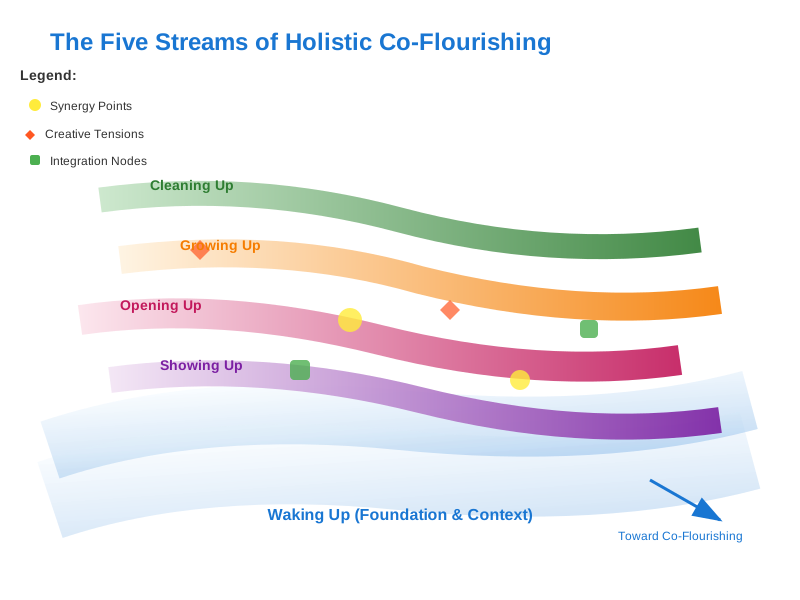
A dynamic river system visualization showing how the five streams flow together within the foundational context of Waking Up. The diagram illustrates Waking Up as both the riverbed (structural foundation) and the water itself (medium of development), with the four other streams as colored currents that converge, diverge, and interact in complex patterns. Points of synergy are shown where streams enhance each other (such as where Opening Up motivates and energizes Showing Up), while creative tensions indicate areas requiring ongoing balance (such as where intensive Cleaning Up work may temporarily destabilize meditation practice). Integration nodes represent breakthrough moments where development in one stream catalyzes growth across all others.
Diagram 2 provides a developmental timeline showing how the streams typically interact over the course of a spiritual journey:
- Early phases often emphasize Waking Up and Cleaning Up as foundational work
- Middle phases involve integration of Growing Up and Opening Up as awareness stabilizes
- Mature phases focus increasingly on Showing Up as inner development seeks outer expression
- Ongoing cycles of deepening and rebalancing as new life circumstances reveal fresh growth edges
This timeline acknowledges that while certain sequences may be common, individual development paths vary significantly based on temperament, life circumstances, cultural context, and the particular challenges each person faces.
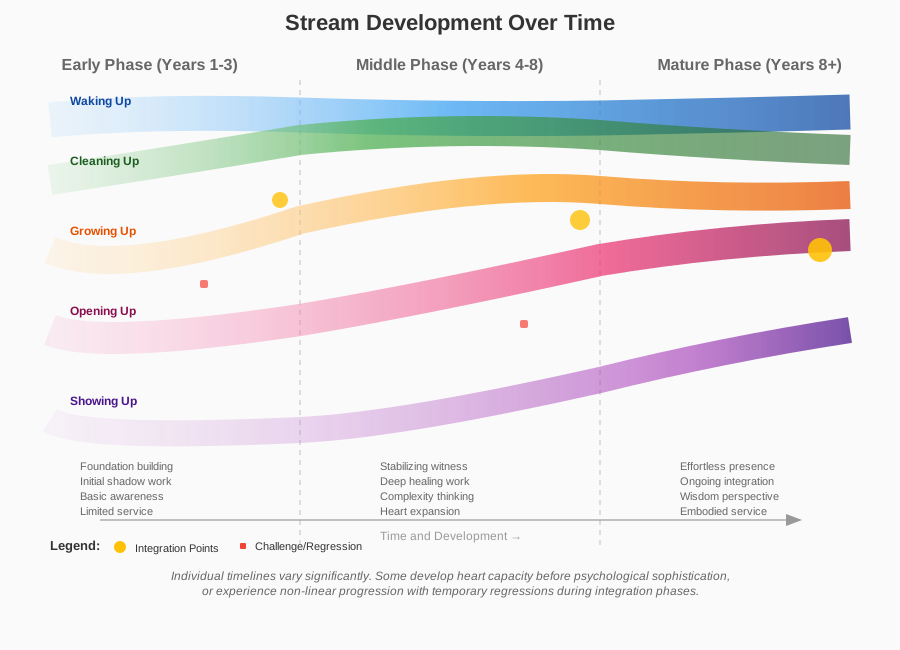
A temporal visualization showing how emphasis and development across the five streams typically evolves over the course of a contemplative journey. The diagram uses flowing bands of varying thickness to represent the relative development and attention given to each stream during different phases. Early phases often emphasize establishing Waking Up foundations and beginning Cleaning Up work. Middle phases involve integration of Growing Up sophistication and Opening Up heart development as awareness stabilizes. Mature phases focus increasingly on Showing Up as inner development seeks authentic outer expression. The visualization acknowledges significant individual variation in developmental timing and sequence, with some practitioners developing heart capacity before psychological sophistication, or experiencing non-linear progression with temporary regressions during intensive integration periods.
7.3 The Invitation: Using the Personal Integration Compass to Engage in the Ongoing, Creative Art of Weaving These Five Streams
The framework presented in this paper is ultimately an invitation to conscious participation in your own development. Rather than leaving growth to chance or pursuing spiritual experiences without regard for psychological foundation, you can become an artist of your own integration—consciously weaving the five streams into a life of meaning, service, and authentic flourishing.
The Integration Compass as Creative Tool: Use the assessment in section 6.1 not as a rigid scorecard but as a creative catalyst for ongoing self-inquiry. Let the questions reveal where your energy wants to flow next, where resistance indicates important work, and where your unique gifts can best serve collective flourishing.
Development as Service: As you integrate across all five streams, your very being becomes a gift to the world. Communities desperately need individuals who combine spiritual depth with psychological maturity, heart wisdom with clear thinking, and contemplative insight with effective action. Your personal integration is not selfish self-improvement but essential preparation for the service our world requires.
The Spiral Nature of Growth: Expect your development to proceed in spirals rather than straight lines. You may return to seemingly basic issues at deeper levels, discover that achieving competency in one area reveals limitations in another, or find that life circumstances require you to strengthen previously neglected streams. This is the natural rhythm of growth, not evidence of failure.
Community as Container: While this paper focuses on individual development, remember that the five streams flourish best within supportive community. Seek out others who share your commitment to holistic growth, find mentors who embody the integration you aspire to, and become a mentor to those behind you on the path.
Cultural Adaptation: Adapt this framework to your own cultural context and wisdom tradition. The specific practices and expressions of each stream will vary significantly across cultures, but the underlying principles of balanced development appear to be universal human needs.
7.4 Future Directions and Empirical Pathways
This model represents a conceptual and phenomenological framework rather than a fully validated scientific theory. While it synthesizes insights from established psychological and contemplative traditions, it requires empirical investigation to test its utility and refine its applications.
Quantitative Research Possibilities:
- Longitudinal studies correlating stream imbalances with well-being measures using established scales like PERMA (Positive emotion, Engagement, Relationships, Meaning, Achievement)
- Cross-sectional studies comparing practitioners from different contemplative traditions on the five-stream dimensions
- Intervention studies testing whether balanced development approaches lead to better outcomes than single-stream focus
- Neuroscience investigations of brain patterns associated with each stream and their integration
Qualitative Research Directions:
- Phenomenological interviews with long-term practitioners about their experiences of integration and imbalance
- Ethnographic studies of how the five streams manifest in different cultural contexts and wisdom traditions
- Case studies tracking individual development trajectories over extended periods
- Community-based research examining how individual integration affects collective flourishing
Clinical Applications:
- Development of therapeutic interventions that integrate contemplative practices with psychological healing
- Training programs for therapists working with spiritually oriented clients
- Assessment tools for evaluating readiness for different types of spiritual practice
- Integration protocols for people experiencing spiritual emergency or difficult spiritual experiences
Educational Innovations:
- Curriculum development for contemplative education programs that address all five streams
- Teacher training that prepares instructors to recognize and address student imbalances
- Community programming that supports holistic development rather than single-practice focus
Cultural and Social Research:
- Investigation of how collective trauma affects community development across the five streams
- Studies of how social justice movements integrate contemplative practice with political action
- Research on indigenous wisdom traditions that naturally integrate multiple developmental streams
- Exploration of how economic and political systems support or hinder holistic human development
The goal of such research is not to prove this particular model correct but to advance our understanding of how human beings can develop most skillfully across multiple dimensions simultaneously. Any useful framework should evolve based on empirical findings and remain open to revision or replacement by more accurate models.
8.0 Glossary
Co-Flourishing: The integrated well-being of individuals, communities, and ecologies that arises from their mutual reinforcement rather than at each other’s expense.
Cleaning Up: The stream focused on integrating repressed psychological material (shadow work) and healing trauma that arrests present-moment awareness and authentic relationship.
Developmental Stage: A stable capacity for meaning-making and perspective-taking that persists across different life circumstances, distinct from temporary states or experiences.
Ego Development: The progressive sophistication of the meaning-making center of personality, from simple dualistic thinking through increasing complexity to transpersonal awareness.
Emotional Bypassing: Using heart-opening practices or concepts to avoid dealing with difficult emotions rather than developing the capacity to hold all emotions within loving awareness.
Growing Up: The stream focused on developing increasingly sophisticated capacities for perspective-taking, meaning-making, and worldview complexity.
Integration: The dynamic process of bringing together different aspects of development so they enhance rather than conflict with each other.
Opening Up: The stream focused on expanding from narrow self-concern to universal compassion and care for all beings.
Personal Integration Compass: A self-assessment tool for identifying developmental strengths and growth edges across the five streams, designed to be used as a reflective catalyst rather than a scoring system.
Shadow: Carl Jung’s term for repressed, denied, or disowned aspects of the psyche that continue to unconsciously influence behavior despite conscious intentions.
Showing Up: The stream focused on translating inner development into embodied presence, ethical action, and authentic contribution to collective well-being.
Somatic Integration: The embodiment of contemplative insights in the nervous system and physical presence rather than maintaining them as purely mental concepts.
Spiral Dynamics: A developmental model describing how worldviews and value systems evolve in response to life conditions, presented here as a culturally contingent tool rather than universal hierarchy.
Spiritual Bypassing: Using spiritual concepts, practices, or experiences to avoid dealing with psychological wounds, practical responsibilities, or uncomfortable aspects of human experience.
Spiritual Materialism: The ego’s co-optation of spiritual concepts and experiences for its own aggrandizement rather than genuine service to awakening and collective flourishing.
State vs. Stage: States are temporary experiences (like mystical experiences or meditative absorptions) while stages are stable capacities that persist across different circumstances and cannot be bypassed through technique alone.
Vertical Integration: The alignment of high-state capacities (access to profound spiritual experiences) with high-stage meaning-making (mature interpretation of those experiences).
Waking Up: The stream focused on developing consciousness states and awareness capacity, from basic mindfulness through witness consciousness to profound unification and transcendent realization.
Wisdom-Compassion: The integration of clear seeing (wisdom) with genuine care (compassion), resulting in skillful action that serves the flourishing of all beings in each unique situation.