Stuga: Building the Mesh When the Grid Fails
Published: January 9, 2026
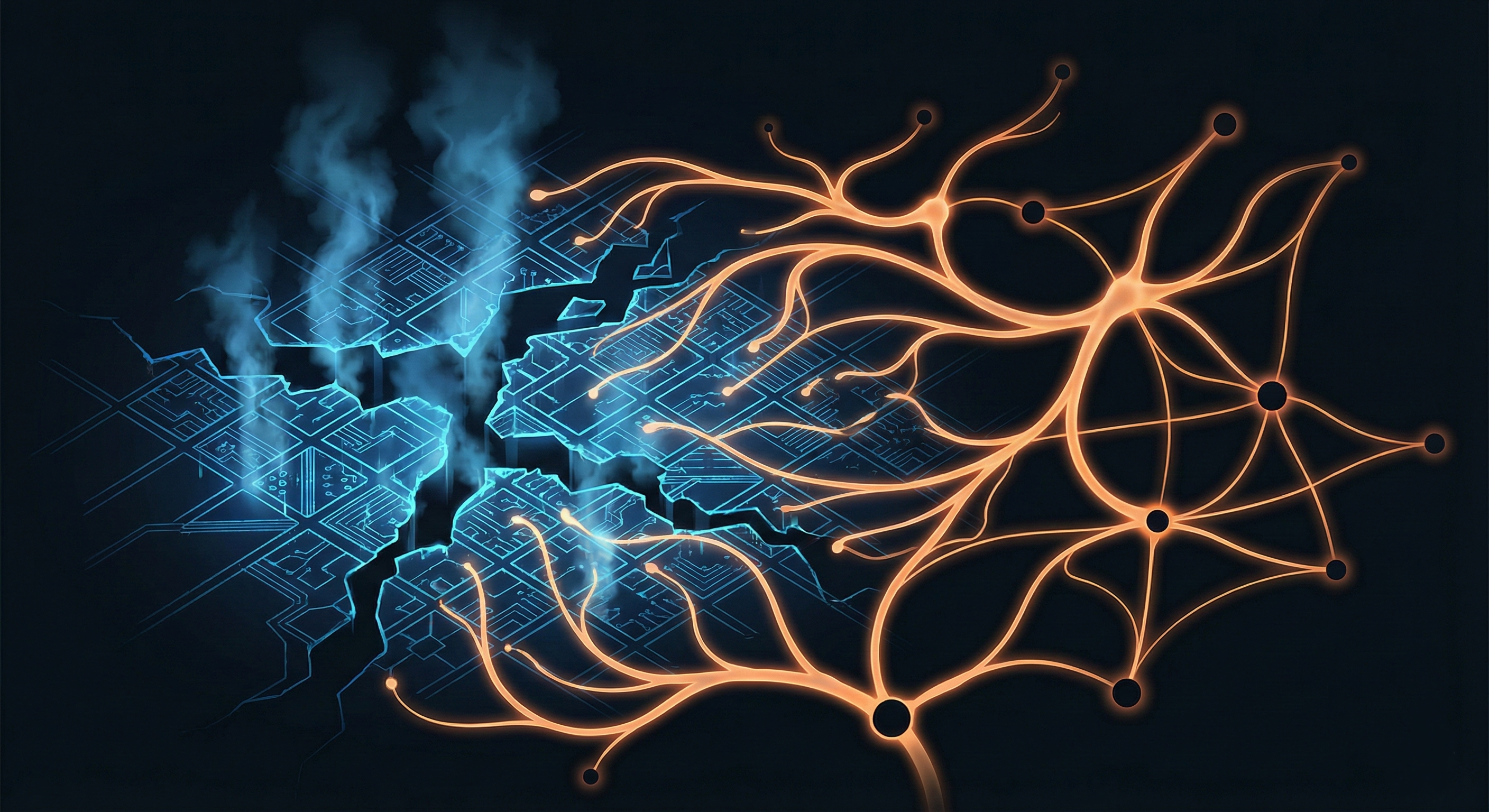
The crisis is not coming. It is here.
Baltic Sea cables severed. Energy grids strained. Supply chains fragmented. Institutions that once moved with bureaucratic certainty now freeze under cascading failures. The high-bandwidth, low-latency world our economies assume is already flickering.
When the lights go out, the question isn’t “which system is more profitable?” It’s “which system still functions?”
This manifesto is not theory. It is field manual for the transition already underway.
The pattern: Seven ways we burn energy pretending
Every approach to organizing human cooperation has a failure mode. Each burns tremendous energy maintaining the illusion of function while delivering catastrophic outcomes under stress.
Markets accumulate systemic drag—energy wasted on financial overhead, compliance layers, and intermediary extraction. A $5 transaction burns enough infrastructure to power a village. When crisis hits, markets seize while trust networks flow.
Purity cultures accumulate a fragility tax—energy consumed policing language, enforcing representation quotas, auditing microaggressions. They optimize for feeling safe rather than being resilient. When the blizzard arrives, the “can-do” hierarchy remains standing while the “cancel culture” hierarchy dissolves.
Rigid bureaucracies accumulate compliance debt—process compounding faster than purpose. They build Maginot Lines against yesterday’s threats while tomorrow’s dangers flow around them. When hurricanes strike, trucks loaded with water sit at state lines because the paperwork hasn’t cleared.
Fear-based power accumulates a vigilance tax—every hour spent detecting disloyalty is an hour not spent building actual power. The strongman becomes enslaved to the need to terrorize. The palace coup is always being planned; the only variable is timing.
Magical thinking accumulates a meaning tax—energy spent on rituals that do not produce food, water, or safety. Each failed rain dance, each preventable death explained as “fate,” chips away at the sacred until even the children stop believing.
Systems thinking accumulates an embodiment tax—every insight that never touches reality slowly atrophies the mind that held it. You become the smartest person in the collapsing room, explaining exactly why the bridge is falling while others throw ropes to the drowning.
Dissociated holism accumulates a dissipation tax—every quantum of awakened awareness that never flows through a material channel radiates away as beautiful, useless heat. “Send love and light” while families freeze. Consciousness without infrastructure is noise.
All seven approaches share one error: confusing the symbol for the substance, the map for the territory, the potential for the actual.
The solution: Economic superconductivity through trust
Stuga is not a product. It is a conductor.
It makes the invisible bonds of community visible and unbreakable. It operationalizes what philosophers preach: that your well-being and mine are materially entangled. It demonstrates through functioning code that the person with firewood and the person who needs it are not separate problems requiring market intermediaries—they are one system requiring only coordination.
The thermodynamic case
Consider the energy required to move one unit of value (a loaf of bread, a cord of firewood) from Person A to Person B:
Market transaction drag score: ~100
- Bank infrastructure running 24/7
- Tax authority compliance
- Legal system overhead
- Global supply chain logistics
Trust network drag score: ~1
- Ledger entry only
- Cryptographic verification
- Local coordination
This is economic superconductivity—exchange with near-zero friction. The trust between participants replaces compliance overhead. The ledger provides transparency without bureaucracy.
As energy becomes scarce—and it will, whether through climate policy, resource depletion, or geopolitical fragmentation—the universe will favor systems that minimize waste heat. Markets that burn tremendous energy coordinating through intermediaries will lose to networks that coordinate through direct relationship.
The second law of thermodynamics doesn’t care about your economic theory.
The resilience case
When the grid fails—and it will—centralized coordination creates single points of catastrophic failure:
Central Command (bottleneck)
    ↓
Regional Bureaucracy (delay)
    ↓
Local Agencies (compliance burden)
    ↓
Actual Citizens in Crisis (last to receive help)
Versus distributed coordination:
Local Citizens ↔ Local Citizens (direct response)
    ⇕
Distributed Ledger (coordination without bottleneck)
    ⇕
Higher-Level Integration (when needed, not by default)
One system routes all survival through a narrow, fragile pipe. The other routes survival through a living mesh.
Stuga is not disruption. It is subsidiarity in action—handling problems at the lowest, most effective level. It is civil defense for the 21st century.
The human case
The refugee’s face in the ledger is not a symbol of oneness. It is oneness with a name, an address, and a specific need for blankets.
When you deliver those blankets through Stuga’s coordination, you are not performing charity. You are performing maintenance on the part of yourself that lives in your neighbor. You are keeping a piece of the larger organism—the community—alive.
This is not metaphor. This is the empirical reality of interdependence made visible through infrastructure.
What Stuga actually is
A crisis-resilient peer-to-peer platform that enables neighborhood-scale coordination when centralized systems fail.
Core functions:
- Resilience Ledger: Who has what? Who needs what? Offline-first, works on 10% battery, no internet required.
- Reputation Layer: Track who actually showed up when crisis hit. Trust earned through demonstrated action, not claimed identity.
- Resource Coordination: Match surplus to need without market intermediaries or bureaucratic overhead.
- Crisis Communication: Mesh networking for when centralized infrastructure fails.
The three design principles:
- Offline-first: If it doesn’t work when the power’s out, it doesn’t work.
- Competence over credentials: The ledger cares only about “did you do what you said you would do?”
- Sacred pragmatism: Every feature must pass the test: Can a freezing family use this to find firewood before nightfall?
The call: From ghost to ground
Seven memos diagnosed seven failure modes. The synthesis is complete. The theory is closed.
Now there is only building.
For the market rationalist (Orange)
You understand efficiency. You see that high-drag systems will not just underperform in energy-constrained futures—they’ll collapse under their own weight. Stuga is not idealism; it’s thermodynamic inevitability. Build with us because the math demands it.
For the compassionate activist (Green)
You want to protect the vulnerable. Understand that competence is not a “capitalist tool”—competence is a humanitarian necessity. The most marginalized people don’t need perfect pronouns; they need bridges that don’t collapse and neighbors who can actually help. Build with us to make care functional.
For the institutional steward (Blue)
You serve tradition and preservation. Recognize that the highest duty is not to preserve yesterday’s process, but to preserve the people—using whatever tools the current moment demands. Stuga is not sedition; it’s the next chapter of civil defense. Build with us to protect what actually matters.
For the power player (Red)
You understand leverage. See that the person with the working ledger when systems fail becomes indispensable. That’s true sovereignty—not being feared, but being needed. Build with us to become the infrastructure your community cannot survive without.
For the community keeper (Purple)
You hold sacred the bonds that give life meaning. Know that Stuga is not the death of the tribe’s soul—it’s the tribe’s soul given unbreakable memory and unbreakable tools. It’s the digital campfire where trust becomes visible. Build with us to strengthen the hearth.
For the systems architect (Yellow)
You see the whole picture. Now descend into the mud. Every bug in the code is not an obstacle to the vision—it is the vision making contact with reality. Stop mapping and start building. The bricks are heavy; that’s how you know you’re finally alive.
For the holistic visionary (Turquoise)
You know we are one. Now make that oneness functional. Love without infrastructure is sentiment. A shift in consciousness without a transaction layer is hallucination. Build with us to give the infinite a postal address.
The only question that matters
Can a tired, scared mother use this to keep her children warm when the grid fails?
If not, it doesn’t exist. If yes, it’s sacred.
The Department of Philosophy is abolished
No more stages to diagnose. No more shadows to map. No more elegant syntheses to admire.
All resources are transferred to the Department of Works.
First order of business: Make the Resilience Ledger function offline, on a phone with 10% battery, in a house with no internet, so a neighbor can find who has candles when the grid goes dark.
That single working feature will shift consciousness more than ten thousand words about vibration.
The spiral ends where the work begins
The stars are made of mud.
The mud is patient.
The neighbors are waiting.
Go build.
Stuga — Swedish: “cabin, cottage”
The place of shelter when the storm comes.
The mesh that remains when the grid fails.
The conductor that grounds cosmic truth in copper wire.
This manifesto synthesizes insights from developmental psychology, thermodynamics, systems theory, and lived experience of crisis. It is not prediction. It is pattern recognition. The transition is already underway. Build accordingly.