From Personal Practice to Civilizational Rehab: Designing Systems That Reward Being Human
Published: November 30, 2025
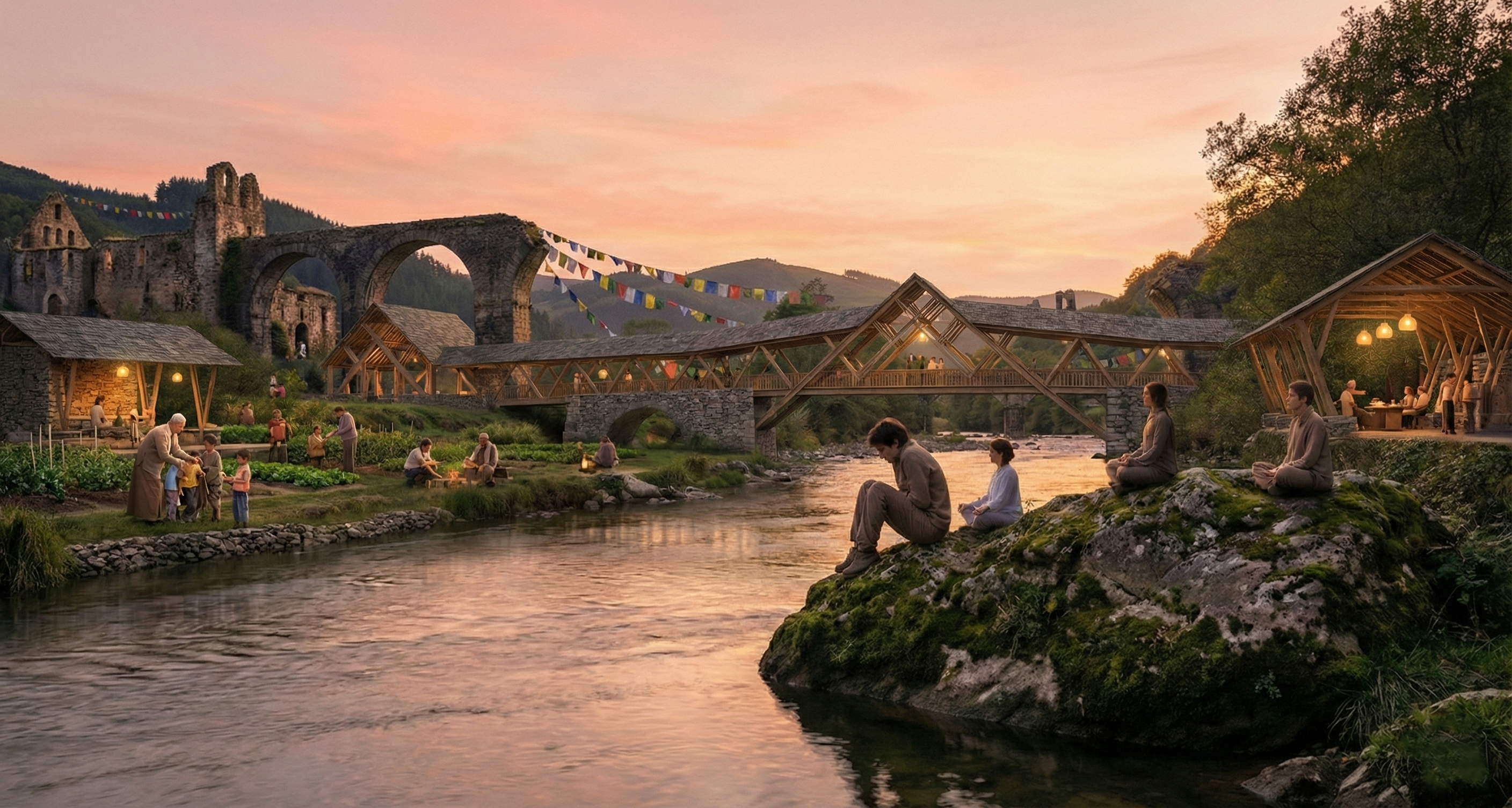
From Personal Practice to Civilizational Rehab: Designing Systems That Reward Being Human
In my first post, I confessed losing the ability to just be. In the second, we mapped the cognitive scaffolding our culture demolished—the conceptual, causal, temporal, experiential, and social infrastructure that once made stillness intelligible as valuable.
Now comes the harder question: What if the problem isn’t just in our heads?
Your “Stillness Reports” keep rolling in, and a pattern emerges that goes beyond individual psychology:
”[Insert user report]”
”[Insert user report]”
These aren’t failures of willpower or scaffolding. These are people trapped in systems designed to prevent exactly the presence we’re trying to cultivate.
You can build all the cognitive architecture you want. But if your economic survival depends on constant productivity, if your social status requires endless achievement, if your physical environment is engineered to maximize your attention extraction—no amount of personal practice will save you.
We need more than meditation. We need different systems.
The Rehab Metaphor
Imagine asking an alcoholic to get sober while the entire society is a 24-hour open bar—and the rent is due at the counter. That’s what we’re asking people to do with stillness practice.
The entire environment is optimized for the opposite of what you’re trying to cultivate:
- Algorithms designed to hijack your attention—these are not bugs; they are deliberate violations of what some now call cognitive liberty
- Economic systems that punish rest and reward overwork
- Social structures that validate busyness and pathologize stillness
- Physical spaces engineered for consumption and transaction, not contemplation
- Time structures that fragment attention into ever-smaller units
You’re not weak for struggling. You’re struggling against a trillion-dollar infrastructure specifically designed to make presence impossible.
Personal practice is essential. Cognitive scaffolding is crucial. But they’re necessary, not sufficient.
What would civilizational rehab actually look like?
The Six Layers of Systemic Change
Drawing from Project Janus—a framework for understanding humans as integrated wholes—meaningful change requires working across all dimensions simultaneously:
1. Biological: Spaces That Support Nervous System Regulation
Our bodies can’t be still in environments designed for perpetual alertness.
Current reality:
- Open offices with constant interruption
- Blue light screens disrupting circadian rhythms
- Noise pollution preventing acoustic rest
- Absence of nature contact
- Seated, sedentary positions all day
Civilizational rehab would include:
- Contemplative architecture: Spaces explicitly designed for silence (not just lack of noise, but presence-supporting acoustics)
- Nature integration: Mandatory green space, natural light, connection to living systems
- Circadian respect: Work schedules that honor biological rhythms, not arbitrary 9-5
- Movement integration: Standing, walking, embodied thinking as norm, not exception
- Sensory sanctuary: Designated spaces free from screens, alerts, stimulation
This is literal public-health infrastructure, as non-negotiable as clean water or sewage systems. We wouldn’t ask people to be healthy while pumping industrial toxins into the air. Why do we accept cognitive toxins?
2. Cognitive: Information Environments That Enable Deep Thinking
You cannot think systemically in an environment optimized for fragmentation.
Current reality:
- Attention spans measured in seconds
- Constant context-switching
- Shallow processing rewarded over deep understanding
- Information overload without synthesis time
- Metrics that measure speed, not wisdom
Civilizational rehab would include:
- Protected thinking time: Blocks where deep work is not just permitted but expected
- Slow information: Curated, synthesized content over infinite feeds
- Contemplative computing: Interfaces designed for depth, not engagement metrics
- Question cultivation: Systems that reward good questions over quick answers
- Integration periods: Built-in time for reflection, not just consumption
Universities once provided this. Libraries were sanctuaries for thought. We need modern equivalents that aren’t colonized by productivity demands.
3. Emotional: Cultural Permission for the Full Human Range
We’ve normalized a narrow band of acceptable emotional states: productive, efficient, optimized.
Current reality:
- Sadness is “depression” requiring medication
- Contemplation is “unproductive” requiring justification
- Grief must be “processed” quickly
- Joy must be “earned” through achievement
- Peace is “boring” or “lazy”
Civilizational rehab would include:
- Emotional diversity normalization: Cultural space for all states, not just achievement-compatible ones
- Grief infrastructure: Sabbaticals for loss, not just productivity
- Celebration without consumption: Joy divorced from purchasing
- Seasonal rhythm: Permission for dormancy, not constant growth
- Failure integration: Cultural scripts for setbacks as developmental, not shameful
What if “I need to do nothing today” was as socially acceptable as “I have a meeting”?
4. Behavioral: Economic Systems That Don’t Require Constant Hustle
Here’s where it gets political: No one can be still when their survival is conditional on constant output.
Current reality:
- Healthcare tied to employment
- Housing costs requiring multiple jobs
- Retirement depending on market performance
- Education creating decades of debt
- Basic security treated as something you must earn daily
The core spiritual violence of the current system is conditional worth: the daily message that you must prove your right to exist.
Civilizational rehab would include:
- Unconditional basic income: Survival decoupled from productivity (this is the foundation—everything else builds on it)
- Universal healthcare: Illness not as financial catastrophe
- Housing as right: Shelter not as speculative asset
- Education as commons: Learning not as debt trap
- Sabbatical norms: Regular, extended breaks as expected, not exceptional
This isn’t about laziness—it’s about making authentic freedom possible. When survival terror is removed, humans naturally create, connect, play, grieve, celebrate, and sometimes do profound work—on their own terms, not because rent is due.
I know this sounds radical. It is. And it’s also the only thing that actually addresses the root cause of our collective inability to be still.
5. Social: Communities That Value Presence
Individual contemplatives need cultural containers.
Current reality:
- Status through busyness signaling
- “Networking” replacing genuine connection
- Social media performing instead of relating
- Loneliness epidemic despite constant connection
- Expertise valued over wisdom
Civilizational rehab would include:
- Contemplative communities: Groups organized around presence, not projects
- Elder councils: Institutionalized roles for wisdom-keepers
- Shared practice spaces: Physical and virtual sanghas, not just churches
- Recognition rituals: Cultural acknowledgment of contemplative development
- Intergenerational wisdom transfer: Systems for learning from those who’ve cultivated depth
The great contemplatives—Buddha, Jesus, Muhammad, Bodhidharma—did their deepest work in solitude. But they returned to communities that could recognize and honor what they’d discovered. We need both: permission for solitary depth and cultural frameworks that value what emerges.
6. Existential: Collective Meaning Beyond Consumption
What’s the point of all this productivity?
Current reality:
- Meaning through acquisition
- Purpose through achievement
- Legacy through wealth accumulation
- Success as individual competitive victory
- Progress measured in GDP, not wellbeing
Civilizational rehab would include:
- Legally protected Sanctuaries: Physical and digital zones where the logic of extraction is forbidden to enter
- Collective purpose narratives: Stories bigger than individual success
- Contribution metrics: Measuring what matters (Love, Meaning, Connection Index instead of GDP)
- Generational thinking: Decisions considering seven generations forward
- Planetary consciousness: Identity extending to biosphere, not just nation
- Wisdom traditions integration: Ancient insight informing modern challenges
When civilization itself is oriented toward something beyond consumption, stillness stops being “unproductive” and becomes essential.
The Developmental Context
Why hasn’t this happened already?
Because our dominant cultural operating system (achievement-focused rational-materialism) literally cannot perceive these solutions. It’s like asking someone to solve a maze while standing inside it—the perspective isn’t available.
Developmental frameworks like Spiral Dynamics show that cultures evolve through stages:
- Red: Power and dominance
- Blue: Order and tradition
- Orange: Achievement and progress (← we are here)
- Green: Equality and inclusion (emerging)
- Yellow: Systemic integration (needed)
- Turquoise: Holistic wisdom (next horizon)
Orange consciousness created our current crisis. It’s brilliant at manipulating the external world, terrible at perceiving interior dimensions. It sees stillness as wasteful because it can’t measure the value it produces.
Green consciousness tries to help—hence mindfulness apps and wellness programs—but often gets co-opted back into Orange productivity logic (“meditate to be more efficient!”).
Yellow consciousness is what we need: the capacity to hold multiple systems simultaneously, to see how economy, ecology, psychology, and spirituality interconnect. To design solutions that address root causes, not symptoms.
This post is written from Yellow, for people ready to think systemically. But it can only work if enough of us develop this capacity together.
What Actually Changes Things
Not individual enlightenment saving the world one person at a time. That’s been the fantasy for millennia, and we’re still in crisis.
What changes things is infrastructure. Systems. Institutions. Norms. Laws. Economic arrangements. Cultural stories.
Here’s what that might look like in practice:
Immediate (1-3 years):
- Pilot programs for universal basic income (like the successful experiments in Stockton, California, and Finland)
- Contemplative spaces in public buildings (following the model of meditation rooms in airports, but making them public and universal)
- Right to disconnect laws (already implemented in France, Portugal, and Ontario, Canada)
- Sabbatical provisions in employment contracts
- Educational curriculum redesign including contemplative development
Medium-term (3-10 years):
- National basic income implementation
- Architectural standards requiring contemplative space in all public buildings
- Cultural shift in status markers (from busyness to wisdom)
- Economic metrics evolution (GDP plus Love, Meaning, Connection Index)
- Intergenerational councils advising on long-term decisions
Long-term (10-30 years):
- Post-scarcity economics where basic needs are unconditional
- Ecological integration where nature isn’t separate from civilization
- Wisdom institutions on par with universities
- Developmental education supporting Yellow/Turquoise consciousness
- Planetary governance considering all beings, not just humans
Is this utopian? Yes. Is it necessary? Also yes.
The alternative is continuing to demand that people be still in environments designed for perpetual motion, while wondering why everyone’s anxious and depressed.
“But who’s going to pay for all this?”
We’re already paying—trillions yearly—on burnout, opioids, depression, climate inaction, and the quiet despair of lives lived in perpetual emergency mode.
Civilizational rehab is not an extra expense; it’s stopping the hemorrhage and redirecting the money we’re already bleeding. Investing in the infrastructure for presence isn’t a cost—it’s shifting resources from treating symptoms (healthcare, productivity loss, social unrest) to addressing the root cause.
And it starts at the edges. We don’t need to flip a switch and transform the entire global economy tomorrow. We start with pilot programs, local ordinances, and cultural shifts that create proof-of-concept. The timeline isn’t a blueprint but a gradient of possibility.
The Personal-Political Bridge
You might be thinking: “This is great, but I can’t change civilization. What do I do now?”
Fair. Here’s the both/and:
Keep building personal capacity. Practice stillness. Develop your cognitive scaffolding. Create pockets of presence in your life. This is necessary groundwork.
And simultaneously work for systemic change:
- Vote for policies supporting basic income, universal healthcare, environmental protection
- Organize contemplative communities in your area
- Advocate for contemplative spaces in your workplace, school, neighborhood
- Support businesses and organizations aligned with these values
- Create alternative systems where you can (co-ops, commons, mutual aid)
- Speak the language of systemic change, not just personal optimization
Most importantly: recognize that your struggle to be still is not your failure. It’s a rational response to irrational systems.
The Larger Stakes
Climate change. AI alignment. Social fragmentation. Existential risk.
These crises only become solvable from consciousness states we’ve systematically prevented people from developing.
You cannot address climate change from the same consciousness that created it—the endless growth, consumption-oriented, nature-as-resource mindset. You need contemplatives who can perceive long-term patterns and make decisions considering seven generations forward.
You cannot align AI with human values when you don’t know what human values are beyond “more productivity.” You need wisdom traditions informing technological development.
You cannot heal social fragmentation with more communication technology. You need communities that can sit in presence together, that value depth over engagement.
The stillness isn’t separate from the solutions. It’s where solutions become visible.
But we can’t expect individuals to bootstrap their way to planetary consciousness while living in systems that punish every step toward it.
An Invitation to Systemic Rebellion
This week, alongside your personal practice, try one act of systemic change:
Identify one system in your sphere of influence (your workplace, school, community group, family)
Propose one small change that supports presence over productivity (a 20-minute silent start to every meeting, a weekly no-phone dinner, a “deep work Wednesday” rule, silent lunch hour in your office, contemplative space in your apartment building, meditation before team meetings, reading period instead of homework):
- Make it specific and small enough to actually happen
- Frame it as an experiment, not a permanent policy
- Find one ally who’ll support it
Document and share what happens (resistance, support, unexpected effects)
You’re not just building personal capacity. You’re hacking the system from within, creating small pockets where different rules apply.
Enough pockets, and the system starts to shift.
The Series Conclusion
We’ve covered:
- The problem: Lost ability to be, collective addiction to doing
- The architecture: Five dimensions of cognitive scaffolding we need to rebuild
- The systems: Why personal practice isn’t enough without civilizational transformation
This isn’t a personal development series. It’s a civilizational development series.
Your inability to be still is the canary in the coal mine—an early warning that our entire system is fundamentally misaligned with human flourishing.
The good news? We know what the problem is. We have frameworks for addressing it. We have developmental maps showing where we need to go.
The challenge? We need enough people to see it clearly enough to demand change.
Not just better mindfulness apps. Different systems entirely.
Are you in?
What’s one system in your life that actively prevents presence? What’s one small change you could advocate for? Share your “System Hack” and let’s map the leverage points together.
Resources for Going Deeper
If these ideas resonate and you want to explore the frameworks underlying this series:
- Project Janus: Understanding humans as integrated wholes across biological, cognitive, emotional, behavioral, social, and existential dimensions
- Spiral Dynamics: Developmental stages of consciousness in individuals and cultures—take a free assessment at Spiralize.org
- The Alchemist’s Dilemma: Ethics of wealth stewardship and resource distribution
- Global Governance Frameworks: System designs for collective flourishing
All available at your website.
The ability to just be isn’t a personal luxury I lost in some moment of weakness.
It is the sign of a civilization that has finally become safe enough for its citizens to rest.
The quiet joy of existence should not be a radical act. But until we’ve built a world that cultivates it, choosing to be—and to build systems that reward being—is the most important work we can do.
This is the work.