The System That Makes the Rich Richer—And the Poor Poorer
Published: May 17, 2025
In this post: The growing wealth gap isn’t simply a result of hard work versus laziness—it’s the predictable outcome of systems designed to extract value from the many for the benefit of the few. We’ll explore how these mechanisms work, their devastating consequences, and the concrete solutions that could create a more equitable economy for everyone.
Wealth Isn’t Just Earned—It’s Extracted
The myth of meritocracy tells us that wealth is a reward for hard work and ingenuity. But this narrative ignores a harder truth: the game is rigged. The rich don’t just “get ahead”—they benefit from systems designed to concentrate wealth at the top, often at the expense of those at the bottom.
While systemic advantages certainly tilt the playing field, this doesn’t mean all wealth creation is extractive. Innovations that genuinely solve problems—from life-saving medications to technologies that democratize access to information—can create legitimate value. The issue isn’t wealth creation itself, but when wealth accumulation happens primarily through extraction rather than contribution. A truly equitable system would reward true innovation while preventing exploitation—a distinction that matters as we reimagine economic fairness.
This isn’t (necessarily) about evil billionaires scheming in boardrooms. It’s about how Stage Orange thinking—the hyper-individualistic, profit-above-all logic of late capitalism—rewards exploitation while disguising it as “success.” Meanwhile, those stuck in poverty aren’t there because they’re lazy; they’re there because the system extracts value from their labor, health, and time to fuel upward wealth transfer.
Stage Orange vs. Stage Yellow: A Mindset Shift
To understand why this system persists, Spiral Dynamics—a developmental model created by Clare W. Graves and expanded by Don Beck and Christopher Cowan—helps explain the values driving our economic thinking:
Stage Orange (Achievement/Individualist): “I deserve my wealth because I earned it through hard work and smart choices.” This mindset values competition, efficiency, and personal success. It brought us incredible innovation but often reduces human worth to economic productivity. Orange thinking treats markets as neutral playing fields rather than constructed systems with built-in advantages.
Stage Yellow (Systemic/Integrative): “Success happens within complex systems that privilege some and exclude others.” Yellow thinking recognizes that individual outcomes depend heavily on starting conditions, social context, and structural access. It values interdependence, sustainability, and designing systems that distribute opportunity more fairly.
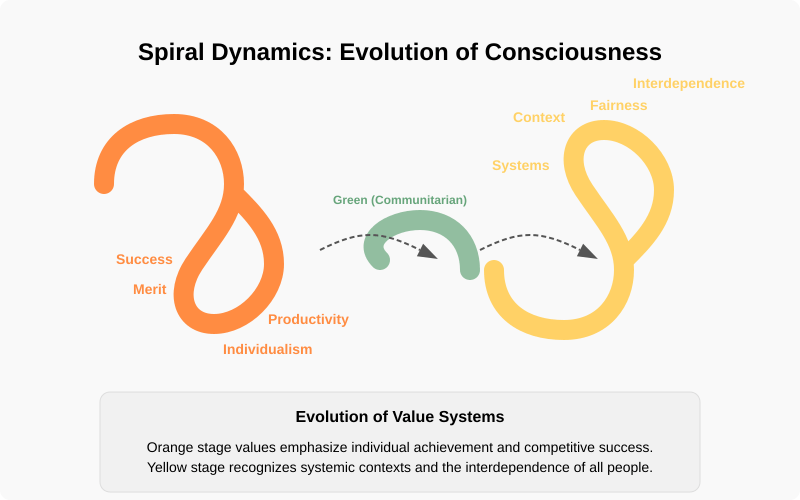
Neither stage is “wrong”—Orange thinking gave us unprecedented prosperity, but its limitations become clearer as wealth gaps widen. Moving to Yellow doesn’t mean abandoning markets or innovation, but redesigning them to benefit the many rather than extract for the few.
(Want to explore Spiral Dynamics further? Visit spiralize.org for free, non-monetized, in-depth content.)
The Hidden Costs: Stress, Hopelessness, and Broken Health
The system doesn’t just drain wallets—it drains lives. When people lack meaningful opportunities (not just jobs, but dignified ways to contribute), the consequences ripple deeper than bank accounts:
Psychological toll: Chronic stress from financial insecurity shrinks cognitive bandwidth by up to 13 IQ points (Science, 2013), trapping people in survival mode.
Health disparities: The poor die 10-15 years earlier in wealthy nations (World Health Organization, WHO), not from laziness but from cortisol, nutrient-poor diets (food deserts), and delayed healthcare.
Lost potential: UBI (Universal Basic Income) experiments show cash relief reduces hospitalizations by 8% (Canada) and depression by 11% (Kenya)—proof that poverty is a policy choice, not a personal failure.
How the System Works
- Wage Suppression & Labor Exploitation
Companies maximize profits by paying workers as little as possible (e.g., stagnant wages despite soaring productivity).
The gig economy turns stable jobs into precarious contracts—no benefits, no security, just cheap labor on demand.
- Asset Inflation & Rent-Seeking
The rich grow wealthier by owning assets (real estate, stocks) that appreciate faster than wages.
Meanwhile, the poor pay inflated rents to landlords and interest to banks, transferring wealth upward without building equity.
The Extraction Economy: How It Works & The Results
The system of wealth extraction operates through three interconnected mechanisms that have transformed income distribution over the past four decades:
1. Wage Suppression & Labor Exploitation
Companies maximize profits by paying workers as little as possible (e.g., stagnant wages despite soaring productivity).
The gig economy turns stable jobs into precarious contracts—no benefits, no security, just cheap labor on demand.
2. Asset Inflation & Rent-Seeking
The rich grow wealthier by owning assets (real estate, stocks) that appreciate faster than wages.
Meanwhile, the poor pay inflated rents to landlords and interest to banks, transferring wealth upward without building zero equity.
Consider Seattle: Between 2012 and 2022, median home prices increased 114%, while median wages rose just 32% (Seattle Office of Housing, 2023). A software engineer who bought a modest home in 2012 might have gained $500,000 in wealth simply by owning property—wealth unavailable to a teacher renting in the same neighborhood who paid $180,000 in rent during that period while building zero equity. The homeowner’s wealth gain wasn’t from “working harder”—it came from having capital at the right time in a system designed to reward ownership over labor.
3. Political Capture
Wealth buys influence: tax loopholes, deregulation, and subsidies for corporations shift public wealth into private hands.
Example: The U.S. spends $1.8 trillion yearly on subsidies and tax breaks—mostly benefiting the wealthy (Treasury Department, 2022).
The Evidence: Four Decades of Divergence
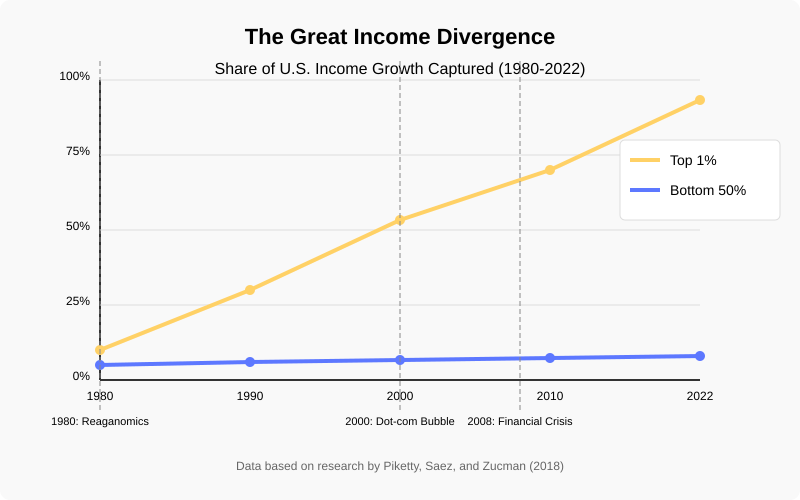
The clearest evidence of systemic wealth extraction isn’t theoretical—it’s empirical. The chart above tracks how income growth has been distributed since 1980, revealing a system increasingly designed to funnel gains upward. Note how policy shifts like the deregulation of the 1980s and the handling of the 2008 financial crisis coincide with accelerations in this trend.
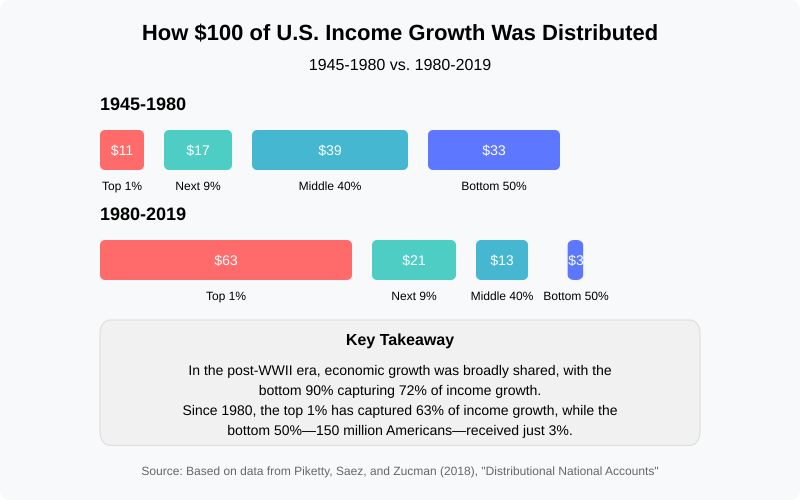
Before 1980, economic growth was broadly shared, with the bottom 50% of Americans capturing a third of all income growth. Since then, a fundamental restructuring has occurred: the top 1% now captures nearly two-thirds of all growth, while the bottom half of the population—about 150 million Americans—receives just 3% (Piketty, Saez, and Zucman, 2018).
This isn’t mere inequality—it’s a deliberate redirection of the economic rewards of productivity away from workers and toward capital owners. It’s the predictable outcome of choices that prioritized capital over labor, ownership over work.
What Can Be Done?
Solutions require both systemic change and new economic paradigms. Here are starting points:
- Policy Innovations
Wealth taxes & worker co-ops to redistribute power.
Adaptive Universal Basic Income (AUBI): A dynamic model that adjusts support based on economic conditions (I explore this in A New Social Contract for the 21st Century). In Sweden, Fjärilspartiet (the Butterfly Party) advocates similar reforms.
Adaptive Universal Basic Income (AUBI): Unlike traditional UBI which provides the same payment to everyone, AUBI offers a foundational universal payment that then adapts based on individual circumstances, needs, and contributions. It combines three core principles: 1) universality through a baseline payment to all citizens, 2) adaptability through adjustments for needs like healthcare, caregiving, or geographic cost differences, and 3) societal value recognition through incentives for community contributions beyond traditional employment. This creates a system that provides essential security while responding to each person’s unique situation—addressing poverty without rigid bureaucracy or work requirements.
Universal basics (housing, healthcare) to decouple survival from exploitation.
Universal healthcare+: Free therapy for poverty-induced trauma (Portugal’s model cut suicide rates by 25%).
- Restructure opportunity
Worker co-ops that share profits and decision-making.
Job guarantees in climate adaptation/public works.
- Cultural Shifts
From “more = better” to post-materialist values (community, sustainability).
Normalize calling out “hustle culture” as Stage Orange narratives that glorify overwork.
Celebrate care work, art, and community labor as real value.
- Power Redistribution
- Unions, shareholder activism, and voting to rebalance influence.
What You Can Do Right Now
Regardless of your economic position, here are concrete steps to challenge the extraction economy:
If you’re struggling financially:
Join mutual aid networks in your community for solidarity-based support
Participate in tenant unions to fight rent exploitation
Use skill-shares and time banks to access services outside the cash economy
If you’re middle-class:
Move savings to credit unions and community development financial institutions
Join consumer cooperatives to increase purchasing power
Support worker-owned businesses in your spending
If you’re wealthy:
Practice “traitor to your class”, or perhaps more positively, “transformational giving” philanthropy by funding economic justice organizations
Invest in community land trusts and democratically-owned enterprises
Use shareholder activism to push for living wages and ethical practices
For everyone:
Build “solidarity bridges” across class lines through organizing
Practice talking openly about money to break taboos that hide inequality
Vote for policies that distribute opportunity more widely
What About Innovation and Risk?
Critics might argue: “If we redistribute wealth too aggressively, won’t we kill the incentives that drive innovation and risk-taking?”
It’s a reasonable concern that deserves addressing. But evidence suggests that:
Many innovations come from public funding and research (the internet, GPS, touchscreens) before being privatized
Countries with stronger safety nets often show higher entrepreneurship rates (Denmark, Sweden) as people can take risks without risking homelessness
Extreme inequality actually reduces innovation by limiting who can participate in knowledge creation
“Won’t wealth taxes discourage investment and drive capital overseas?”
While this concern is commonly cited, evidence suggests it’s often exaggerated:
France’s wealth tax (ISF) raised approximately €5 billion annually from 2013-2017 with minimal capital flight (OECD, 2018)
Norway has maintained a wealth tax for decades while sustaining one of the world’s highest living standards and innovation rates
Studies show moderate wealth taxes (1-2%) primarily affect consumption at the very top rather than productive investment
“Won’t these policies hurt economic growth?”
In fact, growing evidence suggests the opposite:
IMF research found that high inequality reduces economic growth by 0.5-1.5% annually (IMF, 2017)
OECD studies indicate that redistributive policies, when well-designed, can promote rather than hinder growth
Economic mobility—a key driver of productivity—has declined in highly unequal societies, showing that entrenched inequality actually harms growth potential
The goal isn’t to eliminate rewards for innovation, but to ensure those rewards aren’t wildly disproportionate to the contribution. A brilliant inventor deserves to thrive—but do they need billions while their workers struggle? A more distributed reward system would likely increase innovation by enabling more minds to contribute.
The Way Forward
The goal isn’t to shame the rich but to expose the machinery of inequality. Because when we see the system clearly—and evolve beyond Stage Orange thinking, without losing its benefits —we can start dismantling it. Or better yet: redesigning it.
Join the Conversation
Theory and data tell only part of the story. Our lived experiences within economic systems are equally valuable knowledge.
I’ll start with my own:
I have long struggled with both finding meaningful employment and working full-time, even though I was relatively successful during my studies. Around ten years ago I ended up homeless in Spain after losing my savings in an unfortunate investment situation. Thanks to my family and ex-girlfriend, I could return to Sweden, where the social security system allows me to manage my depression and prevent my situation from spiraling out of control again. This has allowed me to utilize A.I. to, among other things, create Fjärilspartiet and spiralize.org.
My story illustrates how individual circumstances, social networks, and government systems all intertwine to determine outcomes. The myth of pure meritocracy falls apart when we look honestly at our own journeys.
Now I’d like to hear your perspective:
How have you personally experienced or observed the systems described in this post?
What insights about economic inequality have you gained from your position in the system?
What solutions or alternatives have you seen work in your community?
Your voice matters in this conversation. The path to more equitable systems requires understanding how these abstract forces shape real lives across the economic spectrum.
Share your thoughts in the comments below or reach out directly at [bjorn.kenneth.holmstrom@gmail.com]. Please indicate if you prefer to remain anonymous.